Yall I think I may have been cursed by a very muscular cat that lives outside
???
Okay I’m gonna tell yall the Legend of Buff Cat™
So we take care of a family of cats that live on our back porch basically. There’s Cat Stevens the mom, her four kittens, and Joe, a grey kitty that hangs out with them. We put food and water out every day and they come out and hang around and lounge and play and shit.
There’s a few other stray kitties that come in and bully them to get to the food. Big Head Cat, Tiger Kitty and Buff Cat. Buff Cat is the most RIPPED cat I have EVER seen. He’s all black and he has like a tiny white patch of fur on his chest. I only ever saw him ONCE until the other night when I heard cats fighting outside. Thinking it was my cat being a dick, I went to break it up, but he was upstairs and no where near the other cats. So I went downstairs and Buff Cat was there, by himself, sitting on top of the wooden fence and staring me down. It was creepy as SHIT. Like this cat has an ENERGY about him.
A few days after this incident my dad tells me he has a dream about my cat getting outside and then he looks out there and FUCKING SEES BUFF CAT STARING AT HIM. He has only seen this cat ONCE.
Anyways I go downstairs to get ready to walk to work at 7AM and I see him, again, just STARING at me, and manage to get a picture:
I swear to god I took this picture, BLINKED and he was gone. Like, looking at this picture makes me feel super wrong. I showed it to a friend and they told me I shouldn’t take pictures of Eldritch Beings.
So I JUST get finished telling this story to my good friends @maris-solstice and @foxcoloredcat and I decide I want to get a snack, so I walk downstairs and
THERE HE IS AGAIN IN THE SAME POSITION, STARING RIGHT AT ME. YOU’D THINK IT’S THE SAME PICTURE BUT THESE WERE, IN FACT, TAKEN 11 HOURS APART.
So there’s the story of how I am now cursed by a cat that is probably a demon or was probably at one time a person that was turned into a cat.
Oh my god thats so weird!
That reminds me of a cat i called Atilla the Hun who was a big mf and would linger by the pool during winter. He had like a mane of beige fluff around his neck
OP it sounds like you have a fairy.
The Cat Sìth (Scottish Gaelic: [kʰaht̪ ˈʃiː]) or Cat Sidhe (Irish: [kat̪ˠ ˈʃiː], Cat Sí in new orthography) is a fairy creature from Celtic mythology, said to resemble a large black cat with a white spot on its chest.
Mr. Rogers had an intentional manner of speaking to children, which his writers called “Freddish”. There were nine steps for translating into Freddish:
“State the idea you wish to express as clearly as possible, and in terms preschoolers can understand.” Example: It is dangerous to play in the street.
“Rephrase in a positive manner,” as in It is good to play where it is safe.
“Rephrase the idea, bearing in mind that preschoolers cannot yet make subtle distinctions and need to be redirected to authorities they trust.” As in, “Ask your parents where it is safe to play.”
“Rephrase your idea to eliminate all elements that could be considered prescriptive, directive, or instructive.” In the example, that’d mean getting rid of “ask”: Your parents will tell you where it is safe to play.
“Rephrase any element that suggests certainty.” That’d be “will”: Your parents can tell you where it is safe to play.
“Rephrase your idea to eliminate any element that may not apply to all children.” Not all children know their parents, so: Your favorite grown-ups can tell you where it is safe to play.
“Add a simple motivational idea that gives preschoolers a reason to follow your advice.” Perhaps: Your favorite grown-ups can tell you where it is safe to play. It is good to listen to them.
“Rephrase your new statement, repeating the first step.” “Good” represents a value judgment, so: Your favorite grown-ups can tell you where it is safe to play. It is important to try to listen to them.
“Rephrase your idea a final time, relating it to some phase of development a preschooler can understand.” Maybe: Your favorite grown-ups can tell you where it is safe to play. It is important to try to listen to them, and listening is an important part of growing.
Rogers brought this level of care and attention not just to granular
details and phrasings, but the bigger messages his show would send.
Hedda Sharapan, one of the staff members at Fred Rogers’s production
company, Family Communications, Inc., recalls Rogers once halted taping
of a show when a cast member told the puppet Henrietta Pussycat not to
cry; he interrupted shooting to make it clear that his show would never
suggest to children that they not cry.
In working on the show,
Rogers interacted extensively with academic researchers. Daniel R.
Anderson, a psychologist formerly at the University of Massachusetts who
worked as an advisor for the show, remembered a speaking trip to
Germany at which some members of an academic audience raised questions
about Rogers’s direct approach on television. They were concerned that
it could lead to false expectations from children of personal support
from a televised figure. Anderson was impressed with the depth of
Rogers’s reaction, and with the fact that he went back to production
carefully screening scripts for any hint of language that could confuse
children in that way.
In fact, Freddish and Rogers’s philosophy of
child development is actually derived from some of the leading
20th-century scholars of the subject. In the 1950s, Rogers, already well
known for a previous children’s TV program, was pursuing a graduate
degree at The Pittsburgh Theological Seminary when a teacher there
recommended he also study under the child-development expert Margaret
McFarland at the University of Pittsburgh. There he was exposed to the
theories of legendary faculty, including McFarland, Benjamin Spock, Erik
Erikson, and T. Berry Brazelton. Rogers learned the highest standards
in this emerging academic field, and he applied them to his program for
almost half a century.
This is one of the reasons Rogers was so
particular about the writing on his show. “I spent hours talking with
Fred and taking notes,” says Greenwald, “then hours talking with
Margaret McFarland before I went off and wrote the scripts. Then Fred
made them better.” As simple as Mister Rogers’ Neighborhood looked and sounded, every detail in it was the product of a tremendously careful, academically-informed process.
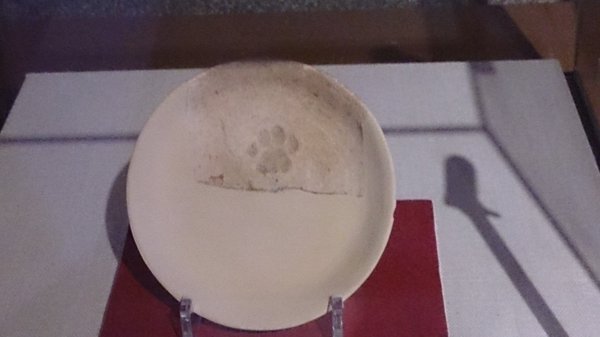
Today marks the second time the Department of Awesome Antiquities has found adorable paw prints unintentionally preserved for posterity. The first time it was a dog’s prints preserved in ancient Roman tiles. These tiny toeses frozen in time belonged to a cat back in 16th century Japan who walked across a brand new earthenware plate before it had hardened.
This plate was recovered from the ruins of Yuzuki Castle located in Matsuyama, Ehime Prefecture, Shikoku, Japan. The castle was destroyed in 1585, but this precious plate survived.


















 Steel Phoenix Studios