tbh i am disgusted that ariana grande had to actually disable her comments on twitter because so many people are blaming her for mac millers death from an overdose. like yes his death is immensely tragic and alcohol and drugs are a huge issue in society today but ariana was in no way obligated to stay with someone who was toxic for her health and well-being. and the people who are saying that it was her job to stay and “take care of him” and “save him” can fucking rot
Dug around in my archive drives for Discworld fanarts. I have a lot of Feelings I can’t articulate very well soooooo I’m not going to, just enjoy the draws xD FYI Zombie Reg is still one of my favorite faces I’ve drawn of all time, ever!
MAN I just remembered how I sketched the Vimes family portrait after I read Thud! I should find that and finish it…
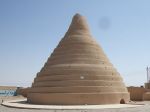
Today in the modern world we take freezers, and the frozen results of freezers for granted. But in ancient times, cold drinks, frozen desserts, and chilled tropical cocktails were a luxury unknown to most people. However the idea of artificially freezing goods is nothing new. As far back as 400 BC, the ancient Persians built special freezers called yakhchals. Yakhchals were large buildings used for storage of ice and foodstuffs during the hot Persian summers. Typically they were around 60 feet tall, and had a large subterranean storage space dug out from under it. The Yakhchal itself was made from a special type of mud clay called sarooj which was composed of clay, sand, lime, goat hair, egg whites, and ash mixed in a special proportion which made it extremely resistant to heat transfer. In other words the inside stayed cool, while heat from the outside was prevented from entering the building because of the thick insulated walls. This combined with the subterranean storage ensured that whatever goods were stored in the pit stayed cool, as temperatures below ground level are usually around the 60 to 65 degree Fahrenheit range. However, these designs were not what made a yakhchal a freezer. There was one other brilliant design feature which ensured that the yakhchal would stay frosty all year long.
At the top of the dome was a small hole, or series of small holes called windcatchers. Typically windcatchers were pointed in the direction of the prevailing winds. Due to its conical shape there was always a negative pressure gradient inside the yakhchal. According to Bernoulli’s Law air flow at a high pressure will always move toward areas of low pressure. Thus air from the outside was constantly flowing through the yakhchal. In addition, according to Venturi’s Principal, whenever air flows through a small hole, the smaller the hole, the greater the speed of the flow. The small hole, or series of holes of the yakhchal ensured that air passed into it at great flows. What resulted was a great amount of outside air entering into the yakhchal at high speeds. While the air itself wasn’t cool, the flows at which it was being entrained into the yakhchal created temperatures that were below freezing. Typically the windcatchers were cut in such a way that the incoming jet of air would be directed onto the storage pit.
The ancient Persians primarily used their yakhchals for storing ice and foodstuffs. During the summer, Persian nobles often enjoyed a frozen treat called faloodeh (pictured above), which is made from thin noodles with syrup made from sugar and rose water, then flavored with lemon, lime, fruits, almond, pistachio, and other flavorings. Due to the Persian’s freezing technology, faloodeh (which is still popular today) goes down in history as one of the first frozen desserts. The practice of building and using yakhchals continued up to the 20th century, when they were eventually replaced with modern freezers and refrigerators.
One of the most bizarrely cool people I’ve ever met was an oral surgeon who treated me after a ridiculous accident (that’s another story), Dr. Z.
Dr. Z. was, easily, the best and most competent doctor or dentist I’ve ever encountered – and after that accident, I encountered quite a number. He came stunningly highly recommended, had an excellent record, and the most calming bedside manner I’ve ever seen.
That last wasn’t the sweet gentle caretaking sort of manner, which some nurses have but you wouldn’t expect to see in a surgeon. No; when Dr. Z. told me that one of my broken molars was too badly damaged to save, and I (being seventeen and still moderately in shock) broke down crying, he stared at me incredulously and said, in a tone of utter bemusement, “But – I am very good.”
I stopped crying on the spot. In the last twenty-four hours or so of one doctor after another, no one had said anything that reassuring to me. He clearly just knew his own competence so well that the idea of someone being scared anyway was literally incomprehensible to him. What more could I possibly ask for?
(He was right. The procedure was very extended, because the tooth that needed to be removed was in bits, but there was zero pain at any point. And, as he promised, my teeth were so close together that they shifted to fill the gap to where there genuinely is none anymore, it’s just a little easier to floss on that side.)
But Dr. Z.’s insane competence wasn’t just limited to oral surgery.
When I met Dr. Z., he, like most doctors I’ve had, asked me if I was in college, and where, and what I was studying. When I say “math,” most doctors respond with “oh, wow, good for you” or possibly “what do you want to do with that after college?”
Dr. Z. wanted to know what kind of math.
I gave him the thirty-second layman’s summary that I give people who are foolish enough to ask that. He responded with “oh, you mean–” and the correct technical terms. I confirmed that was indeed what I meant (and keep in mind, this was upper-division college math, you don’t take this unless you’re a math major). He asked cogent follow-up questions, and there ensued ten or so minutes of what I’d call “small talk” except for how it was an intensely technical mathematical discussion.
He didn’t, as far as I can tell, have any kind of formal math background. He just … knew stuff.
I was a competitive fencer at this point in time, so when he asked if I had any questions about the surgery that would be necessary, I asked him if I’d be okay to fence while I had my jaw wired shut, or if it would interfere with breathing.
“Fencing?” he said.
“Yes,” I said, “like swordfighting,” because this is another conversation I got to have a lot. (People assume they’ve misheard you, or occasionally they think you mean building fences.)
“Which weapon?”
“Uh. Foil.”
“No, it won’t be safe,” and he went off into an explanation of why.
Turns out, he was also a serious fencer – and, when I mentioned my fencing coach, an old friend of his. (I asked my fencing coach later, and, oh yes, Dr. Z., a good friend of mine, excellent fencer.) (My coach was French. Dr. Z. was Israeli. I never saw Dr. Z. around the club or anything. I have no idea how they knew each other.)
So this was weird enough that later, when I was home, I looked Dr. Z. up on Yelp. His reviews were stellar, of course, but that wasn’t the weird thing.
The weird thing was that the reviews were full of people – professionals in lots of different fields – saying the same thing: I went to Dr. Z. for oral surgery, and he asked me about what I did, and it turned out he knew all about my field and had a competent and educated discussion with me about the obscure technical details of such-and-such.
All sorts of different fields, saying this. Lawyers. Businessmen. Musicians.
As far as I can tell, it’s not that I just happened to be pursuing the two fields he had a serious amateur interest in – he just seemed to be extremely good at literally everything.
I have no explanation for this. Possibly he sold his soul to the devil.



































 Steel Phoenix Studios