there’s something endlessly hilarious to me about the phrase “hotly debated” in an academic context. like i just picture a bunch of nerds at podiums & one’s like “of course there was a paleolithic bear cult in Northern Eurasia” and another one just looks him in the eye and says “i’l kill you in real life, kevin”
I heard a story once about two microbiologists at a conference who took it out into the parking lot to have a literal fistfight over taxonomy.
have i told this story yet? idk but it’s good. The Orangutan Story:
my american lit professor went to this poe conference. like to be clear this is a man who has a doctorate in being a book nerd. he reads moby dick to his four-year-old son. and poe is one of the cornerstones of american literature, right, so this should be right up his alley?
wrong. apparently poe scholars are like, advanced. there is a branch of edgar allen poe scholarship that specifically looks for coded messages based on the number of words per line and letters per word poe uses. my professor, who has a phd in american literature, realizes he is totally out of his depth. but he already committed his day to this so he thinks fuck it! and goes to a panel on racism in poe’s works, because that’s relevant to his interests.
background info: edgar allen poe was a broke white alcoholic from virginia who wrote horror in the first half of the 19th century. rule 1 of Horror Academia is that horror reflects the cultural anxieties of its time (see: my other professor’s sermon abt how zombie stories are popular when people are scared of immigrants, or that purge movie that was literally abt the election). since poe’s shit is a product of 1800s white southern culture, you can safely assume it’s at least a little about race. but the racial subtext is very open to interpretation, and scholars believe all kinds of different things about what poe says about race (if he says anything), and the poe stans get extremely tense about it.
so my professor sits down to watch this panel and within like five minutes a bunch of crusty academics get super heated about poe’s theoretical racism. because it’s academia, though, this is limited to poorly concealed passive aggression and forceful tones of inside voice. one professor is like “this isn’t even about race!” and another professor is like “this proves he’s a racist!” people are interrupting each other. tensions are rising. a panelist starts saying that poe is like writing a critique of how racist society was, and the racist stuff is there to prove that racism is stupid, and that on a metaphorical level the racist philosophy always loses—
then my professor, perhaps in a bid to prove that he too is a smart literature person, loudly calls: “BUT WHAT ABOUT THE ORANGUTAN?”
some more background: in poe’s well-known short story “the murder in the rue morgue,” two single ladies—a lovely old woman and her lovely daughter who takes care of her, aka super vulnerable and respectable people—are violently killed. the murderer turns out to be not a person, but an orangutan brought back by a sailor who went to like burma or something. and it’s pretty goddamn racially coded, like they reeeeally focus on all this stuff about coarse hairs and big hands and superhuman strength and chattering that sounds like people talking but isn’t actually. if that’s intentional, then he’s literally written an analogy about how black people are a threat to vulnerable white women, which is classic white supremacist shit. BUT if he really only meant for it to be an orangutan, then it’s a whole other metaphor about how colonialism pillages other countries and brings their wealth back to europe and that’s REALLY gonna bite them in the ass one day. klansman or komrade? it all hangs on this.
much later, when my professor told this story to a poe nerd friend, the guy said the orangutan thing was a one of the biggest landmines in their field. he said it was a reliable discussion ruiner that had started so many shouting matches that some conferences had an actual ban on bringing it up.
so the place goes dead fucking silent as every giant ass poe stan in the room is immediately thrust into a series of war flashbacks: the orangutan argument, violently carried out over seminar tables, in literary journals, at graduate student house parties, the spittle flying, the wine and coffee spilled, the friendships torn—the red faces and bulging veins—curses thrown and teaching posts abandoned—panels just like this one fallen into chaos—distant sirens, skies falling, the dog-eared norton critical editions slicing through the air like sabres—the textual support! o, the quotes! they gaze at this madman in numb disbelief, but he could not have known. nay, he was a literary theorist, a 17th-century man, only a visitor to their haunted land. he had never heard the whistle of the mortars overhead. he had never felt the cold earth under his cheek as he prayed for god’s deliverance. and yet he would have broken their fragile peace and brought them all back into the trenches.
my professor sits there for a second, still totally clueless. the panel moderator suddenly stands up in his tweed jacket and yells, with the raw panic of a once-broken man:
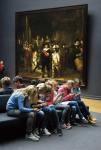
“…last
year this photograph of children looking at their smartphones by Rembrandt’s ‘The
Night Watch’ in the Rijksmuseum in Amsterdam
[went viral.] It was often accompanied by outraged, dispirited comments such as
“a perfect metaphor for our age,” “the end of civilization” or “a sad picture of
our society”.
…It turns out that the Rijksmuseum has an app that, among other
things, contains guided tours and further information about the works on display.
As part of their visit to the museum, the children, who minutes earlier had admired
the art and listened attentively to explanations by expert adults, had been instructed
to complete an assignment by their school teachers, using, among other things, the
museum’s excellent smartphone app….
The tragic thing is that this — the truth — will
never go viral. So, I wonder, what is more likely to bring about the death of civilization,
children using smartphones to learn about art or the willful ignorance of adults
who are too quick to make assumptions?” José Picardo, Medium
My first thoughts were mean ones and im fucking young
Didn’t think one bit about it 😂 I used it myself because school and the museum told me to learn more about it. It is a great and wonderful app it even helps u find were some art pieces are in the museum 10/10 would recommend.
I was reading my writing today, and let me tell you, it may not be good, plot is not the best, and characters are a bit stereotypical, but boy do I have fun writing it
This is such a good mindset to have. There is positive energy in this post
Her rambunctious willingness to hurl herself about became the hallmark
of her slapstick screen persona, Madcap Mabel.“There was no cliff so
high that Mabel was afraid of it,” as Mary Pickford put it; “no bucking
bronco too wild for her to ride; as for dodging Keystone pies, there was
no one ever on the screen who could do it more gracefully and with as
much poise as Mabel.”
Normand not only played the damsel in distress (in Barney Oldfield’s Race for a Life,
she was the first gal to be tied to the railroad tracks), she also
flipped a stereotype only a few years in the forging, by frequently
rescuing the leading man instead. “It was new to see women doing this,”
says Ally Acker, Author of Reel Women: The First Hundred Years. “Pearl
White also did her own stunts, but no one else was spoofing the serials
and turning them into comedy.”
Films such as Mabel’s Dramatic Career and Mabel’s New Hero made her one of the first actors to
have their own name in the title; she also directed many of them, too.
Such multitasking was unusual, but, in the lawless land of early cinema,
says Acker, “all kinds of people could and did move easily between
roles … there were no rules.”
…
Others have gone further. Film historian Raymond Lee says Chaplin owes
Normand his “greatest debt”. “A study of her films, made before Chaplin
came to this country, shows entire routines, gestures, reactions,
expressions, that were later a part of Chaplin’s characteristics.”












 Steel Phoenix Studios