For the uninformed, functioning labels are terms like high functioning autism, low functioning autism, mild autism, severe autism. Other words like moderate or level 1, level 2, etc may be used too.
Functioning labels are extremely offensive because they’re placed on autistic people based on observation from the outside. This is problematic for three reasons.
Functioning labels determine how autistic people are treated. People associate “low functioning/severe” with incompetence or infancy and they end up treating the autistic person like a pet or a baby. High functioning/mild gets stereotyped as people who are just a little quirky and their difficulties get ignored as laziness or intentional stubbornness.
Functioning labels imply brokenness and treat people as if their intrinsic value is determined by what they contribute to society rather than the fact that they are a living being with oxygen in their lungs and blood in their veins like everybody else.
Functioning labels create a dichotomy as if there are differing “levels” of autism or that people exist on different areas of the spectrum. NO, NO, NO, that’s not how it is.
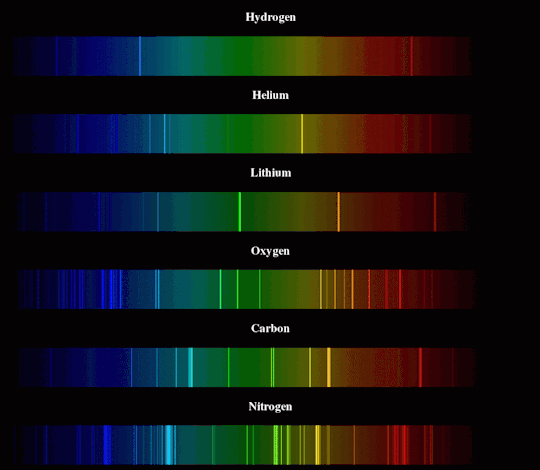
Think of spectroscopy and how the elements create their own signature color lines. Now put peoples’ names in place of the elements: Hydrogen/Harold, Helium/Henry, Lithium/Luke, Oxygen/Olga, Carbon/Carol, Nitrogen/Nadine.
Autism is like that. We’re all on the same spectrum and all that is unique is how we display our symptoms, our sensory issues, our splinter abilities and so forth.
In light of that, I want to change the language. Let’s start pushing for support levels instead of functioning labels.
High support: Anyone who isn’t able to live independently and needs help with some or all of their basic daily living skills such as eating, bathing, basic grooming, putting on makeup, getting dressed and completing tasks. Can be abbreviated online or in writing as HSP for High Support Person or HSAP for High Support Autistic Person.
Usage in speech: Clarissa is a high support autistic person and needs assistance with getting dressed and taking a shower. Abbreviated usage online: I’m a HSAP and I’m really into physics, so the poor sucker who signs me on is gonna hear a lot about it when they hand me my iPad!
Medium support: Anyone may or may not live independently and doesn’t need help with basic living skills, but needs help with other things like cooking, completing some tasks, transportation if unable to drive and assistance for things like grocery shopping. Can be abbreviated online or in writing as MSP for Medium Support Person or MSAP for Medium Support Autistic Person.
Usage in speech: Kevin is a medium support autistic person and needs some assistance to prepare meals and shop for the wood he uses for his carpentry projects. His boyfriend, Max, usually helps him with those. Usage online: I’m a MSAP and I’m looking for info about saws. Any fellow auties know what’s best for cutting oak?
Low support: Anyone who more often than not lives independently and may only need assistance with minor things like balancing a checkbook, getting started on some tasks like organizing a garage sale or arranging to move from one house to another. Can be abbreviated online or in writing as LSP for Low Support Person or LSAP for Low Support Autistic Person.
Usage in speech: Jesse is a low support autistic person and she only needs help keeping her checkbook balanced. Usage online: I’m a LSAP and I’m thinking about moving to Seattle. What’s the weather and traffic like there?
Reasons support levels are better:
They don’t make assumptions about intelligence
They don’t encourage infantilization or pity
They sound more respectful and dignified
Ditch functioning labels and start using support levels. These terms can apply to practically every kind of disability, not just autism.
For the record, I’m a MSAP.
Please reblog this whether you’re disabled or not. Make this viral.
This may just be my experience as an autistic person, but the kids I’ve nannied whose parent’s complain of ‘bad awful in cooperative selfish autistic behavior’ are… Not like that? At all?
Like, for example, I cared for a kid for a while who was nonverbal and didn’t like being touched. Around six years old? Their parent said that they were fussy and had a strict schedule, and that they had problems getting them to eat. Their last few nannies had quit out of frustration.
So, I showed up. And for the first little while, it was awkward. The kid didn’t know me, I didn’t know them, you know how it is. And for the first… Day and a half, maybe? I fucked up a few times.
I changed their diaper and they screamed at me. I put the TV off and they threw things. Not fun, but regular upset kid stuff.
Next time, I figured, hell, I wouldn’t like being manhandled and ordered around either. Who likes being physically lifted out of whatever it is they’re doing and having their pants yanked off? Fucking few, that’s who.
Next time, I go, ‘hey, kiddo. You need a new diaper?’ and check. ‘I’m gonna go grab a new one and get you clean, okay?’ ‘Wanna find a spot to lay down?’ ‘Alright, almost done. Awesome job, thanks buddy’.
I learned stuff about them. They liked a heads up before I did anything disruptive. They didn’t mind that I rattled of about nothing all day. They didn’t like grass or plastic touching their back. They were okay with carpets and towels. They liked pictionary, and the color yellow, and fish crackers, and painting. They didn’t look me in the face (which was never an issue- I hate that too, it fucking sucks) but I never had reason to believe that they were ignoring me.
Once I learned what I was doing wrong, everything was fine. Did they magically “”“become normal”“” and start talking and laughing and hugging? No, but we had fun and had a good time and found a compromise between what I was comfortable with and what they were comfortable with. (For the record, I didn’t magically sailor-moon transform into a socially adept individual, either. In case anyone was wondering.)
I don’t like eye contact. It’s distracting and painful and stresses me out.
They didn’t like eye contact either.
Is eye contact necessary to communication? No. So we just didn’t do it.
Was there ever a situation where I HAD to force them to drop everything and lay down on the lawn? No. So the thirty second warning came into play, and nobody died.
“But they never talked!”
No, they didn’t. And they didn’t know ASL, and they didn’t like being touched.
So you know what happened?
My third day in, they tugged on my shirt. ‘Hey monkey, what’s up?’ I asked. And they tugged me towards the kitchen. ‘oh, cool. You hungry?’. They raised their hands in an ‘up’ gesture. ‘you want up? Cool.’ and I lifted them up. They pointed to the fridge. I opened it. They grabbed a juice box out of the top shelf, and pushed the door closed again. ‘oh sweet, grape is the best. You are an individual of refined taste.’ I put them down and they went back to their room to play Legos.
“But they didn’t say please or thank you!” “But you should be teaching them communication skills!” “But!” Lalalalala.
1. The entire interaction was entirely considerate and polite. I was never made uncomfortable. I was made aware of the problem so that I could help them solve it. There was no mess, no tears, no bruises, no shouting.
2. Did my brain collapse into a thousand million fragments of shattered diamond dust out of sheer incomprehension? No? Then their communication skills were fine. Goal realized, solution found, objective complete. They found the most simple and painless way to communicate the situation and then did it.
Kids are not stupid. AUTISTIC kids are not stupid.
I’m willing to bet real cash money that the real reason the last few nannies had quit had a million times more to do with their own ability to cope, not the kid’s.
To this day, that was the most relaxed and enjoyable job I’ve ever had.
And I know I don’t speak for everyone. All kids are different. All adults are different. But in my time and experience, pretty much 95% of all my difficulties with children come from ME not being understanding enough. Every single “problem child” I’ve worked with turned out to be a pretty cool person once I started figuring out how to put my ego aside and let them set the pace.
Again, not speaking universally, here. I’m just saying. Sometimes social rules are bullshit, you know? People are people
Have you ever read an article about the study that found that teaching the parents to cope with autistic kids yields better results than other therapies? Because this is exactly what they were talking about.
“If autism isn’t caused by environmental factors and is natural why didn’t we ever see it in the past?”
We did, except it wasn’t called autism it was called “Little Jonathan is a r*tarded halfwit who bangs his head on things and can’t speak so we’re taking him into the middle of the cold dark forest and leaving him there to die.”
Or “little Jonathan doesn’t talk but does a good job herding the sheep, contributes to the community in his own way, and is, all around, a decent guy.” That happened a lot, too, especially before the 19th century.
Or, backing up FURTHER
and lots of people think this very likely,
“Oh little Sionnat has obviously been taken by the fairies and they’ve left us a Changeling Child who knows too much, and asks strange questions, and uses words she shouldn’t know, and watches everything with her big dark eyes, clearly a Fairy Child and not a Human Like Us.”
The Myth of the Changeling child, a human baby apparently replaced at a young age by a toddler who “suddenly” acts “strange and fey” is an almost textbook depiction of autistic children.
To this day, “autism warrior mommies” talk about autism “stealing” their “sweet normal child” and have this idea of “getting their real baby back” which (in the face of modern science) indicates how the human psyche actually does deal with finding out their kid acts unlike what they expected.
Given this evidence, and how common we now know autism actually is, the Changeling myth is almost definitely the result of people’s confusion at the development of autistic children.
Weirdly enough, that legend is now comforting to me.
I think it’s worth noting that many like me, who are diagnosed with ASD now, would probably have been seen as just a bit odd in centuries past. I’m only a little bit autistic; I can pass for neurotypical for short periods if I work really hard at it. I have a lack of talent in social situations, and I’m prone to sensory overload or you might notice me stimming.
But here’s the thing: life is louder, brighter and more intense and confusing than it has ever been. I live on the edge of London and I rarely go into the centre of town because it’s too overwhelming. If I went back in time and lived on a farm somewhere, would anyone even notice there was anything odd about me? No police sirens, no crowded streets that go on for miles and miles, no flickery electric lights. Working on a farm has a clear routine. I’d be a badass at spinning cloth or churning butter because I find endless repetition soothing rather than boring.
I’m not trying to romanticise the past because I know it was hard, dirty work with a constant risk of premature death. I don’t actually want to be a 16th century farmer! What I’m saying is that disability exists in the context of the environment. Our environment isn’t making people autistic in the sense of some chemical causing brain damage. But we have created a modern environment which is hostile to autistic people in many ways, which effectively makes us more disabled. When you make people more disabled, you start to see more people struggling, failing at school because they’re overwhelmed, freaking out at the sound of electric hand dryers and so on. And suddenly it looks like there’s millions more autistic people than existed before.



 Steel Phoenix Studios