Finding out you’re ADHD, autistic, etc, first reactions be like the ground fell out from under you, “oh my god I’m X now, on top of everything else”. Really it’s just a label for something that’s always been happening, IT’S ALWAYS BEEN THERE, it just has a name now is all that changed.
this is actually super important!!!
Huh. My first reaction was relief, knowing that I wasn’t imagining it when everything was impossible as a student.
For the uninformed, functioning labels are terms like high functioning autism, low functioning autism, mild autism, severe autism. Other words like moderate or level 1, level 2, etc may be used too.
Functioning labels are extremely offensive because they’re placed on autistic people based on observation from the outside. This is problematic for three reasons.
Functioning labels determine how autistic people are treated. People associate “low functioning/severe” with incompetence or infancy and they end up treating the autistic person like a pet or a baby. High functioning/mild gets stereotyped as people who are just a little quirky and their difficulties get ignored as laziness or intentional stubbornness.
Functioning labels imply brokenness and treat people as if their intrinsic value is determined by what they contribute to society rather than the fact that they are a living being with oxygen in their lungs and blood in their veins like everybody else.
Functioning labels create a dichotomy as if there are differing “levels” of autism or that people exist on different areas of the spectrum. NO, NO, NO, that’s not how it is.
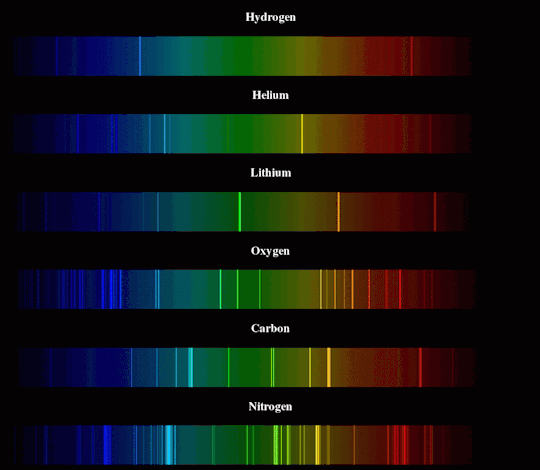
Think of spectroscopy and how the elements create their own signature color lines. Now put peoples’ names in place of the elements: Hydrogen/Harold, Helium/Henry, Lithium/Luke, Oxygen/Olga, Carbon/Carol, Nitrogen/Nadine.
Autism is like that. We’re all on the same spectrum and all that is unique is how we display our symptoms, our sensory issues, our splinter abilities and so forth.
In light of that, I want to change the language. Let’s start pushing for support levels instead of functioning labels.
High support: Anyone who isn’t able to live independently and needs help with some or all of their basic daily living skills such as eating, bathing, basic grooming, putting on makeup, getting dressed and completing tasks. Can be abbreviated online or in writing as HSP for High Support Person or HSAP for High Support Autistic Person.
Usage in speech: Clarissa is a high support autistic person and needs assistance with getting dressed and taking a shower. Abbreviated usage online: I’m a HSAP and I’m really into physics, so the poor sucker who signs me on is gonna hear a lot about it when they hand me my iPad!
Medium support: Anyone may or may not live independently and doesn’t need help with basic living skills, but needs help with other things like cooking, completing some tasks, transportation if unable to drive and assistance for things like grocery shopping. Can be abbreviated online or in writing as MSP for Medium Support Person or MSAP for Medium Support Autistic Person.
Usage in speech: Kevin is a medium support autistic person and needs some assistance to prepare meals and shop for the wood he uses for his carpentry projects. His boyfriend, Max, usually helps him with those. Usage online: I’m a MSAP and I’m looking for info about saws. Any fellow auties know what’s best for cutting oak?
Low support: Anyone who more often than not lives independently and may only need assistance with minor things like balancing a checkbook, getting started on some tasks like organizing a garage sale or arranging to move from one house to another. Can be abbreviated online or in writing as LSP for Low Support Person or LSAP for Low Support Autistic Person.
Usage in speech: Jesse is a low support autistic person and she only needs help keeping her checkbook balanced. Usage online: I’m a LSAP and I’m thinking about moving to Seattle. What’s the weather and traffic like there?
Reasons support levels are better:
They don’t make assumptions about intelligence
They don’t encourage infantilization or pity
They sound more respectful and dignified
Ditch functioning labels and start using support levels. These terms can apply to practically every kind of disability, not just autism.
For the record, I’m a MSAP.
Please reblog this whether you’re disabled or not. Make this viral.
This may just be my experience as an autistic person, but the kids I’ve nannied whose parent’s complain of ‘bad awful in cooperative selfish autistic behavior’ are… Not like that? At all?
Like, for example, I cared for a kid for a while who was nonverbal and didn’t like being touched. Around six years old? Their parent said that they were fussy and had a strict schedule, and that they had problems getting them to eat. Their last few nannies had quit out of frustration.
So, I showed up. And for the first little while, it was awkward. The kid didn’t know me, I didn’t know them, you know how it is. And for the first… Day and a half, maybe? I fucked up a few times.
I changed their diaper and they screamed at me. I put the TV off and they threw things. Not fun, but regular upset kid stuff.
Next time, I figured, hell, I wouldn’t like being manhandled and ordered around either. Who likes being physically lifted out of whatever it is they’re doing and having their pants yanked off? Fucking few, that’s who.
Next time, I go, ‘hey, kiddo. You need a new diaper?’ and check. ‘I’m gonna go grab a new one and get you clean, okay?’ ‘Wanna find a spot to lay down?’ ‘Alright, almost done. Awesome job, thanks buddy’.
I learned stuff about them. They liked a heads up before I did anything disruptive. They didn’t mind that I rattled of about nothing all day. They didn’t like grass or plastic touching their back. They were okay with carpets and towels. They liked pictionary, and the color yellow, and fish crackers, and painting. They didn’t look me in the face (which was never an issue- I hate that too, it fucking sucks) but I never had reason to believe that they were ignoring me.
Once I learned what I was doing wrong, everything was fine. Did they magically “”“become normal”“” and start talking and laughing and hugging? No, but we had fun and had a good time and found a compromise between what I was comfortable with and what they were comfortable with. (For the record, I didn’t magically sailor-moon transform into a socially adept individual, either. In case anyone was wondering.)
I don’t like eye contact. It’s distracting and painful and stresses me out.
They didn’t like eye contact either.
Is eye contact necessary to communication? No. So we just didn’t do it.
Was there ever a situation where I HAD to force them to drop everything and lay down on the lawn? No. So the thirty second warning came into play, and nobody died.
“But they never talked!”
No, they didn’t. And they didn’t know ASL, and they didn’t like being touched.
So you know what happened?
My third day in, they tugged on my shirt. ‘Hey monkey, what’s up?’ I asked. And they tugged me towards the kitchen. ‘oh, cool. You hungry?’. They raised their hands in an ‘up’ gesture. ‘you want up? Cool.’ and I lifted them up. They pointed to the fridge. I opened it. They grabbed a juice box out of the top shelf, and pushed the door closed again. ‘oh sweet, grape is the best. You are an individual of refined taste.’ I put them down and they went back to their room to play Legos.
“But they didn’t say please or thank you!” “But you should be teaching them communication skills!” “But!” Lalalalala.
1. The entire interaction was entirely considerate and polite. I was never made uncomfortable. I was made aware of the problem so that I could help them solve it. There was no mess, no tears, no bruises, no shouting.
2. Did my brain collapse into a thousand million fragments of shattered diamond dust out of sheer incomprehension? No? Then their communication skills were fine. Goal realized, solution found, objective complete. They found the most simple and painless way to communicate the situation and then did it.
Kids are not stupid. AUTISTIC kids are not stupid.
I’m willing to bet real cash money that the real reason the last few nannies had quit had a million times more to do with their own ability to cope, not the kid’s.
To this day, that was the most relaxed and enjoyable job I’ve ever had.
And I know I don’t speak for everyone. All kids are different. All adults are different. But in my time and experience, pretty much 95% of all my difficulties with children come from ME not being understanding enough. Every single “problem child” I’ve worked with turned out to be a pretty cool person once I started figuring out how to put my ego aside and let them set the pace.
Again, not speaking universally, here. I’m just saying. Sometimes social rules are bullshit, you know? People are people
Have you ever read an article about the study that found that teaching the parents to cope with autistic kids yields better results than other therapies? Because this is exactly what they were talking about.
For 17
years, Nick Makris never uttered a word in public. The autistic teenager
from Levenshulme in Manchester has been a selective mute since birth,
unable to speak due to severe social anxiety.
In September he began taking part in a cooking class at the Grange
Special School, which has 137 pupils on the autistic spectrum. The class
was established a year ago by a teacher, Serene Phillips, with food
supplied entirely by the food waste charity FareShare, which the Telegraph is backing in its Christmas appeal.
Every
Wednesday, Nick and his class spend the morning preparing a lunch and
then take it to a nearby day centre where they serve up to 30 elderly
people (many of whom have their own health issues including dementia).
In recent months, because of the social bonds formed over the
lunches, Nick has finally started to speak. With a broad smile on his
face he slowly tells me what he enjoys most about the cooking classes:
“making old people happy”.
Part charity solicitation, but an entirely heartwarming and uplifting story.
singleminded and incredibly dedicated to whatever it is she’s focused on at the time (gets into and then goes to law school to get back warner, even though it breaks with everything she’s done in her life up until that point)
incredibly knowledgeable about her chosen point of interest (”it’s impossible to use half-loop top stitching on low-viscosity rayon”)
has a dog who’s permitted to live with her on campus and go to court with her, and who completes daily-living tasks like fetching mail (i’m calling it: bruiser’s a service dog)
relies on routine and an established set of coping mechanisms (manicures; tries to schedule social events to maintain some sort of consistency)
struggles with social cues (for instance, the way she delivers her introduction when she first arrives at school, the way she interacts with warner)
is incredibly smart (got a 179 on the LSATs) but struggles in school — has difficulty keeping track of her assignments (first day in stromwell’s class), has difficulty answering questions on the spot in class (”do they always do that? put you on the spot like that?”)
struggles with codeswitching in different environments (with her friends in LA, in the classroom, with the other harvard students, in court, etc)
when she does try to institute a change like this, she does it overly dramatically; she over-plays it — see: the outfit she wears for her first day of classes
that line also — ”i totally look the part!” — that idea that what she wears, says, and does are largely performative (maybe also she’s trying to pass?)
uses overly formal or informal language; language inappropriate to the context (”and i am fully amenable to that discussion” when warner is breaking up with her; the ‘valley girl’ language she uses at harvard)
has difficulty identifying sarcasm and mocking (the costume party)
is set up in the narrative as out of place in her social environment
the narrative about elle ultimately winning the case because she uses her existing skills, knowledge base, and passion rather than What She Learned In Law School ™ is also, like, a really strong neurodiversity narrative
i love her and i only care about autistic characters, so she must be autistic
she’d be a textbook example of the sort of woman who falls through the cracks in diagnosing autism, if the textbooks didn’t fail so egregiously in regards to diagnosing women.
how to waste food that could satisfy a family for a month.
This is a gross false equivalency. Stop exploiting the plight of poor people to justify your ableism. If this mom bought her kid a gaming console, would you be here sneering “that’s $300 that could have been donated to a food charity”?
I mean let’s be realistic — giving $300 to poor people would go a lot further towards feeding the hungry than $125 worth of spaghetti*.
Anyone who knows anything about how poverty actually works knows that waste and scarcity are not the reasons people go hungry. Waste and scarcity have nothing to do with homelessness, either. There is more than enough food to go around. There are more than enough houses to go around. Society has a surplus of resources, and has had this surplus for many decades.
Society denies resources to people who lack capital. That’s the only reason poverty exists.
Poor people aren’t suffering because one mom decided to do a nice thing for her Autistic kid’s birthday.
Poor people suffer because they don’t have enough money.
Every kid deserves a birthday present they can enjoy, and $125 is a perfectly reasonable amount of money for a typical middle-class parent to spend once a year for a child’s birthday, so you can take your hate-on for Autistic kids and shove it up your spaghetti hole.
*180lbs cooked spaghetti is approximately 86 lbs dry spaghetti, at $1.45/lb (the price of a box of barilla) is ~$125 worth of food
Image description: [pale purple and yellow background with dark text] This April, don’t support an organization that harms autistic people. [crossed out logo for Autism Speaks] Support one built by autistic people, for autistic people. [logos for the Autistic Self Advocacy Network and the Autism Women’s Network]




 Steel Phoenix Studios