Freddie Oversteegen, Dutch resistance fighter who killed Nazis through seduction, dies at 92

laporcupina:

She was 14 when she joined the Dutch resistance,
though with her long, dark hair in braids she looked at least two years
younger.

When she rode her bicycle down the
streets of Haarlem in North Holland, firearms hidden in a basket, Nazi
officials rarely stopped to question her. When she walked through the
woods, serving as a lookout or seductively leading her SS target to a
secluded place, there was little indication that she carried a handgun
and was preparing an execution.

The Dutch
resistance was widely believed to be a man’s effort in a man’s war. If
women were involved, the thinking went, they were likely doing little
more than handing out anti-German pamphlets or newspapers.

Yet
Freddie Oversteegen and her sister Truus, two years her senior, were
rare exceptions — a pair of teenage women who took up arms against Nazi
occupiers and Dutch “traitors” on the outskirts of Amsterdam. With
Hannie Schaft, a onetime law student with fiery red hair, they sabotaged
bridges and rail lines with dynamite, shot Nazis while riding their
bikes, and donned disguises to smuggle Jewish children across the
country and sometimes out of concentration camps.

In
perhaps their most daring act, they seduced their targets in taverns or
bars, asked if they wanted to “go for a stroll” in the forest — and
“liquidated” them, as Ms. Oversteegen put it, with a pull of the
trigger.

“We had to do it,” she told one
interviewer. “It was a necessary evil, killing those who betrayed the
good people.” When asked how many people she had killed or helped kill,
she demurred: “One should not ask a soldier any of that.”

Freddie Oversteegen, Dutch resistance fighter who killed Nazis through seduction, dies at 92

crossedbeams:

freshprincemomma:

sassy-hook:

pleasant-trees:

aprilsvigil:

manticoreimaginary:

Watching this (and fearing broken ankles with each loop) I can’t helping thinking about that old quote Ginger Rogers did everything Fred Astaire did, except backwards and in high heels.

But no, if you watch closely you’ll see she doesn’t even step on the last chair. That means she had to trust that fucker to lift her gently to the ground while he was spinning down onto that chair. That takes major guts. I’d be pissing myself and fearing a broken neck if I were in her place. Kudos to her. 

I can’t stop watching this. 

Whoa.

Okay so this is true, but a tiny part of a wider truth. 

Ginger Rogers was a FUCKING BADASS. Ignore for a sec the rampant sexism in Hollywood (they once bleached  her hair blonde in wardrobe without telling her beforehand), the fact that she fought her whole career against typecasting and stereotyping from fellow actors (Katharine Hepburn famously said of the Astaire/Rogers partnership “she gave him sex. He gave her class” ) for starting out in musicals, and went on to have a career lasting over fifty years, winning a Best Actress Oscar (Kitty Foyle, 1940). But… JUST focusing on the Astaire movies…

Not only did she dance “backwards” in high heels, the dances were a task in themselves. Astaire was an absolute perfectionist and choreographed for himself, so as a younger, less experienced dancer Rogers came in at a disadvantage and worked her ass off to match him. 

Then there’s the filming complications… these numbers were filmed in ONE TAKE. So one thing goes wrong and you have to start over. Maybe you make a mistake or maybe your dress flies up because…

Ginger had to contend with her wardrobe. Dancing in heels is the norm at this time, but dancing in a dress designed for cinema cameras… not so much. They were heavy, embellished, uncomfortable, restrictive and cumbersome and essentially a third member of the dance, strapped to the body of one partner.Not only did she have to dance and look good, she had to control the dress too!

Take this routine from Swing Time… (it gets going proper at 1:30ish)

This dress has weights, YES WEIGHTS, sewn in to the hem to make it fly out and create a visual effect. So it’s heavy, it hurts if it hits you, and your partner gets mad if it hits him. So you gotta control it. 

Well it turns out all these factors on this set, this particular day aren’t going so well. So you’re doing take after take, here’s no labour laws, so at 4am after 18 hours you’re still going, even though part of the routine requires you to spin up those curved stairs with no rail at high speed….

Okay so now back to those high heels. In Ginger’s autobiography she vividly remembers this night as the night she bled though her shoes. They did so many takes, her feet blistered, bled, and the white satin high heels she was wearing finished he night pink because they were literally full of blood. And still they keep shooting. She keeps dancing.

The take they use in the film is the last. Early hours. Bloody feet. And she spins, acts and bosses out until that last second. Because she was that professional, talented and bloody minded. This is the last set of spins… 

So I say once again. Ginger Rogers was a badass.

She did everything Fred Astaire did backwards, in high heels, wearing a 20 pound dress, exhausted, injured and standing in a pool of her own blood. And watching her perform, you would never know.

swingsetindecember:

ok, i’m built like a noble ox. like i am 6′1 and i am sturdy lady. like thighs for days. if you try to move me. you will be moved. body images aside (lol, i am self conscious about my size, yeah it’s life) 

so like, i am very used to girls standing next to me in public places. i end up acquiring a pack of ladies. just because women are like, that lady is a lady men stay away from. i am jerk kryptonite (usually, i get my fair share of creeps, such is life) but most men have self preservation that this 6′1 ox will break them. and i will

so usually i am in my own phone and look up to another lady standing next to me. and i will immediately look up and make eye contact and nod. like, you know, that nod. i see you and you can talk if there is something wrong. i end up on a reg basis being a defacto bodyguard to these young ladies and small women while waiting for buses and in the metro. 

i am a large oak tree. i protect the other birds. 

ladies, we all got roles. find tree in the wild. we’re always happy to provide shelter from the creeps.

i’ve regularly said, “move on, she doesn’t want to be your friend”

autieblesam:

lesbianshepard:

my fave greek history story to tell is that of agnodice. like she noticed that women were dying a lot during childbirth so she went to egypt to study medicine in alexandria and was really fucking good but b/c it was illegal for women to be doctors in athens she had to pretend to be a man. and then the other doctors noticed that she was 10x better than them and accused her of seducing and sleeping with the women patients. like they brought her to court for this. and she just looked at them and these charges and stripped in front of everyone like “yeah. im not fucking your wives” and then they got so mad that a woman was better at their jobs then them that they tried to execute her but all her patients came to court and were like “are you fucking serious? she is the reason you have living children and a wife.” so they were shamed into changing the law and that is how women were given the right to practice medicine in athens

Yeah, this isn’t some Greek myth story about a hero or demigod or something, Agnodice was a real person who actually did this.

Earliest known biography of an African woman translated to English for the first time

rejectedprincesses:

angryafricangirlsunited:

The earliest known book-length biography of an African woman, a 17th-century text detailing the life of the Ethiopian saint Walatta Petros, has been translated into English for the first time.

Walatta Petros was an Ethiopian religious leader who lived from 1592 to 1642. A noblewoman, she left her husband to lead the struggle against the Jesuits’ mission to convert Ethiopian Christians to Roman Catholicism. It was for this that the Ethiopian Orthodox Täwaḥədo Church elevated her to sainthood.

Walatta Petros’s story was written by her disciples in the Gəˁəz language in 1672, after her death. Translator and editor Wendy Laura Belcher, an associate professor at Princeton University, came across the biography while she was studying Samuel Johnson’s translation, A Voyage to Abyssinia. “I saw that Johnson was fascinated by the powerful noble Ethiopian women in the text,” said Belcher. “I was speaking with an Ethiopian priest about this admiration and he told me that the women were admired in Ethiopia as well, where some of them had become saints in the Ethiopian church and had had hagiographies written about them.”

Ten years later, Belcher still remembers how “thrilling” this revelation was. “What? Biographies of powerful African women written by Africans in an African language? And to be able to pair European and African texts about the same encounter? I knew then I wouldn’t rest until I had translated this priceless work into English.”

Belcher learned Gəˁəz in order to translate Walatta Petros’s biography, working first with the Ethiopian priest, and then with the translator Michael Kleiner. “As a biography, it is full of human interest, being an extraordinary account of early modern African women’s lives — full of vivid dialogue, heartbreak, and triumph. For many, it will be the first time they can learn about a pre-colonial African woman on her own terms,” she said.

The biography has now been published in English by Princeton University Press as The Life and Struggles of Our Mother Walatta Petros. It has only been translated into two other languages before: Amharic and Italian, the latter in the 1970s.

While researching the text, Belcher discovered that the biography contained the earliest known depiction of same-sex desire among women in sub-Saharan Africa, an element she said was “censored” from the manuscript that the 1970s Italian edition was based on.

Belcher writes in the book’s preface that while she and Kleiner were translating the story from the Italian edition, they came across a “perplexing anecdote about a number of community members dying because some nuns had pushed each other around”. Kleiner suspected the manuscript had “been miscopied, perhaps deliberately, in order to censor the original, or merely by accident”, and speculated that “the nuns were not fighting but flirting with each other”.

After consulting with several Ethiopian scholars and looking at digitised copies of the original manuscripts, Kleiner and Belcher found the uncensored manuscript concurred. They translated the line as Petros seeing “some young nuns pressing against each other and being lustful with each other, each with a female companion.”

“This is the earliest anecdote we know of in which African women express desire for other women,” writes Belcher.

The academic also pointed to Walatta Petros’s relationship with her fellow nun Eheta Kristos, describing their first encounter with each other as “rapturous”. The text says that “love was infused into both their hearts, love for one another, and… they were like people who had known each other” their whole lives. Walatta Petros and Kristos “lived together in mutual love, like soul and body. From that day onward the two did not separate, neither in times of tribulation and persecution, nor in those of tranquillity, but only in death”.

“There is no doubt that the two women were involved in a lifelong partnership of deep, romantic friendship,” Belcher writes.

Identifying them as lesbians would be “anachronistic” partly because Walatta Petros was “deeply committed to celibacy”, she told the Guardian.

“Many Ethiopians are quite upset about my comments about the saint, my interpretations of her relationship with Eheta Kristos,” she said. “Part of this upset is due to not understanding my point. I think she was a sincere, celibate nun, but that she also felt desire for other women and that she was in a life-long celibate partnership with Eheta Kristos.”

I just kept smiling wider and wider the more I read.

Earliest known biography of an African woman translated to English for the first time

rejectedprincesses:

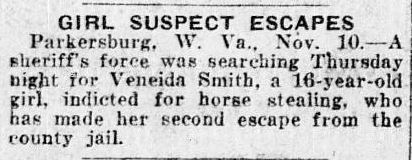
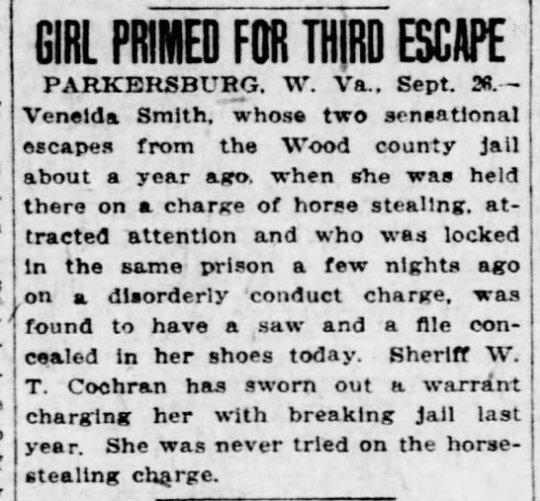
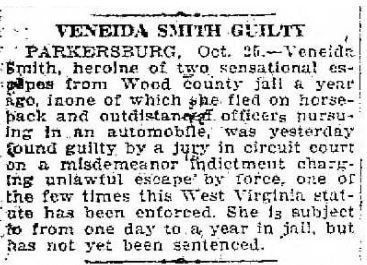
God Bless Veneida Smith.

So this whole thing started with this tweet by Twitter user Katie Henry (KT_NRE). I started plowing through newspapers to find every mention of her – and found most that were out there, but a man named Todd Sanders, who had access to Pennsylvania libraries, found quite a few more. All of this takes place in October and November of 1922, before timeskipping to September 1923 (her third escape), October 1923 (her guilty verdict), and March 1924 (her escape attempt with Roxie Starcher).

I have been unable to find her obituary or anything else out there about my new hero.

Someone make a movie of this.