“But Maria explained and painted their life cycle. Their metamorphosis from caterpillar to chrysalis to butterfly. She not only explained that process, she showed which plant species each butterfly species was dependent upon. This book revolutionised the study of insects in Europe. But it also helped Maria raise the funds to embark upon a journey to study the more exotic creatures that she knew she would find in the tropical regions of the Dutch empire.”
David Olusoga, Civilisations, ep. 6 ‘First Contact’ (BBC 2018)
how did my ancestors survive the brutal unforgiving wilderness when I get anxiety sweats from going to Target
to be fair im sure your ancestors would have the exact same reaction going to a Target
In the brutal unforgiving wilderness false positives cost nothing and false negatives are expensive. You’re better off being afraid of something that can’t hurt you than not afraid of something that can hurt you.
In a world where we mostly aren’t in danger, day to day, as long as we don’t play in traffic or jump off something, that’s no longer quite as adaptive.
We got our anxiety from a long, unbroken line of ancestors who were scared enough to survive, and pass on those genes!
It helps me sometimes to think about that at night, when I can’t sleep because my heart is pounding over something like “what if my usually reliable alarm clock doesn’t work in the morning for some reason and I’m late for work and lose my job and everyone hates me.” There’s nothing wrong with me, I just have a lot of extra, unused run-from-tigers juice that my grandparents left me.
“Unused run-from-tigers juice.”
I love that.
Our brains have been running Hunter/Gatherer 1.0 for 60,000 years without a software upgrade.
When’s the patch due? I could really use less run-from-tigers and more grow-plants-successfully.
You probably thought you knew what not giving a fuck looked like.
Well I’m here to tell you you’re wrong.
This is the ideal Zero Fucks Given. You may not like it, but this is what PEAK FUCKLESS looks like:
That is a hippo getting in the way of a crocodile killing a wildebeest.
On purpose.
Hippos aren’t just not afraid of one of the largest and deadliest subspecies of crocodiles on Earth. They ACTIVELY fuck with them, WHILE they’re eating. They will harass crocodiles as they hunt, interrupt them while trying to feed, and just outright annoy them for fun. They’ll chase crocodiles until they become exhausted (crocodiles have very limited stamina due to lactic acid buildup in their muscles and after short periods of intense activity they become nearly paralyzed with their need for rest), then after the crocodiles have dragged themselves onto the banks to rest in the sun, they’ll just keep on messing with them. Nudge them, push them around, bite them to clean their teeth.
Hippos basically treat crocodiles like mobile toothbrushes that need to be harassed into submission first. They will also outright kill crocodiles if they present a significant threat to their young, or when bull hippos need an outlet for their own toxic masculinity. (Testosterone: Not Even Once.)
Or when they just hate crocodiles, because they really hate crocodiles.
Which is why it’s such a big deal when the near-mythical legendary crocodile from Burundi, Gustave, has reportedly been witnessed killing and eating a bull hippo. A hippo is NOT an easy animal for a crocodile to kill, even an extraordinarily large crocodile.
But Gustave is the definition of an extraordinarily large crocodile:
That’s an adult female next to him, probably anywhere from 9-12 feet long. She’s half his length. His exact size is something that will probably never be determined because Nile Crocodiles are extremely difficult to capture alive (especially ones this big, experienced, and clever) and their remains are virtually impossible to recover if they die in the water. But it’s likely Gustave’s size is comparable to the standing Guinness World Record holder, Lolong:
Except maybe bulkier due to the dietary differences in Nile and Saltwater crocs. There’s some skepticism about Gustave’s size and probably healthy speculation about the accuracy of some of the things attributed to him (like that he has killed over 300 people and survived being shot with a rocket launcher; although he DOES have a few distinct scars from bullet wounds and his migratory patterns line up with dozens of human casualties). And it’s possible that he is already dead, because it’s been a few years since there was a reliable sighting.
It IS within the realm of possibility for a Nile Crocodile to reach Gustave’s reported size, though – especially one who has spent so many years successfully avoiding humans. I’ve linked a clone of this video before but mistakenly presented it as a Saltwater crocodile when the footage was in fact taken in the Okavango Delta in Botswana, in southern Africa:
The (Nile) crocodile in this video appears to be about twice the length of its distance from the camera, which looks to me like about 10-12 feet based on the apparent depth of the water and how far the camera is from where it crossed under the boat. This is a HUGE crocodile. I’d be more surprised if it wasn’t 20 feet long. At least.
But basically, that’s about how big a crocodile needs to be for claims of it killing a bull hippo to be believable. Crocodiles get big:
But it’s really not a small feat to take down Mother Nature’s Two Ton Staple Remover™ that thinks murder is fun:
So while crocodiles do like to eat hippos when they can (young hippos if they can isolate them from the protective mother/herd, adult hippos usually only when they are killed by other hippos, most often males in territorial disputes), hippos don’t have as much reason to be afraid of them as, say, any other living thing within ten feet of the water. (There are videos of crocodiles attacking ELEPHANTS, which I will not link here because I’m already way off topic.)
Anyway, to the original point, one of the things hippos are besides fearless is brown. Hippo skin is shades of brown. Not pink.
The lightest and pinkest coloration is around the sensitive areas where the skin is thinner, especially around the eyes and ears, and parts of their jawline.
But sometimes, they do LOOK a lot more pink, especially when they are OUT OF THE WATER or when the sun is really intense:
(this particular image looks like it might have had some saturation boosting)
This is because hippos are very sensitive to DRY SKIN. What makes their skin pink is not exactly sweat, it’s a reddish substance that basically acts as a natural moisturizer that protects their skin from drying out in the intense sun or when they come out of the water. Sometimes people say, incorrectly, that they sweat blood (the second night picture just above is a good depiction of this because you can see it actually running down the side of its belly) because of this, but it’s just a substance that their skin produces to stay hydrated. So they don’t TECHNICALLY sweat pink because it isn’t sweat, meant to regulate heat by cooling the body as it evaporates, but their skin does secrete a substance that does make them look more pink, but isn’t really sweat. So yes and no.
In contrast, here’s a(n adorable) picture of a hippo fully submerged:
And okay, a few more for good measure:
What a bizarre combination of adorable and terrifying.
Also they’re the deadliest animal in Africa, which is saying something, so you should not fuck with them, probably.
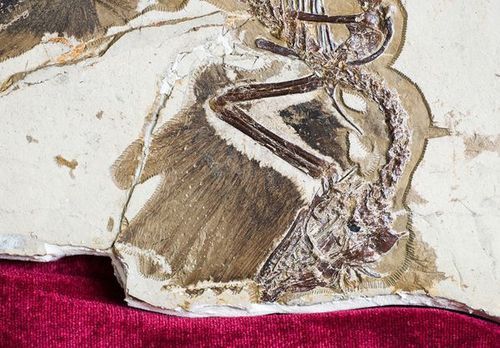
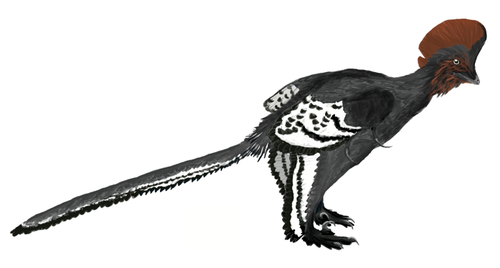
See those feathers? The skeleton they found was so well-preserved that scientists were able to examine the pigment cells in the feathers and compare them to those of modern day birds.
And they were able to do this with such accuracy that they know the coloration of this dinosaur. In life it looked something like this.
It just baffles me that we know the color patterns of an animal that has been dead for 161 million years
They found a prehistoric chicken that wears adidas swear pants my god
like this is pretty obvious and i shouldnt be shocked but like
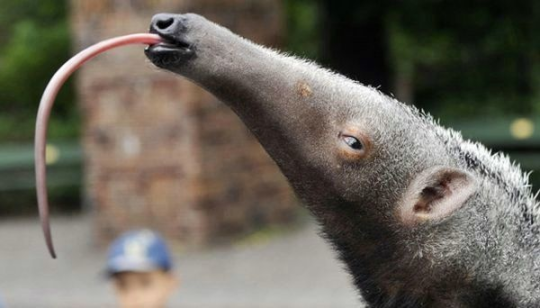
this is what an anteater skull looks like
like its really obvious that Thats Whats Going On under that skin but like….huh. thats what an anteater skull looks like. a piece of driftwood. a door wedge.
We all know what erectile dysfunction is but literally no one is ever taught what vaginismus is and it can cause people to feel extremely lost, broken, and cause people to take their own lives.
Raise. Awareness.
For the uninformed, vaginismus is when the vagina painfully tightens and spasms when faced with pressure, usually from anything trying to insert into the vagina. It’s the reason I can’t wear tampons, and why many people can’t have vaginal sex without severe pain.
There’s not a lot of treatments, and there isn’t a single one that is for vaginismus exclusively – they’re all medications or treatments to treat symptoms, but not the causes. In fact, for a long time doctors waved off vaginismus as a purely psychological disorder in cis women.
Seriously, this is so unaddressed and uncared for in medical circles. Please spread awareness, even if all it’s for is to let those who have it but don’t have a name for it finally be able to understand what’s happening to their bodies.
I’ve never even heard of this??
TMI moment: after I got a horrible, really painful pelvic examination by a male doctor (who didn’t seem at all concerned with how I felt and just kind of unceremoniously followed the procedure of having a female nurse present while he did it when I said I wouldn’t be comfortable instead of taking any measures to try and make the procedure more comfortable for me), I asked the doctor if it was a concern that I couldn’t use tampons or penetrative devices including the examination device without significant pain, like if it was normal or if I needed to be aware of any medical concerns associated with the issue. And this motherfucker told me that maybe I should see a psychiatrist to fix problems in my sex life. As in, he knew nothing about my sex life but was immediately willing to assume and tell me that my vaginal discomfort was a symptom of me being crazy and uptight and needing therapy so I could have sex with men. The medical world is just rampant with sexism and an absolute disregard for the pain and the physical and psychological wellbeing of women. I felt so deeply hurt and violated by the exam he gave me I wanted to cry every time I thought about it for weeks after and he was so bad at what he was doing that I was in a lot of physical pain for hours after the procedure, which absolutely Should Not happen when you get a pelvic exam but he was literally just that mean and rough with my vagina while I was actually crying with pain and he showed zero regard for how badly he was hurting me. And guess what, a week later I got another pelvic exam (because he gave me a medication that didn’t work for me and didn’t list the side effects so I got really sick and then the initial issue got worse), this time from a female doctor, and when I told her she got an extra small device and was extra gentle and it didn’t hurt because she had like the most basic level of human empathy and took the measures that existed to not hurt a woman in her care. But like, that’s the thing, the medical world is run largely by men and medical practitioners aren’t necessarily taught to have empathy for the feelings or even the overall health of women in their care, and in research levels too misogyny is hiding under the surface of the attitudes of much of the medical world. So it’s no wonder that issues related to vaginal and uterine reproductive health are never common knowledge and women’s sexual health is mainly seen even in medical circles as revolving around their ability to engage in sexual interaction with cis men.
There’s something really terrifying about the concept of being pursued by something that can only walk slowly after. Just slooowly following. You can chill for a while if you get far enough away but it’s still coming.
That’s called “persistence hunting” and it’s how humans hunted all sorts of megafauna to extinction, as well as what let our species become so disperse and so numerous. Our existence is a horror story told from the monster’s perspective.
So you’re telling me zombie is absolutely a valid career path
Watch the movie on Netflix called “ It Follows” lol
Basically our hunting super power is that we are really smart, good at tools and can walk/run forever.
If my roommate ran 20 miles twice in one day (possible if she does one in the morning and one in the afternoon) she would out travel a horse.
She is not FASTER than a horse, but if a horse was walking away from her for 8 solid hours, Kait could catch up to it. She could probably also walk after it for an additional 5-10 miles after the run and then stab it when it got too tired to go on.
But kait’s athletic.
I, on the other hand, am a fatty fat who weighs 210 and never exercises ever.
I once, completely spontaneously because i had no money for the train, walked 17 miles in the winter from one end of Chicago to the other. I had also not eaten and was wearing a backpack. It took me 3 hours, but I accomplished it with ease. If i wasn’t a chub goddess, and had eaten and it was summer and I wasn’t wearing a backpack with a laptop in it, imagine how far and fast I could have gone.
Now. Horses can only sustain a run for about 15 miles ( at 8-10mph it takes them a little over an hour).
If my fat ass was walking towards a horse for 3 hours and it was literally running away from me. It would become exhausted after 15 miles and unless it can recover completely in 2 hours for another lengthy sprint, I can reasonably catch up to it and stab it. (not that i would ever stab a horse. horses are terrifying and should be regarded with suspicion, respect and fear)
The longest run ever was 350 miles over 80 hours without sleep.
We are endurance monsters.
humans terrify me
“Our existence is a horror story told from the monsters perspective” is one of the coolest and most terrifying sentences I’ve ever thought about
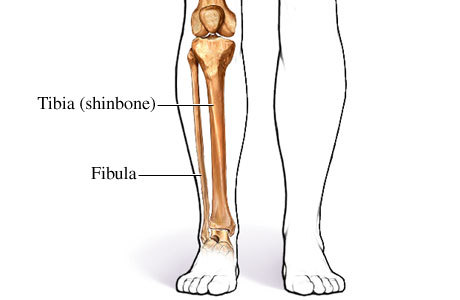
There are two bones in your lower leg. One’s big and buff and one’s pretty wimpy. When you walk, that big tibia takes ~80% of your weight of impact, and the fibula only has to take the remaining 20%.
But skaters place their weight differently over their feet. In principle a hockey player has 100% of their weight shifted forward onto their tibia.
You can actually see the implications of this in practice. If you break your fibula, 20% of the weight-bearing is gone, and you won’t really be able to walk. But a hockey player who cracks their fibula can and will keep skating almost without noticing something’s wrong. This happens pretty damn often when they block shots. You’ll see them skate easily over to get checked out, step up onto the hallway floor, and then suddenly slump over, with medical staff helping them limp off down the hallway.
I hear people saying, “oh, guess he’s fine!” when hockey players get up and appear to be skating okay: nah. And when a player wants to return to the ice: they may genuinely feel better skating but be too injured to walk.
And over time, if you’re in the weight-bearing position for skating more often than walking, and are skating from a young age, yes, that affects the shape of your weight-bearing bones and external appearance of your legs and feet. I don’t have a survey on hockey players’ shapely ankles compared to the normal population in front of me at the moment, but every single skater I see could be identified by their ankles
I thought this was going to be someone condescendingly explaining hockey to me but this is so informative and well written and I trust you with all my bones now.
Someone please source this, it’s too beautiful to not have sources
i can sort of provide some more explanation, maybe? note that all of my skating experience comes from taking figure skating lessons and that i am absolutely not a physiologist/sports science-person.
@brainsandbodies This wasn’t my original post, so I’m sorry I didn’t see you asking for sources earlier. All of you asking for sources here are very cool, and I wanted to round up what I can for you. If I forget somebody’s question, please just @ or ask me. But this also struck me because I think one of the most important things to remember about health is:
basic professional knowledge is often hard to cite and hard to make accessible
Hang with me for a sec.
This happens to be the story that got me into sports med. I’d just lost my parents; fuck knows what I was doing but I knew I needed to make up credit hours and I already had an EMT-B, so I signed up three weeks late for SM 136: Emergency Care, the first class I ever planned to sleep through. I remember coming in late for my first (late) day and seeing a lot of snapbacks in the room. It was taught by a small, sweet-faced man who used to train the Philadelphia Phillies: he’d fly down with the team to Tampa for spring training, so he got to know the head trainer for the Tampa Bay Lightning, and they got to gossiping about the shit their clients put them through.
When he got bored of baseball he left the Phillies, and moved up here to hockey country. He wanted to see some skaters break their legs.
He dragged us through the fundamentals of weight-bearing step by step, and you could see him light the fuck up: you just knew he was getting to something gross.
“So that’s how hockey players can break their own legs,” he said, stopping right by my desk, “and not even know it until they step off the ice. Fine, fine, and then—“ he made a wet sort of crunching noise. Whoever was under the snapback next to me gagged. I was hooked. I said, I believe, “COOL,” full-volume, and he met my eye, nodding with the full solemn grandeur of the wicked awesomeness of physiology.
You’re wondering: I got my first snapback that week.
Here’s the thing:
The fibula was found to bear about 6.4% of your weight when in a neutral ankle position in 1984. At the time the experiment had to be done with autopsy specimens and in simple positions (Takebe, Nakagawa, Minami, Kanazawa, Hirohata,1984). Since then we’ve seen that in the more complex positions of a standard heel-toe walking gait, the fibula typically carries about to 10-15% of a person’s weight and the tibia takes 80%. (It doesn’t add up because there are other tissues involved and the two bones work to stabilize each other.) 80% is the conventional approximation we’re taught in classes, that appears in biomedical textbooks, and that’s used in practice by therapists.
Most of the muscles of your calf and ankle attach to your fibula, so your fibula is all wrapped up snug in a bunch of muscle, so it follows that it’s hard to break. The conventional knowledge in healthcare is that people who come in with broken fibulas are athletes or were in motor vehicle accidents or were physically abused because that’s what we observe.
The risk of breaking your fibula is a casual part of how we talk about shot-blocking, because we see it happen a lot. And the Tampa Bay trainers who work directly with individual players had seen them skate off what turned out to be a broken fibula; my professor had seen it happen; I’ve seen it happen. It’s something that we talk about in classes and look for on the ice. But it’s kind of hard to study beyond the players you personally get your hands on.
Greg Campbell skated on what turned out to be a broken right fibula back in 2013.
But the only reason we have the footage of it was that it was an obvious, severe break, so he was in visible pain, and later the specific injury was made public. In other cases they don’t look especially hurt until they hit the hall, and the injury isn’t shared. So I can’t tell you how often it happens in total, out of all the hockey players out there. That information isn’t gathered anywhere.
Sports medicine is a fascinating and a bit of a fucked up field to try to explain because we have to use observational data and case studies and conventional knowledge.
We can’t line up a bunch of hockey players and whack them in the legs to see what happens in real time, or compare them to a control group who didn’t get whacked.* We can’t wait for people to be injured and round them all up to study, because it’s an unpredictable accident, and we can’t ask players to skate with an injury—that’s what I like to call “un-the-fuck-ethical.”
We’re also limited in how much we can see inside a living skater while they skate! Right now—like right now—motion-capture and 3D modeling is exploding our understanding of biomechanics, and that will inform PT practice. (There’s a reason Mathews and McDavid and all the other monsters are here now; we’re just now figuring out how to train them like that.)
But it’s still difficult even to gather data on how or how often certain injuries happen to certain people beyond individual trainers’ clinical observations. It’s not a centralized system. We don’t have concussion reporting worked out yet!
And it’s hard because it’s hard to get money to research something that’s already Known.
All that means that sports medicine is something of a slow science: individual providers are using clinical judgement and observing to see what works and drawing on a body of knowledge about what has worked in the past to inform their treatment, but we can’t test or tell you a lot of things.
And that also makes it hard for people who don’t have that professional knowledge to access your own medical information. Because you need basics and context to interpret everything but that information is just in our heads.
Ideally, the point of the professional trainer is just to be efficient: they carry that body of knowledge and fish out what you need when you need it so you don’t have to sit through Human Anatomy & Physiology and SM 101 just to understand what your ankle is doing. In practice, the knowledge often bottlenecks there and it never gets to you.
So you want to search and ask for sources for medical information, but also keep in mind that not all our knowledge is available in a form you’re familiar with, and what is out there might need a lot of context.
@selasphorus-rufus is spectacular for jumping in to talk about edges: I skimmed over them here and got into it more in a couple replies, because apparently I sure misread the room and thought it would muddy things up.
“if you look at that leg diagram, the tibia is much closer to where the inner edge of the skate is, ergo hockey players would be positioning most of their weight on the tibia as it’s much easier to balance on the inner part of your foot when using the inner part of your foot”
This is a great way to start reading it, and the basic principle is on point.
How To Evaluate Figure Skating Injuries by Rachel Janowicz, DPM gives a quick summary of edgework and how it affects the entire leg; I’m limiting myself to the ankle because the good lord knows I need some limits here, (but you better believe skating-related bone changes work all the way up through your hips and back.)
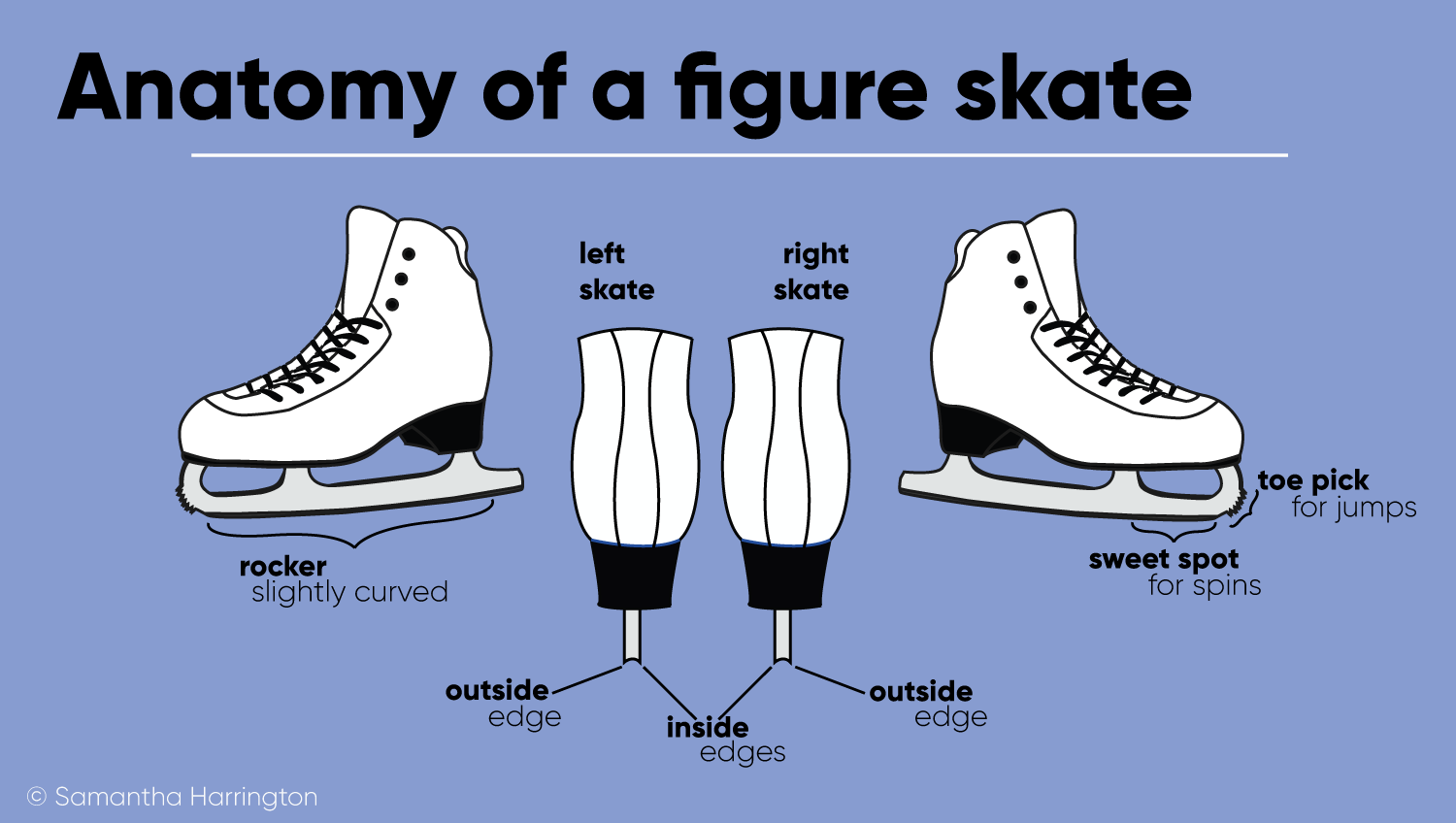
It’s a little more complex because your ankle is complex. When you use your edges, the sole of your foot doesn’t stay flat and perpendicular to your leg bones: you lift up off the heel and onto the ball of your foot, and your tip the sole of your foot in or out, which is called pronation or supination. That creates an angle between your leg bones and your foot bones.
They’ve drawn a straight line, but his actual feet are slightly, distinctly tipped out as he strides. That supination make an angle with his tibia that makes his medial malleolus (the lumpy end fibula at the inside of your ankle) pop out.
(@angsversteuring and @ismellapples That’s what people are looking at. I also think it looks Completely Normal, but many people have much, much less malleolus, so it looks odd to them.)
The bone there is physically pushed out more. High-top “ankle supporting” skate boots put extra pressure on that prominent point of bone (Both hockey players and figure skaters now wear those, so @ineptshieldmaid and @luckyhorseshoecrab yes, both would see this. There are also other factors for figure skaters but I’m too far gone to get into it call me back and remind me later please). That stress as well as the stress of your strides on the angled bone causes increased bone growth, potentially forming bone spurs or bursae, which all adds to the aesthetic charm of your big honkin skater ankle (Smith, 1990; Luke & Micheli, 1999; Anderson, Weber, Steinbach, & Ballmer, 2004.
Smith, A. D. (1990). Foot and ankle injuries in figure skaters. Phys Sportsmed18(3):73-86.
Luke A. C., Micheli, L.J. (1999). Ankle Swelling – Figure Skating. Med Sci Sports Exercis 31(5):S87.
Anderson, S.E., Weber, M., Steinbach, L.S., Ballmer, F.T. (2004). Shoe rim and shoe buckle pseudotumor of the ankle in elite and professional figure skaters and snowboarders: MR imaging findings. Skeletal Radiology 33(6):325-329
Takebe, K., Nakagawa, A., Minami, H., Kanazawa, H., Hirohata, K. (1984). Role of the fibula in weight-bearing. Clin Orthopaedics Related Res. 184, 289–292
*I suppose we could let the Washington Capitals whack each other, but that would be a kinkier kind of science.
Look, I love the natural world, and all of its wonders. But sometimes evolution has obviously had a few drinks, taken things a little too far, and when called on it, decided to double down.
















 Steel Phoenix Studios