And I saw something on their front page that I assumed was the result of someone screwing around that hadn’t been cleaned up yet
So I followed the link, thinking it would lead me to Angelina Jolie’s page with some amusing changes made to it, but instead I found this:
There is actually a trapdoor spider named after Angelina Jolie. And one named after Bono. And Stephen Colbert. Apparently the same scientist discovered all of these and really like naming spiders after celebrities.
Entomologists are just. They do this. Other biologists too, but especially entomologists There’s ants named after Douglas Adams (Tetramorium adamsi), two genera of wasps named after Dante, (Aligheria and Aligherinia), ELEVEN species named after David Attenborough (including a beetle, shrimp, echidna, fish, grasshopper, dragonfly, three plants, two spiders, and a plesiosaur), Two worms named after the Beatles (and no beetles that I’m aware of), two David Bowie spiders (Heteropoda davidbowie and Spintharus davidbowiei).
There’s wasps for both
Angelina Jolie and Brad Pitt (the aforementioned angelinajolieae and Conobregma bradpitti), and Stephen Colbert not only has a spider named after him, but he also then set off a competition between other researchers to name a “way cooler” animal after him, which due to, again, entomologists, ended him up with two beetles, a stonefly, and a wasp (Agaporomorphus, Sonoma, Diamphipnoa and Aleiodes colberti). A fly with a golden butt is named for Beyoncé. There’s an HP Lovecraft wasp named Nanocthulhu lovecrafti. Terry Pratchett got a turtle (
so you see, humans evolved to be bipedal on account of how our ancestors transitioned from the forest environment to the savannah environment, and in the savannah environment bipedalism was more adaptive because it provides better thermoregulation and allows you to carry things, but most of all because bipedal locomotion is highly energy efficient and energy efficient locomotion would have been very strongly selected for on account of how time budgets are a limiting factor on home range which is a limiting factor on diet quality and breadth which is really quite important
my lecturers have been very clear and very insistent that bipedalism evolved first and then allowed tool use, tool use did not spur a transition to bipedalism, the fossil record is Clear On This Point
and what I do not understand is: if bipedalism is so completely wonderfully energy-efficient and optimal, why are there so few bipedal things? How come lions and gazelles and giraffes and buffalo aren’t bipedal? Why aren’t other savannah species selected for energy-efficient locomotion too?
I am sure there is a good explanation for this but my lecturers have still not provided it and I must know please god just somebody explain this to me or I will die of curiosity
Reasons Why We Have Bipedal Apes, But Not Bipedal Lions, According To My Biological Anthropology Supervisor:
You know when creationists talk about how an eye couldn’t possibly evolve gradually, because half an eye is useless and a waste of resources and worse than no eye at all?
They’re wrong about eyes; a single photoreceptor cell (usually just an evolutionary ‘tweak’ away from a regular epidermal cell with biochemistry that happened to be photosensitive) is actually useful and great, and more is better. If you imagine breaking a modern wing in half and attaching it to a bird, “half a wing is useless” sounds true, but it stops sounding true when you realise that halfway to a wing doesn’t look like a modern bird wing but broken in half, it looks like a slightly enlarged membrane between a limb and your body that gives you just an extra half second of glide time when you jump.
But there *are* adaptations in this class of things, where it’s great if you have full-blown X but shitty to have half-baked X. As you might imagine, they are quite rare, because as the creationists correctly observe, if half-X is maladaptive there is no path to arrive at X through gradual adaptation to an environment. And yet bipedalism is of this class. How?
Well, you wanna know what it looks like to have enough bipedal foot structure that you decide to go adventuring around in the savannah on two feet, but you haven’t got the pelvic structure to make it efficient yet? YOU CAN’T RUN. You are literally incapable of moving faster than a kind of slow awkward lope. Your back kills all the time because your bones are all pointed the wrong way and your back muscles are trying to keep you upright. Your ankle and leg bones take far more pounding than they were ever optimised before and occasionally shatter. You’re unbalanced and ungainly and frankly sort of pathetic, and at very high risk from predators (to repeat: RUN AWAY IS NOT AN AVAILABLE STRATEGY).
Why would anything go through a long gradual process of getting much shittier and then eventually getting better, since evolution can’t plan or foresee? WRONG QUESTION. Whoever told you evolution was a slow gradual constant drift was a dirty rotten liar, just like all your other teachers from when you were twelve. More commonly, evolution involves long periods of relative stability where the organism is pretty much as adapted to its niche as it’s going to get, and then something changes and there’s a very rapid response. Or it involves successful populations dispersing widely over a landscape, then becoming distinct reproducing populations which lost genetic contact with each other and diverging, and then there’s an environmental change and they reconnect and sometimes they happily interbreed and sometimes one of the divergent branches drives the others extinct and disperses itself widely and rinse and repeat.
What happened was, basically:
Hi we’re early hominins and we just love hanging around in trees and we’re proud to say we’ve been hanging around in trees now for a couple million years and we haven’t changed a bit, slightly bigger skulls aside, we’re basically just per- what the fuck? WHAT THE FUCK? WHERE DID THE TREES GO?? WHY IS IT SUDDENLY SO DRY???? oh my God I can see nothing but grass and I am having to walk around on my hind legs all the FUCKING time and FUCK FUCK FUCK THAT’S A LION FUCK PANIC RED ALERT oh okay we’re bipedal now I guess, that was quick, oh well, all fine, carry on
Somehow we survived when a change in environment pushed us into a new ecological niche. The selection pressure was strong enough to make us acquire a really quite extensive range of mods to make bipedalism work, but not strong enough to make us dead.
Of course, “strong pressure to adapt somehow” doesn’t necessarily mean “strong pressure to adapt in this specific way we know is really good”. Early hominins who lived before the forest shrinkage have been shown to have a few bipedal adaptations. We weren’t sure what the hell they were doing with them, so we looked at chimps. Turns out chimps display short-distance carrying behavior – as in, picking up an object and carrying it. They don’t carry tools and can’t move far bipedally, but what they do do is pick up a valuable resource like a choice bit of prey and haul it off with them, away from the group of moneys fighting over the rest of the prey. So before the forests collapsed, there was a mild selection pressure to be able to use only your hind legs for a short stretch so that you could carry something in your arms, and when they collapsed, individuals good at that behavior were better at surviving the savannah and evolution just slammed its foot on the gas pedal until you get obligate bipeds.
So, a species that wasn’t forced into a rapid niche change like that, wouldn’t evolve an initially-painful thing like bipedalism. What about all the other species that made the same change as the same time as us? Eh, many went extinct, that happens a lot with ecological change, but the ones who survived didn’t do bipedalism.
Points to those who said it was about evolution having different starting points to build on, y’all were correct. No matter how awesome and efficient and optimal bipedalism is, evolution only cares about whether the next tiny step in some random direction increases or decreases how many offspring are produced. Evolution “looks” for the NEAREST solution that counts as a solution, not the best solution.
For a species of monkeys that were forced to spend less time in the forest and range wider and already had some variable locomotion abilities, evolution went for bipedalism. Bipedalism may have enabled the future awesomeness of humans with its efficiency and head stability and what have you, but evolution made it happen just because it was the local maxima – its awesomeness is a lucky side effect.
But where monkeys used short bursts of bipedal movements to carry things, another species might use something more convenient for them – say, a lion might pick up and carry things in its mouth, and if there was a selection pressure to be better at carrying the lions might end up with bigger mouths, but “become bipedal” is very unlikely because half bipedal is worse than no bipedal at all.
Basically, monkeys had the preconditions for bipedalism, nothing else did. (Note that this does not make monkeys special – the ancestor of any species with an unusual adaptation, from giraffes’ long necks to penguins’ Arctic-water-proofing feathers, was a thing that had the preconditions for that adaptation when nothing else did.)
Bipedalism didn’t happen because it was awesome, it became awesome because the range of adaptations it supports turned out to be a package that turned into, well, us.
…Notice that we are not actually the only bipedal species. Notice what they mean when they say things like, “Bipedalism leads to the ability to carry things leads to tool use leads to bigger brains”. On a naive reading, it means “bipedalism is a part of the tech tree and once you’ve bought it you can get hands optimised for holding tools”, and if it says this then you are right to be confused as to why perfectly good bipedal emus do not also have spears and control of fire.
When you realise that evolutionary studies is so full of ridiculously many caveats and preconditions that lecturers just omit them and assume you know they’re there, you start interpreting what they say more like, “In a species that already dabbled in just a tiny bit of bipedalism, bipedalism was the only way to go when the niche changed, it was way better for the new niche then the old way of locomotion, and given the likely presence of some proto-tool-like behaviors like throwing rocks or poking things with sticks, it created an adaptive opportunity to better fit this particular environment by improving on the tool behaviours using the new physiological advantages.”
Also god I learned a lot in that hour. Why does time spent *not* talking to biological anthropologists have to be a thing? Talking to biological anthropologists is the BEST.
Epistemic status: my recollection of a conversation an hour ago between me and an academic in this field, any misunderstandings are because I’m an undergrad who didn’t get what he was trying to say.
THIS IS SO COOL
(Why do I not live on a university campus D:)
SO YES and also, I’m going to pull out my Vaclav Smil* for a second here.
Human locomotion is not particularly energy efficient! It takes us more energy to walk or run than it does for most mammalian quadrupeds, but our energy use curves look pretty different from theirs.
If a horse goes for a trot, its trot (like all its gaits) has a U-shaped energy curve. It costs more to trot at slower speeds, goes down to a most-efficient pace, and then comes back up. At a certain point, it crosses over the energy curve for the horse’s next gait, and the horse will (left to its own devices) start to canter or gallop.
Human WALKING has a U-shaped curve like that, but human RUNNING does not, and that is damned strange for a mammal. Our friend Smil says: “the energetic cost of human running is relatively high, but humans are unique in virtually uncoupling this cost from speed”. That particular aspect of things is a direct side-effect of bipedalism: we can vary our breathing in ways that quadrupedal animals (who have supporting legs all attached to their breathing apparatus) cannot. Basically, we are the evolutionary equivalent of cartoon characters who can spin their legs really fast. So we aren’t as efficient at running as a horse who is going at its optimum pace, but we can speed up and slow down and it won’t cost us much, which is not true of the horse.
Not incidentally, this is why many humans practiced (or still practice) persistence hunting. If you are less efficient than that delicious antelope, but you can make it run at its least-efficient panic speed while you trundle along at a nice constant rate, you can exhaust it.
* Smil, Vaclav (2007-12-21). Energy in Nature and Society: General Energetics of Complex Systems (MIT Press). The MIT Press. Kindle Edition.
New research, published in October in the Proceedings of the National Academy of Sciences, concluded that despite size discrepancy, there’s no functional difference between men’s and women’s brains. “Male” brains and “female” brains simply don’t exist. In fact, there’s significant overlap.
This study had 1400 people in it… Remember that sample size matters. remember this when someone tries to rebuke this with a study that has 80 participants. Be as scientifically literate as possible so that we can debunk this nonsense one step at a time.
Nicknamed Marble, this zebra has an area of small scrambled stripes on it’s back, giving it a marbled look. [x]
A reconstructed quagga-like animal, it’s legs clean, and it’s rump and belly nearly free of markings. The stripes it does have are fairly narrow for a plains zebra. It’s tail and mane are much lighter, and has a faint brown wash along it’s back.[x]
Two reduced striped animals, the middle with a few stray stripes on it’s rump and legs, the one on the right has a nearly all white body and legs. Both have a fewer number of facial markings as well.[x]
A diluted, brown striped adult zebra. Zebra foals are born brown and white, but this one didn’t seem to lose it’s baby colors. [x]
Blonde is a term applied to leucistic zebras. Albino is sometimes used for the really light animals, like this blue eyed and creamy tan striped one, however I keep reading that true albinism has not been recorded in equines, so I’m hesitant to use that term.[x]
This abundistic has stripes that thicken and meld together on it’s back and neck, forming white spots.[x]
Dotted and dashed with white on a black background, this heavily abundistic zebra has a very unique and striking look.[x]
The back of this abundistic Burchell’s(E.q. burchellii) is so densely marked, it’s a nearly solid blanket of color ticked with a bit of white. The rest of it’s stripes and brown shadow stripes are jagged and messy.[x]
Unfortunately, without the help of the naturally camouflaged striped coat, this extremely dark abundistic foal was an easier target for predators and didn’t make it into adulthood. Still in it’s dark brown baby coat, it probably would look very similar to number 8 but with a darker face, smaller spots, and wider white stripes on it’s rump.[x]
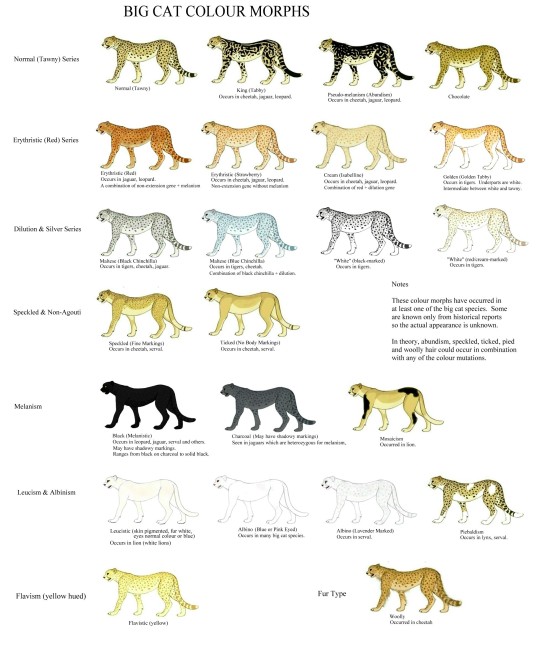
This chart from MessyBeast is a great example of the differences in color morphs. While the graphic is specific to big cats, much of it does transfer to other species.
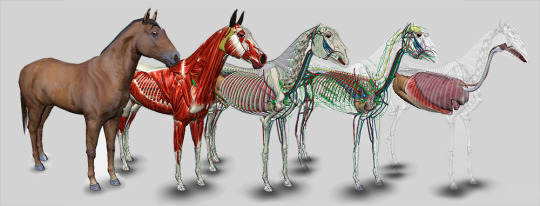
The horse, Equus caballus, is one of my favorite arguments against Intelligent Design. I’ve spoken before about why I no longer see them, but even as a student I would wonder why and how this species existed when there were apparently so many things that could go wrong with its own anatomy, especially next to something tough like a trusty cow.
I don’t know how it’s possible to believe in a benevolent, loving, wise creator when creatures like the horse come to exist.
So I’m going to use your question as an excuse to write a post that had been on my mind for a while:
Things That Are Wrong With Horses
The basic structure of a horse has a few significant design flaws.
Cannot vomit. This means that anything which would make another species sick enough to vomit results in a horse getting s distended stomach and colic, where the stomach can rupture and the horse can die. Also means symptoms of illness are hidden longer
The large bowel (hind gut) of the horse is fricking huge, but can actually displace itself and bend around the wrong way, resulting in obstruction, colic and death without surgical intervention. This can commonly happen after exertion (splenic contraction) and giving birth. Colic due to nephrosplenic entrapment is particularly common after the horse has an adrenaline release, which causes the spleen to temporarily contract, and this seems like a poor design to risk death every time you spook or go for a fast run, especially in a species known for spooking and running fast.
Giving birth is a fast and explosive affair in the horse. The whole pushing business should be over and done with in about 20 minutes, however this assumes that everything is lined up just right for a normal delivery. Foals are all long legs and necks, which are easy to get tangled or bent around the wrong way. A mare is strong enough to push her foal’s feet through her uterine wall, which is death all round.
Speaking of strength, sometimes horses will kick each other when they have attitude, and they can do so with enough strength to rupture each other’s spleens.
When galloping most horses, best studied in thoroughbreds because they are made to gallop on a regular basis, horses routinely bash their diaphragm with such force against their liver that their liver bruises.
Galloping also often makes their lungs bleed. That’s why racehorses have their head held up after a race, so you don’t see any blood come out their nose and disqualify them. Even horses that you don’t see bleed have evidence of pulmonary bleeding after a gallop if you scope them.
Their leg bones are actually pretty damn tough, but the ends are spindly little things compared to the mass of musculature up top. Their legs are subjected to huge biomechanical forces when a horse runs which can often subject them to ligament damage and lameness. A fractured leg bone can heal like any other, but if a horse can’t bear weight evenly on all four legs for an extended period of time (eg after a fracture) then they are at risk of laminitis.
Laminitis can cause the hoof to slough off. (Aaargh!) They can also get laminitis from eating a bit too well.
Speaking of eating, they can also get colic (and risk death) from eating not enough fiber or the wrong sort of plants or from eating too much dirt.
Oh, and just to mess with you, horses have a space in their head called a guttural pouch which seems to exist for no other reason as far as I can tell (okay, maybe it’s about heat regulation) other than to get fungal infections that eat through the exposed artery and cause the horse to die from blood loss through it’s nose.
And Bonus: Exquisite sensitivity to tetanus and vulnerability to Hendravirus
This list is by no means complete. I haven’t even touched on their anesthetics or drug reactions, but it’s a simple start.
calling on my neuroscientist friend @dendritic-trees to back me up on this and presumably un-oversimplify it
You do in fact have a mini-brain, not only in your stomach, but stretching through your whole GI tract. It is your friend, the enteric nervous system. The basics are pretty good on its wikipedia page if you want a few more details, but basically it is part of the autonomic nervous system (the same system that controls automatic things like the fight or flight response) and controls the movement of the guts. And it will work even if it is completely disconnected from your brain.
But the two systems interact so that stuff going on in your brain can disrupt your digestion, but equally so that issues in the gut can create feedback that alters your mood. Science heavy explanation here. More lay-person friendly summary here (from Johns Hopkins, don’t read the comments). Also if you get “all disease can be fixed by changing your diet” out of this (I read the comments) you are guilty of gross over-interpretation and have to go to data analysis jail).
Quite a few have been saying:”But what about laughing?”, in the comments of my ‘Weird Human Reactions to Fear: the Singing Edition’ post. My question is: do you know why humans laugh when shit gets real?
Laughter is our brain’s Blue Screen of Death.
Where a computer would throw up an error and possibly crash, our brains go:”well, shit”, and hit the big red button labelled: ‘LAUGHTER (and possibly applause, but probably not applause)’. Since we need our brains 24/7, we don’t have the luxury of error messages. So our brains buy some time to figure out what’s going on by making us laugh in the weirdest situations.
Imminent doom? Laugh.
Absolutely livid? Laugh.
Distraught? Laugh.
Pretty sure you’re gonna die? Laugh.
I mean, we can’t be sure the aliens don’t have brains that work the same way, but seeing as other animals on Planet Earth don’t really have that either… that’d probably freak them the fuck out too.
Not only do the gangly bipeds sing when they’re scared, they could just as easily start laughing.
Like seriously I wish we had a more comprehensive sex education program in the U.S. You know how many guys I know who had no idea an unaroused vagina is only 2-3 inches deep? Or that the cervix raises up when aroused to accommodate dick? Or that if a girl is “tight” that generally means she’s not turned on and you’re shitty in bed? Or that the cervix has an entire cycle it goes through throughout the month where is changes hardness, placement in the vagina, wetness? Like, when you’re ovulating your cervix gets soft and raises high up into the vagina and your hormones get you really horny. It’s like natures way of moving the furniture around and fluffing the pillow for dick because it wants to get pregnant. And before menstruation, it gets really hard and low in the vagina. It’s basically inactivating it’s Facebook and saying “I just need some alone time for a few days”
Ladies and gentlemen, take a moment to learn about vaginas. Men, take an interest into your woman’s menstrual cycle!
U.S. Needs better sex Ed because I’m a 23 year old woman and didn’t even know all of this
Ok I didn’t know about the cervix thing until recently and I always wondered why sometimes sex would be painful and other times it would be fine.
This is what they don’t teach you in school that you really need to know.
Very true. I recommend Animal by Sara Pascoe for eeeeveryone on this website. It not only explains so much about the female experience of heterosexual sex that sex education glances over or misses out, it provides great food for thought about the way society regards female sex and the female body the ways in which we internalise that. It’s both a warm and funny autobiographical tale and a look at the current understanding of evolutionary biology.
Even if you feel pretty well informed about the biology of sex (and I’m not much younger than the author herself and I learned stuff!), it’s worth it to question assumptions and attitudes you don’t even necessarily realise you have.
It also focuses on the science of love at least as much as the mechanics of sex. Anyone involving themselves in heterosexual boinking and/or relationships would get a lot from it.


 Steel Phoenix Studios


