Conservation
Status: Critically Endangered; there are 153 as of 2016
Other Common
Names: Night parrot, owl parrot, tarapo, tarepo
Average Length
(wild): 23 – 25 in, 58 – 64 cm
Average Weight
(wild): 2 – 9 lb, 0.95 – 4 kg
Average Lifespan:
58 years, but have potential to live into their 90s. Their exact
lifespan is unknown. Researchers in the recovery program will know
when the kakapo hatched in the recovery effort die of old age, which
could be decades from now.
(Above: Historic range; Below: Current range)
Native Range:
Used to live from the far north of the North Island to the south of
the South Island. Now they are only found on offshore islands that
are protected areas without introduced predators. It is not believed
that there are any left on the main land of New Zealand, when the
recovery program began they were all captured from the Fiordland
National Park and brought to protected zones. They currently live on
Codfish Island (Whenua Hau), Little Barrier Island (Hauturu ao Toi),
and Anchor Island.
Naturalized
Range: N/A
Natural Habitat:
Formally from sea level to near tops of mountains. They are ground
dwellers who live in forest substrate and scrubland.
Flock Size:
They are solitary, gathering only to breed
Call: Loud
screeching “skraark”
Breeding:
They do not breed every year, as they will only breed when there is
enough rimu fruit.
Breeding season
starts around December and lasts until April
They engage in
“lek” breeding, which is when the males compete for female
attention. They are the only parrot species and New Zealand bird
species to do this.
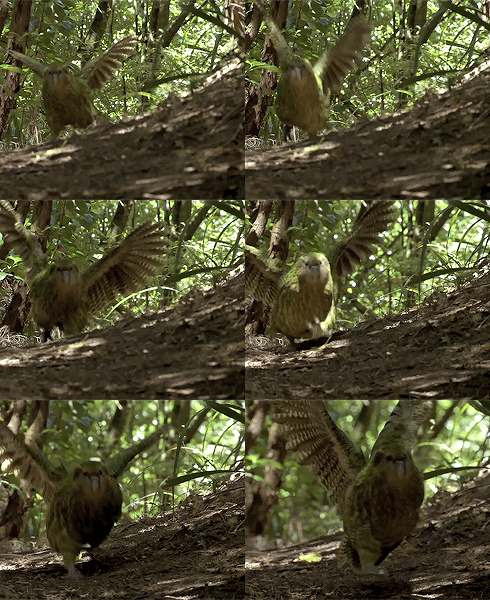
The male
inflates like a balloon, and then emits a low boom which can be
heard from up to 5 km away. This lets any females in the area know
that he is ready to mate
After 20 -30
booms, the male emits a high-pitched ‘ching’, which pinpoints his
position, allowing females to find him
This booming
and chinging can last for 8 hours nonstop every night for 2-3 months
during breeding season
(Above: Booming Sketch)
Nesting: The
female lays 1-4 eggs. They are similar in size to chicken eggs and
will hatch after 30 days. The female raises them by herself, and has
to leave the nest at night to search for food. After 10 weeks, the
fledglings leave the nest, but may still be fed by their mother for
up to 6 months.
Wild Diet:
The berries of the Rimu plant (see picture) are their favorite food.
They also eat parts of other native plants, including the fruits,
seeds, bark, bulbs, leaves, stems, mosses, ferns, fungi, and roots.
Species include pink pine, stinkwood, Hall’s totara, and mountain
flax. When food species that are important to their diet become
abundant, they feed exclusively on it.
Currently, they
are also fed pellets, freeze-dried and frozen fruit, walnuts, and
pine conelets by the recovery effort.
Sexually
Dimorphic: Yes, the males are larger
Description
(wild): The upper side of their body is green with random black,
brown, and yellow barring and mottling. Their underparts are a
yellow-green and have irregular yellow and brown barring. The face is
yellow-brown and the beak is grey and smaller in females. The primary
wing feathers are tipped with yellow in males and green and brown in
females. The tail is green and brown with yellow and black barring
and flecks.
Color Mutations:
N/A
Noise Level:
Loud
Talking Ability:
N/A
Personality:
They are nocturnal and solitary and roost on the ground or in trees
during the day. When disturbed, they freeze, trying to blend in with
their background.
Behavioral
Concerns: They are not equipped
to deal with human intrusion and introduced predators, which caused
their numbers to decline rapidly. By 1970, there were only 18 males
left in Fiordland. In 1977, a small population of both males and
females were found.
Health Concerns:
Recently there has been an increase in cases of “crusty butt”,
which is a viral infection that causes the cloaca to become inflamed,
and presents like severe dermatitis.
It is still unknown what is
causing the virus and if it is infectious. There has been one death
due to this infection, and treatment, a topical cream, seems to only
help some individuals.
As of now, it is only found on Codfish Island,
and has been since 2002.
It is being taken very seriously and is
being closely monitored, with research being done to learn more about
it.
Aviculture:
N/A
History in
Captivity: Some young chicks are raised in captivity as part of a
Conservation attempt to save the species. Conservation and recovery
of this species has been going one since 1977, when a population of
both females and males were found on Stewart Island.
Fun Facts:
They are the largest parrot species in the world (by weight) and
possibly the oldest living bird!
Sirocco, a male
kakapo born March 23, 1997, was raised in captivity due to a illness
that required he be hand raised and quarantined from other kakapo. He
now thinks he’s human and is a conservation ambassador for the kakapo.
He
proved that kakapo can swim, after deciding to join one of the
rangers’ family who were swimming in the ocean. He jumped off the jetty and paddled around for a bit before going back to shore, completely nonchalant.
He is also the kakapo who made
his species famous after “shagging” Mark Cawardine on the BBC
series “Last Chance to See”.
my friend left her window open in her bedroom and came back to find this
look at his self-satisfied little face, the cheeky shit
motherfucking australia
if there was a post to describe australia, this is it
wait.
you mean to tell me this isn’t even a pet bird?
that in australia, you have wild birds that just fly from house to house with the express purpose of fucking shit up?
fucking HELL australia, what is wrong with you?
wake up australia
That’s what birds do
They fly around and fuck shit up
Do you have some kind of mysterious nice birds in your weird foreign country
Do birds in America and England fly into your house and make the bed and tidy up the living room a little bit
It’s cold here, so they just bounce off the windows and lie there and twitch spasmodically while you look for the shovel.
Basically hurling themselves at windows is the worst thing birds do
yeah man a kookaburra literally flew into a classroom at my high school and just sat his smug ass down on top of the desk for a good 20 minutes
why has nobody mentioned the fact that in australia there are 3-4 months a year where everybody just accepts that they’re going to get attacked by magpies. It is literally called “swooping season” and these birds will fly down to peck your fucking face, and people get their eyes ripped out and shit, it’s fucking brutal.
My teacher had to go to hospital and have surgery because of swooping season. It was in the parking lot of school and all the kids would do a mad dash towards the car as the magpies tried to kill us.
no but when you’re 12 years old and riding your bike like mad on the way home from school with an icecream bucket on your head with like branches and shit sticking out if it to scare them off and none of this is considered strange
what the actual fuck australia
I am pretty sure all of these Australia stories are a massive, globally-spanning trolling effort, and only the people who have visited the country are allowed to be in on the joke.
Nope.
Went there.
Parrots tried to take our car.
Came home IN A FUCKING HURRY.
Interesting thing about magpies – they’re not great at identifying individual humans visually, but if you make yourself identifiable in some way they’re usually open to reason. We used to have some very aggressive swoopers in our back yard – as soon as they realised that the humans *inside* the fence never bothered them and were the source of the delicious compost heap, they turned into flying black and white guard dogs who would viciously assault any passing stranger but never bothered anyone inside the yard. Several times they swooped at us when we approached from outside, then when we walked into the yard they would pull up and act incredibly apologetic like sorry ma’am I had no idea it was you I would never please don’t stop stocking the food pile.
There was another little group of magpies in the park who would attack any solo pedestrian but never bothered anyone walking a dog or pushing a pram, because apparently those were identifiable traits indicating a non-threatening human. In the spirit of inquiry, I started going out of my way to be polite to the magpies – carefully walking a wide arc around them when they were on the ground, etc – and emitting an identifiable call of ‘hello birdie’ before swooping season started.
I spent the next ten years crossing that park at least once a day and as long as I turned at the first flutter of wings and said ‘hello birdie’ to the magpie waiting to attack as soon as my back was turned, I was fine. Every time, the magpie would stare at me for a minute and then fly off to harass some other pedestrian because apparently the magpies and I, we were cool.
Parrots are a lot less open to negotiation, and the little bastards travel in flocks. Beware the parrots.
New Zealand has kea, the world’s only alpine parrot, who are renowned for their trolling. Their most common trick is to eat the windscreen wipers and door seals from cars.
[Narrator: A scientist in Peru [pause for peep] captured this, escaping from the tiny body [pause for peep] of a sleeping hummingbird. [pause for peep] A high-pitched [pause for peep] but unmistakable snore. [pause for peep] Hummingbirds are loved for their beauty and speed [pause for peep] but this one was behaving a little bit like a human. [pause for peep] The perfect cute-response trigger.]




 Steel Phoenix Studios