……..also while I firmly believe that T’Challa, Nakia, and W’Kabi went to the same schools that all children in the capital city attend (because Wakanda isn’t about to socially stratify its educational system—rich or poor, royalty or no, all children from all tribes attend the Wakandan schools) they also had a whole bunch of additional lessons. As royalty and de facto nobility, they were being raised with the expectation that they would one day rule, so they were stuck in lots of boring English/French/Mandarin lessons; lessons on the laws of Wakanda and the intricacies of the Council’s etiquette, etc.
And then, when they’re a little older they have combat and warcraft; statecraft lessons with the Dora-in-training, and this is when they meet Okoye. She’s a gawky teenager—taller than all of them, she had her growth spurt first—who scowls whenever they whisper or giggle in class. (She is not from the capital city, her Wakandan still accented; later they learn she traveled hundred of miles with nothing but her pack, just to come before the head of the Dora and throw herself on her knees, begging to be considered. She has sweat and bled for it, and she thinks they are not taking their duty to Wakanda seriously enough.)
Still, despite being stiff and disapproving, she’s smart, and fierce; the other Dora-in-training seem to look up to her and like her. (They also have gone disapproving and haughty when it comes to the Trio.) However, maybe a year into their lessons, the Dora-hopefuls play a hilarious prank on their Modern Politics instructor. It involved a jackfruit, a pun on the Wakandan word for colonialism, and their teacher’s inability to remember anyone’s names; it was extremely funny.
And T’Challa, Nakia and W’Kabi are floored when they discover it was Okoye who planned it—they didn’t think she had a sense of humor, or was capable of something like a prank, even if it was a hilarious and generally harmless.
They decide they like Okoye immensely, and she should be their friend. They put their heads together, and carefully plan charm offensive—behaving in class so she doesn’t glare at them, asking to sit with them and eat with them; inviting her to the market with them and encouraging her to tell stories. The Dora-hopefuls live in the barracks, so they cannot invite her to sleep in T’Challa’s rooms, the way W’Kabi and Nakia often do, but they would have her study with them there.
This, they think, is a good plan.
She looks spooked, the first time Nakia asks her to sit and eat with them in the gardens beyond the Dora training building. Okoye sits cross-legged and stiff, barely touches her food, her eyes darting around as though she is a trapped animal. When Nakia reaches out—just to indicate the tattoo on her shoulder, ask about its meaning, she was not going to touch her—Okoye flinches.
Possibly the start of something, definitely not what I set out to write. Zero spoilers for Infinity War – I could have written this after seeing Black Panther.
Once Bucky’s able to walk around without needing a nap, they move him out of Central Wakanda to a rural part of the Merchant Tribe’s lands. For his recovery and safety, they tell him. If there are going to be spies in Wakanda, they will be in the capital. And the pastoral life will help him heal, although he is not so sure about that. Before he was a weapon he was a fireman’s kid from the part of Brooklyn that didn’t have much nature still left standing. He doesn’t know anything about livestock apart from what was on view at the butcher’s, but now he’s bunking down in a place where the animals outnumber the people. Which is apparently the point of the exercise – to separate him from all that has come before so that he can figure out who he will be now.
He’s pretty sure he’s not gonna be a farmer, but for the time being he is.
TeepublicandRedbubblehere, for stickers, shirts and such! I also have a 1920×1080 wallpaper(if there’s a specific size you’d like, I’m more than willing to resize it to fit your needs).
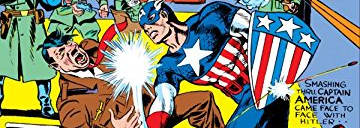
In December of 1940, America still hadn’t entered the war.
There were a lot of Americans – such as the 800,000 paying members of the America First Committee – who looked at fascists massacring their way through Europe and declared “that’s not our problem.”
Captain America was created by two poor Jewish Americans, Joe Simon and Jack Kirby, with the specific intent of trying to convince Americans that entering the war was the right thing to do. It wasn’t easy – Kirby went far beyond what was expected of artists at the time, penciling the entire issue with a deadline that would have been difficult for a two-man crew to pull off.
Captain America punched Hitler right on the cover, at a time when a majority of Americans just didn’t feel like doing anything decisive against the Nazis.
Kirby and Simon faced considerable resistance for their creation, including steady hate mail and outright death threats.
Once, while Jack was in the Timely office, a call came from someone in the lobby. When Kirby answered, the caller threatened Jack with bodily harm if he showed his face. Kirby told the caller he would be right down, but by the time Jack reached street level, there was no one to be found.
Both creators enlisted after America entered the war. Kirby, as an artist, was called upon to do the extremely dangerous work of scouting ahead to draw maps. He also went on to co-create Black Panther in 1966.
They didn’t create Captain America to be an accurate depiction of America-As-It-Is. The character was meant to inspire and embolden, to show America-As-It-Should-Be.
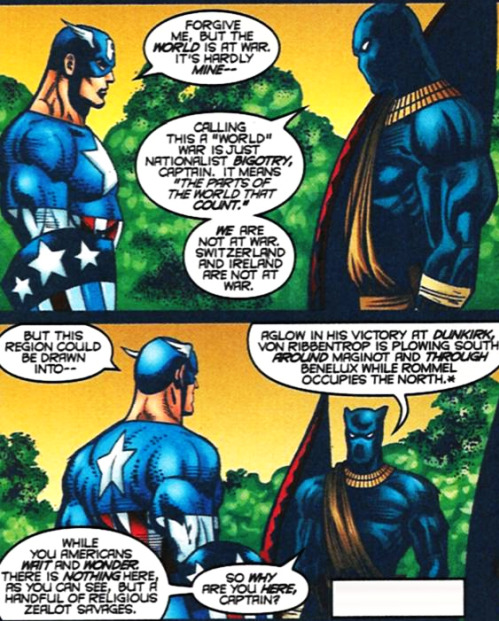
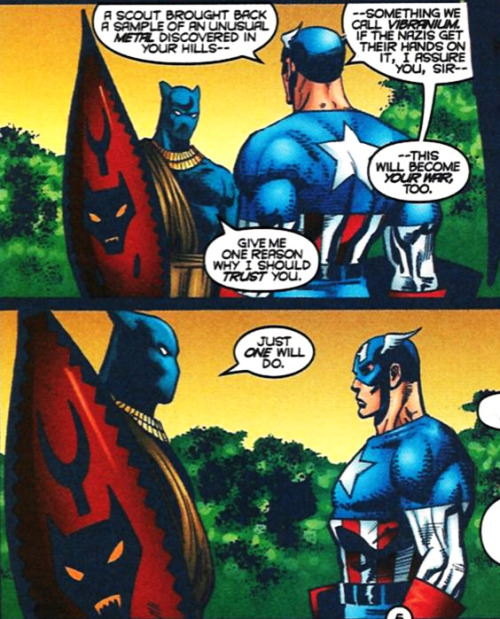
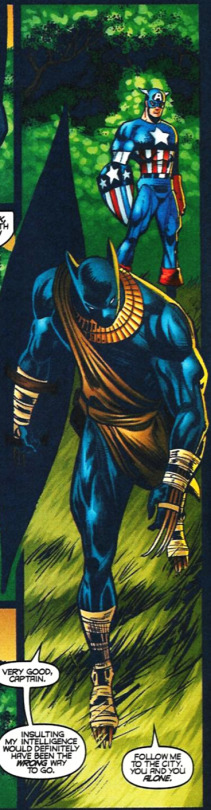
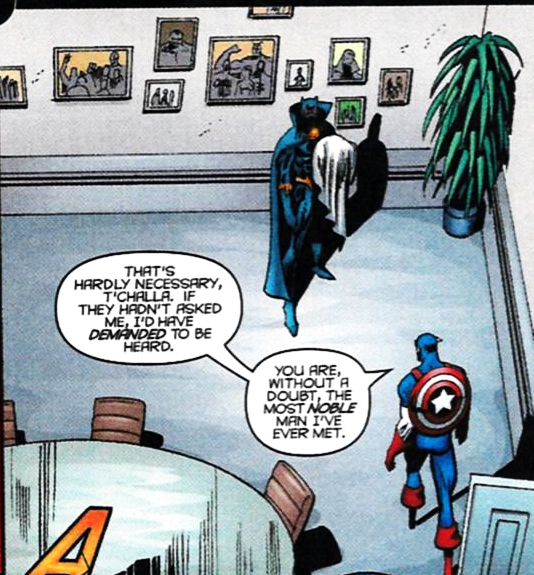
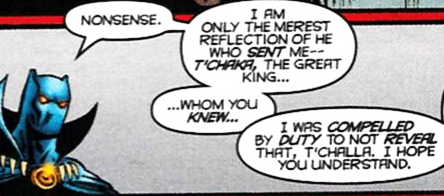
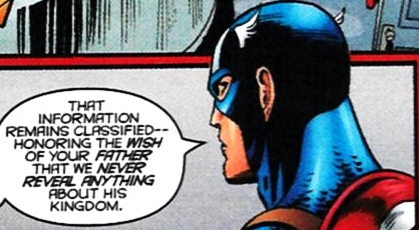
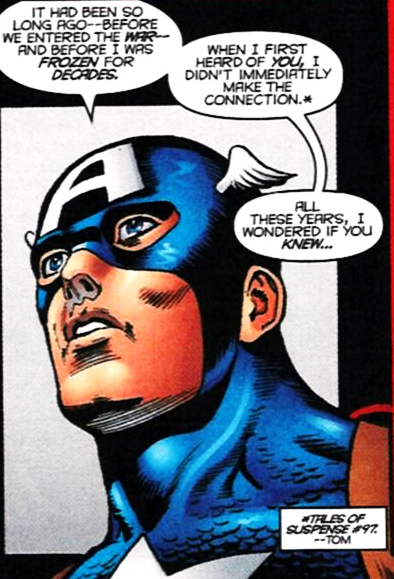
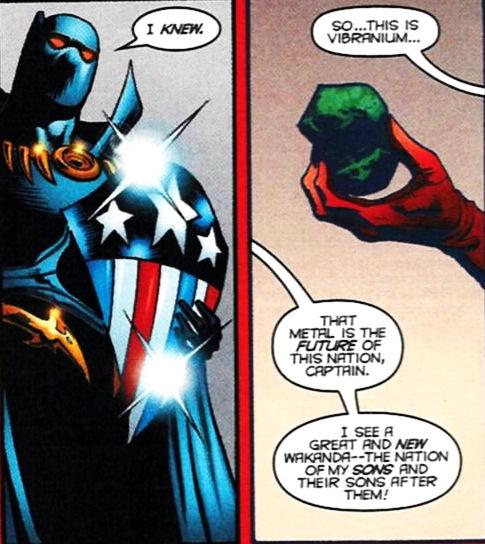
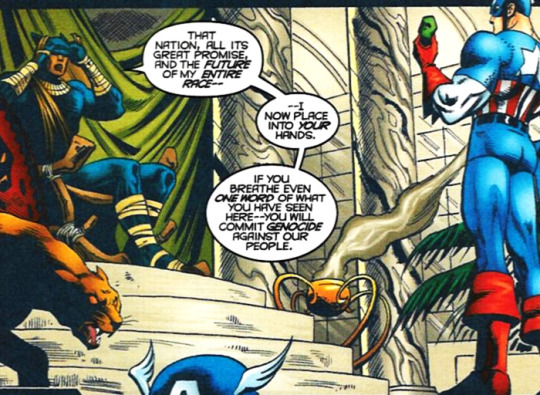
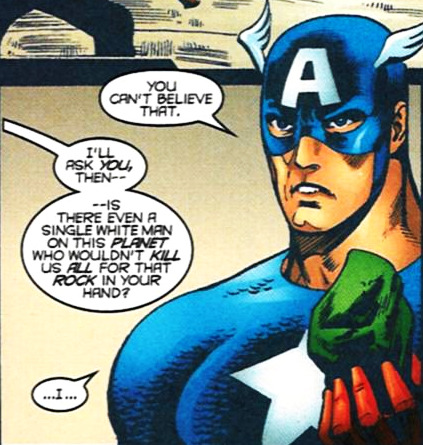
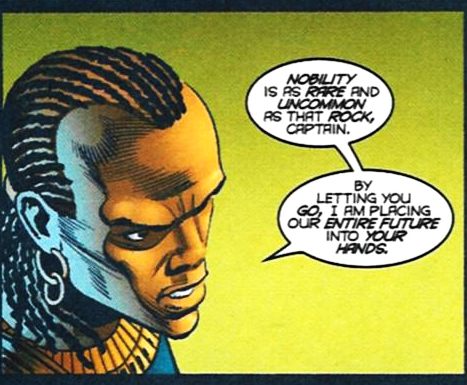
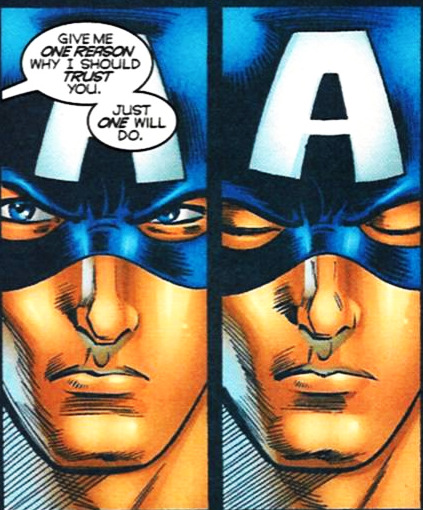
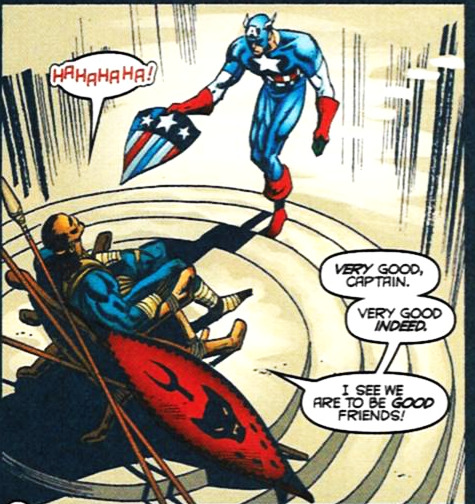
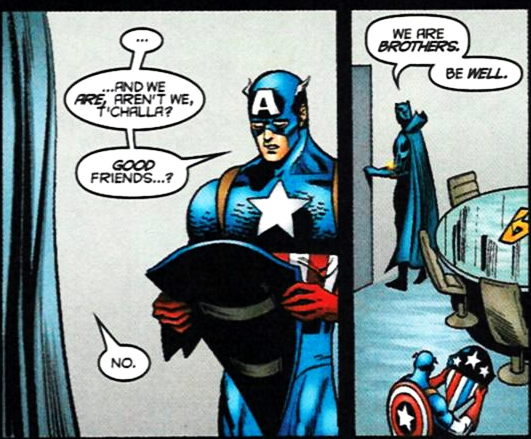
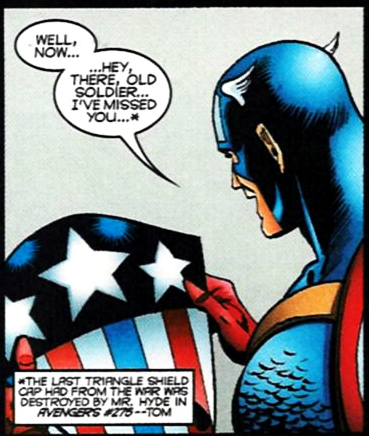
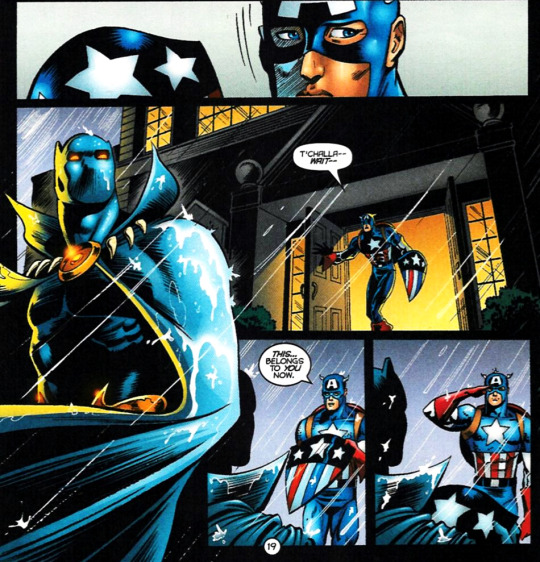
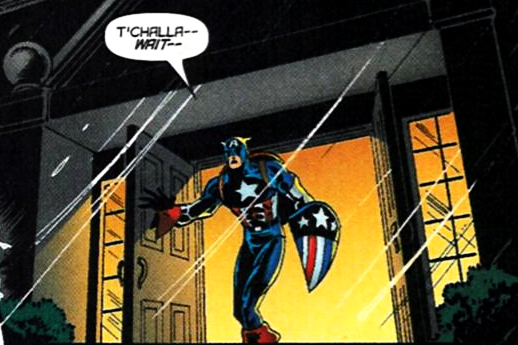
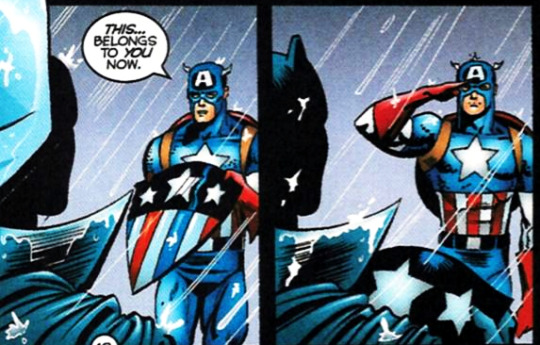
The subject of where the Vibranium for the shield came from actually never came up for decades of comics, until it was finally addressed by Black Panther’s writer, Christopher Priest, in 2001. Priest never shied away from acknowledging America’s racism, but he also understood that Captain America represented an ideal, intended to inspire Americans to be better.
The story mixed together a “present day” discussion between Cap and T’Challa with flashbacks to when Cap met the Black Panther ruling Wakanda during World War II.
FLASHBACK:
PRESENT:
PRESENT -> FLASHBACK
PRESENT:
The Vibranium was given, freely, by one good man to another good man.
It is right to rage against the injustices done by our governments. We must call them out, and we must fight for what’s right.
But if you can’t even stand to see the symbols created to inspire people to be better, and rail against those,then you’re just confusing cynicism for realism.
okay, so everyone has set up the main rivalry in Black Panther as Killmonger vs T’Challa. And obviously that’s the main narrative structure of the story, not arguing with that. But I feel like from a purely character arc standpoint, the actual battle is Killmonger vs Nakia, and she obliterates him.
Erik Stevens is a CIA covert operative; basically, he’s a spy. So is Nakia. And when you look at their various actions through the lens of “who accomplished their mission better?”, it becomes pretty clear that Erik spent 20-some years preparing to destabilize T’Challa’s reign, including having inside knowledge and a birthright on his side…and Nakia spent roughly 36 hours successfully destabilizing his reign, in turn, with nothing but her incredible ability to network disparate resources.
Let’s just review her actions over those 36 hours okay:
– Gets the surviving members of the royal family successfully out of danger within seconds of the coup (aka the only living people with a competing blood claim to the throne aka the greatest threat to his regime)
– Sows enough doubt in the “greatest warrior in the country” about Killmonger’s ability to lead that when the time comes, Okoye and the entire Dora Milaje all defect (eventually saving hundreds of lives)
– Steals a heart-shaped herb from under his nose as he’s identifying it as the most important power resource in the country and trying to prevent it falling into anyone else’s hands, lol too late buddy
– Immediately identifies the person in the country with the best platform to mount a counter-insurgency (M’Baku), identifies what it will take to get him on their side, and casually resolves a centuries-long division in their country while she’s at it
– Correctly predicts Killmonger’s opening move of distributing vibranium to the war dogs, and assists in a comprehensive strategy that shuts it down cold–a strategy they wouldn’t have been able to use if she hadn’t gotten Shuri, Ross, and T’Challa all in one place with the right information at the right time
As soon as T’Challa is back she takes an immediate backseat again (she said it herself, she’s a spy, not the leader of an army), but, seriously, if you have to pinpoint the one person who took down Killmonger, it’s undeniably her. And she did it by clearly demonstrating that her skills as a war dog are miles ahead of his as a CIA agent (due in part, I’m sure, to being trained in a superior country, but also she’s Just That Good).
Yes! Erik’s real misfortune was coming up against a much better and smarter intelligence operative. She also gives the lie to the stereotypical spy narrative (embodied by Erik) that you have to be heartless and violent to achieve your ends. She is the moral center and touchstone of film, so filled with goodness it comes off her like a glow, but she kicks the ruthless Erik’s ass from Wakanda to Kinshasa.
Another thing Nakia was good at was identifying where the necessary resources weren’t, namely in herself. That was why she argued Ramonda out of the idea of taking it herself. It wasn’t self-effacement or modesty, it was a clear-eyed calculation of what it would take to win and the best chance was with M’Baku, not her.
And she did much of this while she thought the man she still loved was dead. She admits as much to Okoye, too. Think of how much sheer fortitude that took, to work through a grief like that to save your country. She is a hero and her heroism is no less amazing for not being flashy or center stage.
not to be dramatic, but Okoye telling her bitch ass husband she would end him without hesitation when he tried to manipulate her changed me as a person and cured my depression.
“would you kill me my love?”
“for wakanda? No question.”
a woman in my theater: “oH I HEARD THAT!!!!”
Listen. LISTEN. *cups your face in my hands* Listen to me. I have never so perfectly and purely seen a Paladin depicted in a movie as I saw in Okoye. Lawful good to her core. Pure, unvarnished loyalty to Wakanda and her people evident in every goddamned motion. Dignified, graceful, reverent respect for the rules of her country and its greater good.
There is something so beautiful about faith, something that just burns through with a beautiful glow that lights up someone’s eyes and every expression. There is a confidence and a peace that is both palpable and enviable when faith has been tested and come through intact. You could so hear it in her voice.
Personal shit is great, and I’m glad she was seen in a loving relationship. The Lone Woman Warrior trope is worn thin, and I’m sure even thinner for black women who are often not allowed to be lovable people on screen. But the core of the Paladin is ‘there is something greater than I, and I will sacrifice everything for it’, and it was beautiful to not only see that happen on screen but see her proved right, see her win, in one case by not even raising her weapon. She stood firm in her faith and the narrative said yes, it said this is just, it said your very faith will protect you from harm. And she’s not seen as hard or cold edged weapon for that. The imagery around her in that moment is more like a saint or an angel, glowing and reaching out a peaceful hand to a symbol of one of the tribes of her country. Her country loves her back.
Okoye doesn’t just love her country. She doesn’t just serve her country. She doesn’t just believe in her country. She has unshakable faith in an absolute truth: Wakanda Forever.
She is elevated for her faith as much as her skill.
The movie is brilliant. They didn’t leave a stone unturned.
Ok not only that! but! I’m feeling like the reason why N’jobu wasn’t in Wakanda in the ancestral plane is because 1. he wasn’t buried the right way, (if you remember several times throughout the movie, the burial process is mentioned to be extremely sacred and important), and 2. because N’jobu hadn’t died in Wakanda.
This was another reason to point out what Erik and his father were talking about being lost and away from their home. Because N’jobu would never go home, in his former life and the next, he’d always be trapped, forever lost from finding his home
^^this gave me chills.
I also thought it could be relationship to how black men in America encouraged to not show emotions, not cry or hug, as they make it seem to show a since of weakness.
When N’jobu asked Erik,” No tears for me?” You could see how Erik was holding back tears and just left it as,” the world is hard, men don’t have the chance to cry” in so many words.
I really almost cried because he could finally see his father and they didn’t share a tender embrace as T’Chaka and T’Challa..
☝damn, NOW I’M CRYING AGAIN 😭😭😭
They didn’t hug because Killmonger’s father was disappointed, both in himself and in his son. And yes because toxic masculinity defines our society.
T’Chaka was proud of his son because T’Challa was a good man despite T’Chaka’s mistakes. N’jobu failed his son utterly and completely. He was estranged from Wakanda and so, in turn, was his son.
It was a beautiful scene, full of regret and the ways in which the mistakes of the past can be visited on present generations. The scene was supposed to be our clue that Killmonger was not going to be king. He was not a product of Wakanda. He was a product of that sad, angry room with both the guns and the history hidden behind a painting on the wall.
He was a product of a hidden history and a violent society. So that is where he went, and that is where he met his father forever trapped by the mistakes of men who could not see beyond their own needs. T’Chaka, his need to protect his vision of himself and Wakanda and N’jobu, his need to heal the world by defying his King and country.
The thread running through Black Panther is estrangement. It is the stylised story of a people whose history has been hidden for far too long. It is the story of a people estranged from themselves and their history. It is the story of the Diaspora. It is also a story of choice. We, the Diaspora, choose every day and in every minute our response to that estrangement. Are we defined by the wrongs visited upon us as a people? Do we hold the anger in? Do we explode? Do we make people pay for the hurt, the pain, the indignities? Will we be Killmongers?
Will we meet our ancestors in the sad, dark places of our pain?
That was one of the points of that scene. Erik Killmonger met his father in the sad, dark place of his pain.
I hope that the original cut has another scene. One in which Erik Killmonger joins his ancestors in Wakanda, because in the moments before his death he got it. He finally became a child of Wakanda. He would have freed himself and his father from those chains.
I mean look at how that scene began. Erik learned his history by finding it in the hidden place. His father wanted him to find it, but that is not how you teach children their history. You hold them in your lap and say this is who we are. You tell them stories. You take them home.
Ryan Coogler is trying to show us in a few scenes what estrangement means. What being cutoff from your history means. You are not supposed to find it in a cutout behind a painting sitting next to the guns. And that wasn’t his fault. Other people made bad choices. A society made bad choices and he paid for their bad choices with his soul.
But then there comes a point when you choose who you will be, despite the bad choices that formed you. Killmonger made the correct choice in the end, or at least the only choice he could have made.
His story is heartbreaking. It is Shakespearean. He is the first beautiful villain in the MCU, and I adore his story.
Black Panther is such and complex and compelling story with such rich text and undertones and themes that I’m thoroughly convinced that we’ll be discussing its meaning for, possibly years to come.
Another thing I love that I’ve probably already mentioned on here is how T’Challa woke up the second time with his back turned on his ancestors symbolizing he was turning his back on their old ways. The symbolism running through the entire movie is intense.

 Steel Phoenix Studios
