Male Scifi and Fantasy writers: Look at this !Strong! female character! She can fight and solve puzzles, and ends up with the sidekick not the hero! Isn’t she a great character?
Everyone: No, she’s one-dimensional and still only exists to please the hero’s ego
Male scifi and fantasy writers: You’re never happy! This is how characters are written! Besides, it’s much harder for us to write women because we are men!
Terry Pratchett: *creates a female character who is literally the embodyment of a dog, sets her up to be the love interest of Protagonist Hero Man.* *writes her as clever, emotionally tortured, lonely and powerful* *uses her to explore difficulties of bisexuality and masculine dominated workforces*
Terry Pratchett: *Creates a pair of old witches, one of whom is a virgin and the other who has slept with lots of men.* *makes them best friends, never dismisses one lifestyle of the other, explains lifestyle choices based on characters history and personality, uses this to develop each character as the books progress*
Terry Pratchett: *Writes Sybil Rankin* *makes the powerful rich lady heavy set but beautiful, never plays her by her looks, develops her as she ages, acknowledges the way society views such people and then spits on their attitudes* *does it again with Agnes*
Terry Pratchett: *Writes a book about an entire army secretly being women, creates complex female relationships, introduces same sex relationships completely naturally*
Terry Pratchett: *takes old joke about female dwarves and uses it to explore gender identity without making it seem forced or unnatural, carefully discusses some of the issues and complextities whilst still making funny and witty observasions and maintaining genuine fantasy tropes*
Terry Pratchett: *DOES THIS ALL OVER AND OVER AGAIN, DEVELOPING CHARACTERS AS HIS VEIW OF THE WORLD DEVELOPS AND CAREFULLY APOLOGIZES FOR EARLY MISTAKES*
Colophon: a statement at the end of a book containing the scribe or owner’s name, date of completion, or bitching about how hard it is to write a book in the dark ages
Oh, my hand
The parchment is very hairy
Thank God it will soon be dark
St. Patrick of Armagh, deliver me from writing
Now I’ve written the whole thing; for Christ’s sake give me a drink
Oh d fuckin abbot
Massive hangover
Whoever translated these Gospels did a very poor job
Cursed be the pesty cat that urinated over this book during the night
If someone else would like such a handsome book, come and look me up in Paris, across from the Notre Dame cathedral
I shall remember, O Christ, that I am writing of Thee, because I am wrecked today
Do not reproach me concerning the letters, the ink is bad and the parchment scanty and the day is dark
11 golden letters, 8 shilling each; 700 letters with double shafts, 7 shilling for each hundred; and 35 quires of text, each 16 leaves, at 3 shilling each. For such an amount I won’t write again
Here ends the second part of the title work of Brother Thomas Aquinas of the Dominican Order; very long, very verbose; and very tedious for the scribe; thank God, thank God, and again thank God
If anyone take away this book, let him die the death, let him be fried in a pan; let the falling sickness and fever seize him; let him be broken on the wheel, and hanged. Amen
growing up in maine us writers were of course always comparing ourselves to stephen king. TURNS OUT HE’S FUCKING WRITER GEORG
“average writer writes 3 books a year" factoid actualy just statistical error. average person writes 1 book per year. Steven King, who lives in cave & writes over 10,000 each day, is an outlier adn should not have been counted
If you have a problem with punching Nazis, I’m here to collect your copies of Hunger Games, Harry Potter, Hamilton, X-Men, and Firefly. Someone else will be by later for Star Wars, LOTR, Captain America/Marvel, etc. I don’t make the rules; you’re the one who thinks it’s wrong to resist oppression by violent means.
As someone who originally trained as a social historian of the Medieval Period, I have some things to add in support of the main point. Most people dramatically underestimate the economic importance of Medieval women and their level of agency. Part of the problem here is when modern people think of medieval people they are imagining the upper end of the nobility and not the rest of society.
Your average low end farming family could not survive without women’s labour. Yes, there was gender separation of labour. Yes, the men did the bulk of the grain farming, outside of peak times like planting and harvest, but unless you were very well off, you generally didn’t live on that. The women had primary responsibility for the chickens, ducks, or geese the family owned, and thus the eggs, feathers, and meat. (Egg money is nothing to sneeze at and was often the main source of protein unless you were very well off). They grew vegetables, and if she was lucky she might sell the excess. Her hands were always busy, and not just with the tasks you expect like cooking, mending, child care, etc.. As she walked, as she rested, as she went about her day, if her hands would have otherwise been free, she was spinning thread with a hand distaff. (You can see them tucked in the belts of peasant women in art of the era). Unless her husband was a weaver, most of that thread was for sale to the folks making clothe as men didn’t spin. Depending where she lived and the ages of her children, she might have primary responsibility for the families sheep and thus takes part in sheering and carding. (Sheep were important and there are plenty of court cases of women stealing loose wool or even shearing other people’s sheep.) She might gather firewood, nuts, fruit, or rushes, again depending on geography. She might own and harvest fruit trees and thus make things out of that fruit. She might keep bees and sell honey. She might make and sell cheese if they had cows, sheep, or goats. Just as her husband might have part time work as a carpenter or other skilled craft when the fields didn’t need him, she might do piece work for a craftsman or be a brewer of ale, cider, or perry (depending on geography). Ale doesn’t keep so women in a village took it in turn to brew batches, the water not being potable on it’s own, so everyone needed some form of alcohol they could water down to drink. The women’s labour and the money she bought in kept the family alive between the pay outs for the men as well as being utterly essential on a day to day survival level.
Something similar goes on in towns and cities. The husband might be a craftsman or merchant, but trust me, so is his wife and she has the right to carry on the trade after his death.
Also, unless there was a lot of money, goods, lands, and/or titles involved, people generally got a say in who they married. No really. Keep in mind that the average age of first marriage for a yeoman was late teens or early twenties (depending when and where), but the average age of first marriage for the working poor was more like 27-29. The average age of death for men in both those categories was 35. with women, if you survived your first few child births you might live to see grandchildren.
Do the math there. Odds are if your father was a small farmer, he’s been dead for some time before you gather enough goods to be marrying a man. For sure your mother (and grandmother and/or step father if you have them) likely has opinions, but you can have a valid marriage by having sex after saying yes to a proposal or exchanging vows in the present (I thee wed), unless you live in Italy, where you likely need a notary. You do not need clergy as church weddings don’t exist until the Reformation. For sure, it’s better if you publish banns three Sundays running in case someone remembers you are too closely related, but it’s not a legal requirement. Who exactly can stop you if you are both determined?
So the less money, goods, lands, and power your family has, the more likely you are to be choosing your partner. There is an exception in that unfree folk can be required to remarry, but they are give time and plenty of warning before a partner would be picked for them. It happened a lot less than you’d think. If you were born free and had enough money to hire help as needed whether for farm or shop or other business, there was no requirement of remarriage at all. You could pick a partner or choose to stay single. Do the math again on death rates. It’s pretty common to marry more than once. Maybe the first wife died in childbirth. The widower needs the work and income a wife brings in and that’s double if the baby survives. Maybe the second wife has wide hips, but he dies from a work related injury when she’s still young. She could sure use a man’s labour around the farm or shop. Let’s say he dies in a fight or drowns in a ditch. She’s been doing well. Her children are old enough to help with the farm or shop, she picks a pretty youth for his looks instead of his economic value. You get marriages for love and lust as well as economics just like you get now and May/December cuts both ways.
A lot of our ideas about how people lived in the past tends to get viewed through a Victorian or early Hollywood lens, but that tends to be particularly extreme as far was writing out women’s agency and contribution as well as white washing populations in our histories, films, and therefore our minds eyes.
Real life is more complicated than that.
BTW, there are plenty of women at the top end of the scale who showed plenty of agency and who wielded political and economic power. I’ve seen people argue that the were exceptions, but I think they were part of a whole society that had a tradition of strong women living on just as they always had sermons and homilies admonishing them to be otherwise to the contrary. There’s also a whole other thing going on with the Pope trying to centralized power from the thirteenth century on being vigorously resisted by powerful abbesses and other holy women. Yes, they eventually mostly lost, but it took so many centuries because there were such strong traditions of those women having political power.
Boss post! To add to that, many historians have theorised that modern gender roles evolved alongside industrialisation, when there was suddenly a conceptual division between work/public spaces, and home/private spaces. The factory became the place of work, where previously work happened at home. Gender became entangled in this division, with women becoming associated with the home, and men with public spaces. It might be assumable, therefore, that women had (have?) greater freedoms in agrarian societies; or, at least, had (have?) different demands placed on them with regard to their gender.
(Please note that the above historical reading is profoundly Eurocentric, and not universally applicable. At the same time, when I say that the factory became the place of work, I mean it in conceptual sense, not a literal sense. Not everyone worked in the factory, but there is a lot of literature about how the institution of the factory, as a symbol of industrialisation, reshaped the way people thought about labour.)
I am broadly of that opinion. You can see upper class women being encouraged to be less useful as the piecework system grows and spreads. You can see that spread to the middle class around when the early factory system gears up. By mid-19th century that domestic sphere vs, public sphere is full swing for everyone who can afford it and those who can’t are explicitly looked down on and treated as lesser. You can see the class system slowly calcify from the 17th century on.
Grain of salt that I get less accurate between 1605-French Revolution or thereabouts. I’ve periodically studied early modern stuff, but it’s more piecemeal.
I too was confining my remarks to Medieval Europe because 1. That was my specialty. 2. A lot of English language fantasy literature is based on Medieval Europe, often badly and more based on misapprehension than what real lives were like.
I am very grateful that progress is occurring and more traditions are influencing people’s writing. I hate that so much of the fantasy writing of my childhood was so narrow.
This is great!
Adding that quite a bit of recent research suggests that a significant portion of European women in the Middle Ages never married at all, and they didn’t all become nuns. Plenty of “singlewomen” lived on their own, or in households with a few other women, or as domestic servants in larger households. If they lived on their own, they too might raise some chickens, spin, brew, take in laundry, or do other manual tasks for wages. In some places they could practice specific skilled crafts (often textile-related) and join guilds. Were a good number of these women lesbians, or ace? Quite probably.
There is a lot more to the past than what we think we know from seeing the same canned images in media over and over again.
This is why I tend to jump up and down like I am slightly unhinged and tell people to READ PRIMARY SOURCES. (In translation if you’re not an academic; I’m not nuts.) But even the primary sources from a fairly basic medieval history class will give you a much wider view of history as it was lived than the flat recycled stuff we see filtered through the mesh of (a very specific kind of) nostalgia.
If you want to really stretch your idea of who a medieval/renaissance woman was or what she could do, read Marie de France or Margery Kempe or Christine de Pizan–or any number of Norse sagas (ask me about
Hallgerthr and Bergthóra!). But even if you stick to the “mainstream” classics, your Canterbury Tales or your Gawain and the Green Knight or your Two Lives of Charlemagne, if you pay attention, you will notice a lot of women doing a lot of fascinating things that do not boil down to ‘being pretty’ and ‘being assaulted,’ which is what a lot of historical fiction and historical fantasy would like to boil us down to.
Also, let me be honest here, primary sources are just fun. They can be slow going at first, but the thing that really sold me on history when I was in college was not sweeping descriptions of battles. It was this one bit in a history by Notker the Stammerer (and how can you beat that as an author’s name?) where Charlemagne was bitching and moaning about Kids These Days and their inadequate cloaks, which aren’t even long enough to keep you warm when you have to get down off your horse and pee.
History is a million times richer than most of us give it credit for, including in the lives of women, I guess is my point. Also: READ PRIMARY SOURCES. They will upturn a lot of your assumptions about the lives of women, and of people in general–and they’re just a delight.
Fun little European history lesson; love this!
I don’t know if it was ever translated in english, but I would highly recommend to anyone who can read italian or can find someone who reads italian and is willing to translate if for them to read La Ragazza Col Falcone (The Girl With The Falcon) by italian author Bianca Pitzorno.
It’s an YA book centered in the time of Frederick II Holy Roman Emperor and it centers around the family of Messer Rufo and his wife Madam Yvette, spanning through most of the life of their two elder daughters.
Long post but damn if it isn’t amazong to the very end
Reblogging again ‘cause I found a copy of the book I was talking about and I wanted to translate a bit of it, which relates to the duties of a woman in a rich but not particularly noble household.
This is a lot spoilery for the book so I’m putting it under a cut:
A few years ago, I came out to my mom the morning after my senior prom. She was surprised, then quiet, then asked what my real orientation was. I said, “I have no idea, but I like this one girl.” She was a little confused, but she kissed me and said, “As long as she makes you happy.” For the next few weeks, she asked a lot of questions: when did I realize? What was my new girlfriend’s orientation? What was the word for this or that? I WAS happy, right?
Fast forward about two years. My mom sits me down and tells me that she needs my help with her next book. She’s been writing middle-grade girls’ books (like, 9-14 range) since I was eight, and she says she has an idea that she really, really wants to get right. It follows the plot of Romeo and Juliet, she says, and the main character is a twelve-year-old girl realizing she has a crush on another girl when they put on the play for English class.
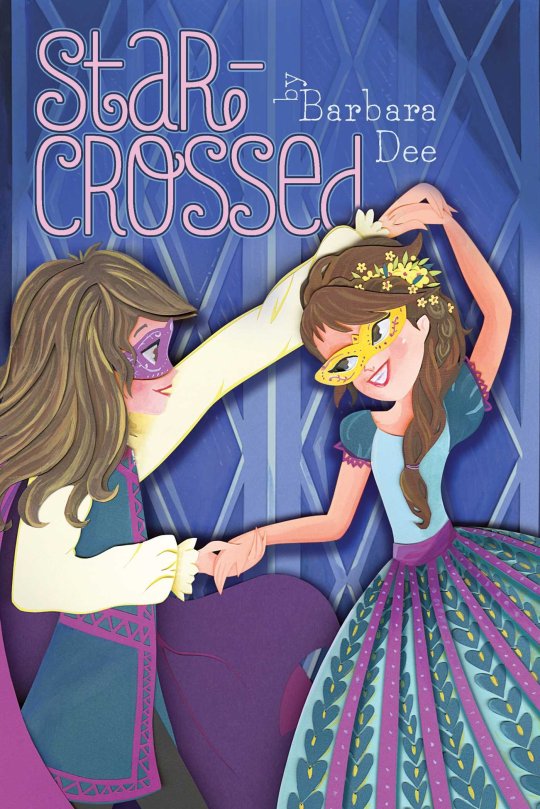
Fast forward another year to now. STAR-CROSSED is about to come out, and it is absolutely amazing.
My mom has poured her heart and soul into making sure this is a positive thing for kids to read.
I’ve been reading and editing and helping with this book since its first draft and I’ve been, metaphorically and sometimes literally bouncing up and down on my heels, waiting to be able to tell people about it. It’s beyond sweet, and there’s a ton of Shakespeare and humor and goofy preteen drama and twelve-year-old girls flirting and Star Wars jokes and a glossary of Shakespearean insults in the back (yes, really), and it’s just so fun and positive and smart and I want to show it to every kid I know.
This book is for LGBT kids, written by a mom who has asked questions and done her research and tried as hard as she possibly could to make her own queer kid feel safe and loved and valid, and it REALLY shows. Mattie (the cutie on the left) and Gemma (the cutie on the right) are given space to learn about themselves, and ultimately they don’t have to figure themselves out right away or come out to everyone at once or choose a label. They’re kids. It’s okay to still be figuring things out. It’s okay.
Fun facts:
My mom said from the beginning she wanted both girls on the cover to make it clear what the book was about; then when they got the final artwork and Mattie’s hair was short, my mom wrote back and asked the artist to do the hair over to make it as obvious as possible that Mattie is a girl.
When a few people started buzzing about Mattie being the youngest bisexual protagonist they’ve seen, she went back and changed passages to confirm that Mattie likes boys and girls.
When I asked for a happier and less ambiguous ending scene, she set Mattie and Gemma up on a frigging date.
It comes out on March 14, 2017. Please join me in GETTING HYPE FOR STAR-CROSSED ❤
Thats the weirdest erotic sentence i’ve read all month
this fucking post singlehandedly ruined my life
You don’t really appreciate how fucking great fan fic is when it comes to writing sex untill you stop to recognise how Serious Literary Stars fail at writing sex.
Forget what his dick is doing, what are her breasts doing? How do a pair of fat sacks attached to a ribcage barrel-roll anywhere? Let alone across a man’s mouth and then his wanger immediately after? Sir, why is your mouth so dong-adjacent? Is your weiner detachable, is that it? Do you have your joystick clutched in your hand so that you can score a sweet schlong-to-titty-roll immediately after a kiss and then proceed to beat your banana all over her body in the world’s most failed attempt at erotic massage??? HOW DO YOU THINK SEX WORKS???
… guys
….. Are the sex scenes in My Immortal better than this? “HE PUT HIS THINGY IN MY YOU-KNOW-WHAT AND WE HAD SEX.”
… I mean. Comparatively…
Like, in My Immortal, it’s at least implied he knows where he’s supposed to put it. It’s very simplistic, Ikea-style sex (insert tab A into slot B) but that’s better than this vague, useless composition of random, nonsensical placement and movement of body parts.
So yes, the sex in My Immortal is, in this sense, better.
OK so I’m sure people are aware of this, but just in case you’re not: there is an annual ‘award’ given every year by the Literary Review for bad sex scenes in fiction. The above entry (sorry) by Morrissey won this illustrious award in 2015 (and yes, he threw a massive tantrum about it, because he’s Morrissey):
The best part of this is that the 2016 nominations were just announced, and OH BOY, there are some absolute crackers this year:
And in case anyone is interested, these are some of the entries that Morrissey beat to the top prize last year:
I agree. We are spoilt by fanfiction.
I literally never want to hear anyone badmouth fanfiction again, I have never in all my years of internetdom read anything as troubling as, “Under that sling, her breasts were like young fawns, sheep frolicking in hyssop – Psalms were about to pour out of me.”
tag urself i’m “Come, sonny boy!”
I kind of see what the fawn thing was going for – imitating Song of Songs – but (a) it does so badly, (b) it then brings up the Psalms INSTEAD OF Song of Songs. If you’re going to do literary allusions at least get them right, my dude
My worst (first) written sex scene is like literary gold compared to what I’ve just writnessed with mine own two eyeballs.
I suck at writing sex scenes and… well. I feel positively gifted, compared.





 Steel Phoenix Studios