the scene in the first avenger when peggy carter asks a soldier to step forward and then she fucking decks him in the face and straight up knocks him to the ground without once showing an emotion changed me as a person
When Bucky was missing in action, Steve thought he was dead. But it’s interesting to consider that Steve went missing, too, and Bucky didn’t know what had happened to him.
Steve signed up for a secret government experiment. I doubt they let him have contact with anyone he knew, or tell anyone where he was going. And when he became Captain America, his real identity was hidden. So Steve Rogers just disappeared. Letters from Steve must have abruptly stopped. Bucky would have thought something terrible had happened to Steve, like he was arrested for forging documents, or he picked a fight with the wrong person. Maybe Steve wrote Bucky once, to say he was accepted into the army, and then Bucky never received another letter. He would have assumed the worst.
In this moment, it looks like Bucky is realizing Steve is really alive.
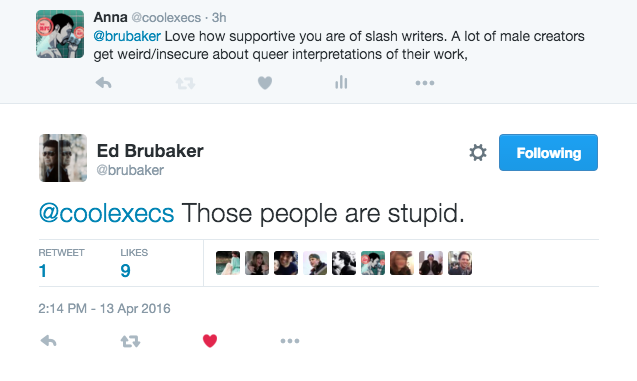
I’ve had plenty of people tell me that it’s “disrespectful” to the authors if you interpret a character as queer without a clear textual indication. But the people who actually made these characters disagree with that.
MCU Cast & Crew:
The Russos are cool with it and have repeatedly validated the interpretation, even noting that a lot of women who worked on the movie are invested in that relationship. (Link 1, 2, 3, 4).
Sebastian Stan is fine with it, and thinks it’s great that people can interpret it however they want. (Link).
Chris Evans says he didn’t deliberately put it into his performance, but he has no problem with it and thinks a romantic relationship “wouldn’t be so bad.” (Link).
Emily VanCamp was excited to hear about it, and thinks it’s great that this is a conversation we’re having about a character like Captain America. (Link).
Hayley Atwell is a fan of bisexual Steve Rogers, and hates pretty much every ship for Steve but Steve and Bucky. (Link 1, 2).
Comics:
Ed Brubaker, the man who created the Winter Soldier, not only fucking loves it, but has also been known to tweet links to Steve/Bucky fan fiction. (1, 2, 3, 4, 5).
If you have a problem with interpreting this character as anything other than heterosexual, not only is that problem yours alone, but the character’s creator thinks you’re stupid. Stop hiding behind authorial intent, and consider why it bothers you so much that someone you thought was straight might not be.
Also, Hayley ships Cartinelli. ❤
Samuel L Jackson literally called Chris “LGBT Captain America” on a red carpet–in front of Chris, Scarlett, and a ton of press. Chris responded with a happy laugh.
For the fucking record, there’s no mention of Captain America’s creators in the above posts. Jack Kirby and Joe Simon created Captain America. SO, you’d better correct your statements as it applies to Disney’s Marvel only.
The fact that there’s no real evidence to support Captain is homosexual tells me he isn’t. Fan interpretations are just fans individualising and tailoring things they like to be more fitting for their lifestyle.
That is all.
Oh, and fuck Disney’s Marvel.
I find that it’s often somewhat difficult to ask dead people for their opinions on a topic. But I pulled out my ouija board just for you, and they told me they’re both cool with it.
They also wanted me to pass on, “F U C K Y O U”
Maybe that’s some sort of pet name you guys had for each other?
Peggy’s first Christmas season in New York is
both delightful and depressing – it’s so lovely to see America’s bounty
and good cheer on such vivid display, especially after how England spent
the last few Christmases. But she misses her family and she even misses
the way misery and fear of the Jerries so close by made every bright
spot shine all the more. Her own preoccupation (self-absorption, if she
must be honest) leaves her only surprised and curious when the
candelabra appears in the one window in the main lab that’s not bricked
over from the outside. It’s high up – they’re underground, after all –
and needs a ladder to get to, although they keep a ladder handy because
this is a lab with chemicals and there are times when extra ventilation
is ideal. The candelabra is not a fine one; it’s tarnished silver of a
low quality, battered and dented, and Peggy’s embarrassed that she has
to be told that it’s a chanukia and not someone’s odd attempt at giving
the lab a touch of class for the Christmas season.
Gloria, who is the one to tell her, does not know whose it is.
Most
of the scientists are Jews here, but their relationship with their
faith is complicated and Peggy generally chooses to say nothing lest she
inadvertently poke at a sore spot. And that goes for Howard, who views
his Jewishness as an annoying childhood nickname he can’t get rid of, as
much as it is for Abe or any of the other refugees who have lost
everything – up to and including their families – because of it. Yiddish
might be the unofficial second language of Project Rebirth and the lab
was unofficially closed in the fall for the Jewish New Year and Yom
Kippur, but most of the men work into the night on Fridays and the
biggest dogmatic disagreements usually end up being about food – what is
the appropriate method of preparation of a brisket, not whether Walker
should eat his ham sandwich at his workstation.
FAKE BOOK COVERS FOR BOOKS REFERENCED IN TIN SOLDIERS:
1. Miller, John. Birth of an Icon: Captain America and the Restoration of the Hero. New York: Routledge, 2001. Print. 2. Anderson, Lynn E. Captain America: Behind the Mask. New York: Palgrave Macmillan, 2012. Print. 3. Mbatha, Michelle. The Anatomy of a Sidekick. Bucky Barnes and the Propaganda Machine. New York: Routledge, 2011. Print. 4. Everett, Lloyd. The Star-Spangled Man: Captain America in Comic Books, War Photography and Propaganda. Malden, MA: Blackwell Publishing, 2009. Print. 5. Singh, Kajal. Taking up the S.H.I.E.L.D. Peggy Carter and the Post-War Era. Malden, MA: Blackwell Publishing, 2010. Print. 6. Reid, Maya. The Popular Life of Captain America. Steve Rogers in Popular Culture and Fandom Practice. New York: Palgrave Macmillan, 2013. Print.

 Steel Phoenix Studios