So why don’t all vertebrates have this adaptation? It’s an advantage to animals that are active in the dark – cats, dogs, owls, raccoons, crocodiles, and so on – but it makes everything slightly blurry. Many daytime vertebrates (including humans and most other primates) do not have one and instead have better day vision.
I know cats have a stigma of being evil little robots who care for nobody but themselves. I don’t deny that there are some out there like this. But in defense of the large majority of darling cats who have been given a bad name due to the wicked few, I would like to tell you a story…
I am asthmatic. I’m not as bad as some; my asthma is generally well-controlled, and I don’t have much trouble with it on a daily basis. However, as all asthmatics know, getting sick becomes a nightmare. Even a small cold can turn into a days-long asthma attack, one that is very painful, and very annoying for me and those around me. The asthma cough sounds like an ill seal at best, or an angry moose with a nasal condition at worst. Y’all with asthma, and y’all with asthmatic friends, know exactly what I’m talking about. The bark. The hack. The Cough Heard Round The World. It’s painful, it’s loud, and it doesn’t stop. Even the rescue inhaler can only do so much to calm it. It just has to run its course with the cold.
Well, this week I caught the crud, and in the past few days it deteriorated into The Cough. Last night, I took some NyQuil to try and stave it off for as long as I could, just to try and get some sleep. That meant that for a few hours, I was cough-free. After that, I was still doped up enough to sleep through some of it. However, by 2am the sleep aid had worn off and The Cough woke me up. Since lying down makes it worse, and I didn’t want to wake my sister, I sneaked out of my bedroom into the living room, where I sat on the recliner and proceeded to hack up a lung while I waited for my next dose of NyQuil to kick in. That is when I noticed Simon.
Simon is a Russian Blue with a masterful resting-witch-face and an attitude to match. She (yes, she’s a girl, that’s another story) is old, fat, proprietary, and attitudinal. She isn’t shy about telling you when she is displeased, and does so with a loud shriek and some teeth or claws thrown in. She is convinced she owns the place, and owns all of us in turn. She is particular about where you can pet her, like most cats; and, like most cats, she loves her sleep and hates to be woken up.
And of course, my hacking woke her up.
Attempting to whisper an apology in between bouts of coughing, I noticed she was getting off her perch atop the chair nearby. She stretched, made a little squeaking sound, and trotted over to me.
I expected her to demand petting as payment for having woken her precious sleep, but she did not. Instead, this traditionally cranky dragon of a cat did something that amazed me.
She began to purr loudly, and sat herself directly on my aching chest. She kneaded my sternum softly, and nosed my chin as if to say, “I’ve got this, you sleep.” Even though I was still coughing, and bouncing her horridly in the process, she remained settled on my chest right above my diaphragm, purring loudly so that it vibrated through my ribs. I don’t know what magic spell she was chanting between her boat-like purrs, but within minutes my cough had subsided and I was able to sleep.
I didn’t wake up until about 4:30. When I did, it was to discover that my lap and chest were devoid of Simon’s presence, and I was coughing again. As I started coughing once more, I heard her familiar “I’m here” squeak from the area of the water dish. I heard some hurried lapping, and then her heavy gallop across the floor. She flumped onto my lap again, and resumed her purring and kneading. She had evidently been doing that for the past 2 hours, and had only left to get some water. Hydrated, she had returned to take care of me.
So yes, she has her share of evil, jerk-cat moments, but I can no longer pretend that Simon is entirely heartless. For that matter, I now refuse to believe that about any cat. Just because they act like a jerk doesn’t mean that they don’t love you.
There’s some research that the frequency of a cat purr (generally they purr in the range of 20 to 140 Hertz (Hz) can increase bone density, help relieve pain, and aid the healing of muscles/tendons. I’d link but I’m on mobile (google cat purr frequency healing" if you’re interested!) so it’s possible that the relief you felt was actually her!
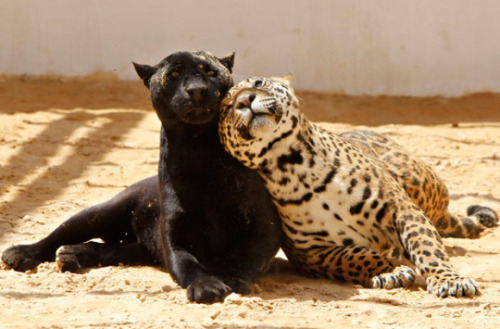
The opposite of albinism called melanism, a recessive trait where the skin and fur are all black.
nature & real talk
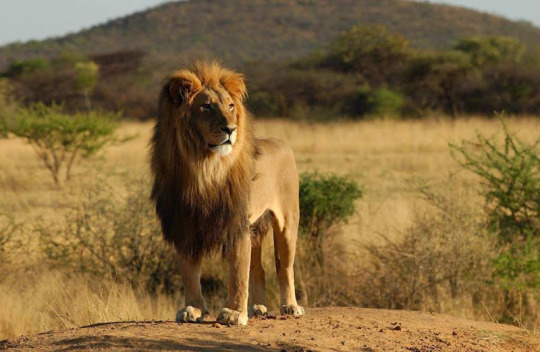
Holy shit that’s majestic.
Yes, the powers of Photoshop are indeed majestic
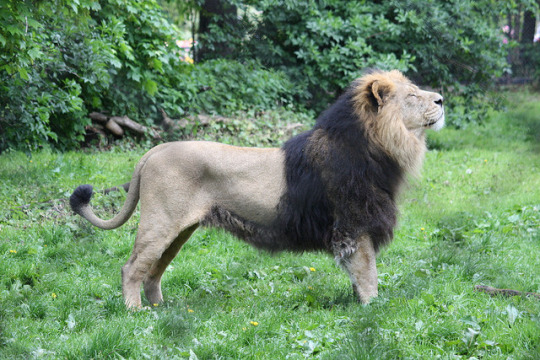
So far the closest thing we have to melanistic lions are the black-mained Asiatic lions
(Panthera leo persica), and it’s not known whether lions are even able to be melanistic!
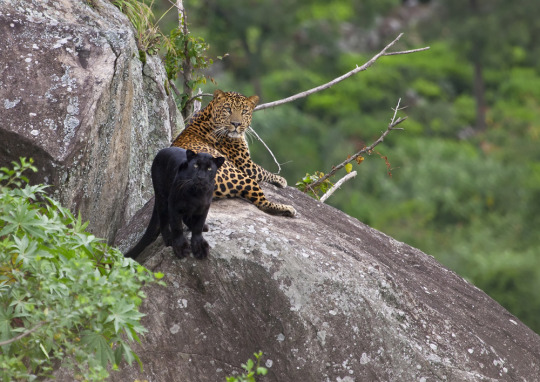
The only melanistic big cats we know of are jaguars…
…and leopards.
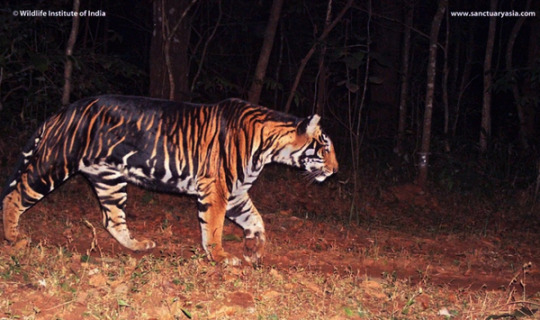
We do, however, know of abundism in other big cats! What’s abundism you may ask? Well, it’s basically when places that normally have a lot of melanin end up producing an abundance of it. So an abundistic tiger looks like this:
And an abundistic cheetah looks like this:
And just for good measure, here’s an abundistic leopard:
This has been a PSA!
Oooh okay, I want to jump in here, purely because I saw this and it brought back my childhood fascination with king cheetahs so I had to infodump.
As far as I can tell, that is actually a king cheetah, not an abundistic cheetah. From a brief bit of research, the king cheetah coat pattern isn’t strictly caused by abundism, but is actually caused by a recessive mutation in a gene responsible for coat patterning.
It was found that a mutation in the Taqpep gene is what causes the king cheetah coat pattern where “the black spots coalesce into larger areas, and multiple longitudinal black stripes appear on the dorsum“. Just to illustrate this a little better, here’s a regular cheetah on the left, with a king cheetah on the right
The scientists who discovered that this mutation was responsible for king cheetah patterning actually first discovered the mutation in domestic cats. It is the same gene that causes the blotched tabby mutation (as opposed to the striped/mackerel tabby coat pattern).
It gets slightly more complicated after that. The scientists also found that, while the Taqpep gene is responsible for patterning the areas of yellow vs black coat colour, it isn’t directly responsible for producing a darker coat (the taqpep gene is found in low levels in both light and dark areas of the cheetah/cats skin). This raises the question, if Taqpep isn’t directly changing coat colour, then what is?
After some investigation in fetal cats (and some confirmation tests done in lab mice), it was found that Edn3 was the gene responsible. Edn3 produces a hormone that up-regulates the differentiation and grown of melanocytes (the cells that produce melanin). So, putting things all together: it seems that Taqpep expression sets up an invisible zones of patterning, and these zones determine the level of expression of Edn3. By extension, this increases the number of melanocytes present in the skin, and thus the yellow vs black coat colour. Mutations in the Taqpep gene lead to wider, more erratic zones of colouration, which leads to the blotched coat pattern responsible for king cheetahs.
Okay, so, I know this wasn’t really at all related to the original post, or even the comment above, it was mostly just my sudden need to infodump my knowledge on king cheetahs. I do apologise if I’ve over-stepped, and if people would rather I removed my comment and just made a separate post, I can do that. Also, I apologise for any factual errors I’ve made in this post; it’s mostly what I’ve learnt from quickly skimming through the paper and trying to summarise what I could (the paper itself is very informative and goes into a lot more detail than I have if you’re interested in this kind of thing). If you spot any glaring mistakes, let me know and I’ll happily edit this where necessary.
Reference:
Kaelin, C., Xu, X., Hong, L., David, V., McGowan, K., Schmidt-Kuntzel, A., Roelke, M., Pino, J., Pontius, J., Cooper, G., Manuel, H., Swanson, W., Marker, L., Harper, C., van Dyk, A., Yue, B., Mullikin, J., Warren, W., Eizirik, E., Kos, L., O’Brien, S., Barsh, G. and Menotti-Raymond, M. (2012). Specifying and Sustaining Pigmentation Patterns in Domestic and Wild Cats. Science, 337(6101), pp.1536-1541
What better day than Caturday to check out another one of photographer Andrius Burba’s origianl Underlook projects: “Under-Cats”! These awesome photos were taken over the course of two days at an International Cats Show in Kaunas, Lithuania.
“My mother-in-law was baking one of her awesome Black Forest cakes for my sister-in-law’s birthday. She left the cake cooling and when she went to look…”





 Steel Phoenix Studios