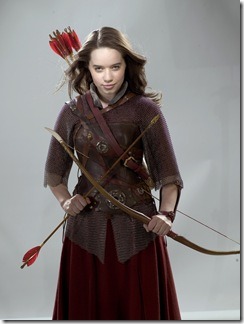
can we take a second to ponder on the fact that a kids movie did lady armor better than the entire film and comic industry
guess who i’m talking about
did you guess? Well you’re fucking WRONG because it’s Susan goddamn Pevensie
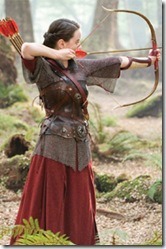
They gave her light armor, appropriate for a small archer:chainmail, an arm brace, chest plate, and a light skirt she can easily run around murderizing dudes in the face in
her hair is also only loose in the promo pictures because Susan is fucking busy not dying because her hair was flying into her eyeballs so she braids that shit back
her mail shirt is also loose enough that it doesn’t impede her arm movements it’s almost like she’s dressed for a fight wow
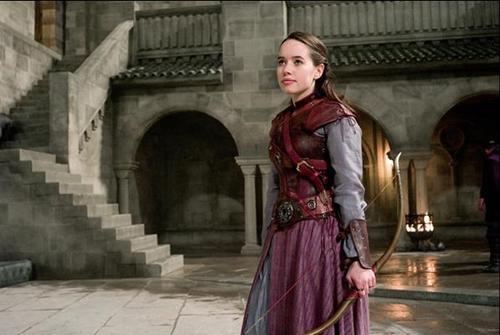
I like the pinks and purples under her bitchin as hell leather armor here, because you don’t have to be masculine to shoot someone in the goddamn face
Everyone, including the actress who played her, agrees that Susan was the most boring of the Pevensie siblings, yet the filmmakers had enough respect for the character to dress her in practical light armor. And didn’t have to bend over backwards to slap on “feminine features” (read: giant boobplate) to make sure no-one confuses her gender.
Would other female characters in life action get non-exploitative clothes if they were also played by underage girls?
~Ozzie
PS: Props for archer costume with puce as its primary color instead of green!
That Susan? That Susan does not embitter herself, does not brick her heart off, does not doubt like it’s a lifeline– not yet. She yanks open the wardrobe’s doors as soon as she finds her balance, shoves through the fur coats and mothballs, and slams into the solid back of it. She shuts the wardrobe and opens it; locks it and unlocks it; throws all the coats on the floor; gets wood splinters under her fingernails from trying to get through the back of it.
It is one things to lose a home, and it is another to lose a child. I don’t think she would ever stop looking.
Her little girl couldn’t have been more than four or five. Did she have Lucy’s cheeks? Edmund’s wit? Peter had been her favorite aunt or uncle, because he had been so patient with her. He had been teaching her to read.
Susan dredges up every arcane idea she’d ever heard whispered in Narnia, about its magic, about its origins, anything that might lead to a way back. She researches the wardrobe, its make, its history. She drags its purchase papers out of a sympathetic Professor Diggory, who has never had children and who does not understand, especially not with Susan’s present pubescent face glaring up at him.
When they send her back to her parents, when the war ends, she kisses her mother on the cheek and then runs away from home, to go find the wardrobe manufacturers, to find supposed occultists in cheap little flats that smell of garlic, to bury herself in library stacks.
–
And what about the child? Her mother, aunt, and uncles all gone on a single afternoon. Susan’s daughter was just learning to read, and now she is crowned princess heir. She has beaver nannies and centaur tutors, and she has stories about how beautiful her mother had been.
The last thing she had seen of her mother had been her riding away through Cair Paravel’s gate, long dark braid whipping behind her. She is afraid of horses all her life, but she rides them anyway when she is old enough. It would not do for a queen to seem frightened.
Her father is the sort of verybminor foreign royalty who had farmed his own little plot of land way out in the backcountry. They had needed to make an alliance, but for all Susan’s practicalities that was one place she remained– what was it exactly? Faithful. Childish. Stubborn. She wanted to marry for love, and she had.
But Susan disappears, the queen and king and high king with her, and her husband gets pulled out of tending his private vegetable garden to be his only daughter’s regent. He tries to keep her separate but teach her what she needs to know, all at once, so Susan’s child grows up with that weight on her shoulders early.
She does not know it, because the court artists always painted her mother smiling, but those stiff shoulders are one of the best connections she will ever have with her mother– Susan had been made the little mother too early, too, the one relied upon, who worried and herded and doubted because no one else was going to do it. Her child is a little queen, looking out and out over the acres of land and knowing what she owes this quiet piece of the world.
She rules in peace and in war, neither Gentle or Valiant but instead Wise. Her name is spoken with love and praise, and she raises her own children to be just, to be valiant, to be gentle, to be magnificent.
–
Susan has still not given up looking when her own horn calls her home to Narnia. It has been more than a year for her. It has been hundreds for her home. Cair Paravel might be overgrown, unrecognizable. It might be recently abandoned. It might still be thriving, vibrant, alive.
But this is what matters: Susan walks up to a high green hill and all the old standing stones propped up on its ridge.
She finds her husband’s name and drops wild daisies on his grave. She finds her daughter’s grave. She traces the dates of her rule, of her life, and she drops down and weeps.
They save Narnia, again, from invaders and war, and Aslan sends them back to England.
When she forgets about Narnia, seventeen and widowed, seventeen and her child grown and buried and unknown and decomposed– when Susan forgets about Narnia it will be, more than ever, an act of self defense.
–
Alternatively: Susan manages to shake news of the rings out of Professor Diggory.
She and whichever of her siblings wants to most stumble back onto Narnian soil: Peter wouldn’t leave the two younger kids alone in England; Edmund loves Narnia as much as anyone, still feels like he’s repaying it debts that it’s already forgiven him for, but Lucy has been crying since she crashed back down on her skinny knees on the upstairs bedroom floor in the Professor’s old country house. So it’s Lucy and Susan who take the rings, then. They kiss their brothers, their co-monarchs, on their cheeks and they go.
The girls hike with younger, childish muscles to Cair Paravel, their limbs growing and strengthening in the Narnian air, remembering themselves. They will not reach their exact old heights, not for years, but they are home and that is enough to send them sprinting and dancing and crying as they travel old known paths.
Susan is smaller and her child is older, closer to grown, but they slam into each other’s open arms as soon as they see each other in that royal courtyard– however close in size they get, her mother’s arms will always be the safest place she knows.
Lucy and Susan retake their crowns. Susan curls up in the warmth of her husband’s arm, buries her face in his shoulder, and tries to inhale every year she missed. He gives them to her in stories at the breakfast table for years, in ecstatic descriptions of carrot crops missed out on and fields of grain unseen. Narnian agriculture has seen a boost in the years of his regency.
There are years of Susan’s daughter’s life that she missed, and she grasps what she can of them in recollection and anecdote. She tells them about the desperation, much more amusing now, with which she searched for them. She and her daughter build something new between them, these two daughters of Eve. Lucy still gives the best piggy-back rides even when Susan’s daughter is almost of a height with her.
Lucy and Susan reign well–valiant and gentle, blinding faith and practical doubt. When Susan’s daughter is old enough, Lucy and Susan forfeit her their crowns and stay on as advisers. They never hunt stag again, but even as an eighty year old Lucy hobbles her way down to Mrs. Beaver’s daughter’s little house for tea and to hold baby beavers in her wise old lap.
–
When Peter and Edmund get yanked back into Narnia from a train stop, Susan’s old horn is not being blown by a Calormene named Caspian.
Susan is buried on a high green hill, Lucy on one side and her husband and daughter on the other. Their granddaughters and grandsons are scattered over the hill, and Peter and Ed do not even know their names.
The stones are worn by strong wind and long decades. They are overgrown with small white flowers. The boys will go up there, later, and they will cry like the earth is still dark and fresh over each of those graves. For them, it is.
But Cair Paravel is not overgrown, destroyed, or forgotten. It is centuries older and Peter and Ed do not recognize the new additions, the court fashions, or even some of the words whispered by the gathered crowd.
They do recognize the crinkled eyes on the young queen standing crowned and patient before them, a horn in her hands. She has Edmund’s best quirked grin, and they will learn she has Lucy’s talent at speech-making and Peter’s at tactics. They recognize her long dark hair.
cant believe a bunch of english kids go through a fuckin cupboard and find a magical kingdom full of wonder and they go “yeah we’re the royal family now”
typical english behaviour
I think what’s more creepily imperialistic is the reaction of everyone in Narnia to the Pevensies.
Like, the Pevensies end up the royal family in large part because everyone’s like ‘it has been prophesied that you will come and rule us and everything will be great!’ and, well, in-universe I can’t really fault them on that; if I were a young teen or pre-teen in a completely foreign country, I too would probably just go along with whatever seem to make people friendly to me.
But the reaction of the Narnians, in almost ubiquitously welcoming these foreigners as obviously destined to rule them even though they know nothing of the country and the culture… now that is some creepily imperialist writing.
This is the only good reblog of this post in it’s entire 3 year hellscape existence
if four foreign kids popped out of a magic box and deposed trump by the express wishes of god’s fursona, i’d crown ‘em. this winter already fuckin feels like it’s lasted 100 years.
What she means: I understand the Chronicles of Narnia was at its heart a fairytale with theological analogies for children. But why did Lewis never address how they had to adapted to life on Earth again. Why does no one talk about how the Pevensies had to grow up with a kingdom of responsibilities on their shoulders, only to return to Earth and be children. Take Lucy, she was youngest and perhaps she adapted more quickly-but she had the memories and mind of a grown woman in an adolescent body. Edmund literally found himself in Narnia, he went from a selfish boy to mature and experienced man. He found a purpose and identity through his experiences to come back as just Edmund, Peter’s younger brother. Did people wonder why the sullen, sour boy came back, carrying himself like a wisened king? Did his mother wonder why he and Peter suddenly got along so well, why they spent so much time together now? And Susan, the girl of logistics and reason came back with a difference in her. She learned how to be a diplomat and ambassador, Susan the Gentle had to live to endure not-so-gentle circumstances. She had the respect she wanted, only to be just another teen girl. And Peter, he entered the manhood and maturity he so wanted. He earned the responsibility and stripes he yearned for. He learned to command armies and conduct the menial tasks demanded of a king to rule a nation. But he came back, appearing to be just anther glory-hungry boy. Not to mention the PTSD they must have struggled with. Especially Edmund. How often did he wake up in a sweat, screaming a sibling or comrade’s name? His parents believe it’s the war, but it’s an entirely different one he has nightmares about. How often did he have trouble with flashbacks and mood swings? And how many times did he and Peter sit over a newspaper or near the radio listening to reports on the troops. How often did they pour over lost battles and debate better strategies. Did their parents ever wonder why they seemed to understand flight war so well? How long was it before they stopped discussing these things in front of people? Why does no one talk about this???
Why am i fucking crying
Why does no one talk about how the Pevensies had to grow up with a
kingdom of responsibilities on their shoulders, only to return to Earth
and be children
It’s not addressed because it’s understood. It was the shared experience of the generation. You are describing coming home from World War One, battle wearied and aged beyond belief, but walking around in the body of a youth. C S Lewis went to the front line of the Somme on his nineteenth birthday and went back to complete uni in 1918 after demob.
Not seen it with this very very pertinent addition before



 Steel Phoenix Studios