d&d is great
I just tried to slam a guy with a two-handed maul and missed, swinging into the floor
I roll for damage against the floor bc of course I do. I roll high. The tiles are crushed to bits
As a free action, I grab a handful of floor gravel and shovel it into my mouth and straight up eat it in an intimidation attempt
My combat opponent is horrified. I get +2 to hit him next turn
I fought an opponent who had an eye patch. I used Mage Hand to pick up his eye patch and move it to his other eye.
The Mantle of the Tempest in action. This was actually the first time I’d been able to try it on full length because it doesn’t really fit in my apartment. So I couldn’t resist asking @commandercait to snap a few self indulgent pictures on my phone while we were up in the mountains. It’s unwieldy as all hell and I need someone to help me foof it out and adjust it once it’s on, but I kinda love that it’s just so freaking obnoxious. I feel like dnd always has this kind of ridiculous and cliche melodramatic undertone that needs to be gleefully embraced with the full power of a 1980s fantasy novel cover, so for Keyleth that translates into “I’m gonna wear a literal tree and no one can stop me.”
Concept: a TV series consisting entirely of “filler episodes” from some notional story of grand adventure whose ongoing events can only be inferred from the incidental context of whatever character-driven bullshit is happening this week.
Like, maybe they’re a D&D-style adventuring party, and we only ever see them during downtime between adventures. Sometimes one of them is suffering from some improbable injury or bizarre curse, and the particulars of how it happened are only vaguely alluded to – their entire professional lives are basically one big Noodle Incident from the audience’s perspective.
I think you could get some use out of “previously on” and “next time on” segments showing footage that never happened.
For example: “Previously on, Champions of Karamore!” *Shot of a scepter lying on a pedestal in a tomb somewhere* Wizard: “The Scepter of Aratoom is the key to Garroth’s Ascension” *Four Seconds of the Heroes engaged in epic combat* Warrior: “I’LL HOLD THEM OFF, GET THE SCEPTER” Rogue *Looking at empty pedestal*: “IT’S GONE! WE’RE TOO LATE!” *Dark cloaked figure that the audience has never actually seen before, holding the scepter* “At last…it begins”
And then the entire episode consists of them hanging around the nearest inn, looking at maps and arguing about different ways they could have gotten there, and if any of those methods would have gotten them to the Tomb fast enough. “I told you we should have sold the horses in Roksport and taken a ship to Veremen” “We paid good money for those horses! Staying overland cut at least three days off our trip!” “It would have, HAD THE HORSES NOT BEEN EATEN BY WEREWOLVES!” “There’s no way we could have known about the Werewolves.” “THE TOWN WAS CALLED LYCANSBURG JEREMY!”
[[ Source. Original creator: wats6831. Additional information and images linked under each one. ]]
Universal:
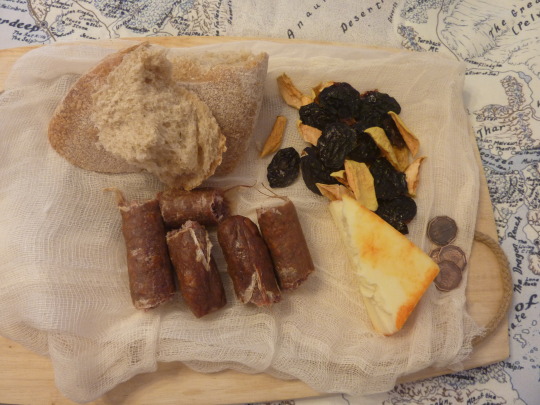
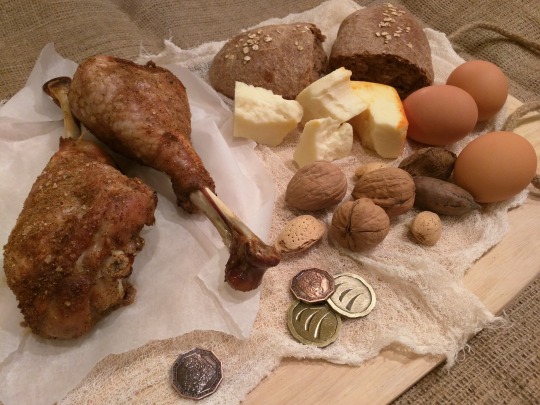
Homemade artisan herb bread, home grown and dried apples and prunes, uncured beef sausage, munster cheese. Made a small bag from cheesecloth and tied it closed.
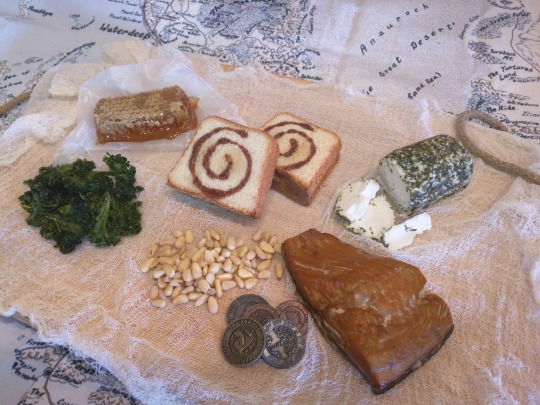
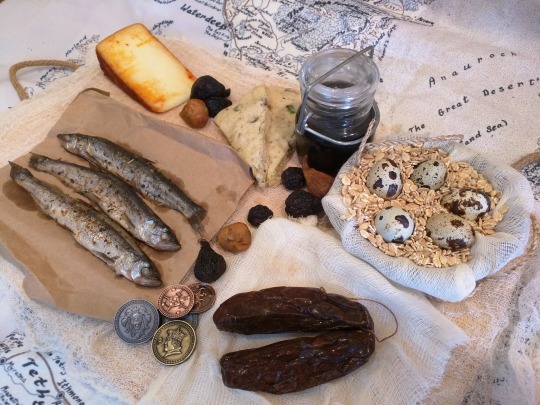
Top left to right: Evereskan Honey Comb, Elven Travel Bread (Amaretto Liquer Cake with custom swirls), Lurien Spring Cheese (goat cheese with garlic, salt, spices and shallots), Delimbyr Vale Smoked Silverfin (Salmon), Honey Spiced Lichen (Kale Chips), and Silverwood Pine Nuts.
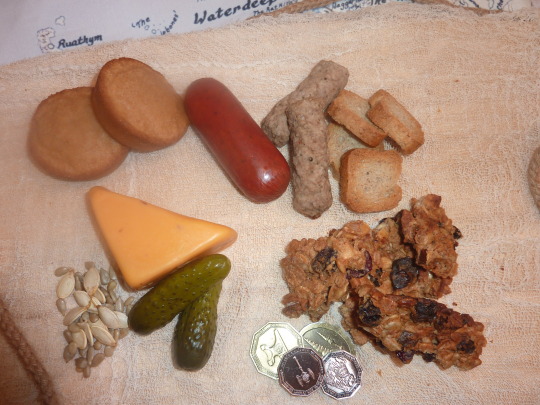
From upper left: “Honeytack” Hard tack honey cakes, beef sausage, pork sausage mini links, mini whole wheat toast, cranberry cheddar cheese mini wedge, mini pickles, pumpkin and sunflower seeds, lower right is my homemade “travel cake” muesli with raisins, golden prunes, honey, eggs and cream.
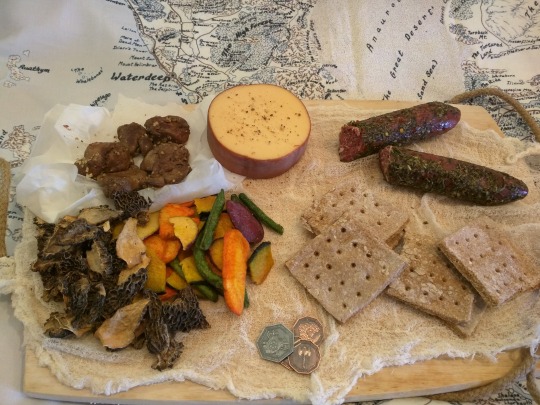
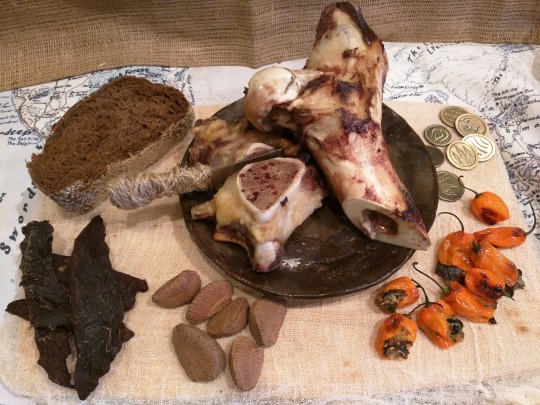
Orcs aren’t known for their great cuisine. Orcs prefer foods that are readily available (whatever can be had by raiding), and portable with little preparation, though they have a few racial delicacies. Toughs strips of lean meat, bones scavenged from recent kills, and dark coarse bread make up the bulk of common orc rations.Fire roasted rothe femur (marrow is a rare treat) [beef femur], Strips of dried meat (of unknown origin) [homemade goose jerky], foraged nuts, only edible by orcs….nut cracker tusks [brazil nuts], coarse black bread, made with whatever grains can be pillaged [black sesame bread], Pungent peppers [Habanero peppers stuffed with smoked fish and olives].
Lizardfolk are known to be omnivores, forage for a surprising variety of foods found within the confines of their marshy environs, in this case the Lizard Marsh near Daggerford. Fresh caught boiled Delimbyr Crayfish on wild chives, coastal carrageen moss entrapping estuary brine shrimp (irish moss, dried brine shrimp), Brackish-Berries (blackberries), Blackened Dart-Frog legs (frog legs) on spring sprouts (clover sprouts), roasted bog bugs on a stick!
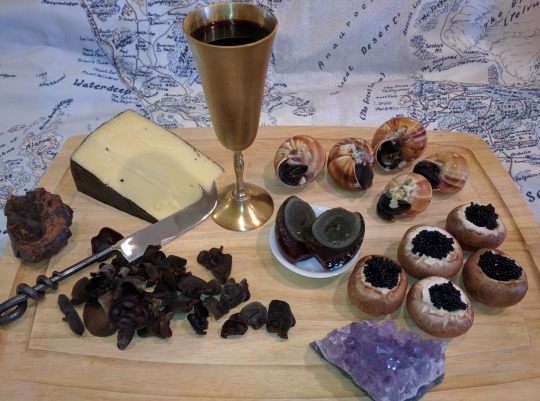
From top left: Menzoberranzan black truffle rothe cheese (Black Knight Tilsit), Donigarten Moss Snails (Escargot in shallot butter sauce), Blind cave fish caviar in mushroom caps (Lumpfish caviar), faerzress infused duck egg imported from the surface Realms (Century egg), Black velvet ear fungus (Auricularia Black Fungus Mushroom).
Under D&D rules, a dagger does 1d4 base damage. The average human has a Strength score of 10, adding no bonuses. Several of them, due to the military background of many, likely had strength or dexterity scores of 11-14. But only two or three, and quite a few would be frail with old age, sinking to 8-9 strength. All in all, we can only add a total of +1 damage per round from Brutus.
An estimate of sixty men were involved in Caesar’s actual murder. Not the wider conspiracy, but the stabbing.
Julius Caesar was a general, which is generally depicted as a 10th level fighter. Considering his above baseline constitution and dex, weakened by his probable history of malaria, epilepsy, and/or strokes (-1 dex modifier), and lack of armor at the time of the event, he would likely have something along the lines of AC 9 and 60 HP. The senators would likely hit him roughly 55% the time.
So the Roman senate had a damage-per-round of 66, more than enough to kill Caesar in one round even without factoring in surprise round advantage.
Now THESE are the kind of statistics I wanna see!
So as a giant nerd with the 5e player’s handbook in her purse DM, I’m going to quibble with your math just a tiny bit. Just getting Caesar to 0 wouldn’t do it – he’d have to fail his death saves or be reduced to -60hp to autodie.
First of all, I think given the facts, we can safely disregard any surprise round damage or advantage. Caesar had ample warning of the attack prior to its execution, both from rumors of the plot and portentous omens. This, combined with historical writings that state Caesar attempted to flee, would indicate that there was no surprise round and Caesar was active in the initiative order from the first event.
Accepting your numbers, 33 of the 60 conspirators involved should have succeeded in their attack rolls. This includes Climber, who successfully restrained Caesar, and Brutus, who did an additional 1 point of damage. 3 of the 33 attacks, statistically, were critical hits. If we assume that everyone was using a dagger, no one besides Brutus had damage modifiers, and no one besides Climber used their attack for anything other than a grapple, then the final damage total of the Roman Senate is 71 points of damage. (28 regular attacks at 2 points each [56] + 3 critical attacks at 4 points each [12] + Climber’s grapple [0] + Brutus’s attack at 2+1 [3])
Here’s where it gets hairy. According to historical record and autopsy, only 24 of the 60 attacks landed. (23 stab wounds, plus Climber’s grapple.) This indicates that:
Caesar had a much higher dex mod and correspondingly higher AC/initiative
Some of the conspirators used their actions to increase the DC of Climber’s grapple, rather than attack.
A combination of the above.
Further complicating matters are the following facts:
Caesar attempted to flee, but was blinded by the blood in his eyes, and fell prone.
He not leave melee range, so none of the 60 conspirators received attacks of opportunity against him.
Any attacks after this point had advantage.
The official autopsy and historical record states that the second strike to the chest was a lethal wound, however, the actual cause of death was ruled to be loss of blood from multiple stab wounds.
This single wound was struck late in battle after Caesar was already bleeding out.
Caesar definitely spoke after Casca and Brutus’s attacks, indicating that he was not yet unconscious and these were not the fatal blow.
Either two attacks landed after Caesar was unconscious, each registering as an automatic critical and therefore two failed death saving throws OR
The final attack to land did enough damage to instantly reduce Caesar from 1HP to a number equal to or below his starting HP, resulting in instantaneous death.
With all these facts in consideration, I think we can surmise the following.
Caesar, despite being feebled by age and illness, had a higher dex modifier than the original post credits him with. This aided him in AC, but due to illness, his HP was significantly lower than the average level 10 fighter. Additionally, he must have rolled very poorly on initiative, or else many more conspirators would have hit him while he was prone.
Caesar entered the senate chamber. Climber, who led the initiative round, approached Caesar and grappled him. Immediately after, Casca and Brutus attacked Caesar, both landing non-fatal wounds. Caesar used his first round reaction to grapple Casca in return, grabbing his arm. Casca called for aid, and some other 57 conspirators rushed to help. Given the final numbers, it’s likely that some used their action to dash or add to the DC of the grapple. Most of them acted before Caesar, attacking while he was grappled but not prone. Because of his high AC, many of these strikes missed.
On his turn, Caesar attempted to break the grapple. Caesar rolled a 1, prompting him to become prone. From this point on, attacks against him had advantage. When he was near death, a rogue, (assuming level 10) landed a critical hit with sneak attack. The presence of rogues is supported by Caesar’s words to Casca earlier: “Casca, you villain,” if we assume “villain” is meant, literally, as criminal, and not a metaphor for “stabhappy person”.
What’s awesome is we can use the rogue’s attack as a control for our estimation of Caesar’s HP.
Using the quick build rules in the PHB a human rogue at that level could have a dex as high as 20. For the sake of argument we’ll nerf him down to 15. That gives him a total dex+prof modifier of +6 with a dagger. So for final damage we’re looking at 1d4+5d6+6. That averages out to 23 including the modifier. Maybe around 30 if he rolls extremely well. And, if he struck after Caesar was unconscious, he’d crit automatically. So we’re looking at an average of 40 and a max of 75 points of damage. That gets us right to the sweet spot of the OP’s estimated 60 HP, with a good roll.
So there you have it. The average damage round of the Roman senate is around 70ish points of damage, but against a grappled and prone foe with the aid of one asshole rogue, it’s more in the 120 range.
Really good, and more in depth, analysis.
For clarification on one minor point, “Casca, you villain, what are you doing” is “Scelerate Casca quid agis?” In the original Latin of Suetonius’ account; sceleratus is more much in line with the modern use of villainy- a vile, wicked, debased person- than fur, furcifer, latro, raptor, or any other term a Latin would use for a rogue.


 Steel Phoenix Studios