
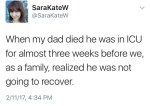
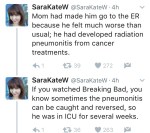

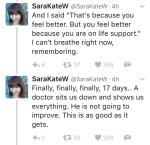
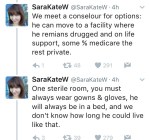



This is what Republicans try to demonize for political gain. Think about it.
“Death Panel” is an easy manipulation. Know why? Because death is FUCKING SCARY! For everyone involved – patient and family.
Know what else? Hospice care is FREE for Medicare and Medicaid patients. And it’s typically covered by private insurance at a high percentage (and realistically, if you qualify for hospice care, you’ve likely already met your deductible).
Here are some (American) hospice facts:
– hospice care is for anyone who receives a prognosis of six months of life or fewer.
– hospice care isn’t just for cancer or dementia patients. Any life-ending diagnosis qualifies for hospice care.
– hospice care isn’t just for elderly. Again, anyone who has a life expectancy of six months or fewer should quality for hospice care.
– every licensed hospice provider is required by federal law to use a team approach. The team includes the medical director (who is an MD), nurses (RNs and LPNs), CNAs, social workers (MSWs), chaplains, and volunteers. These people are death experts.
– the RN case managers see everything. EVERYTHING. Every imaginable living condition, every insane family dynamic, and every conceivable physical condition. They know wounds. They know symptoms. They know pain. Can’t poop? Ask a hospice nurse. I guarantee they’ll have a dozen recommendations, including their own secret recipe for a “brown bomb” or “crappuccino” or “loosey goosey”. They all taste like garbage, but YOU WILL POOP!
– hospice CNAs are maybe the most gentle people on the planet. They care for a patient like they’re caring for their own grandparent. They’ll wipe your butt and wash your armpits. They’ll hold your hand and cry with you. They’ll sing to you or paint your nails or trim your ear hair and they’ll do all of it without an ounce of judgement.
– hospice social workers know death. Lots of families hear social worker and think family drama. That’s not what hospice social workers do. (Though they do that too, when necessary.) They help with anything not directly medical. Moving the patient from the hospital to home? The social worker can help with logistics. Questions about money? The social worker probably knows, or knows where to send you for answers. Need help with a living will or DNR? Ask the social worker. Terrified about what the final moments might be like? The social worker can walk you through what to expect.
– a patient or family can choose hospice care at any point, whether immediately after receiving a diagnosis or within hours of death. Obviously, the longer the hospice team is involved, the better they can guide the patient and family along the journey.
– hospice care can be revoked at any time, should the patient or family choose to seek active treatment or discontinue the care. Hospice care can be reinstated as well – it’s typically just a matter of paperwork.
– here’s what Medicare and Medicaid cover for free
- the team home visits (home is considered wherever the patient currently lives, whether it’s the hospital, a long-term care facility, or their actual family home)
- the medications needed to treat the symptoms of the qualifying diagnosis, plus the pain management meds and anything else the medical director prescribes
- supplies – bed pads, diapers, gloves, bandages, etc
- equipment – hospital bed, oxygen, lifts, etc
- room and board isn’t covered if a patient is in a facility – that cost falls to the family.
Choosing hospice care isn’t giving up. It isn’t a death panel. It isn’t euthanasia. Choosing hospice care is acknowledging the reality that time is limited and that the patient deserves expert, specialized end-of-life care.
Hospice care is a choice. It’s not that surprising that Republicans are anti-choice.
Rebloging for the American followers.






























 Steel Phoenix Studios