I always send an email to my professors about a week before the semester starts that says this:
SUBJECT: Preferred Name
Body:
Dear [PROFESSOR’S PREFIX AND LAST NAME], My name is [YOUR FIRST AND LAST NAME], and I will be attending your course [COURSE TITLE] on [DAYS OF CLASS] at [TIME OF CLASS] this semester. I am transgender and have not yet legally changed my name. On your roster is my name is [LEGAL NAME]. I would greatly appreciate it if you refer to me as [PREFERRED NAME] and use [PREFERRED PRONOUNS] when referring to me. Thank you for your understanding, and I look forward to starting your course this week. Sincerely, [PREFERRED FULL NAME]
Also, look into seeing if your school has a preferred name policy! My school just implemented one last August! It still has some loose bolts so I email my professor’s still anyway but it can be helpful on school IDs and such!
As a prof, this is both overkill and perfect – very polite and very thorough.
I only say ‘overkill’ because I get a lot of email in August and September and would be happy with something that got to the point a little faster:
Dear Professor [name],
I’m in your [course number or title] class, [section number if applicable] this semester. My name on official documents is [legal name], but I would greatly appreciate it if you would use [preferred name] and [preferred pronouns].
Thanks for your understanding, [etc.]
I don’t need to know why, unless someone is comfortable disclosing. I just need to respect it.
(I’ve even had “hey, my name on the list is [name] but I go by [name] and [pronouns] instead. cool?” … But I teach in a very informal department, and while I was fine with it, I wouldn’t actually recommend that course of action as a first contact. XD )
A message to teachers who refuse to pronounce the names of their students of color correctly.
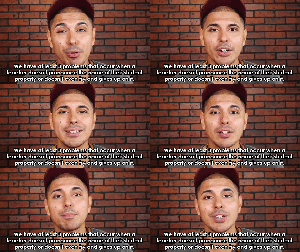
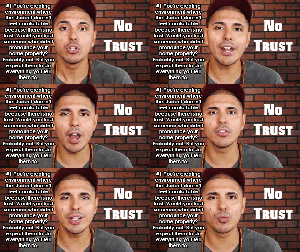
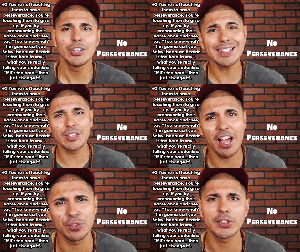
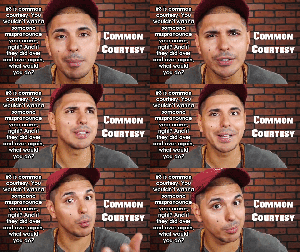
In a new video, Adam Levine-Peres, an educator in the Bronx, talks about the importance of teachers, especially white teachers, learning how to pronounce the names of Black and Brown students properly. He says pronouncing the students’ names correctly “will go along way in the classroom”, otherwise there might be lack of trust, students might end up giving up on things like their teacher gave up on saying their name the right way.
some highlights from my students’ romeo and juliet modern interpretation projects:
– someone made a username for friar laurence with 420 at the end – the same kid who put 69 in romeo’s username like i wouldn’t know what either of those things mean – the girl who added ‘clean’ at the end of all the songs on her juliet playlist like lmao girl i know spotify doesn’t have the clean version – the kid who said romeo and juliet killed each other – the weird dichotomy of kids who put love story on their playlist vs the kids who choose bad blood – the kid who wrote ‘get a room’ as tybalt’s comment on romeo’s couple pic – the kid who said ‘romeo is probably one of those douches who follows a ton of people so they follow him back and then he unfollows all of them’ – the one who legitimately used the word ‘alrighty’ do kids say this in their text messages???? i thought i was the one talking like an elderly person but okay – the one who made romeo’s username ‘montagoose’ – the only kid who acknowledged that posting about your secret relationship on instagram was a bad idea – the girl who wrote that romeo would unironically say ‘#blessed’. she’s right. – the one single solitary girl who wrote mercutio as gay as shakespeare did (she’s also the only one who used mercutio at all which is a tragedy but whatever) – the one who wrote romeo’s insta bio as ‘thus with a kiss i die… LOL RIP ME 😂💀’ – the one who made benvolio’s username benvoliYO
I worked with toddlers and pre schoolers for three years. Sometimes I accidentally slip and tell a friend to say bye to an inanimate object (“say bye bus!”) & occasionally they unthinkingly just do it.
I’m glad there’s a teacher version of “accidentally called teacher ‘mom’”
when I worked at Medieval Times occasionally I would slip in real life and call people “my lord”
One time during family prayer, dad began: “our father who art in heaven, American Airlines, how can I help you?”
One time my dad went to the White Castle drive-thru and the lady (who was supposed to say ‘Welcome to White Castle, what’s your crave?’) asked, “Welcome to White Castle, what’s your problem?”
She apologized profusely while my dad proceeded to lose his shit laughing.
Yesterday I went to Wendy’s and the girl said “Welcome to McDonalds” and then just sighed
Somebody in the elevator asked me what floor I lived on, and I answered “please open your books to page eight”, and we just kind of stared at each other, blinking.
i work retail full time and my script gets frequently messy – ill ask the same question twice, or say “$2.60 is your total” while handing back their change, or say “how are you doing today?” instead of “have a good day!” like name it ive bungled it
but anyway, this lady came thru my line buying a book and the review on the front said: “few books are well written, fewer still are important, and this book manages to be both”
as i handed her the bag i was trying to say “thanks, youre all set” and instead my brain mashed up the review and i said “thanks, youre important”
there was this short pause in which i tried to figure out what the fuck id just said. she blinked and then said “oh thank you! youre important too!”
the real kicker was one of my coworkers. when i was relating this story later his response was “at least you said something NICE. last week i accidentally combined ‘youre welcome’ and ‘no problem’ into ‘youre a problem’”
one time, since I used to work as a daycare teacher with preschoolers, i was on my college campus in my gym, and someone was running in the weight room and tripped over a machine and fell, and instead of offering to help, I just stared and said, “This is why we use our walking feet.”
we both sat there for a while until the guy nodded and said, “yeah, okay, i should’ve done that.”
I’ve spent a good chunk of time working in kitchens, so I still will reflexively say shit like “behind” and “coming around” as I maneuver through spaces and around people.
Which, actually, not such a bad thing; I’m a big guy and can come across as imposing pretty easily. The position calls can help defuse that, and also help avoid collisions.
Less good is the time my brain was half functional and I let slip a “coming with a knife” while grocery shopping. THAT took some explaining.
I work in an office and send tens of emails to customers every day. Once my mum asked me to send her a train ticket I had bought for her. I emailed her “Hello mum, as agreed, please find attached the ticked you requested. Thanks, Alex”
i worked as a camp counselor, and i would have the kids tap somewhere on my legs if they needed something because im a pretty tall dude. today asked my cat if he needed something.
I have woken up in a cold sweat saying “is that for here or to go?”
Every time a friend thanks me, and I respond with “gladly” or “my pleasure”, I die completely 1000% inside
I work at a plasma donation center. When processing donors, we call them by name, they walk up to the counter, and then we ask for their name and donor number. One time, instead of saying “Robert” I hollered “Name and donor number!?” into a full waiting room. Three people started announcing their names and donor numbers before we all realized that I fucked up.
In college, I was a barista at Borders (remember Borders, you guys?!) I once drove through Taco Bell on my way home after a shift. When the cashier said, “okay, that’ll be $5.46!” I cheerfully responded, “Do you have a Borders rewards card?”
I have dealt with so many difficult customers over the years that I used to angrily call my dog “Sir” when I was mad at him.
My first job was at my nearest Panera, and after coming home from a ten-hour Sunday morning shift, I was exhausted; but when my mom called me to come downstairs, instead of replying in the grumpy teenagerish tone I usually would, I said in my cheeriest, fakest voice, “Not a problem at all, let me just check with my manager!” before realizing my mistake.
my coworker went to back up the cash registers one time and she had been at customer service right before. when we finish with a customer we have to sometimes get the attention of the next person and will shout “i can get the next person in line!” but instead of saying that she yelled “HI WHAT CAN I HELP YOU WITH” to everyone in the general area
I have told my dog “no thank you” so many times after working at a preschool
a couple of times i’ve gotten stuck in a hello how are you good how are you good how are you loop with an equally tired Fred Meyer’s cashier after a long shift but the best time was after a 10 to 10 post-holidays after they told me my total, I asked if they would like a bag today and after a confused few seconds they were like, “no… I have the bags”
Worked in a gallery where we asked people to take off their backpacks in order not to accidentally damage paintings. So when I went to the shop later and saw a guy in the line in front of me, I told him he had to remove his backpack. He probably thought I was politely trying to rob him.
I teach in a secondary school. One time I was driving my friends to buy skates and had to make a tricky turn in a very tight space up a very steep hill. They were all cracking jokes with each other and it was hard to focus so I snapped without thinking, “Ladies in the back, kindly stop talking,” in pure school trip teacher voice.
to be fair: it worked. they stopped talking.
I’ve worked at call centres almost all my working life. The number of times I’ve answered my personal phone with “Welcome to business faults, how can I help?” is… countless.
An assignment I actually wrote on the board this week:
In groups, write 2 sentences (in Latin) using only the
vocabulary in your textbook. Make sure to include:
1 irregular verb
1 imperfect verb
5 cases
BEES?
I’ll elaborate in a minute, but I need to stop laughing
first.
So I’d originally planned on a 20-minute grammar lesson,
followed by a handout to be finished in pairs, but I’d made the mistake of telling
this class about Latin Day in April and how we were encouraging them to come to
school in costume. All they wanted to do was talk about costume opportunities
(and since I would like to keep my job, I had to explain why staging Caesar’s assassination
in the middle of the lunchroom would be a Bad Idea), so I shifted gears and decided
to channel that creative/social energy into a different assignment.
After lugging them through a condensed version of the
grammar lesson on irregular verbs in the imperfect tense, I split them into
groups and pulled an assignment out of the air.
The requirements:
Write two sentences in Latin
Use ONLY vocabulary from the textbook
Include at least ONE irregular verb
Include at least ONE verb in the imperfect tense
Include 5 (out of 6, including the vocative)
cases
The goal:
To write them on the board for their ‘rival’
groups to translate
They are a competitive bunch, so I knew this would be enough
to encourage them to go All Out. But then one student raised her hand.
“Can our sentences be about bees?” she asked.
Bees. I swear this class has a thing with Bees. I hesitated.
“There are no bees in your textbook.”
“Yes, but you taught us that word.”
I had, back when this same student had asked me how to say “the
bees are suffering” for a kahoot she was writing. Granted, this same student is
planning on coming in on Latin Day dressed as Caligula’s horse, so none of this
surprises me.
I opened it up to the other ‘groups’. “What do you think?” I
asked. “Should we let them write about bees?”
“No,” said one student with a heavy sort of solemnity, looking
me dead in the eye. “We should all be required
to write about bees.”
As the rest of the class eagerly cheered and nodded in
agreement, three things occurred to me.
The word for bee, “apis”, is a 3rd-declension
i-stem noun, which they could use more practice on.
They’re going to want to describe the bees,
which means they will likely also be practicing noun-adjective agreement with a
3rd-declension i-stem noun, which they could also use more practice
on.
This could be flipping hilarious.
And so I added “BEES?” to the list.
The results:
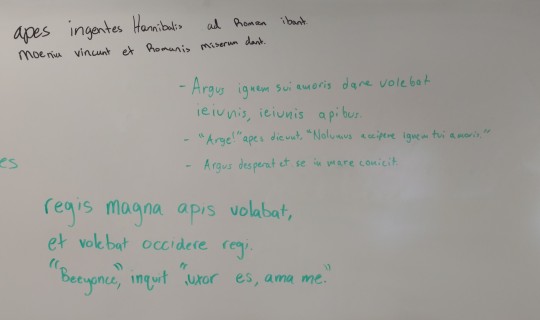
1. apes ingentes Hannibalis ad Romam ibant. Moenia vincunt et Romanis miserum dant.
“The giant bees of Hannibal
were going to Rome. They conquer the walls and give misery to the Romans.” In hindsight the noun miseriam would have been better, but still solid. Mentions bees AND misery. Implies an AU where Hannibal brought giant bees
across the Alps instead of elephants. Carthage wins the Punic Wars. 10/10
2. Argus ignem sui amoris dare volebat ieiunis, ieiunis apibus. “Arge!” apes dicunt. “Nolumus accipere ignem tui amoris.” Argus desperat et se in mare conicit.
“Argus was wishing to give
the fire of his love to the hungry, hungry bees. ‘Argus!’ the bees say. ‘We do
not want to accept the fire of your love.’ Argus despairs and hurls himself
into the sea.” Descriptive. Tragic. Mentions fire. Has something for
everyone. Also 10/10
3. regis magna apis volabat, et volebat occidere regi. “Beeyonce,” inquit, “uxor es. Ama me.”
“The great bee of the king
was flying, and he was wishing to kill for the king. ‘Beeyonce,’ he said. ‘You
are my wife. Love me.’ ” 100/10 for Beeyonce.
“I want to be a hematologist. That’s a blood doctor. Well not a blood doctor, exactly. But a doctor that finds cures for blood diseases.” “How’d you decide on that?” “We were dissecting frogs in class and learning about how the blood flows through the body. And I went home that night and wrote an essay. And it wasn’t like any other essay I’d ever done. Normally when I write essays, it takes me a long time, but this was the fastest essay I ever wrote. So the next day I was asking the teacher mad questions, and she was like, ‘You know you can get a job in this.’ And she pulled it up on the internet, and was showing me all about hematologists.”
SUPPORT THIS BOY
I love it when someone gets that thunderbolt “I wanna do this forever” moment. It’s amazing to see that change in them once they’ve got an actual concrete dream to work towards.
Rejoice fellow uni students looking for some studyspo, we urge you to take a few free lessons, as well as academic lessons provided from actual universities on several topics. Have a look at the 50 top learning sites you can find online to help you save some time.
Art and Music
Dave Conservatoire — Dave Conservatoire is an entirely free online music school offering a self-proclaimed “world-class music education for everyone,” and providing video lessons and practice tests.
Drawspace — If you want to learn to draw or improve your technique, Drawspace has free and paid self-study as well as interactive, instructor-led lessons.
Justin Guitar — The Justin Guitar site boasts over 800 free guitar lessons which cover transcribing, scales, arpeggios, ear training, chords, recording tech and guitar gear, and also offers a variety of premium paid mobile apps and content (books/ ebooks, DVDs, downloads).
Math, Data Science and Engineering
Codecademy— Codecademy offers data science and software programming (mostly Web-related) courses for various ages groups, with an in-browser coding console for some offerings.
Stanford Engineering Everywhere — SEE/ Stanford Engineering Everywhere houses engineering (software and otherwise) classes that are free to students and educators, with materials that include course syllabi, lecture videos, homework, exams and more.
Big Data University — Big Data University covers Big Data analysis and data science via free and paid courses developed by teachers and professionals.
Better Explained — BetterExplained offers a big-picture-first approach to learning mathematics — often with visual explanations — whether for high school algebra or college-level calculus, statistics and other related topics.
Design, Web Design/ Development
HOW Design University — How Design University (How U) offers free and paid online lessons on graphic and interactive design, and has opportunities for those who would like to teach.
HTML Dog — HTML Dog is specifically focused on Web development tutorials for HTML, CSS and JavaScript coding skills.
Skillcrush — Skillcrush offers professional web design and development courses aimed at one who is interested in the field, regardless of their background — with short, easy-to-consume modules and a 3-month Career Blueprints to help students focus on their career priorities.
Hack Design — Hack Design, with the help of several dozen designers around the world, has put together a lesson plan of 50 units (each with one or more articles and/or videos) on design for Web, mobile apps and more by curating multiple valuable sources (blogs, books, games, videos, and tutorials) — all free of charge.
General – Children and Adults
Scratch – Imagine, Program, Share — Scratch from MIT is a causal creative learning site for children, which has projects that range from the solar system to paper planes to music synths and more.
Udemy— Udemy hosts mostly paid video tutorials in a wide range of general topics including personal development, design, marketing, lifestyle, photography, software, health, music, language, and more.
E-learning for kids — E-learning for Kids offers elementary school courses for children ages 5-12 that cover curriculum topic including math, science, computer, environment, health, language, life skills and others.
Ed2go — Ed2go aims their “affordable” online learning courses at adults, and partners with over 2,100 colleges and universities to offer this virtual but instructor-led training in multiple categories — with options for instructors who would like to participate.
GCF Learn Free — GCFLearnFree.org is a project of Goodwill Community Foundation and Goodwill Industries, targeting anyone look for modern skills, offering over 1,000 lessons and 125 tutorials available online at anytime, covering technology, computer software, reading, math, work and career and more.
Stack Exchange — StackExchange is one of several dozen Q+A sites covering multiple topics, including Stack Overflow, which is related to computer technology. Ask a targeted question, get answers from professional and enthusiast peers to improve what you already know about a topic.
HippoCampus — HippoCampus combines free video collections on 13 middle school through college subjects from NROC Project, STEMbite, Khan Academy, NM State Learning Games Lab and more, with free accounts for teachers.
Howcast— Howcast hosts casual video tutorials covering general topics on lifestyle, crafts, cooking, entertainment and more.
Memrise — Lessons on the Memrise (sounds like “memorize”) site include languages and other topics, and are presented on the principle that knowledge can be learned with gamification techniques, which reinforce concepts.
SchoolTube — SchoolTube is a video sharing platform for K-12 students and their educators, with registered users representing over 50,000 schools and a site offering of over half a million videos.
Instructables — Instructables is a hybrid learning site, offering free online text and video how-to instructions for mostly physical DIY (do-it-yourself) projects that cover various hands-on crafts, technology, recipes, game play accessories and more. (Costs lie in project materials only.)
creativeLIVE — CreativeLive has an interesting approach to workshops on creative and lifestyle topics (photography, art, music, design, people skills, entreprenurship, etc.), with live access typically offered free and on-demand access requiring purchase.
Do It Yourself— Do It Yourself (DIY) focuses on how-tos primarily for home improvement, with the occasional tips on lifestyle and crafts topics.
Adafruit Learning System — If you’re hooked by the Maker movement and want to learn how to make Arduino-based electronic gadgets, check out the free tutorials at Adafruit Learn site — and buy the necessary electronics kits and supplies from the main site.
Grovo — If you need to learn how to efficiently use a variety of Web applications for work, Grovo has paid (subscription, with free intros) video tutorials on best practices for hundreds of Web sites.
General College and University
edX — The edX site offers free subject matter from top universities, colleges and schools from around the world, including MIT and Harvard, and many courses are “verified,” offering a certificate of completion for a nominal minimum fee.
Cousera— Coursera is a learning site offering courses (free for audit) from over 100 partners — top universities from over 20 countries, as well as non-university partners — with verified certificates as a paid option, plus specializations, which group related courses together in a recommended sequence.
MIT Open Courseware— MIT OpenCourseWare is the project that started the OCW / Open Education Consortium [http://www.oeconsortium.org], launching in 2002 with the full content of 50 real MIT courses available online, and later including most of the MIT course curriculum — all for free — with hundreds of higher ed institutions joining in with their own OCW course materials later.
Open Yale Courses — Open Yale Courses (OYC) are free, open access, non-credit introductory courses recorded in Yale College’s classroom and available online in a number of digital formats.
Open Learning Initiative — Carnegie Mellon University’s (CMU’s) Open Learning Initiative (OLI) is course content (many open and free) intended for both students who want to learn and teachers/ institutions requiring teaching materials.
Khan Academy — Khan Academy is one of the early online learning sites, offering free learning resources for all ages on many subjects, and free tools for teachers and parents to monitor progress and coach students.
MIT Video— MITVideo offers over 12,000 talks/ lecture videos in over 100 channels that include math, architecture and planning, arts, chemistry, biological engineering, robotics, humanities and social sciences, physics and more.
Stanford Online — Stanford Online is a collection of free courses billed as “for anyone, anywhere, anytime” and which includes a wide array of topics that include human rights, language, writing, economics, statistics, physics, engineering, software, chemistry, and more.
Harvard Extension School: Open Learning Initiative — Harvard’s OLI (Open Learning Initiative) offers a selection of free video courses (taken from the edX selection) for the general public that covers a range of typical college topics, includings, Arts, History, Math, Statistics, Computer Science, and more.
Canvas Network — Canvas Network offers mostly free online courses source from numerous colleges and universities, with instructor-led video and text content and certificate options for select programs.
Quantum Physics Made Relatively Simple — Quantum Physics Made Relatively Simple” is, as the name implies, a set of just three lectures (plus intro) very specifically about Quantum Physics, form three presentations given by theoretical physicist Hans Bethe.
Open UW — Open UW is the umbrella initiative of several free online learning projects from the University of Washington, offered by their UW Online division, and including Coursera, edX and other channels.
UC San Diego Podcast Lectures — Podcast USCD, from UC San Diego, is a collection of audio and/or video podcasts of multi-subject university course lectures — some freely available, other only accessible by registered students.
University of the People— University of the People offers tuition-free online courses, with relatively small fees required only for certified degree programs (exam and processing fees).
NovoEd— NovoEd claims a range of mostly free “courses from thought leaders and distinguished professors from top universities,” and makes it possible for today’s participants to be tomorrow’s mentors in future courses.
IT and Software Development
Udacity — Udacity offers courses with paid certification and nanodegrees — with emphasis on skills desired by tech companies in Silicon Valley — mostly based on a monthly subscription, with access to course materials (print, videos) available for free.
Apple Developer Site — Apple Developer Center may be very specific in topics for lessons, but it’s a free source of documentation and tutorials for software developers who want to develop apps for iOS Mobile, Mac OS X desktop, and Safari Web apps.
Google Code— As with Apple Developer Center, Google Code is topic-narrow but a good source of documentation and tutorials for Android app development.
Code.org — Code.org is the home of the “Hour of Code” campaign, which is aimed at teachers and educators as well as students of all ages (4-104) who want to teach or learn, respectively, computer programming and do not know where to start.
Mozilla Developer Network— MDN (Mozilla Developer Network) offers learning resources — including links to offsite guides — and tutorials for Web development in HTML, CSS and JavaScript — whether you’re a beginner or an expert, and even if you’re not using Mozilla’s Firefox Web browser.
Learnable — Learnable by Sitepoint offers paid subscription access to an ebook library of content for computers and tablets, and nearly 5,000 videos lessons (and associated code samples) covering software-related topics – with quizzes and certification available.
Pluralsight— Pluralsight (previously PeepCode) offers paid tech and creative training content (over 3,700 courses and 130K video clips) for individuals, businesses and institutions that covers IT admin, programming, Web development, data visualization — as well as game design, 3D animation, and video editing through a partnership with Digital-Tutors.com, and additional software coding lessons through Codeschool.com.
CodeHS — CodeSchool offers software coding lessons (by subscription) for individuals who want to learn at home, or for students learning in a high school teacher-led class.
Aquent Gymnasium— Gymnasium offers a small but thorough set of free Web-related lesson plans for coding, design and user experience, but filters access by assessing the current knowledge of an enrollee and allows those with scores of at least 70% to continue.
You’re never too old (or too young!) to learn something new!
I just got swarmed by a dozen preschoolers who were VERY touchy and VERY interested in my lesson. They were three toddlers petting my hair while I tried to teach them about animal teeth… the rest all opened their mouths as wide as possible and shoved themselves close to my face so that I could see that they, too, had teeth in their mouths.
Great job, babies. You sure do have teeth. Thank you for not biting me while you attacked me with hugs.












 Steel Phoenix Studios