the-stray-liger:

trashedandwroth:

datmassivepanda:

trapqueenkoopa:

aspiringwarriorlibrarian:

greaseonmymouth:

mllemusketeer:

inushiek:

deniedmysign:

scarletgoldenthorn:

fridjitzu:

did-you-kno:

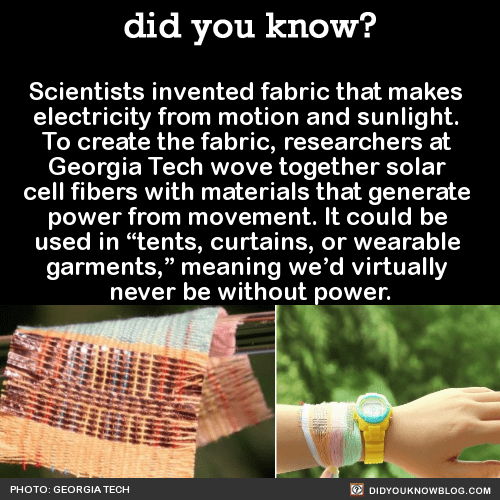
Scientists invented fabric that makes
electricity from motion and sunlight.
To create the fabric, researchers at
Georgia Tech wove together solar
cell fibers with materials that generate
power from movement. It could be
used in “tents, curtains, or wearable
garments,” meaning we’d virtually
never be without power. Source

Y’all are fucking idiots. Clean energy will NEVER be enough to replace the energy we have now. We’d have to tear down DOZENS of forests just to fit enough windmills and solar panels to get even a QUARTER (probably less, tbh) of the energy we can produce now.

Yeah, sure, when they’ve already calculated that a few square miles of panels in the empty ass Arizona desert could power the whole nation. But ok, fracking and the diminishing petroleum supply is worlds better.

Nevermind that windmills are often most efficient off the coast. There they take up no land, impact no trees, don’t pollute the water, and are conveniently located where winds are often strongest anyway.

And solar panels can literally be built into roofs of buildings and in empty areas like deserts. The sun strikes the Earth with the same amount of energy in an hour that our civilization uses in a year.

But yeah, it would be impossible for us to ever have enough energy from clean sources.

Durr hurr technology is bad and I would rather light shit on fire than have clean energy

I can also testify to the Arizona desert being empty ass. And the California desert. And the Nevada desert. 

also…no forests were cleared to make space for Denmark’s windmills and yet they regularly produce so much power that it covers almost all of the country’s power needs. Oh, and then there’s the times when the windmills generate 140% of Denmark’s power needs. https://www.theguardian.com/environment/2015/jul/10/denmark-wind-windfarm-power-exceed-electricity-demand

Friendly reminder that oil pipelines are a scam.

The fact that anyone can believe a limited amount of dinosaur oil is more plentiful and efficient than moving air or fucking sunlight is proof that entire populations can be completely brainwashed.

I’m here for the clean energy smackdown!

clean energy smackdown!

Costa Rica has been powering itself almost exclussively through hydroelectric, eolic and geotermic means for a while lmao all you need to do is not be a coward

beabcurd:

irenezelle:

brunhiddensmusings:

wtf-fun-factss:

India’s Plastic Roads – WTF fun fact

‘we are dumping all this waste that will not biodegrade and will still be present intact in hundreds of years’

‘we also have these roads that degrade in less then twenty years and need frequent costly repairs’

‘guess these two completely unrelated problems will never be solved’

WHAT ARE WE WAITING FOR

our costly road repairs rely heavily on oil and coal based products

you want to fix our environmental hellscape?
burn the fuckers who are directly profiting from destroying our planet

Did somebody say space laser?

nasa:

We’re set to launch ICESat-2, our most advanced laser instrument of its kind, into orbit around Earth on Sept. 15. The Ice, Cloud and land Elevation Satellite-2 will make critical observations of how ice sheets, glaciers and sea ice are changing over time, helping us better understand how those changes affect people where they live. Here’s 10 numbers to know about this mission:

image

One Space Laser

There’s only one scientific instrument on ICESat-2, but it’s a marvel. The Advanced Topographic Laser Altimeter System, or ATLAS, measures height by precisely timing how long it takes individual photons of light from a laser to leave the satellite, bounce off Earth, and return to ICESat-2. Hundreds of people at our Goddard Space Flight Center worked to build this smart-car-sized instrument to exacting requirements so that scientists can measure minute changes in our planet’s ice.

image

Sea ice is seen in front of Apusiaajik Glacier in Greenland. Credit: NASA/JPL-Caltech/Jim Round

Two Types of Ice

Not all ice is the same. Land ice, like the ice sheets in Greenland and Antarctica, or glaciers dotting the Himalayas, builds up as snow falls over centuries and forms compacted layers. When it melts, it can flow into the ocean and raise sea level. Sea ice, on the other hand, forms when ocean water freezes. It can last for years, or a single winter. When sea ice disappears, there is no effect on sea level (think of a melting ice cube in your drink), but it can change climate and weather patterns far beyond the poles.

image

3-Dimensional Earth

ICESat-2 will measure elevation to see how much glaciers, sea ice and ice sheets are rising or falling. Our fleet of satellites collect detailed images of our planet that show changes to features like ice sheets and forests, and with ICESat-2’s data, scientists can add the third dimension – height – to those portraits of Earth.

image

Four Seasons, Four Measurements

ICESat-2’s orbit will make 1,387 unique ground tracks around Earth in 91 days – and then start the same ground pattern again at the beginning. This allows the satellite to measure the same ground tracks four times a year and scientists to see how glaciers and other frozen features change with the seasons – including over winter.

image

532 Nanometer Wavelength

The ATLAS instrument will measure ice with a laser that shines at 532 nanometers – a bright green on the visible spectrum. When these laser photons return to the satellite, they pass through a series of filters that block any light that’s not exactly at this wavelength. This helps the instrument from being swamped with all the other shades of sunlight naturally reflected from Earth.

image

Six Laser Beams

While the first ICESat satellite (2003-2009) measured ice with a single laser beam, ICESat-2 splits its laser light into six beams – the better to cover more ground (or ice). The arrangement of the beams into three pairs will also allow scientists to assess the slope of the surface they’re measuring.

image

Seven Kilometers Per Second

ICESat-2 will zoom above the planet at 7 km per second (4.3 miles per second), completing an orbit around Earth in 90 minutes. The orbits have been set to converge at the 88-degree latitude lines around the poles, to focus the data coverage in the region where scientists expect to see the most change.

image

800-Picosecond Precision

All of those height measurements come from timing the individual laser photons on their 600-mile roundtrip between the satellite and Earth’s surface – a journey that is timed to within 800 picoseconds. That’s a precision of nearly a billionth of a second. Our engineers had to custom build a stopwatch-like device, because no existing timers fit the strict requirements.

image

Nine Years of Operation IceBridge

As ICESat-2 measures the poles, it adds to our record of ice heights that started with the first ICESat and continued with Operation IceBridge, an airborne mission that has been flying over the Arctic and Antarctic for nine years. The campaign, which bridges the gap between the two satellite missions, has flown since 2009, taking height measurements and documenting the changing ice.

image

10,000 Pulses a Second

ICESat-2’s laser will fire 10,000 times in one second. The original ICESat fired 40 times a second. More pulses mean more height data. If ICESat-2 flew over a football field, it would take 130 measurements between end zones; its predecessor, on the other hand, would have taken one measurement in each end zone.

image

And One Bonus Number: 300 Trillion

Each laser pulse ICESat-2 fires contains about 300 trillion photons! Again, the laser instrument is so precise that it can time how long it takes individual photons to return to the satellite to within one billionth of a second. 

Learn more about ICESat-2: https://www.nasa.gov/icesat-2

Make sure to follow us on Tumblr for your regular dose of space: http://nasa.tumblr.com.

a tale of trees and espionage

emberglows:

okay story time:

my professor (lovely man, married to our TA, 5’2", about as intimidating as a muffin) is a dendrologist by trade, so he studies trees. it was about three hours into our social sciences course, last lecture before exams, everyone was frazzled and exhausted, so he told us about his most exciting/in-depth research to date to cheer us up.

(the few of us who actually showed up were like “ok sir im sure its fascinating” but in our minds we were totally like its trees what. is. exciting. about trees. You might be wondering the same thing – the acorns? the leaves? the roots? BUT NO. IMMA FUCKIN TELL YA.)

ANYWAY we settle in, he had a few pictures loaded up from his field work (we were chuckling at this point…. ‘hehehe field work’ i giggled to my frend. its trees.) and began to tell his tale. it’s long, imma warn you, but……. god. just read it.

theres an species of tree called the cucumber tree (Magnolia acuminata, if ya wanna get all Latin-y). its super endangered, in our region there’s only ~280 that are registered by the government, yadda yadda yadda. my prof thought that was tragic (i know) but also strange, because when he was writing his thesis about local trees years ago, he kept coming across cucumber trees in really random places. we’re talking like backyards, independently-owned nurseries, etc. WHICH IS IMPOSSIBLE because, according to tree law (i know) it is very strictly protected by the government, and thus super “illegal to possess, transport, collect, buy or sell any part of a living or dead member of a listed species if it originates from wild sources.” essentially, the govt takes control over growing the trees and anyone who independently raises them is breaking the law (i know)

so he’d ask people “do you have a permit for these trees?” and they were like “uh no, it’s just a tree someone sold me, i think it looks nice, are you gonna arrest me?” so he’d be like “nah nah nah just tell me who sold it to you”

eventually, months/years later, someone did, and turns out it was like this underground sort-of illegal tree dealing club (i know). so my prof went, got a bit of funding from the government, who were getting pissed at independent cucumber tree numbers, and THIS IS WHERE IT GETS INTO THE GOOD SHIT I STG.

he infiltrates the tree trafficking organization. he buys a cucumber tree from an independent nursery, raises it for months, ensures he gets noticed by the traffickers, and then INFILTRATES it and convinces its leader to LET HIM JOIN. he has to pay like a steep entrance fee, which he does (and it blows my mind that the government of my country paid money to illegal tree dealers), but then he is given full access to records and maps because they think he’s one of them, not a SECRET AGENT.

now this part blows my mind because the tree lords don’t even have to try very hard to find cucumber trees because government agents MARK THE TREES AND DISTINCTLY TAG THEM SAYING THIS IS ENDANGERED DO NOT TOUCH. so, ya know…………. it’s a bit obvious. my prof hangs out with the members so much that he figures out their “hit spots”. these are where the trees are relatively secluded and unguarded. (he writes all this shit and numbers down for his research.)

BUT THATS NOT ENOUGH BECAUSE THE GOVT SAYS HES WASTING THEIR FUNDING IF HE DOESNT HAVE PROOF and they are willing to take LEGAL ACTION for misuse of funding (my prof doesn’t have the money nore time nor power to take them to court, which would also blow his cover). so my prof literally STAKES OUT a copse of cucumber trees at a recognized wildlife reserve for. DAYS. he camps there, and watches the trees, is about to give up, he’s going off an unreliable rumor from the traffickers that a harvester would be going there within the next week. finally, this guy comes and takes the cucumber tree seeds from the CLEARLY MARKED trees by the government, and my prof takes pictures (we are shown these pictures, most of us are speechless at this point). dozens of candid shots of a man my grandpa’s age with a grocery store bag, garden shears, and a ladder, clipping away the illegal seeds and then going on his merry fucking way.

so my prof has the proof, he’s been undercover for months now at this point, he writes up his report, gives it to the government who is like…….. “oh shit”, helps them draft up a new LESS COMPLETELY FUCKING OBVIOUS way of marking endangered trees (so that way non-tree-lovers wouldn’t damage them further, etc.), and then never returns to the tree traffickers. he’d given them a fake name, address, everything….. he disappears.

…there was a full minute of stunned silence from us students at this point, during which he grew more and more nervous (again, he’s a muffin) and all of us students are just like……. “whoa.” we asked him what happened to the remaining illegal cucumber trees & if he turned the tree dealers in to the government, and that is when he smiles a little bit and shows us the last few pictures. because here’s the kicker… he never turned the smugglers in. he burned all the data he collected, defied the government pressuring him to turn them in, and the only reason he’s not incarcerated is because his work is so prominent in certain circles now & universities love him, that there would be an uproar if he got arrested. he’s like a fucking anti-hero and then he tells us (i’ll never forget, it’s the most inspirational green-thumb thing in the world) “it may be ‘illegal’, but those who risk their liberty to ~save the world~ should never be reprimanded, no matter what those in power say.”

we are all stunned. some of us are considering dendrology as a field we’d now be interested in pursuing. he clicks his slide one final time, before we leave our last lecture and, since he had an asthma attack (lil muffin) he didn’t attend our exam, so i never see him again…………

and there, on the slides, the last picture? THERE HE IS. in his own backyard. with his equally lovely TA wife. both grinning innocently, standing underneath a……. FUCKING. FULL GROWN. ILLEGAL. CUCUMBER TREE.

cricketcat9:

greycloudsandlinings:

vladdies:

vladdies:

have y’all seen that nasa pic of the earth with the sun behind it on the night time side it really really fucked me up my own soul became solid and like………….. weeped!

who wouldn’t see this and then look deeply into their own emotional playing field to see what improvements could be made purely inspired by the vulnerable earth. this is the face of all literal gods

That’s actually called the Overview Effect– something experienced by some astronauts that makes them see that “from space, national boundaries vanish, the conflicts that divide people become less important, and the need to create a planetary society with the united will to protect this “pale blue dot” becomes both obvious and imperative”.

We really need to send a few people in space. Now.

You know of any examples of wintry Solarpunk?

primarybufferpanel:

wetwareproblem:

homo-machina:

third-nature:

I’m not sure how all of the logistics would work (I’m more of a sociology guy than a STEM guy), but I don’t see why a colder climate wouldn’t be able to take advantage of renewable energy sources – geothermal and perfected solar technology and such.

Aesthetically, you’d probably end up with something very similar to the “Northern Lights glass igloos” in Finland:

image
image
image
image

Maybe connect all the igloos with a tunnel/tube system and have them all link up to a big hub at the center. Maybe the hub has advanced solar panels and sits on a geothermal hot spot, and the energy accumulated there could power the surrounding homes and buildings. 

People can and should add to this, because my winter solarpunk imagination is a tad limited. 

One thing to remember about northern climes is that while winter days are brief and dark, summer days are very, very long; in my part of the world, nights at the height of summer last something like six hours.  The issue comes with the winter months, when the sun all but disappears and the emphasis turns to keeping out the cold and lighting up the dark; geothermal is an excellent solution, but wind power is also a viable option that’s fairly popular.  Additionally, a concept exists wherein one uses walls as heat-sinks, absorbing sunlight and heat during brief winter days and using that to keep a structure warm through the night, combined with a broad roof to keep the sun off of it in the summer months when the sun hangs higher in the sky; scale it up a bit, and one could imagine entire south-facing housing complexes benefiting from this method.

Venturing into a more sci-fi sorta realm, one could take the most advantage of geothermal by constructing subterranean cities that siphon heat from the depths of the Earth’s crust, or take advantage of long summer days by setting up solar heat-sinks that store huge amounts of energy all summer and slowly release it through the winter.  On a smaller scale, combine OP’s transparent igloos with dark-colored spheres filled with something with a high heat capacity (even plain water would do) and you get something that takes up heat through the day and radiates it all night, a low-tech, solar-powered space heater (though combine this with ultra-black nano-compounds and glass that turns opaque at night to keep the infrared radiation inside and it becomes a bit less low-tech).

Solar is less of an option in cold climates – they’re cold because the solar energy density is lower. Geothermal and wind are the way to go.

Then there is tidal energy. Solarpunk doesn’t have to be literal solar

There’s been a big increase in the popularity of mudbrick, compressed earth, and stone housing, which is naturally insulating (both heat and cold) and is super economical. They’ve been doing it for millennia – check out the turf houses of Scandinavia and the underground houses of Tunisia (famously used as the Lars Homestead in Star Wars).

Also – I can’t find the link for it, but – there’s an aircon system using a series of liquid-filled coils buried in the ground (3-5m deep iirc), you can have natural heat exchange (warmth in the winter and cold in the summer), and all you need to power is the pump.