when i was in middle school, i got bullied for being a black fall out boy fan.
literally almost every day of my life these idiots would trash my interests and my personality because of my race.
all because “emo music is white culture”.
if you’re a person of color who’s bullied for their “white” interests, i raise my glass to you and wish you have an amazing day. it will get better, you rule.
if you’re white, you can and are encouraged to reblog this. thank you for being kind and wonderful to kids of color.
Also friendly reminder that Pete Wentz, the Fall Out Boy frontman, is half black. Referring to music/art created by POC as “white culture” is racist gatekeeping edgelord nonsense. You’re basically just telling your own people to “behave” and “stay in their place” – doing the white man’s work for him.
it’s sort of funny that the current cultural idea of the flapper dates not from the 1920s, but the 1950s when costume designers took the radical, gender-fluid, sexual, sexually liberated ideas and fashions of the 20s and made them sexy. as in sexual objectifying.
because 1950s and fuck female agency.
If you would like, I would love to hear more about this. What, exactly, happened, and what was the true 1920s aesthetic, untainted by 50s views?
hokay. so it’s the 1950s and it’s the heyday of the studio system and writers and movie makers (and audiences) want rom coms and frolicking films and lighthearted fun, but there’s just one problem.
WWII
but that was the 1940s! you say
you’re right.
but in order to set a film in the 1950s, writers and film makers have to establish what the male lead character did during the war or risk it coming across like he didn’t, well, serve. can’t have a shirker or a coward and rejected for medical reasons really doesn’t fly in the 1950s. and there’s only so many times you can write about soldiers and sailors and airmen and the occasional spy before it starts to become stale. and it doesn’t terribly fit with the fluffy writing because, well, war and death and tens of millions of people dead. contemporary films more fall in the line of what we now call film noir. men and women who have been damaged by war, but that’s another topic.
sooooo, you do period pieces. no one wants to do the 1930s because that’s the great depression. so 1920s. frolicking and gay and fabulous!
(Great War, what Great War?)
but the thing is, the 1920s, especially in Paris and Berlin, were a massively transgressive, reversal, and experimental time period in art, fashion, society, and all over. but only a little bit in america because honestly we were barely touched by wwi so it’s not like we’re partying to forget an entire generation of young men killed off and entire towns wiped off the face of the earth using weapons the likes of which had never been seen before. the us as a whole mostly heard about sarin gas, not see it poison entire landscapes and men and animals dropped to the ground and die in truly horrific ways.
the europe that emerged from wwi was massively shell shocked, angry, and living in a surreal dream of everything being upwards and backwards and live now because tomorrow you may die and it’s all nonsense anyway. it’s a world in which surrealism and dadaism and german expressionism make sense because fuck it all.
you get repudiation of the old, experimentation, deliberate reversals, transgressive behavior, and if there’s an envelope to push, you tear it open. France calls the 1920s “Années folles”, the crazy years.
the things we’re doing now, with fluidity and experimentation and exploration of gender and sexuality and presentation? the 1920s did that already. it’s drag and androgyny and blatant homosexuality. it’s extramarital affairs and sex before or without marriage, it’s rejection of marriage as an idea and an institution, it’s playing with gender and gender roles and working women and unrestrained art and
it’s everything the 1950s hated. or more accurately: absolutely terrified of.
the flappers of the 1920s went to college and cut their hair to repudiate a century of a woman’s hair being her crowning glory. they wore obvious makeup and makeup in ways that are not terribly appealing now and weren’t terribly appealing then, but they signaled you were part of the tribe.
they were women who wanted independence and personal fulfillment.
“She was conscious that the things she did were the things she had always wanted to do.“
so the 1950s didn’t want that. they wanted films with dancing and chorus lines and pretty girls to be looked at. they wanted spaghetti straps and fringed dresses that moved pretty when the chorus girls danced.
1920s fringe doesn’t. 1920s fringe is made of silk, incredibly dense, incredibly heavy, sewn on individually by hand, and rather delicate. the all-over fringe dress didn’t exist until the 1950s invention of nylon and continuous loops that could be sewn on in costume workshops by the mile on machines.
(this is before “vintage” exists. to the 1950s, the 1920s (or earlier) wasn’t vintage, it was old-fashioned. démodé. out of style. last last last last last season.)
1950s 1920s-set movies have clothes that are the 1950s take on it. the dresses have a dropped waist, but they’re form-fitting, figure-revealing. the actresses are pretty clearly wearing bras and 50s girdles under them a lot of the time. they’re not
the woman on the far left is basically wearing a man’s suit with a skirt. la garçonne. some women went full-out and wore pants. you could be arrested for that. they were. still wore pants. and pyjama ensembles in silk and loud prints.
or class photo of ‘25
or even
not that 1920s dresses could be sexy or sexual; they often were. i’ve seen 20s dresses that were basically sideless and held together with straps. but it’s sort of like how the mini skirt went from being a thing of sexual liberation to an item of sexual objectification.
it’s ownership and it’s agency and it’s hard to put a name or finger on it, but you just know. sex goddess versus sex icon.
Forgive me for adding to this, OP, but my favorite movie of all time is Singin’ in the Rain, a 1952 film set in 1927. If you look into the behind-the-scenes stuff about the costuming, the people involved talk a lot about how difficult it was because, quite frankly, 20s fashion was seen as laughably ugly by 50s standards. For them, it was what their parents wore before they were born, so think of just the worst 70s or 80s fashion you can imagine and trying to look glamorous in that. (Or for some of you tumblr kids, the 90s, but I’m here to tell you we looked great in that decade.) The closest they got is probably this:
Even here, Debbie Reynolds’s dress has a sheer overlay so you can see that really rigid, curvy 50s silhouette underneath it.
(Also, the ideal female body type was totally different and fashion hung on those frames very differently – flat and athletic and boyish in the 20s, stacked in the 50s. There’s a joke in the movie version of Thoroughly Modern Millie (1967, set in 1922) where Millie laments that her “fronts” are too “full” to let her long string of beads lie flat against her chest – the joke being that no woman would want to be smaller-busted.)
Anyway, I always thought that contrast between the fashion of the two decades and how the 50s were left struggling to interpret such a different aesthetic in a way that their audiences would find beautiful was fascinating, but I never thought about how that 50s reaction of “this is laughably ugly” might stem from a place of “this is alarmingly androgynous and non-constrictive and not designed for the male gaze.” LET KATHY SELDEN WEAR PANTS AND LIVE IN SIN.
This comes at a great time because my alma mater wants to have a flapper themed jubilee with the gowns and beads and shit, and I am a grumpy queer feminist alumna who will not hesitate to throw this stuff their way.
“Imagine having a child that refuses to hug you or even look you in the eyes”
Imagine being shamed, as a child, for not showing affection in a way that is unnatural or even painful for you. Imagine being forced, as a child, to show affection in a way that is unnatural or even painful for you. Imagine being told, as a child, that your ways of expressing affection weren’t good enough. Imagine being taught, as a child, to associate physical affection with pain and coercion.
As a preschool special ed para, this is very important to me. All my kids have their own ways of showing affection that are just as meaningful to them as a hug or eye contact is to you or me.
One gently squeezes my hand between both of his palms as he says “squish.” I reciprocate. When he looks like he’s feeling sad or lost, I ask if I can squish him, and he will show me where I can squish him. Sometimes it’s almost like a hug, but most of the time, it’s just a hand or an arm I press between my palms. Then he squishes my hand in return, says “squish,” and moves on. He will come ask for squishes now, when he recognizes that he needs them.
Another boy smiles and sticks his chin out at me, and if he’s really excited, he’ll lean his whole body toward me. The first time he finally won a game at circle time, he got so excited he even ran over and bumped chins with me. He now does it when he sees me outside of school too. I stick out my chin to acknowledge him, and he grins and runs over and I lean down for a chin bump.
Yet another child swings my hand really fast. At a time when another child would be seeking a hug, she stands beside me and holds my hand, and swings it back and forth, with a smile if I’m lucky. The look on her face when I initiate the hand swinging is priceless.
Another one bumps his hip against mine when he walks by in the hallway or on the playground, or when he gets up after I’m done working with him. No eye contact, no words, but he goes out of his way to “crash” into me, and I tell him that it’s good to see him. He now loves to crash into me when I’m least expecting it. He doesn’t want anything, really. Just a bump to say “Hi, I appreciate you’re here.” And when he’s upset and we have to take a break, I’ll bump him, ask if he needs to take a walk, and we just go wander for a bit and discuss whatever’s wrong, and he’s practically glued to my side. Then one more bump before we go back into the room to face the problem.
Moral of the story is, alternative affection is just as valid and vitally important as traditional affection. Reciprocating alternative affection is just as valid and vitally important as returning a hug. That is how you build connections with these children.
This is so goddamn important.
I verbally express affection. A LOT.
My husband… doesn’t. I don’t know why. For the longest time part of me wondered if it meant he loved me less.
At some point I told him about a thing I had done as a kid. Holding hands, three squeezes means ‘I Love You’.
Suddenly he’s telling me I Love You all the time.
Holding my hand, obviously, but also randomly.
taptaptap
on my hand, my shoulder, my butt, my knee, whatever body part is closest to him, with whatever part of him is closest to me
All the time.
More often than I ever verbally said it.
It’s an ingrained signal now, I can tap three times on whatever part of him, and get three taps back in his sleep. Apparently I do the same.
I’ve seen some comparisons between the Dora Milaje and Black Widows that gloss over a really key point.
The Dora Milaje are not abused.
Debate who’s more skilled or who’s better for a specific task, absolutely. (At this point, both comics and film canon is pretty overwhelmingly on the side of the Dora Milaje in every match-up we’ve seen, but there are certainly areas where people could have a good-spirited discussion, or imagine an amazing team-up.)
But I think that it’s really important to be explicit about this in any comparison: the Dora Milaje choose their role. They get to decide how to best use their own skills. In current comics canon and all MCU canon, everyone in the Red Room had their choices were taken away from them and their stories are either of taking that back, being corrupted by what was done to them, or death.
The Dora Milaje are champions of Wakanda. They are warriors; some are also spies. But they all have agency, and they have personalities. They were not depersonalized or stripped of their rights to make choices.
Arguably, the fact that being a member of the Dora Milaje is an honor, and that they choose to be there, is part of what makes them the best. And that says so many positive things, about both Wakanda as a country and about the Dora Milaje in particular and, more broadly, about the importance of women having agency over their own lives.
It disrespects the Dora Milaje to compare their training to the Red Room.
“Make sure to stay healthy. We should definitely meet up again.”
“Take care and see you someday.”
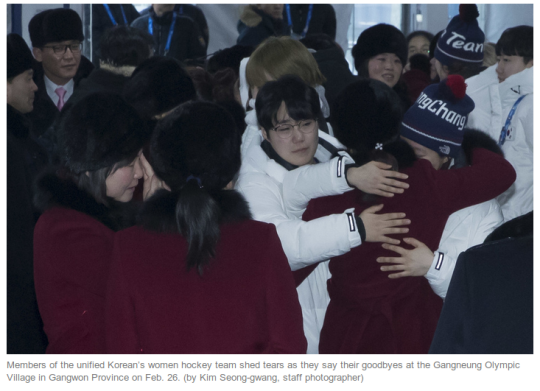
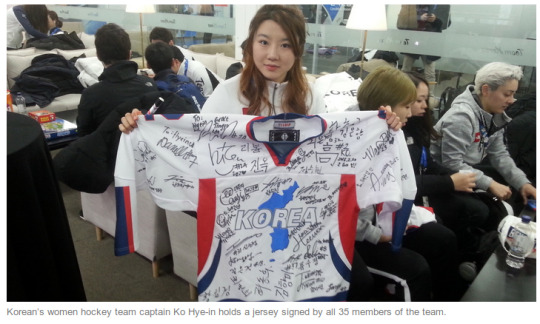
It was around 7:40 am on Feb. 26, and the welcome center in front of the Olympic athletes’ village in Gangneung was awash in tears. The bus was just 20 meters away, but it took the North Korean players on the unified women’s ice hockey team ten minutes to reach it. The South Korean athletes who had come to see them off embraced them tightly and would not let go. Team coach Sarah Murray and North Korean coach Pak Chol-ho also shared a tearful embrace. As they boarded the bus, the North Korean players opened the windows and reached their arms out to ease the pain of their goodbye.
“Who makes athletes cry? It’s just heartbreaking,” a Korea Ice Hockey Association (KIHA) official said.
On Feb. 23 and 24, the Hankyoreh visited Murray and the South Korean athletes at the Korea House in Gangneung’s Olympic Park to hear their fond memories of 33 days as a unified team.
When the 12 North Korean players first joined them at the Jincheon athletes’ village in North Chungcheong Province on Jan. 25, few truly understood how “peace” would become the 2018 Pyeongchang Olympics’ greatest legacy.
“The unified team was put together two weeks ahead of the Olympics, so there was a lot of concern,” Murray recalled.
But the unified Korean team proved the key driving force behind the Olympics’ success. The International Olympic Committee (IOC), which emphasizes the legacy of individual Olympics events, is certain to remember the Pyeongchang event as a “peace Olympics.” The puck used to score the team’s first goal in a Group B match against Japan is to be enshrined in the International Ice Hockey Federation (IIHF) Hall of Fame. Many foreign reporters could be seen cheering on the unified team members as they watched their matches. …


 Steel Phoenix Studios