Fannish History Friday: Crack Van

otw-fanlore:

image

“Want some candy, little fangirl?” This Fannish History Friday, we’re looking back on the long-running LiveJournal recs community Crack Van

Did you write a fandom primer, or sign up to pimp your fandom for a month? Did you discover a favorite story, or even a favorite fandom through a Crack Van post? If you remember Crack Van, add your experience to our page on Fanlore.


Not sure how to become an editor on Fanlore? Check out our wide variety of resources including tutorials or our new visitor portal. If you have any questions, you can also reach out to us directly by using the Ask feature on our Tumblr or email us. Happy editing!

Oh man. Crack Van was the best. The amount of times I fell down the hole of new fandoms or found new favourite fics was phenomenal. I drove the van for Generation Kill for a couple of months and it was a fantastic experience.

AO3 through the years

naryrising:

One odd complaint I’ve seen is that “AO3 hasn’t changed”.  First, if something is well designed and working, it shouldn’t need to change constantly (does anyone actually like it when Tumblr makes random changes to things? no.)

Second, even at a cosmetic level, it’s just… not true? Not unless you haven’t been around very long.

image

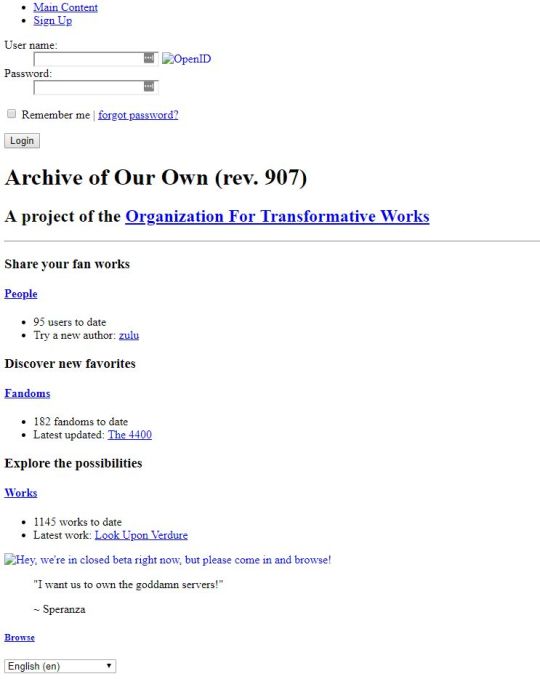
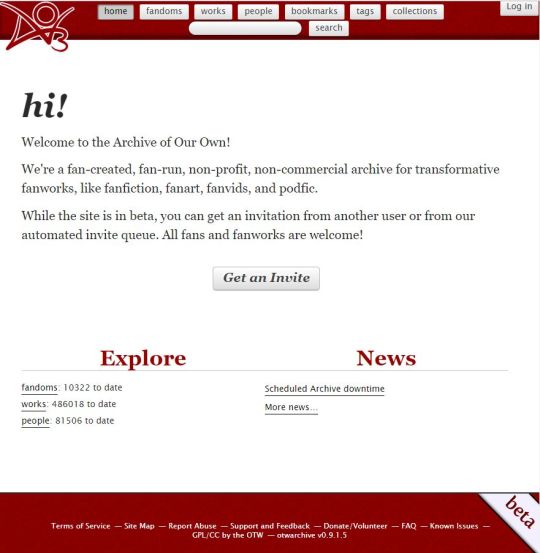
AO3 in 2008 – the first decent cap from the Wayback Machine.

image

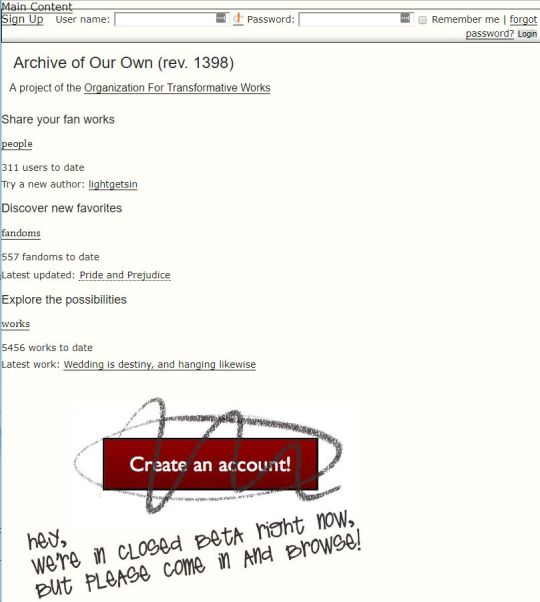
AO3 in 2009.  Still in closed beta.  About 5500 works.

image

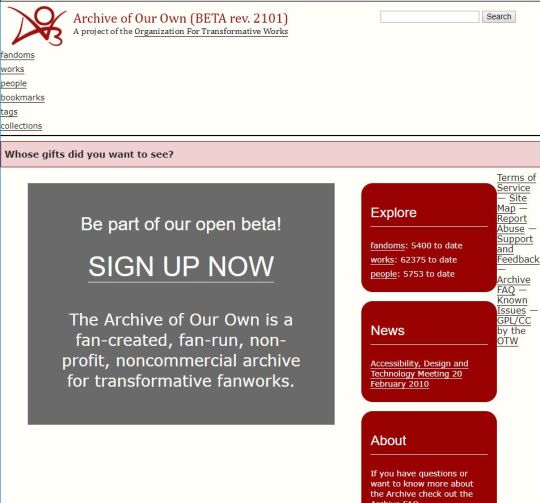
AO3 opens for general signups! 2010.  Also, our logo makes its appearance :3

image

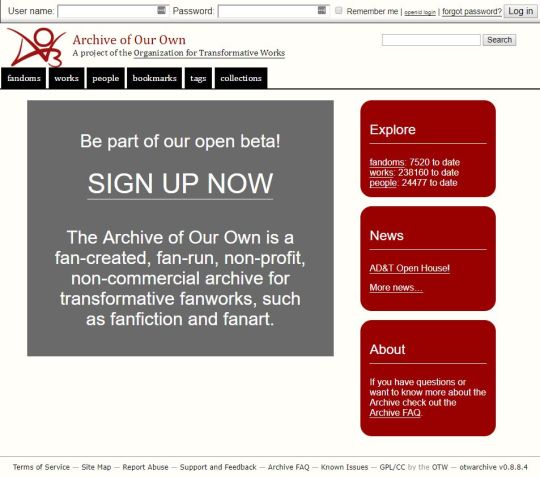
2011 – the tabs appear at the top of the page.  Things looking generally more tidy and less squished.

image

2012 – a more chipper intro page.  Things shifted around a bit as well.

image

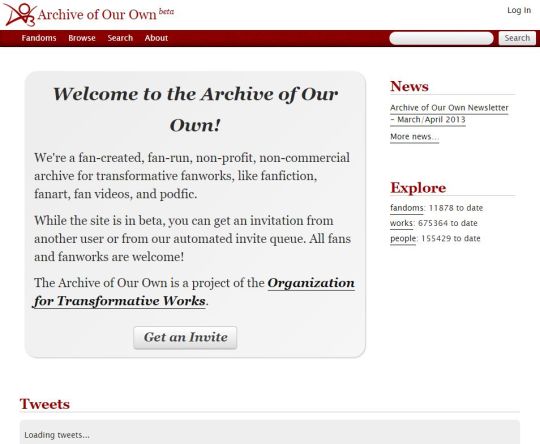
2013 – looking a little more classy now.  Tweets available on the main page.

image

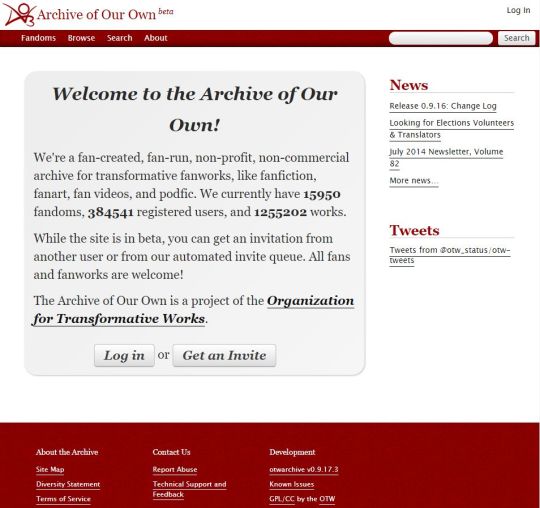
2014 – some more subtle changes, including adding the number of works and fandoms in a prominent place.  1.2 million works at that point…

image

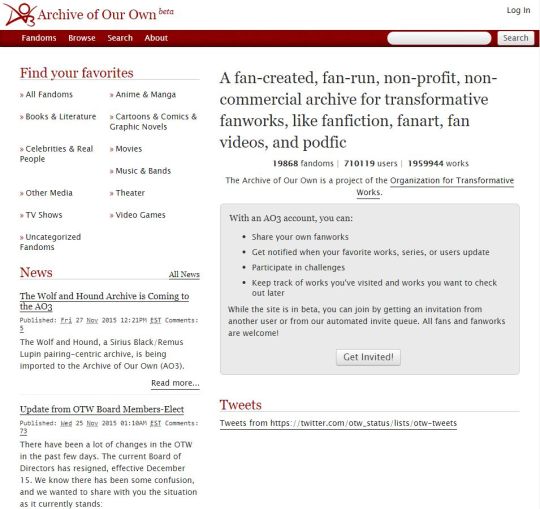
2015 – look how much it’s changed! The categories move to the front page for ease of access.  Recent news updates also on display.  Nearing 2 million works…

image

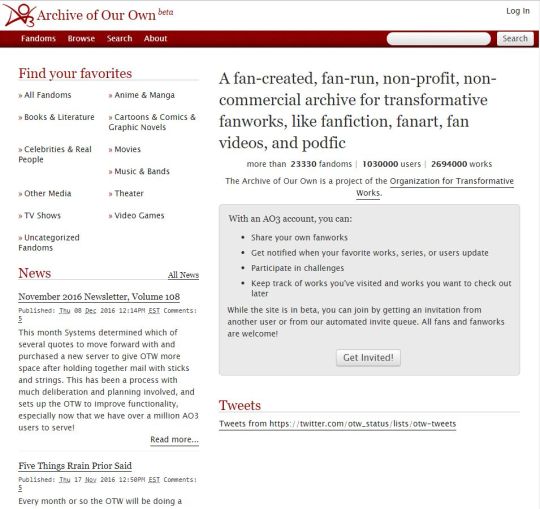
2016 – I admit I picked this one because of the news update about buying a new server “after holding together mail with sticks and strings”.  Nearing 2.7 million works.

image

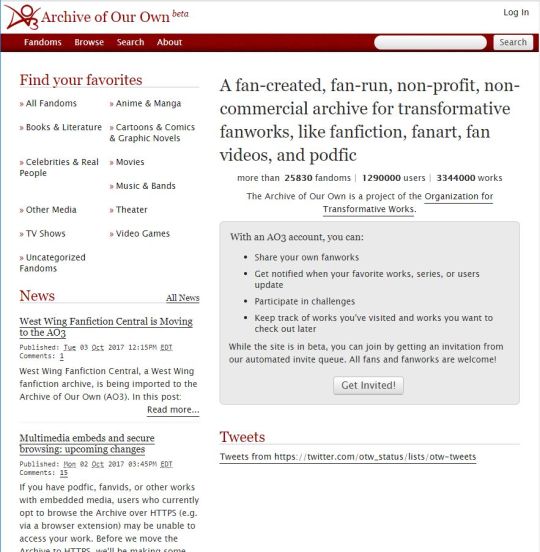
2017 – cosmetically few changes but look at the works number – 3.3 million works.  This was just about a year ago (October 2017) and the current number today is about 4.2 million.  You can also see from the news post that this was when we were in the middle of upgrading to HTTPS, which was a difficult but important process.

image

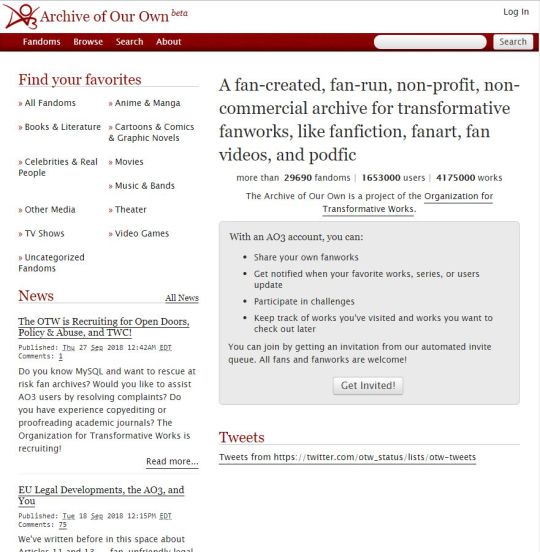
And here we are at more or less the present – 2018 (September to be precise).  I agree fully that if you joined the site in the last 3 years, you might not have seen a lot of cosmetic/interface changes, but that’s because people – volunteers – spent the previous 5-6 years hashing those out to get them into their present state.

More importantly, you might not have noticed the under the hood changes that necessarily come with going up by roughly a million works a year.  You might not have noticed the updates to site security that came with HTTPS, and maybe you didn’t even notice the huge changes to searching and filtering over the past few months.  I get that it’s easy to say “nothing has changed”.  That’s because there’s a team of volunteers who are working hard to make sure pages keep loading quickly, downloads keep working as expected, searches find you what you’re looking for, and downtime is kept to a minimum.  Without them, I guarantee you would notice a lot more changes at this rate of growth, and not for the better.

propinquitous:

gitwrecked:

viudanegraaa:

viudanegraaa:

Why are people still up in arms about AO3 needing donations to run? Their budget is publicly available. You can go onto the website, right now, and read it. If you donate more than a certain amount (pretty sure it’s more than $10), you can vote in their elections, because you’re considered a member, and that’s how memberships work.

It’s a free site to use, but not to run or to maintain, especially not with all these net neutrality battles.

Here’s a list of the OTW’s projects.

Here’s its Terms of Service.

Y’all gotta understand that it’s not just fanworks, there’s a lot more that goes into archiving.

Signal boosting this because it’s important af. OTW is a nonprofit organization, specifically a public charity as classified by the US tax code. That means they file a 990 tax report each year that lets you see all of their finances – what they’re spending money on, where their money comes from, etc. You can see their 2016 990 here if you’re so inclined.

And if you’re not sure about how OTW is using their donations? Ask questions. Get involved. Even if you’re not comfortable with or not in a position to donate, there are lots of opportunities to give your time; it’s an all-volunteer organization that recruits regularly. I know for a fact that I get more value out of what OTW provides than most, if not all, my other paid services combined, so $10 to be a member is more than worth it.

ao3 is routinely used as an example of an excellent digital archive in library and information schools – they’re not just a fansite; they’re held in high regard by people across the industry. they run initiatives to preserve old fansites and groups, in addition to the day to day work of hosting all of our work ad-free to ensure maximum creative freedom. ao3 is not just a place to post your fic; it catalogues and preserves our history and culture.

rosalarian:

shiralipkin:

thelilithnoir:

startrektrashface:

schumie:

keeveet-talks:

obstinatecondolement:

I wonder when exactly it was that Star Trek stopped being perceived as light, fluffy, not-really-legitimate sci fi that ~housewives~ liked and started being seen as serious nerd business that girls had to keep their gross cooties off. 

Also when did the Beatles start to be remembered as rock legends rather than a silly boy band teenaged girls liked?

When men decided they liked them.

this is seriously exactly how it happened. Women were actually the first rock and roll ‘critics’ because they would write in to women’s papers and magazines to share and discuss what their kids were listening to when men still thought it was trashy teeny bopper music. once it became a lucrative, mainstream genre men shoved women out of the space. Men also tend to be gatekeepers once they move into formerly female spaces – early trek fandom was incredibly open and inclusive; women would set up fan get togethers in their own houses to discuss the show or invite the actors to visit before conventions became a thing, and then were huge in organizing the first conventions – but now the stereotype of a trekkie is a nerdy white dude who scoffs derisively at casual fans and newbies with his encyclopedic and pedantic knowledge of trek

I propose we call this “mentrification”

YES

MENTRIFICATION that’s genius

Coming into a fandom late

itssinwithagrin:

ferainart:

eriplier:

illogicalvoid:

inverted-mind-inc:

sageblackrose95:

jupiter235:

not-so-secret-nerd:

nerdsagainstfandomracism:

my-reylo:

street-of-mercy:

dj-killer:

221books:

valerieparker:

baxtersaurus:

mishstiel:

image

Coming into a fandom early and watching it become an angry clusterfuck

image

Being in a dormant fandom that suddenly comes alive again after a new book/movie

image

Don’t forget about those who come in the midst of a fandom war. 

image

Accuracy at its best

Being in a fandom and not even knowing there’s a war going on…

all of this shit…lol

When You’re Not In The Fandom But You’re Nosy AF

When you get into a fandom only to discover it’s dead

This gets better every time I see it. 

@fuboos-mess

Being in a dead fandom…

Or being in such a tiny fandom that it feels like youre the only one

The accuracy hurts.

When you’re in a fandom that got revived for a younger generation:

Omg

spockslash:

adhdcaptain-kirk:

I found a little book of star trek trivia at my favorite used book store and the book was published in the 80s and I’m flipping through it and it’s like “dedicated Fans taping episodes of star trek ensure that future generations will be able to enjoy the series” which is such a weird sort of technology whiplash like we went from VHS tapes being THE way to consume media on demand and I’m over here in 2018 watching this show on my smartphone on Netflix and?? When the show came out VHS wasn’t even a wildly avaliable thing??? Sometimes little things give me hope, like a tiny book reminding me how much humanity has accomplished in 50 years.

Oh my goodness, there was no such thing as media on demand when TOS aired! We could not have imagined such a thing. 

Around 1970-71 a group of original fans in the LA area did what we could to make a record of what happened in each episode, because it could easily be a year or more before our local station might run any given episode again. Whenever a rerun was shown, we worked as a team, taking Polaroid photos of the TV screen at each scene change and writing a quick description of what happens in the scene.  These we glued onto poster boards, one for each episode, building up the collection over a couple of years (the rate at which we were able to see the episodes in reruns). The poster boards hung in a couple of our garages and were available for any fan to view with an appointment. 

We would have been so jealous of fans now, had we known the day would come when we could see episodes any time we wanted. I still find it somewhat miraculous!

Rant about fanfiction writing

thelightningstreak:

greenappleeyes:

I was just informed by my brother (who thinks he’s a better writer than anyone else because he has some fancy degree in writing) that fanfiction “doesn’t count” as “real writing” because you aren’t using your own “ideas.”

He doesn’t know that I write fanfiction. He probably wouldn’t have admitted his opinion if her did. But it has pretty much solidified that I will never tell anyone I know in person what I write.

I’ve already been told by several family members that my obsession with a “stupid tv show” is ridiculous and that I’m “too old” to fangirl.

Sigh. /rant

In Defense of
Fanfiction

I am a professional writer and editor in real life. I have a
double degree in English and writing and am currently in school once more to
obtain a master’s degree. If your brother’s fancy writing degree was worth anything
at all, he should be able to admit that the vast majority of all literature is
in fact fanfiction of someone else’s story and its elements. In other words, no
one’s idea is, by definition, original.

Let’s take a look at just
a few
examples to support my theory that some of the most important or
well-known pieces of literature ever created qualify as fanfiction:

Ancient/Old Literature

·       
Around
2000 BCE:
The Epic of Gilgamesh
was inspired as a fanfiction of a historical King of Uruk, mixed with
Mesopotamian mythology. The story includes the character Utnapishtim, who lives
through a world-wide flood by building a ship per the instructions of the god
Enki and ultimately landing on a mountain in the Middle East, similar to Noah’s
story from the Bible (dates for the book of Genesis vary anywhere from 1400 BCE
to 800 BCE). Many historians suggest that the story of Noah was directly
inspired by Gilgamesh’s story of
Utnapishtim. Other historians suggest the two were simply inspired by a similar
source. Either way, there’s too many startling overlaps to classify Utnapishtim
and Noah as only a coincidence.

·       
20-ish
BCE:
The Roman author Virgil wrote The
Aeneid
, which is a direct sequel to the previously created epic The Iliad attributed to Greek bard Homer.
Virgil was also known for writing pastoral poems based off and inspired by the
work of the great poet Theocritus (280 BCE). As a fun addition, Theocritus
himself was known for rewriting the cyclops villain (Polyphemus) of Homer’s Odyssey into a love-sick idiot in his
work, Idyll XI.

Medieval Era (500-1500-ish CE)

·       
700-1000:
The Alphabet of ben Sirach was an
anonymous Hebrew collection of satires that included a parody of the biblical
Genesis story of Adam and Eve. The story gave Adam a totally different wife by
the name of Lilith, the character of which was inspired by Babylonian
mythology. The whole of the collection is additionally wrapped in a fictional
account of telling the stories to the historical figure of the Babylonian king
Nebuchadnezzar—another real person fanfiction of a celebrity from that time.

·       
Around
1000:
The world’s first novel, The
Tale of Genji
by Lady Murasaki Shikibu, inspired the massive outpouring of Japanese
Noh theater plays involving characters from the novel, such as Aoi no Ue (Lady Aoi), which has been
attributed to a few people (Zeami Motokiyo and Inuo). This play appropriates
the Lady Aoi from Shikibu’s psychological novel to explore her death and is
only one example of the available fanfictions of the novel.

·       
1308-1320:
Dante’s Divine Comedy (known most
famously for the Inferno) is a
literal OC self-insertion of the Italian Dante Alighieri himself into the hell,
purgatory and heaven from Catholic / biblical texts. Its format is in an epic,
in an attempt to outdo the Aeneid and
Iliad before it. It also includes an insertion
of a ghostly Virgil, who copied the Iliad
to write the Aeneid. Furthermore,
Dante’s work includes insertions of real historical people that Dante didn’t
like. It’s possibly the most self-indulgent fanfiction ever created while also
being named one of the greatest poems in literature.

·       
1392:
Geoffrey Chaucer (known as the father of English literature) wrote a  famous
collection called The Canterbury Tales.
The collection takes its basic format and inspiration from Italian author
Giovanni Boccaccio’s The Decameron (written
in 1351). It’s suggested that some of the tales Chaucer uses actually
originated from Boccaccio’s work.

Renaissance Era (1550-1660-ish CE)

·       
1590:
English poet Edmund Spenser borrowed the legend of Arthur of the Round Table in
his epic poem, The Faerie Queene. In
it, Arthur is pretty love-sick over the fairy queen.

·       
1597:
English playwright Shakespeare borrowed various mythologies and historical
figures and mixed them together. Not even his most popular play, Romeo and Juliet, was original. He took
the idea from a poem written by Arthur Brooke in 1562, called, “The Tragicall
Hystorye of Romeus and Iuliet.” Even more interesting, Brooke had taken his
idea from the 1554 Giulietta e Romeo
by Italian author Matteo Bandello. (Shakespeare repeatedly sourced other
people’s ideas or historical existence for his plays.)

Enlightenment Era (1660-1789)

·       
1667:
English poet John Milton wrote Paradise
Lost
, a fanfiction epic of the biblical story in the book of Genesis about
the fall of creation and humankind into imperfection.

·       
1712:
English poet Alexander Pope wrote a mock-heroic epic called the Rape of the Lock to make fun of all the
serious epic writers before him, borrowing such images as the way epic warriors
put on armor and connecting it to the way rich people put on rich clothing and
jewelry. He used other standard epic elements as repeated throughout The Iliad, Aeneid, and so forth.

·       
1759:
French writer and inventor, Voltaire, wrote a satire Candide. It borrowed various elements from Tales from a Thousand and One Arabian Nights, a collection of
Middle Eastern folktales from the Islamic Golden Age.

Romantic Era (1789-1850)

·       
1819:
In Don Juan, English poet Lord Byron
took the pre-dated legend of Don Juan, which was about a man who seduced a lot
of women, and reversed the original plot so that Don Juan ended up seduced by a
lot of women.

·       
1820:
English poet John Keats wrote a poem as a retelling of the Greek mythological
creature called Lamia, which was a half-woman and half-monster (description
varies depending on the Greek source). A lot of his works borrowed heavily from
Greek mythology and literature, and he idolized the English Renaissance poet
Edmund Spenser, to a point where his first work was called, “Imitation of
Spenser” (1814). In it, he borrowed various images from Spenser’s epic, The Faerie Queene.

·       
1843:
English writer Charles Dickens wrote A
Christmas Carol
, based off the various stories compiled in the 1841 and
1842 The Lowell Offering, a publication magazine written by a group of
intellectual but mostly anonymous women. He borrowed the certain pieces of plot,
language, and descriptions for Scrooge’s ghostly encounters from the stories “A
Visit from Hope” (anonymous), “Happiness” (anonymous), and “Memory and Hope”
(by someone named Ellen). A Christmas
Carol
is additionally littered with biblical allusions all over the place.

·       
1844:
French writer Alexander Dumas borrowed The
Three Musketeers
, as well as many of the story’s side-characters, from The Memoirs of Monsieur d’Artagnan by
French author Gatien de Courtilz de Sandras. He didn’t even change the names or
who the villain, the Cardinal, was.

·       
1845:
American author Edgar Allan Poe wrote The
Thousand and Second Tale of Scheherazade
, in which he has the mythical Scheherazade
from the Tales from a Thousand and One
Arabian Nights
telling another story about the legendary Sinbad the
Sailor.  

·       
1861:
Hungarian author Imre Madach wrote The
Tragedy of Man
, which reverses the biblical moral principles of God and
Satan: In this story, God is the violent and evil ruler, and Satan is the jaded/trickster
victim just trying to open humanity’s eyes to the truth.  

Modern Era (1900ish-1950s)

·       
1922:
Irish novelist James Joyce wrote his stream-of-consciousness novel Ulysses, which was based off of Homer’s Odyssey, to a point where he took the
characters and simply renamed them, as well as aligned the structure of his
book to the various episodes in Homer’s work.

·       
1930:
The Nancy Drew series was created under
the penname Carolyn Keene, who did not exist. Instead, an American man named
Edward Stratemeyer would write three pages of a story, then send it to one of
several ghostwriters who wanted to write Nancy Drew. The ghostwriter would take
the story and expand it. The anonymous group of ghostwriters all writing about
the same character still exists today. Each individual ghostwriter has made
changes to Nancy’s personality, looks, and age, as well as the type of plots said
character engages in.

·       
1937:
English writer JRR Tolkien wrote The Hobbit
and then Lord of the Rings in the
1950s. He borrowed the names of characters and places after those seen in the
Icelandic sagas Poetic Edda and Prose Edda by Snorri Sturluson. Tolkien admitted
he based the physical appearance of Gandalf off of the Norse god Odin. He
modeled the character of Aragorn directly after Beowulf, from the old English epic
(700-1000 BCE) Beowulf. Aragorn himself
even paraphrases the Anglo-Saxon poem, “The Wanderer,” as an example of a verse
created by his people of Rohan. Another fun fact is that Tolkien specifically
borrowed the phrase “my precious,” from a Middle English poem called Pearl. Additionally,
Tolkien was a big fan of romantic prose/poetry writer William Morris and wanted
to write like him, so he borrowed a lot of phrases, aesthetics, and even names
from such works like the 1888 The House
of the Wolfings
by Morris, including the place called “Mirkwood.” Of
curious note is that Morris’s work was massively influenced by Virgil’s Aeneid.

·       
1938:
African-American author Richard Wright wrote a collection of stories called Uncle Tom’s Children, with an obvious
borrowing of the title from Uncle Tom’s
Cabin
, written by Harriet Beecher Stowe in 1852.

·       
1930s-present:
DC and Marvel comics mostly just updated the mythological gods and goddesses
for a modern era, appropriating their names, special relics, and abilities for
their heroes, and then mixing them with some modern-day cover identifies. As an
example, Wonder Woman was originally a nod to the Greek goddess Diana, a nod to
the female Amazon warriors, and a redesigned image of Rosie the Riveter. As
another example, the Flash is a reproduction of the Greek god Hermes, his
winged helmet further clarifying the connection. Even the name Superman was not
entirely original. 1938 Illustrator of Superman, Joe Shuster, took the name
“Superman” from the German “Ubermensh,” a term coined by the philosopher
Friedrich Nietzsche. As a final example, sometimes the appropriation from
mythology is incredibly obvious, as in the case of Thor.

·       
1949:
English author George Orwell reviewed a book called We by Russian author Yevgeny Zamyatin. He wrote a rave review on it
and declared that he would try to write something similar, which ultimately
became 1984, sharing many similar
plot points and concepts while bringing the story of We into a more realistic environment. The novel We also inspired Ayn Rand’s Anthem and Kurt Vonnegut’s Player Piano, for which Vonnegut
admitted he also borrowed concepts from Aldous Huxley’s Brave New World.

·       
1950s:
The Chronicles of Narnia by British author
C.S. Lewis was based on biblical stories conveyed through various mythological
elements as well.

Postmodern Era (1950s-Present, debatably)

·       
1977: African-American
author, Toni Morrison, wrote a critically acclaimed novel called Song of Solomon, which took its title
name, as well as the names of several characters and plot points, from the
Bible.

·       
1988:
British-Indian author Salman Rushdie’s The
Satanic Verses
was inspired by the life of the Islamic prophet Muhammed.
Its title is a direct reference to controversial verses once placed in the
Quran but then removed. These highly controversial and sensitive connections to
Islamic and Old Testament personalities of Gabriel and Satan resulted in the
banning of Rushdie’s book from several regions.  

·       
1997-2007:
The Harry Potter series by British author
JK Rowling borrows heavily from historical alchemy, including the age-old
legend of the philosopher’s stone and the 1652 book Culpeper’s Complete Herbal, which was about the medicinal and
occult properties of plants, which helped her build how magic was used in her
stories. Rowling also admits the 1652 book inspired many of the character’s
names. She appropriates several historical figures as well for her own purposes
(as a sort
of real-person fanfiction), including references to alchemists Nicolas Flammel and
Paracelsus. She even admits to, while writing Harry Potter and the Sorcerer’s Stone,
dreaming about Flammel showing her how to make a philosopher’s stone.

·       
2003:
American author Dan Brown’s The Da Vinci
Code
and its twisting conspiracies are based almost entirely on the books
of Margaret Starbird, most of which were written between 1993 and 2003.

·       
2009:  Pride and Prejudice and Zombies, by American
author Seth Grahame-Smith, is a rehashing of Jane Austen’s 1813 Pride and Prejudice. But with zombies.

·       
2015: American
writer of critically acclaimed The Outsiders,
S.E. Hinton, claims that she has posted anonymous fanfictions of her own novel,
as well as at least four Supernatural fanfics, being a huge fan of the show and
of the paranormal.

As a professionally educated and trained writer and editor
myself, I had to study the intertextualities of several of the pieces I
mentioned above. But this is not an exhaustive world list by any means and is missing some other fantastic and influential writers—I’ve included only
what has come to my mind in a short time. Plots and characters and ideas have
been largely passed around throughout the history of literature. Without
fanfiction, a solid portion of well-known literature would not exist.   

In fact, many authors and even inventors will say that there
is no such thing as an original idea. Certain pieces get touted as creative
because they combine previously suggested elements in a different or
thought-provoking way. (Don’t even get me started on how science fiction is a
driving force behind many scientific advancements today!)

If you’re writing fanfiction, then you’re participating in a
tradition that spans millennia. There is no piece of literature created in some
“original” vacuum. That is precisely why literary critics, and those who have professionally
studied fiction in an academic setting, use the word “intertextuality” to
describe how works of fiction are ultimately interrelated in some way or
another.

Therefore, fanfiction is the legacy of literature. If
Virgil, Dante, Shakespeare, Voltaire, Keats, Poe, Dickens, Tolkien, and Brown can
write fanfiction about and expand other people’s works, you can too. So the
next time someone tells you to stop writing fanfiction, or tells you that it’s
not a valid form of art, tell them that they obviously have never read the most
important historical works of fiction, or even many popular modern stories,
which are all rehashed fanfiction stories, borrowing characters and names and setting and even syntax. 

Rant written for @greenappleeyes and everyone else unfairly shamed for writing fanfiction. Content was retrieved from my own class notes, as well as publically available online interviews and articles. 

centaurianthropology:

olderthannetfic:

maleccrazedauthor:

bonibaru:

naamahdarling:

sulphur-crested-cocktease:

shidgephobe:

wrotemyown:

araceil:

denaceleste:

nwcostumer:

wrangletangle:

beatrice-otter:

tomato-greens:

joestrummin:

i didnt realise ao3 was started in response to lj deleting account relating to p//edophi|ia and they explicitly support the posting of such works yikes

it wasn’t, like, ~~~we luv pedophilia, it was way more complicated than that!

although it’s true AO3 does allow all fannish content provided it’s properly warned for, there’s a long history there – of spaces being used by fans until the host decided whatever we were doing was too weird and distasteful and either kicking us off, banning certain content, or changing the nature of the site until it was no longer viable as a host.

you’re referring to the LJ Strikethrough of 2007, which, being an ancient crone, I lived through, and since I was hanging out in the last vestiges of SGA and in bandom, I saw some of the fallout. this was before LJ was sold to the Russians (which is a whole ‘nother story), when it was still owned by Six Apart; in an effort to clean up LJ’s act, Six Apart decided to delete all accounts using tags like underage, incest, rape, etc.

this was supposed to get rid of actual child porn on the site, and I hope it did, but it also targeted fan communities. this was a problem for a couple reasons; for one thing, not every story tagged with these words is in favor of them; for another, these things happen to real people and these personal posts were also potentially in danger of being attacked; for the last one, look, I ain’t into this kind of fic but people write about what people write about, and if it’s fictional and not explicitly banned in the TOS (correct me if I’m wrong; I don’t think written content about this stuff was banned?) then it’s not cool for a content host to just start deleting communities without warning.

but that’s what happened! these deletions were also primarily targeting slash communities, which smacked of some serious homophobia since things were deleted that had nothing to do with any of this kind of content.

eventually someone found out it was this super conservative religious group who’d sent a list of journal names to Six Apart, and who if I remember correctly targeted slash fic on purpose, even after it became clear that the fic was, well, totally fictional. after a while, Six Apart admitted they’d made a mistake and started to reinstate journals, but all of fandom was pretty shaken up.

THEN Boldthrough happened, which was essentially the same debacle several months later, at which point fandom began its long slow migration from LJ to GJ, IJ, and eventually AO3, Twitter, and tumblr.

AO3 was opened in 2008 in response to several incidents, of which Strikethrough was a really intense one. remember, also, that back in 2008 the stigma surrounding fandom was significantly greater and more shameful than it is today, so finding hosts willing to archive fic was difficult unless someone had the dough to pay for server space – often not an option. this was also back when fanfic.net’s HTML restrictions were so great that users couldn’t use any special characters or bold or italicize anything, and it didn’t allow R-rated content, so it was clearly not ideal. in addition, although cease & desist letters were much less common than they were in the early 2000s and before, DMCA takedowns were still a phantom on the horizon.

LONG STORY SHORT, even though pedophilia is reprehensible and I personally cannot stomach fanfic that involves that kind of content, AO3 was founded specially as a safe space for fandom communities that could not find homes elsewhere. it requires warnings precisely for that reason, and if you find a story that is not properly warned, you can alert the admins and get the story labeled appropriately.

IDK, maybe it’s just because I am, again, ancient, but I was in and around fandom before homosexuality was legal in all 50 states. so were most of the people who started AO3. for most of my formative life, being gay was associated with pedophilia, and so was writing about gay characters. just – it’s a lot more complicated than you might expect, and there’s a reason many older fans who have been involved in several generations of fandom were so grateful to have AO3 as an option.

I don’t read, for example, Hydra Trash Party fics.  They squick me, and I generally feel they are pretty gross.  But writing noncon body-horror is not the same as saying “yeah, I totally want to go out and rape and torture people for years while brainwashing them!” or even “yeah, I wouldn’t do it myself, but it would be totally okay if someone did!”  Nobody is hurt by it, and nobody is going to be hurt by it.  So should I have the right to go, that is gross, you don’t get to write or read that?  No.

In the same way, writing about underage teens getting it on–sometimes with each other, sometimes with adults, sometimes consensually, sometimes not–is not the same as child pornography, nor does reading a fic about Hermione and Snape getting it on while she was his student mean someone thinks that would be a good and/or healthy thing in real life.

Fiction affects reality, but fiction is not reality.  And writing about something does not mean you want to do it in real life, or believe that anyone should.

Let’s take a closer look at that “Ao3 supports pedophilia!” shall we?

1) The only fics I have ever come across that had actual pedophilia (i.e. someone having sex with a child), it was clearly and explicitly abuse.  It was not meant to titillate or arouse.  It was meant to horrify.  It was seldom explicit.

2) There’s a lot more incest, but it is usually portrayed either as explicitly mutually consensual (i.e. Sam/Dean) or as abusive.

3) I’ve been in fandom for a decade and a half.  When people start getting upset at “omg pedophilia, think of the children!” the fics they are usually objecting to aren’t actually pedophilia.  Usually, it is teenagers having sex, especially queer sex.  And people don’t like that, and use pedophilia as an excuse to shame people for writing/reading sex they don’t like.

Let’s look closer at Strikethrough, shall we?  I hope that, if there were any communities of actual pedophiles on LJ, they got taken down, too.  But here are some of the communities that got taken down that were not in any way supporting pedophilia and/or rape and/or incest that got taken down:

1) at least one support community for survivors of sexual abuse.

2) a literary book discussion group that was reading Lolita.

3) lots of slash fanfic communities, for things like Draco/Harry fic set in their fourth year (when both boys would have been 15).

Basically, this very conservative “family values” group hated porn, and they hated queer stuff even more, and used “but think of the children, it’s pedophilia!” to pressure LJ to get rid of huge swathes of things they didn’t like.  And one time taking down the worst of it wasn’t good enough for them.  No, this was step one on a moral crusade.  If you acceded to their demands, all that did was whet their appetite, and soon they would be back with a new list of demands.  This is why the 2007 strikethrough was not an isolated event, but rather one of a series of events, nor was LJ the only website thus targeted.  It starts with anything that can get labelled “pedophilia” or “incest” because that’s low-hanging fruit.  But they use that to go after anything relating to queer teen sexuality.  Then anything with teen sexuality.  Then once the community is already divided and diminished, they go after anything with non-con.  Then whatever is next on their list.  It doesn’t stop until they’ve won the point and nothing but suitably “family-friendly” fics that match their purity test are allowed.

Which is why AO3 has no morality content in their terms of service.  You can’t break copyright beyond fair use (and AO3 has an expansive view of “fair use” and a team of lawyers on call).  You can’t use AO3 for commercial advertising.  And you can’t post ACTUAL child pornography, i.e. the things that are legally prohibited, i.e. actual photographs or videos of actual children (not teens) in sexually explicit positions–you know, the stuff that actually hurts kids.  Other than that?  It’s fair game.  You can post anything you want, and the archive will not judge.  There is no handle for the Moral Majority Family-Friendly Thought Police to latch onto, no cracks they can exploit to divide and conquer.

We’ve been down that road.  It doesn’t lead anywhere good.

Reblogging this for the excellent explanation of what exactly the moral crusaders did last time. They had an explicit agenda of anti-queerness, and they specifically targeted slash and femslash communities in particular, such that many ship communities became (or started as) deliberately members-only. You had to apply, and your personal blog had to look like a real person and a fan. You were vetted, a la 1990s private servers.

During this period, Dreamwidth was also targeted by attacking its payment processor. They had to get a new one. These “Warriors” (literally called themselves that!) were totally on board with destroying fandom as a side effect of destroying the parts of fandom they didn’t like.

If you’re carrying out harassment of people right now because they’re posting works with sexual elements you don’t agree with? (And it’s always sex, never non-sexual violence, how strange….) If you’re doing that, you’re also totally on board with destroying fandom as a side effect of destroying the parts of fandom you don’t like. Because your tactics are fandom-destroying, and so is your agenda.

reblogging because this is important: strikethru and boldthru and all the various “purges” that fandom went thru about 10 years ago: this had to do with OUTSIDERS deciding that fandom in general and fanfiction in specific were evil and needed to be destroyed; unless we were writing and shipping good vanilla M/F married people. These were outsiders, going after fictional writing about fictional characters.

AO3 and OTW are HUGE, because now we have an organization, with very smart women and a lot of lawyers, that have our back. Fannish history is important, people! It has not always been this way.

This is so, so important: there’s that other post about AO3 and fanfiction floating around, about our history. People decry violent video games but no one is trying to force companies out of business. But people can and do attack fanfiction: an activity primarily written by women for women, about fictional characters. And often about sex. We have to constantly defend ourselves, protect ourselves, support each other against charges like “paeodophilia”.

^^^rebageling again for excellent commentary

Throwing this in because I was also present: This was during the American Government’s attempts to pass censorship laws on the internet. As MOST of those domains had their serves in America, they were beholden to those censorship laws. A great deal of fanfiction.net was removed because they happened to lose a goddamn courtcase. I’ve been on the site since 2002. They may not have ‘officially’ allowed NC-17 rated content (what it used to be listed as in the filters), it never did a damn thing to remove it. Ever. They had it listed as a rating option during ‘New Story’ uploading after all. It was i nthe search filters. After they lost the courtcase however, they legally had to start doing things about the mature content reports they got. The admins and mods were not actively looking for fic to remove, they were just responding to reports they had already received. 

tl;dr – I know tumblr is all about black and white “you’re either all right or all wrong” thinking, but it’s important to understand what actually happened before going “ew ao3 was made to give pedophiles a safe place to post” because that is 110% not what happened.

This is why so, so many of the comparatively older fannish folks on tumblr like me are so vehemently against stuff like the anti movement and “all ships are valid UNLESS”. It smacks of censorship and content policing – and we’ve been there. We got our shit deleted and our accounts banned because someone else thought what we were reading or writing or talking about needed to just… not exist. No warning. Literally overnight. We just woke up and stuff was gone.

And yeah, the group was legit called Warriors for Innocence (or maybe of). I knew several people that were members of survivor/support groups that lost their groups – and their main support network – when Strikethrough happened (ten years ago holy shit).

You antis need to listen when us older fans tell you that the censorship you’re advocating for, when put into practice, is NOT a positive thing; it’s an extremely scary thing!

I can guarantee that you would be very, very upset if another event like LJ Strikethrough were to happen today because *you* are just as vulnerable as the rest of us! If you support the rights of marginalized groups of people, if you’re a slash or fem slash shipper, if you support gender identities that aren’t defined by biological sex, if you care about representation, if you support women, if you have any kind of kink, if you care about fandom in any capacity beyond its eradication, YOU DO NOT ACTUALLY WANT THE SORT OF CENSORSHIP YOU’RE ADVOCATING!!

People were terrified during Strikethrough.  I was there.  Communities were being shut down, individual users were being shut down.  People were losing access to their own fics, their feedback, their comments – a LOT went on in comments on LJ.  Think more coherent reblogs, much more personal, very widespread.  Comments were also very important, and in terms of networking/communicating, were absolutely critical.  

LJ was, for many people, central.  

It was a fundamental part of the infrastructure of fandom at the time.  

Having it attacked, having parts of your fandom’s territory just deleted like that, was very very scary.  People didn’t know who was next.  Every day, the list of stricken journals grew.  And not all of them came back, not all of them recovered their content.  Some people even voluntarily deleted their content as a form of protest.  It was a bad time.

You do not have to interact with fic that grosses you out or makes you uncomfortable.  Tagging is a thing.  And even outside of tags, you are responsible for curating your own fandom experience.  It is not right to expect it to be curated for you.  And it is not right to lash out when someone refuses to do so and expects you to walk away from things that do not concern you.

I was gonna say “things that don’t harm anyone” but I realize you can argue that.  If you get triggered, that’s upsetting.  That could be considered harm.  And I have sympathy for that.  I do.

I have run across fic that triggered me.  I have pretty specific triggers, and people don’t always think to warn for them because they aren’t that big a deal for a lot of people.  Or it’s sort of bundled into kink and is presumed, that if you’re okay with certain kinds of kink, you’re okay with this.  So I’ve been blindsided by it before.  And it sucks for a couple of days while I get over it.

That was not the fault of the authors! You could argue that tagging should have been used, and maybe it should, but ultimately that’s not an ironclad obligation.  It’s a tool people provide out of courtesy.

That was not the fault of the site!  The site is there to give authors a way to make fiction available, not to judge each work and interrogate its validity and make sure everything is tagged so that nobody has to see anything bad, ever.

That was not even my fault!  It was my responsibility to try to curate my experience, and I tried, but it wasn’t my fault because I didn’t deliberately set out to trigger myself.

When I get triggered, unless it is by a deliberate act, it is actually the fault of the people who hurt me in the first place! And I refuse to let them off the hook and blame perfectly innocent people who just wanna write their fanfiction! I may hate that fanfiction, but that is irrelevant to the question of whether or not people should be allowed to post whatever they want.

Also, some people cope by writing about fucked-up shit.  My best friend in the whole wide world has shared her fic with me, and HOO BOY it is messed up. She wrote it during a time in her life when she was in and just coming out of a horrifically abusive relationship.  I mean, it was exactly the kind of relationship all of us here on Tumblr love to hate.  She was married to a shitty, abusive man who preyed on someone younger than he was and used his influence over her to treat her in a way that would be right at home in that Lundy Bancroft book Why Does He Do That?  He was a real rapist, a verified grade-A bad fuckin’ guy.  (She was lucky to escape.  I have immense respect for her.)  And she wrote some fucked up fic to deal with it, and she shared it, and people were invested in it.  And because this was early 2000′s, she had to host it on a foreign server and cover her tracks, because at that time no-place was safe to post it.

“Yeah, but if she’s writing it for therapy, she doesn’t have to post it where other people might have to see it!” I hear you say.

But like … what the hell??? “Shut up, don’t talk about it, it’s bad to talk about these things, because these things are bad!” is something used against folks with trauma.

“This isn’t good for me, I can’t talk about this, I can’t be your audience for this,” that’s fine, those are boundaries that people with trauma use to defend themselves.  You should learn to say those things!  It will help you!

But expecting other people to never create and share art about trauma is just so thunderously oppressive I lack the ability to fully articulate it.

And nobody should have to disclose their history of trauma to prove their motives are pure or virtuous enough for their speech to be protected.  I’ve only really been able to openly say “I was assaulted, it was traumatic, I am a little fucked up from it” for the past couple of years, tops.  I couldn’t talk about it before that.  Couldn’t!  And it was over 20 years ago!

I also believe, very firmly, that you don’t need a history of abuse to find writing really messed-up shit satisfying, or to find reading it cathartic.  I believe 100% in the freedom of creative expression, and the freedom to read whatever fucked up shit you want to read.

All y’all fandom youngsters can spit nails all you want over gross rape fic, incest fic, whatever.

Fine, I don’t like it either!

But that fucked up shit?  That fucked up shit helped carve out the spaces we have today.  You don’t have to like it, but campaigning to get it deleted, harassing content creators, calling people rapists and pedophiles who have never done and would never ever do such a thing, that is not the way to improve the world, it doesn’t keep actual kids or teens or assault/rape victims safe.  It wouldn’t have made me feel safe when I was 16 and did’t want what was going on.  It doesn’t make me feel safe now.  I can say with the perspective of someone 24 years away from that event, it doesn’t make the world safer for people like I was.  It actually makes it worse.

Learn to steer clear of the messed-up stuff you don’t like.  It’s a skill, you get better with practice.  Have someone else vet stuff for you if you need help doing it now.

Everything that is sketchy and gross is not criminal, and writing about a thing is not morally the same as doing it.  Please stop acting like writing about an adult and a teenager having really questionable, gross sex is as bad as the actual registered sex offender they caught hanging around an actual elementary school two neighborhoods over from mine, just trying to talk to the kids.  The former is, at most, in poor taste, and potentially triggering to abuse victims.  The second makes me want to vomit because even though he was just talking, that guy was gearing up to try something and create another abuse victim.  A g a i n.  

The first can be avoided because it is imaginary and you, an adult, have power over your back button so that you don’t have to witness harm to imaginary people.  The second, those very real kids had to rely on real adults and real law enforcement to keep them safe from very real assault.  

(It worked!  The neighborhood rallied!  He was arrested for violating parole!)

Pretty sure Sleazebag McDongface didn’t read some gross NC-17 Draco/Lucius fic before deciding to harm an actual human being.  Pretty sure not having read it didn’t keep him from doing it. ‘Cause he fuckin’ did it.  And he would have done worse. But actual people stopped him.

I get wanting to protect victims when so many of us are victims ourselves, but man, going after fiction is not the way to do it.

An author is not a perpetrator.  Stop trying to make those things synonymous in the minds of other fans, and in the minds of other recovering victims.

I’m a crone who also lived through strikethrough, and all y’all young fans need to read this and understand it if you don’t want history to repeat itself someday.

Here’s the thing, also: it doesn’t stop with fic about objectionable stuff.

If you have a website with TOS that includes any kind of “objectionable content” rules, there will be parties who will use those rules to try to silence other people whom they want silenced.

Let’s look at the alt-right and MRA movements today, or GamerGate a few years ago. What is one of their primary weapons? They report black or feminist or really any leftist YouTube channels (or Twitter accounts, or whatever) whose message they don’t like and claim those channels are are violating TOS by posting hate speech or incitations to violence or whatever bullshit they can come up with, in an attempt to silence those channels.

When Anita Sarkeesian of Feminist Frequence came under fire for starting a crowdfunding endeavor to fund the production of her Tropes vs. Women in Video Games series of videos, male gamers tried to get her KickStarter and various social media accounts shut down by reporting her for for hate speech and promoting terrorism.

Luckily, that became a big enough story that the dudes failed and their efforts backfired. But a lot of times, these tactics work.

How do I know this? Because it happened to me. Not over major shit like the examples above, but over something completely petty.

Back in the mid-to-late 90s, before LiveJournal really became the place for fandom, before FF.net was really a thing, you had to create your own personal website on whatever free webhost you could find (GeoCities was popular, but there were others) if you wanted to host your fic somewhere.

And back then, TV studios and book authors were still sending their lawyers after people who wrote fanfic, issuing cease and desist letters to not only the authors, but also to their webhosts.

At the time, I was writing perfectly het Mulder/Scully fanfic. No rape, no pedophilia, no slash. Maybe a little BDSM. But largely it was unobjectionable.

Then the 8th season of X-Files started, David Duchovny decided he only wanted to be involved part-time, and the show decided to bring in another male character. The fandom lost their shit–as fandoms do–over the idea of “replacing” Mulder blah blah blah.

One of the most popular fanfic mailing lists–one that had previously had no restrictions on what characters or pairings could be posted–decided that if you wrote fanfic involving this character, you were no longer welcome. Well, this was the mailing list with all the readers. Sure, authors could go to other mailing lists, but they wouldn’t have exposure to the sort of readership this other list boasted.

I spoke out, saying that this change was unfair to fic authors and that the moderator of this list was behaving in a pretty vile way. The moderator and her friends took aim at me and began a campaign of harassment, and a few days later, suddenly my website with my XF fanfic was TOSed because someone had reported it. So was the next site I tried to create to host my fic, and the one after that.

Thanks to the way AO3s TOS are constructed, that sort of shit doesn’t happen now. I can speak up if I need to, and while I may receive harassment on my various social media accounts, there’s no chance they can have my fic taken down just because they have an agenda and don’t like me for reasons not relating to my fic.

So yeah, AO3′s rules protect fic a lot of us might find objectionable. But they also protect fic that is in no way objectionable from being targeted by unrelated harassment campaigns. And since any of us could find ourselves in the sights of those sort of campaigns at any time, we need to thank our lucky stars for that.

I like this last addition.

When I helped write the ToS for AO3, I wasn’t primarily thinking about strikethrough. I was primarily thinking of FFN, where so many people post things that are technically against the ToS but that the community tolerates. Any time someone gets pissed off, they can go on a grudge-reporting spree and target their enemy’s work. Often, that means guys targeting slash or Twilight fic because it’s “for girls” and thus sucks. Sometimes, it’s one ship vs. another. I was also thinking of Miss Scribe and all of that other Harry Potter fandom drama. (And if you think fans are above destroying an entire archive just to strike at one enemy, think again!)

We can’t force people to like each other. We can’t force people to be nice to each other. But we could take away fandom bullies’ favorite tools.

So we did.

Watching young (ostensibly liberal) bloggers and fans take up the deeply conservative rhetoric and moral crusading of the right wing and evangelical groups from the 90s has been both fascinating from an anthropological perspective, and fucking horrifying for someone who lived through this time period and the death of LJ.  

So I’m not sure if this has been asked before, but do you remember the reaction you or your fellow fans had to the episode with Tarsus IV tragedy? it’s still a huge thing in the Star Trek fandom, especially with the fanfic writers, so I’m curious how this reveal that kirk is the survivor of such a horrific tragedy affected your outlook of him.

spockslash:

What a great question! Thanks for asking me; I’ve been thinking about it for some days, and I also asked some of my fan friends from way back to get their memories on the subject.

When I returned to fandom after 25 years and started reading modern fan fic on AO3, I noticed how much the Tarsus tragedy is infused into Jim’s being, his character.  It’s my memory, and my friends concur, that this came up in an occasional story back in the 70s, but it was not much written about nor did it shape Jim’s character the way it often does now.

I’ve been puzzling over this difference in how fandom, 40 years apart, views this incident so differently. The best I can come up with is that society’s attitudes and understanding have changed dramatically in the intervening years.

In the 70s we, as a society, were so much less informed and aware of how trauma can affect a person’s psyche.  That shows in how badly Vietnam veterans were treated: they were generally considered to be “malingering” when they came home with PTSD (which was not a term we had in our vocabulary yet). They were criticized and marginalized, because society then thought it unmanly to be so affected by trauma.  A sad and shameful part of our history.

I find it very interesting to read the newer fiction and see how a younger generation allows Jim to be human, not just some outdated ideal of a “real man.” I like how he is treated with more tenderness.  I know it does not appeal to everyone of my generation, but I like it.  And I love that younger people still care enough about Jim and his cohorts to want to write new fan fic, giving a new understanding of these characters, one that is true to their (your?) own worldview and experience.