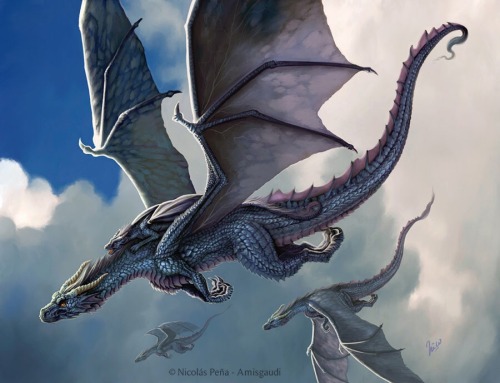
The eyes-in-the-front thing (usually) only applies to mammals. Crocodiles, arguably the inspiration for dragons, have eyes that look to the sides despite being a predator.
hey what up I’m about to be That Asshole
This isn’t a mammalian thing. When people talk about ‘eyes on the front’ or ‘eyes on the side,’ they’re really talking about binocular vision vs monocular vision. Binocular vision is more advantageous for predators because it’s what gives you depth perception; i.e, the distance you need to leap, lunge, or swipe to take out the fast-moving thing in front of you. Any animal that can position its eyes in a way that it has overlapping fields of vision has binocular vision. That includes a lot of predatory reptiles, including komodo dragons, monitor lizards, and chameleons.
(The eyes-in-front = predator / eyes-on-sides = prey thing holds true far more regularly for birds than it does for mammals. Consider owls, hawks, and falcons vs parrots, sparrows, and doves.)
But it’s not like binocular vision is inherently “better” than monocular vision. It’s a trade-off: you get better at leap-strike-kill, but your field of vision is commensurately restricted, meaning you see less stuff. Sometimes, the evolutionary benefit of binocular vision just doesn’t outweigh the benefit of seeing the other guy coming. Very few forms of aquatic life have binocular vision unless they have eye stalks, predator or not, because if you live underwater, the threat could be coming from literally any direction, so you want as wide a field of view as you can get. If you see a predator working monocular vision, it’s a pretty safe assumption that there is something else out there dangerous enough that their survival is aided more by knowing where it is than reliably getting food inside their mouths.
For example, if you are a crocodile, there is a decent chance that a hippo will cruise up your shit and bite you in half. I’d say that makes monocular vision worthwhile.
Which brings us back to OP’s point. Why would dragon evolution favor field of view over depth perception?
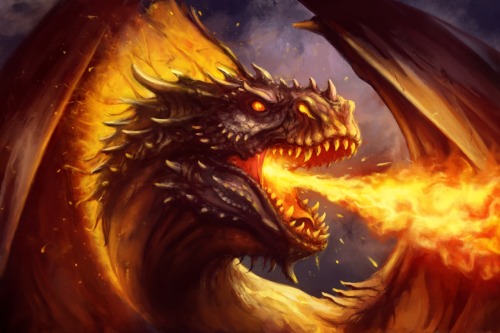
A lot of the stories I’ve read painted the biggest threats to dragons (until knights with little shiny sticks came along) as other dragons. Dragons fight each other, dragons have wars. And like fish, a dragon would need to worry about another dragon coming in from any angle. That’s a major point in favor of monocular vision. Moreover, you don’t need depth perception in order to hunt if you can breathe fucking fire. A flamethrower is not a precision weapon. If you can torch everything in front of you, who cares if your prey is 5 feet away or 20? Burn it all and sift among the rubble for meat once everything stops moving.
Really, why would dragons have eyes on the front of their heads? Seems like they’ve got the right idea to me.
this is some good dragon discourse right here, 10/10, and i dont mean to derail the whole thing away from the eyes, but i feel obligated to mention that in many stories and accurate to some reptiles, dragons have an extremely acute sense of smell/taste which would definitely help narrow down the depth perception issue. things smell stronger the closer they are. and i feel like i read somewhere that a blind snake can flick the air with its tongue and track its target mouse with no trouble at all. gotta imagine the “great serpents of the sky” had some pretty advanced biology. enough to make field of view win out against depth perception.
anywho. cool stuff. fear the dragons even if they are the prey cause they still beat us on the food chain.
The next long awaited post in the Fantasy Biology series, finally looking at the popular pegasus thanks to popular opinion on my Patreon.
Long time followers of this blog have been waiting for this one for a while. You all seem very keen for my take on how to make a six-limbed creature work, get airborne, and ideally be ridden.
There is a lot to talk about with these flying horses. In the interest of narrowing the topic, I’m only going to discuss pegasus with bird wings, not with bat/dragon wings or any other magical flying horses.
Key features of a pegasus:
Horse body
Bird wings
Can fly
Ridden by heroes
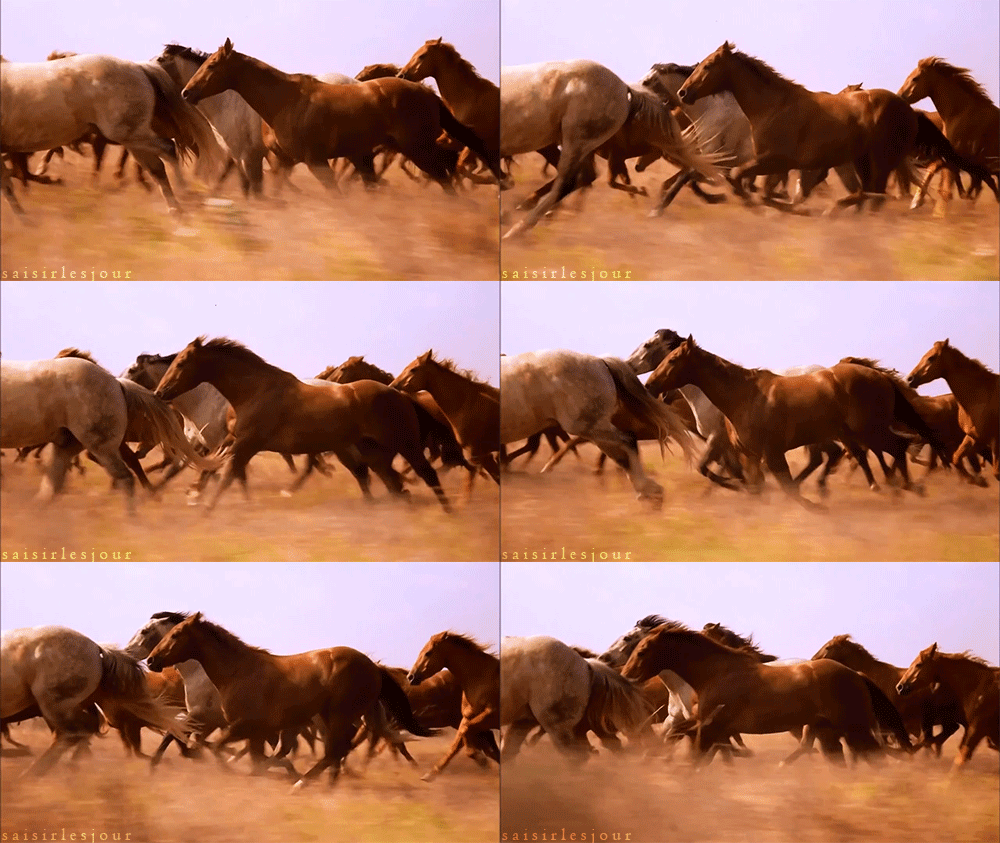
The biggest difficulty with making a pegasus ‘work’ is that you have two different types of forelimbs, that both use very different shoulder joints to function. A horse shoulder moves forward to back when running….
But a bird shoulder moves up and down with some rotation when flapping…






 Steel Phoenix Studios