A knight in shining armor outsmarts the dragon and climbs to the highest tower, only the princess locked away at the top of the tower is… a lesbian.
“Oh thank god,” Thomas says, laying his helmet down. “Because I kept thinking on the climb up here that this was going to be a really awkward first meeting, and its stupid to expect you to fall in love with me just because I saved you.”
Lucinda gives him a surprised look. “You’re rather weird. Usually I get guys that demand I fall in love with them because they ‘saved’ me. Which by the way, you didn’t actually do.” She jabs a thumb towards the direction of the dragon. “She’s trained. I tell her to keep assholes away from me, but if I tell her to let you in, she won’t do anything to you.”
“Oh.” Well now he feels a bit better. “But um, the whole lesbian thing? I uh… god this is going to sound weird, but would you consider dating my sister if I brought her to you?”
Lucinda blinks, opens her mouth, and then shuts it. She finally settles on, “Is your sister cute?”
“Um, I don’t know? I mean to me she is, because she’s my sister. But um.”
“Describe her.”
“Red hair, freckles, five foot… two, I think? Likes to make dresses and pretty headdresses out of flowers, her favorite activity is scrapbooking. She’s nineteen and looking for a nice girl to settle down with.”
Lucinda admits, she sounds tempting. “Fine, I’ll meet her. But why are you acting as the go-between for your sister’s love life, exactly?”
Thomas grimaces. “Dad wants to marry her off, and she’s… kind of a lesbian too. Except dad thinks if he throws her at the right dick, she’ll suddenly want that, so… yeah.”
Lucinda cackles. “Oh my god, you climbed a tower to wingman for your sister?”
“Um, yes?”
She stands, brushes her dress off. “I like you. Show me this cute little sister of yours. We’ll take the dragon – let’s see what that old man of yours thinks when a stolen princess shows up riding a dragon wanting to marry his daughter.”
I always find it kind of weird that matriarchal cultures in fiction are always “women fight and hunt, men stay home and care for the babies” because world-building-wise, it makes no sense
think about it. like, assuming that gender even works the same in this fantasy culture as it does in ours, with gender conflated with sex (because let’s be real, all of these stories assume that), men wouldn’t be the ones to make the babies, so why would they be the ones to care for the babies? why is fighting and hunting necessary for leadership?
writing a matriarchy this way is just lazy, because you’re just taking the patriarchy and just swapping the people in it, rather than actually swapping the culture. especially when there are so many other cool things you could explore. like, what if it’s not a swap of roles but of what society deems important?
maybe a matriarchy would have hunting and fighting be part of the man’s job, but undervalued. like taking the trash out or cleaning toilets: necessary, but gross, and not noble or interesting. maybe farming is now the most important thing, and is given a lot of spiritual and cultural weight.
how would law work? what crimes would exist, and what things would be considered too trivial to make illegal? who gets what property? why?
how would religion work? how would you mark time or the passage into adulthood? what would marriage look like? if bloodlines are through the mother, bastardy wouldn’t even be a concept – how does that work?
what qualities would be most important in a person? how would you define strength or leadership? what knowledge would be the most coveted and protected? what acts or roles are considered useless or degrading?
like, you can’t just take our current society and say you’re turning it on its head when you’re just regurgitating it wholesale. you have to really think about why things are the way they are and change that.
THIS IS SUCH A GOOD POST THOUGH.
I think what really bothers me about the whole “men take care of the children and tend house because they’re not in charge” thing is that it reinforces the idea that traditionally feminine work SHOULD be undervalued. That there’s no way anyone could see raising children and think, “wow, what a valuable contribution to society”. Even though families are what societies are MADE of, and if you ignore the welfare of your children the society falls apart in a generation or two.
Imagine if women were seen as the ideal political leaders BECAUSE they’re the ones best suited for raising young children. What if it was assumed that government positions were sort of scaled-up households, and that only a leader who saw their subjects as their children could be fair and compassionate enough to rule effectively? What is a village, or a country, but an extended family?
On the one hand, the ability to use physical force effectively is super important for a low-tech society, and there’s always the threat of hostile military takeover, either from outsiders or via internal revolt. On the other hand, a society where all the men want to rebel is probably not a society that’s being run at all effectively, and there are other ways of maintaining control (ie religion, cultural traditions, propaganda, etc). Women could be the more educated group–in some ways that’s even intuitive, since a non-magical preindustrial society is one with a high infant mortality rate, which means it has to have a high birth rate to compensate, which means women will be pregnant a lot. If they have trouble consistently working physically demanding trades, why not assign them to jobs that require more mental exertion? Why not a society where all the lawyers are female, all the doctors are female, all the historians and most respected poets are female? If you keep that up for long enough, eventually that gets seen as an inherent sex difference, and men don’t exert physical force because holy shit they’d have no idea what they were doingonce they gained power.
It doesn’t have to be these specific differences, of course. But I think that’s the thought process that most of the best worldbuilding comes from–why are things this way? How have they stayed this way? Just saying “what if women could tell MEN what to do!” is so boring compared to asking why we value the things we value. Besides, fictional societies that are created without asking why things are the way they are are not going to stand up under close scrutiny, whether they play into or subvert our expectations.
This is such an excellent addition to my post, @apprenticebard, I am rubbing my hands together with glee.
(Not aliens, but goes along with some discussions on how cultures might differ.)
The thing about a gender hierarchy is that most gender-based “x gender is better at y task” is bullshit, and so is “all x gender have (or are supposed to have) z trait.” You will find all kinds of people of all kinds of gender presentations with all kinds of skills and traits. I mean, there is an after-the-fact correlation where girls are taught one set of things and boys are taught another, but it has zip zero zilch nada nothing to do with aptitudes and interest.
So if aptitudes and interest and the raw stuff of skills and traits is gender-neutral, how come we think some things belong to one gender or another? The answer is quite simple. Because any trait or skill that society values gets assigned to the highest gender in the hierarchy.
Let me repeat that for the folks in the back. Any trait or skill that society values gets assigned to the highest gender in the hierarchy. And you can see this because as values change, tasks and traits get passed between genders.
The best example of this that I know of is sexual appetite. See, one thing that really boggles peoples minds when they read medieval literature is that their assumptions about sex are, to us, backwards. Ask anybody today who has the greatest sexual appetite, and they’ll say it’s men! Who has the least sexual appetite? Women! A great deal of research has shown that this is bullshit, that there is a wide range in both men and women and gender tells you exactly bupkiss about sex drive, but even people who know this are guided by unconscious assumptions that men are ravening sex fiends and women are only in it for the emotions.
Except in the middle ages, they thought the exact opposite. Men were pure, in it for emotions and cerebral affection. Women were the ravening sex monsters who couldn’t control their lusts. Why? Because celibacy and sexual innocence was the highest sexual virtue. Therefore, men had it and women didn’t.
This changed in the Renaissence, when potency and virility (and hence, lots of sex) became the highest sexual virtue. Therefore, men have high sex drives and women don’t.
When you look at occupations today, and which ones we value and which ones we don’t, especially as you track changes over time, you will also notice that when men enter a field in large numbers, its prestige and pay rises. When women enter a field in large numbers, its prestige and pay fall. It is not that some jobs are high-status and men gravitate to those jobs, and women gravitate to “lesser” jobs. Instead, JOBS THAT MEN DO ARE VALUED, AND JOBS THAT WOMEN DO ARE NOT.
So for example, in the USSR there were a heck of a lot more female doctors than there were in the west at the time. Since “doctor” was a high-status occupation in the West, the West assumed that women were more equal in that they had access to high-status jobs. Not so; women were just as oppressed in the Soviet regime as they were in the West. The difference was that in the USSR, being a doctor was a low-status job. Therefore, it was open to women.
So if you are going to build a matriarchal society from scratch, your first question should not be “which genders do which jobs” but rather “which jobs are going to be high status in this society, and which are going to be low-status?” and then assign the high status jobs to the women.
This! ^^^
This post was insightful and interesting, but also rubbing me kinda the wrong way, and I couldn’t figure out entirely why until I saw @beatrice-otter’s addition.
The first thing you need to decide, when building any fictional society, is how it sustains itself. What does it run on? How does it gain power, gain security, manage labour, acquire resources? This doesn’t mean that you have to be an expert in economies or politics (although research helps). What it means is that you have to have some kind of an idea of what sort of civilization you’re looking at.
The concept of a ruler-as-parent is not inherently matriarchal (paternalism in violently bigoted societies is often a major thing, in fact, and lots of patriarchal civilzations have equated kings with fathers). The concept of a conquest-driven warrior society is not inherently patriarchal, either, we just associate parenting with women and violence with men because of our own socially-conditioned presumptions. And any civilization which heavily preferences one group of people over another is probably going to be exploitative, because that’s the main motivation for encouraging social inequity – it lets the people in power hold on to their power, and accumulate even more by increasing the disparity between their authority and other people’s. (Which isn’t to say that some of the above ideas aren’t still good ways to look at things, just that it’s kind of an incomplete perspective).
The ‘elite’ set the tone for what is valued or devalued, as it suits the climate of their society. When computers were a new and niche thing, and no one was quite sure how far they would take off, programming was considered a branch of secretary work – it was women’s work (and WoC’s work). As computers became more influential, and men in the field became more frustrated with having their work ‘devalued’ by its association with women, a concerted effort was made to drive women away from computing and associate it with them, instead. And now the typical image of a computer expert is, of course, a dude with glasses. Image campaigns were launched, more men were recruited to the field and fast-tracked to promotions, women were discouraged and pushed out via harassment and reduced career mobility, and historical retcons were put forward to make it seem as if they’d never been there to begin with. The social equivalent of headbutting your partner out of the classroom window on Science Fair Day and telling the teacher you did all the work yourself.
Of course, there is a question of how one gender initially gains this kind of advantage over another, and then builds off of it in order to reach the level of privilege where this sort of shit can fly. We don’t honestly know for certain, but women are, of course, strongly associated with the ‘gives birth’ end of the reproductive equation. Pregnancy, labour, breastfeeding, these things can all disadvantage someone when it comes to doing other stuff – especially if you’re doing them routinely because infant mortality rates are high and birth control is less-than-reliable. Free time and mobility are significant factors in who can explore their interests or focus on learning new skills, travel to other places, or investigate untested concepts.
So, provided the genders of this hypothetical matriarchy are still composed along our own lines of thinking*, that should probably be taken into account when considering what runs this civilization**. Either the people going through pregnancies need to have an easier time of it for some reason (i.e. magic makes it easier on them, society is comprised of immortals who can waste time on loads of stuff anyway, etc) or the people not having babies need to have a harder time of it for some reason (i.e. magic makes it rougher on them, pregnancy provides some kind of immune boost that makes people more resistant to some kind of plague, etc).
Because the unpaid/unacknowledged part of the equation is the most important. A matriarchy which is run by rule of violence still might not be all that interesting to read/write about in the end (at face value, it can look less like a meaningful social critique, and more just like ‘look how horrible the world would be if women were in charge! This is what feminists want!!!’ which is.. tiresome). But in order to switch that around, step one is figuring out where the power is, and how this one group of people got a hold of it. That will give you the best indicator for how they should go about keeping it, which will, in turn, tell you what social roles are probably going to be the most lauded and compensated.
*More works which change this up would be pretty cool, I think. And shine some light on the arbitrary nature of a lot of presumptions about gender.
**Of course, that’s if you don’t just want to shrug and go ‘I dunno, something happened in the early days of the major society we’re focusing on, and the advantage tipped far enough the other way that women have been able to build up on it since’ – that’s also totally fair.
YES. This whole thread is the best thing and betterbemeta’s tags (above) are on point. I would love actual ‘realistic ancient battles’ where like ten actual fighters and whatever serfs they can persuade to accompany them posture and try to intimidate each other, or have an Official Scrum on a mutually beneficial day. That and just…cattle raiding.
I guess in post-collapse terms it’s theoretically different because your whole raider gang exists to nick other people’s shit so doesn’t need to cultivate or craft much except perhaps to make them more self-sufficient in weaponry, armaments, and other logistical things that’ll enable them to raid harder and more often. That’s exactly why, on the other side of things, as many citizen’s as possible in your vulnerable good-guy farming commune might need to be militia members to protect themselves from people who can dedicate their full-time everyday energy to Being Raiders.
I say in theory because, even if you’re nicking other people’s shit, why not treat that as a bonus? Why not look to history’s peoples who placed a particular import on raiding as a way of life, and notice that none of them were just straight-up predators. They had enough agricultural or pastoral or pescatoral (is that a word?) infrastructure to subsist, and then the luxury, the surplus, came from attacking other people part-time, very occasionally. Look at norse folks going viking; look at the invasive pastoralists of the Eurasian steppe. Just in terms of the caloric requirements and risks inherent in combat, you’re not gonna want to do that full-time. Training to do it well will take more calories and they need to come from somewhere. You pick your battles. You take without fighting at all where you can – so intimidation and making enemies surrender without having to fight is important here; c.f. pirates of the Golden Age – and you fight rarely and only when you know you can a) win, b) benefit hugely from it.
THANK YOU
i think this post has changed my world. literally.
the ‘death is cheap’ approach to warfare only really came on the scene in the 19th century, and not full-blown until WW1. the american civil war and similar conflicts, with mass charges against cannon and the like, that’s a very modern approach to warfare and it assumes manpower is your cheapest resource.
in a non-industrialized setting, manpower is your most EXPENSIVE resource. you don’t throw masses of bodies against a position unless you’re an idiot, except in very rare cases – say, xerxes vs the 300 – where numbers are your only advantage and you don’t have any other options.
in pre-industrial warfare, tactics could make a shockingly outsized difference. there are many documented cases of a few commandos or a surprise flanking move defeating an army ten, twenty times their size. well-trained, well-equipped soldiers are not expendable in that setting. they are your best hope of winning. a medieval warlord would no more throw away his knights, archers, sappers, or other trained troops on massed action than a modern general would throw away her heavy bombers on a strafing run. that’s not how you use those.
just as the modern general uses long-range missiles for bombardment before sending in rare and expensive things like helicopter gunships for close engagement, the medieval warlord used mobile cavalry to isolate and harrass the enemy, and archers to soften them up, before picking his moment and ground to strike with heavy cavalry.
as ellis points out, these trained and equipped troops need a lot of support. reducing the enemy’s support was an essential tactic. when fantasy writers have a siege happen, they tend to think it’s just about starving the other guy or breaking down the wall. but the besieged army often ran into trouble long before that. running out of arrows was a problem, for instance, and when you eat your horses you no longer have a cavalry. a lot of times, that heroic ‘sally forth’ business that broke a siege one way or the other was just because it was eat the horses or use them, and a knight on foot was no longer able to fulfil his tactical role, so the leader rolled the dice rather than have his knights downgraded to footsoldiers.
one result of the need for civilian support for these troops was that you really, really didn’t want to slaughter the peasants if you could help it – at least not if you were taking over the territory, or thought you might want to at some point. it’s not like you could just ship a hundred thousand political prisoners from moscow to work the farms. the peasants WERE the land. without them, it was just a lot of mud you had to get across. you couldn’t stay, you couldn’t use it.
so i’d advise a moratorium on medieval armies burning every farm they pass, and slaughtering the inhabitants of cities they occupy. a few particularly ruthless warlords in history did that a few times, to make a point, and it was shocking back then, or it wouldn’t have worked. alaric sacked rome as revenge, not a takeover bid; you wouldn’t do that to a city you wanted to keep.
Thank you.
Fantasy writing has often forgotten how essential communities are to support that sort of setting.
This post has some good points, but
it’s generalizing them WAY too far.
So, first off: the number of food
producers you need per full time non-food producer is not constant
across all environments and agricultural systems. The Vikings are
probably one of the worst areas to generalize from, because they
lived in an area that was very poorly suited for their agricultural
crops, to the point where their economy was dependent on raiding for
subsistence survival and iirc there was some abandonment of
settlements because the land just wasn’t set up for survival based on
grain crops. You should assume that numbers pulled from them are the absolute highest
end.
Somewhere like Ireland, with a year
round temperate climate that allows multiple growing seasons and has
high rainfall, is going to have a much lower number of food producers
per non-food producer; somewhere like Incan era Peru, with
centralized agricultural planning and spectacularly high producing
plants like the potato, will be lower still. If your food producers
are pastoralists who mainly herd instead of growing, things are again
very different; same with people who subsist mainly off of orchard
crops with wildly different labor requirements; etc.
Side note: I always see people talking
about food production historically, but very rarely cloth production,
which has generally been equally labor intensive and vital. I would
really love it if people paid attention to this.
As for the death is cheap thing –
yeah, warfare at pretty much any time in the ancient past is not
going to be exactly like modern warfare. That said, there were
absolutely periods and places where throwing peasants at the enemy
was a standard approach. To a certain extent, the reason that empires
like Rome and China were so powerful was that their
centralized planning, their vast populations and (at least in Rome, I
know less about China) their slavery-dependent food economies allowed
them to keep throwing more troops at rebellious provinces until they
won.
There have also definitely been
recorded historical incidences of slaughtering huge percentages of a
local population, such as the Mongol conquest of Baghdad or the
Turkish conquest of Constantinople. (These instances also involve
enslaving most or all of the survivors.) On a smaller scale, the
herem institution or rite among nomadic populations in the Bronze and Iron Age Middle East involved the slaughter of entire villages as a
prerequisite to taking them over and settling there.
None of this negates the fact that for
many other times and places, warfare might look more like stealing
cattle and maybe exchanging a couple projectiles, or posturing at
each other for a few hours, or a fist fight between rival families in
the market place.
In general, assume that there isn’t
an “in general,” historically.
Some relevant citations:
[On Viking agricultural economies being
poor]
“Feasting in Viking Age Iceland:
sustaining a chiefly political economy in a marginal environment” –
Davide Zori, Jesse Byock, Egill Erlendsson, Steve Martin, Thomas Wake
& Kevin J Edwards, in Antiquity 87.
“The Midsummer Solstice As It Was, Or
Was Not, Observed in Pagan Germany, Scandinavia and Anglo-Saxon
England” – Sandra Billington in Folklore 119.
[discusses Peruvian and general
American agriculture, including some stuff about orchard crop systems
too]
1491: New Revelations of the Americas
Before Columbus – Charles Mann
[discusses the herem
institution mentioned above, as well as some information about
pastoral economies, though neither are a focus of the work]
The Legacy of Israel in Judah’s Bible: History, Politics, and the
Reinscribing of Tradition – Daniel E. Fleming
You can verify the information about the conquests of Constantinople
and Baghdad by checking Wikipedia, so I’m not going to cite those,
and basically any decent book about Roman warfare will include the
vast population advantage; I got that from a Roman history class.
That all gave me immense pleasure.
Just adding that in 1241, the mongolian armies under the rule of Batu khan invaded Hungary with around 90 000 soldiers, while the hungarian army consisted about 50 000. Still middle ages!
Also the invading army killed around 40-50% of the population in the span of a year (around 1.5 million people).
That said, after laying ruin to basically the whole of Eastern Europe, they went home the next year, possibly because the hardships of consolidating their rule (too big expansion in too little time, they couldn’t get the stone castles/cities either) and supporting the army.
This would make some pretty spectacular movie while being totally realistic!
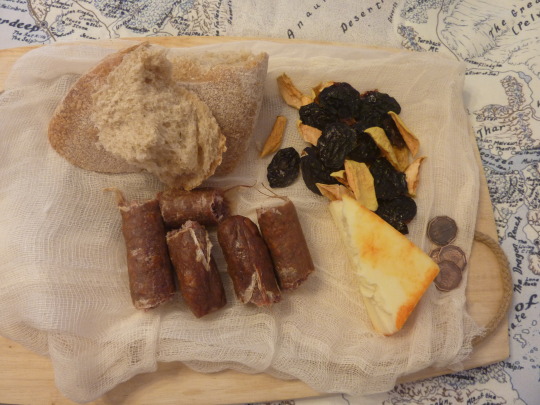
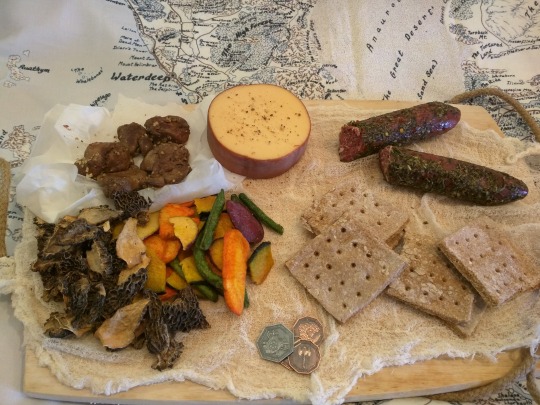
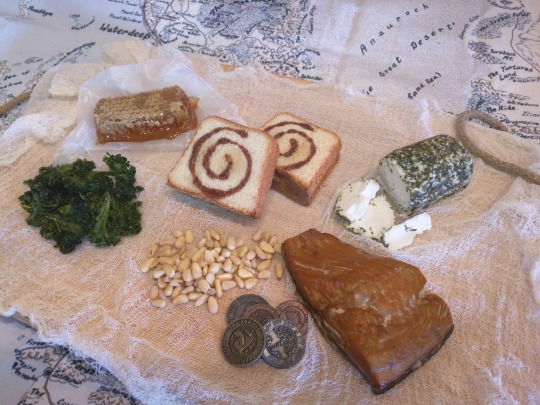
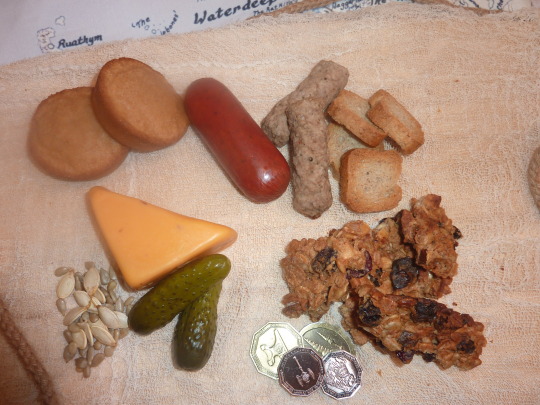
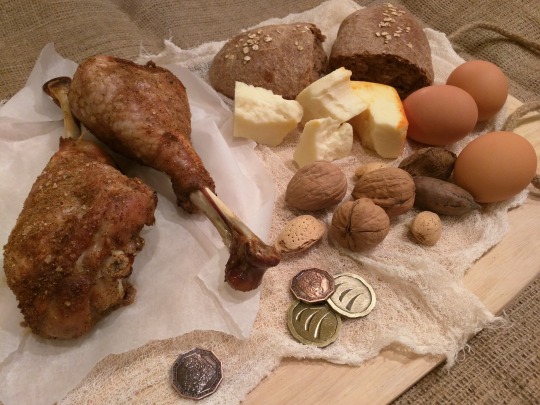
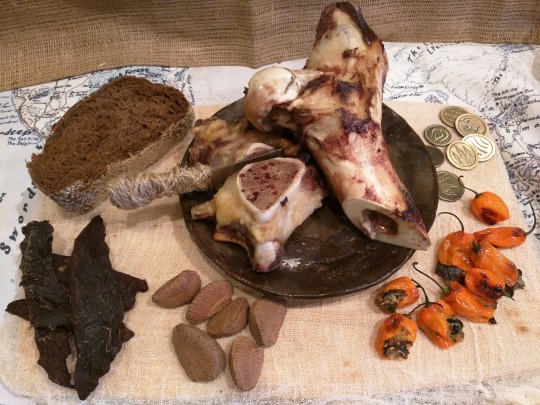
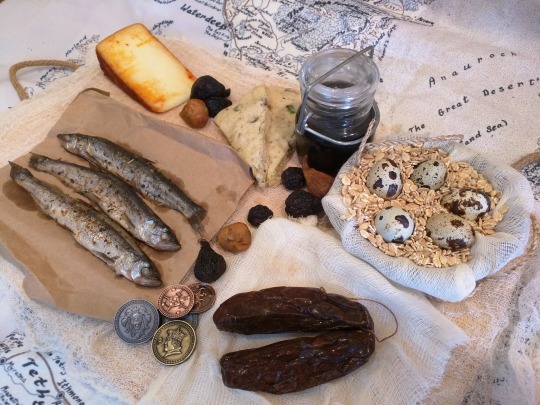
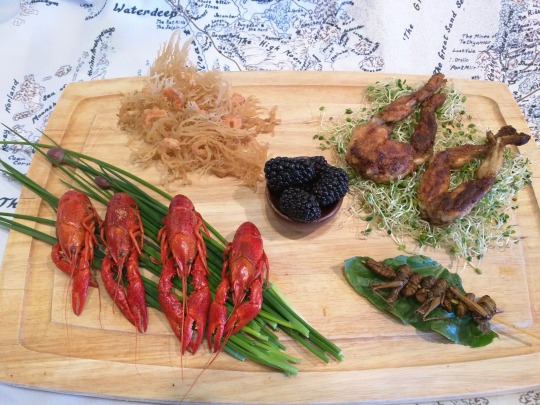
[[ Source. Original creator: wats6831. Additional information and images linked under each one. ]]
Universal:
Homemade artisan herb bread, home grown and dried apples and prunes, uncured beef sausage, munster cheese. Made a small bag from cheesecloth and tied it closed.
Top left to right: Evereskan Honey Comb, Elven Travel Bread (Amaretto Liquer Cake with custom swirls), Lurien Spring Cheese (goat cheese with garlic, salt, spices and shallots), Delimbyr Vale Smoked Silverfin (Salmon), Honey Spiced Lichen (Kale Chips), and Silverwood Pine Nuts.
From upper left: “Honeytack” Hard tack honey cakes, beef sausage, pork sausage mini links, mini whole wheat toast, cranberry cheddar cheese mini wedge, mini pickles, pumpkin and sunflower seeds, lower right is my homemade “travel cake” muesli with raisins, golden prunes, honey, eggs and cream.
Orcs aren’t known for their great cuisine. Orcs prefer foods that are readily available (whatever can be had by raiding), and portable with little preparation, though they have a few racial delicacies. Toughs strips of lean meat, bones scavenged from recent kills, and dark coarse bread make up the bulk of common orc rations.Fire roasted rothe femur (marrow is a rare treat) [beef femur], Strips of dried meat (of unknown origin) [homemade goose jerky], foraged nuts, only edible by orcs….nut cracker tusks [brazil nuts], coarse black bread, made with whatever grains can be pillaged [black sesame bread], Pungent peppers [Habanero peppers stuffed with smoked fish and olives].
Lizardfolk are known to be omnivores, forage for a surprising variety of foods found within the confines of their marshy environs, in this case the Lizard Marsh near Daggerford. Fresh caught boiled Delimbyr Crayfish on wild chives, coastal carrageen moss entrapping estuary brine shrimp (irish moss, dried brine shrimp), Brackish-Berries (blackberries), Blackened Dart-Frog legs (frog legs) on spring sprouts (clover sprouts), roasted bog bugs on a stick!
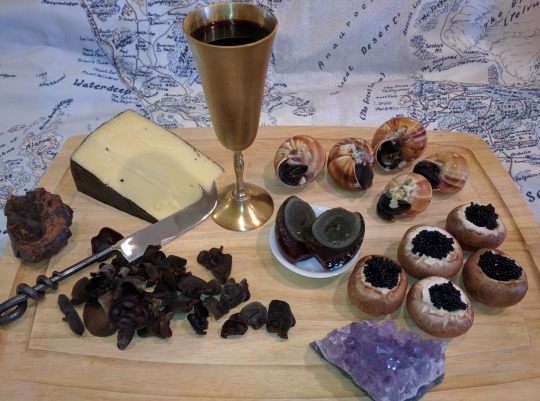
From top left: Menzoberranzan black truffle rothe cheese (Black Knight Tilsit), Donigarten Moss Snails (Escargot in shallot butter sauce), Blind cave fish caviar in mushroom caps (Lumpfish caviar), faerzress infused duck egg imported from the surface Realms (Century egg), Black velvet ear fungus (Auricularia Black Fungus Mushroom).
I wish i had a context for this. But I really dont.
I was all ready to “um, actually” this, but, um, actually there’s about 3-4 grams of iron in a person, which x400 is 1.2-1.6kg, which is a smallish but not unreasonable sword. So. Math checks out.
How would you extract the iron, though? The more practical solution would be to kill a mere hundred men, then mix 1 part blood with 3 parts standard molten iron, imo. Cheaper and faster, while still retaining the edge that only evil magic can give you.
Or, you could just make the sword of iron, and then use the blood to temper the blade.
1.2 to 1.6 kilograms is a perfectly reasonable large sword. Your average longsword was 1.1–1.8 kg and I don’t even remember if that’s including the weight of the hilt, guard, and pommel or just the blade. Your more classic “knight sword” was a mere 1.1 kilograms on average; the blood of 400 men is more than enough.
This is using the comparatively crappy metallurgy of medieval Europe and their meh iron swords. Move east to, say, contemporary Iran and make a scimitar using high carbon steel (~2%) for a .75 kilogram blade and you only need the blood of about 225 men.
So putting my thoughts in on this… because how could I not.
So you’ve exsanguinated your 400 guys to get the iron for your sword. Cool. But now you have 400 bodies lying around.
Why not put those to good use and cremate them. Use the carbon from those 400 bodies (you won’t need all of them) and now you can make a nice mid-high carbon steel sword.
Now you have a sword forged with the blood of your enemies AND strengthened with their bones.
“high fantasy math” – the tag I should have expected to write some day.
I’m so proud of everyone in this post
Fantasy math. Uhm…sure, yes. *taking notes*
*mutters* I can probably find 400 enemies SOMEWHERE.
Artist Brian Kesinger Creates Adorable Dragon Illustrations to Debunk Stereotypes About Them
California-based artist Brian Kesinger has always been inspired by dragons since his childhood. He loved watching movies and video games with mythical beasts, dragons and dungeons, which have shaped his artistry and imagination
He tells Bored Panda, “Often dragons are depicted as villainous, treasure hoarding monsters but I wanted to break past the stereotypes and delve into the different personalities of each character. As far as the styling of the drawings themselves, I wanted to go for an old fashioned look of classic illustration, maybe even having a feel that they were sketched from life in some explorer’s journal.”
Find his quirky and adorable compositions in his Etsy shop.


 Steel Phoenix Studios