I’ve always loved collecting books. I’ve got enough books that my friends make jokes about using stacks of books as furniture – not true, but close enough. But there is one type of book that I’ve never been able to get my hands on: fanfiction and other independently written, underground work. Especially work with queer themes and/or erotica.
It’s frustrating that fanfiction isn’t generally publishable or sellable. It’s a shame that creators could spend months or years laboring over a phenomenal piece of work and never see a dime for it, never see it in print. So I finally hit on an idea, an attempt to thank the authors of these wonderful underground works, without wandering into legality issues. I decided to learn how to make books. These books are not for sale and are gifts to the authors.
So I have been working on this for a couple of months and here are the first results. These are the very first books I have bound.
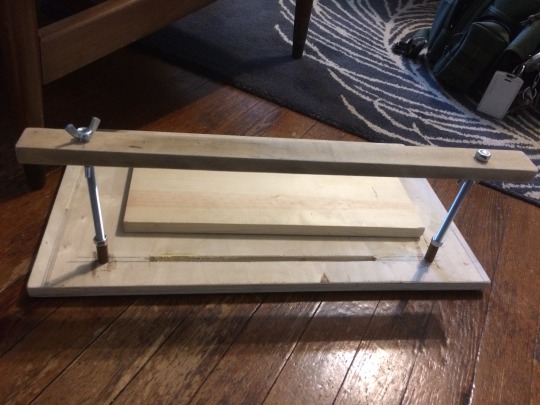
Step 1. Making bookbinding tools. I realized very quickly that I needed a sewing frame and a book press. If I were to order these things I would have spent anywhere from $150 – $500. Luckily my family likes to make things. So I enlisted my dad to help me make some simple tools. cost: $30 in materials and an afternoon.
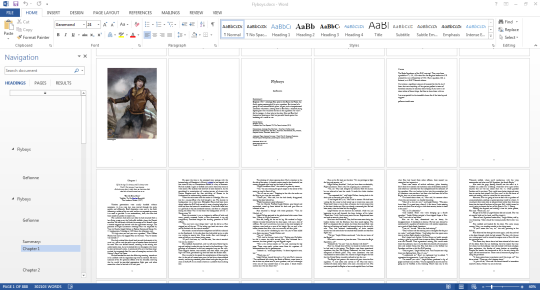
Step 2. Typesetting. Microsoft Word lets you print in “booklet” form, which allows you to create signatures from folded 8.5×11" paper. Each book takes a half to a full day to format.
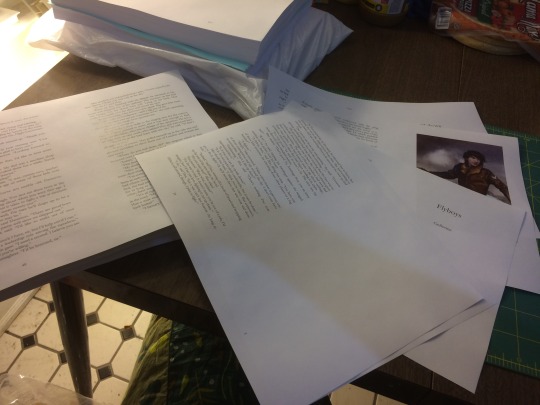
Step 3. Printing. I am lucky enough to have a robust color laser printer at my disposal. Lightweight 20lb bond / 75gsm copy paper is what I used. This isn’t ideal for books, but it’s inexpensive, easy to procure, and doesn’t choke the laster printer. Perhaps in the future I can do an edition on super thin Bible paper, if I can find a printer that will print on it.
Step 4. Folding, Punching. Perhaps the most tedious part: Every sheet of paper must be folded individually. Then you assemble the signatures and use an awl to punch holes for sewing. Flyboys was 888 pages, which means 222 sheets of paper to fold.
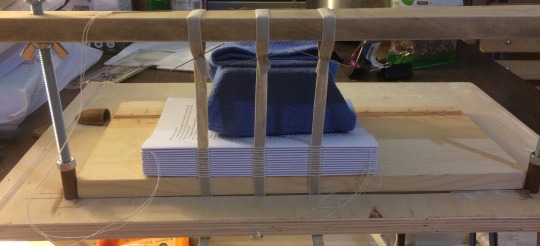
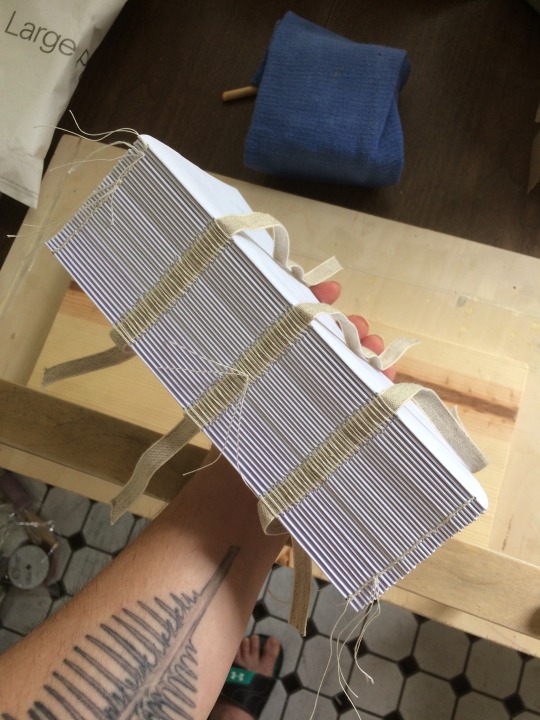
Step 5. Sewing the text block. Now it’s time for tool #1, the sewing frame. This worked exactly as designed, holding the linen tapes steady while I sewed around them. A brick in a rag serves as a weight to hold the text block down while sewing.
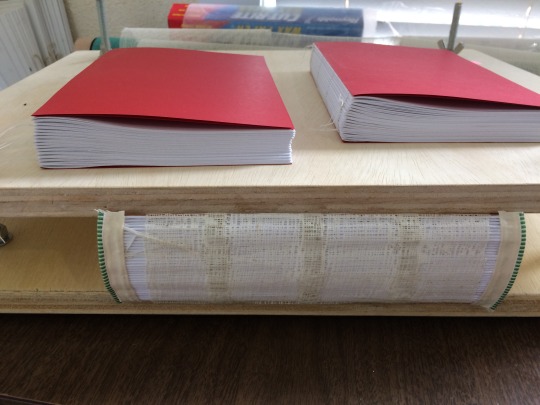
Step 5. Gluing. Once the text block is sewn, I glue the end papers to both sides. Then it goes into tool #2, the press, with the spine edge poking out. I glue the signatures together, then apply the headbands and mull as further reinforcement. I leave the book in the press overnight.
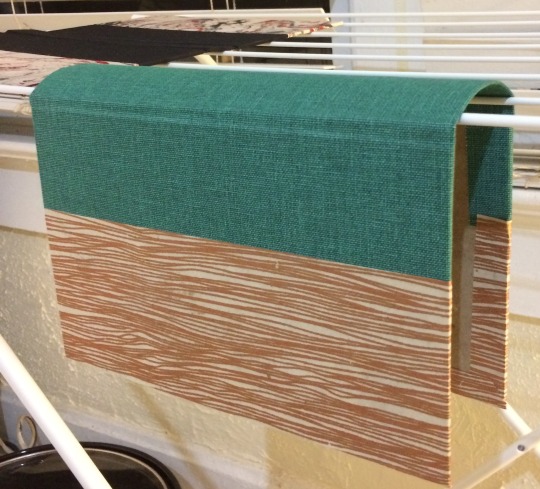
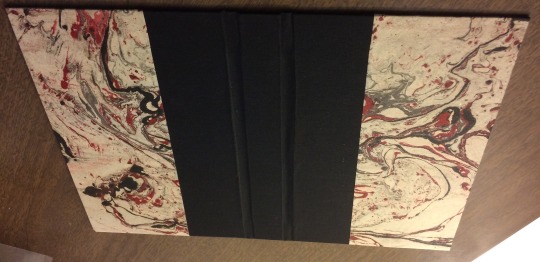
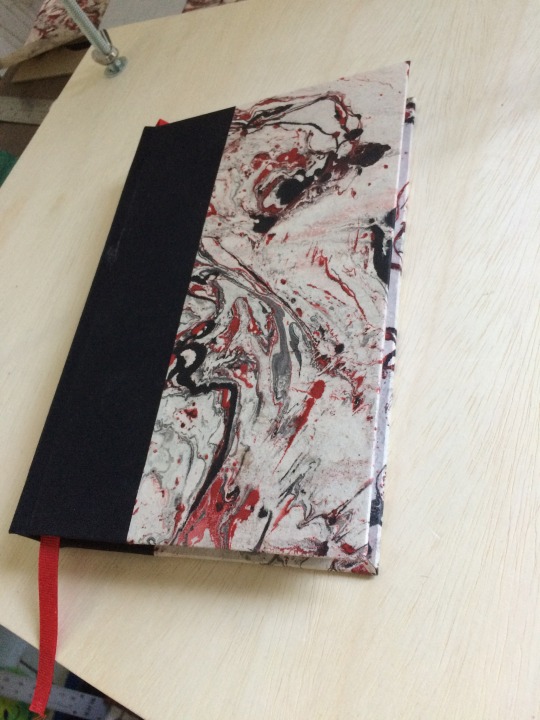
Step 6. Making the Case. The case or cover. I’m making half-bound cases, which means there is fabric on the spine, but the boards are covered in decorative paper.
For Flyboys, I went with a “Hux’s hair and verdigris” theme of green cloth, copper printed paper and copper endpapers.
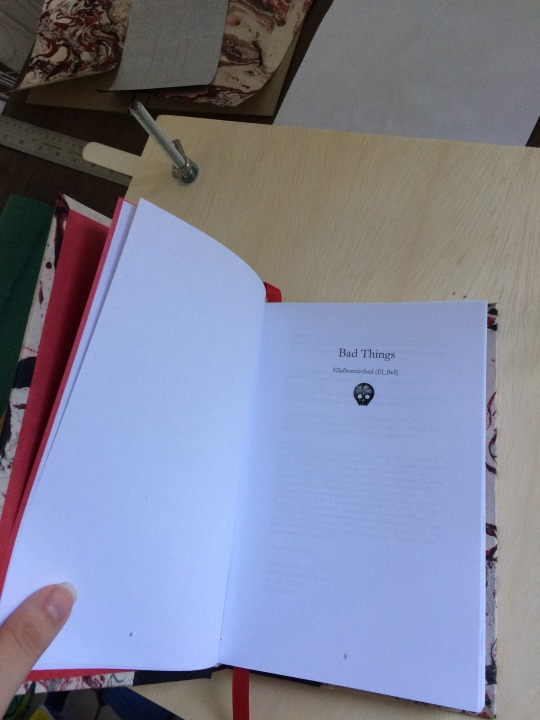
For Bad Things, I wanted murderous blood spatters. I ended up with black cloth, black and red marbled paper and red metallic endpapers.
Step 7. Assembly. The most nerve-wracking step. This is where you glue the block to the case. One shot deal. If you do it crooked, the book is crooked forever. YIKES! After you glue it, you put it in the press overnight again.
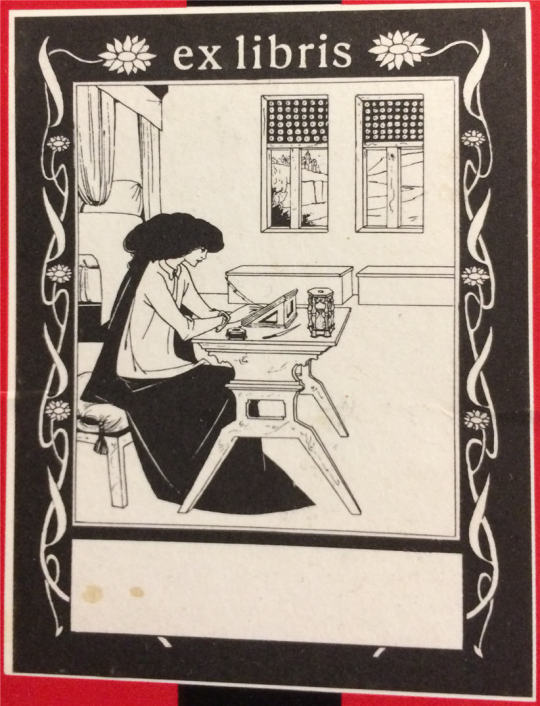
Step 8. Ex Libris. I have a few old ex libris labels with Aubrey Beardsley art, I think that’s an appropriate choice to pair with the queer and sexy, so I am adding them inside the front endpapers in the traditional spot. An ex libris label is a traditional way to signify who the book belongs to.
Step 9. Make author squeal with glee. My favorite step.
Again, these books are NOT FOR SALE.
Gods, it’s been an age since I did any bookbinding. It’s SO good to see somebody writing about doing a good job of it.
There’s a great book which I originally got from the library. I bought a copy by the time I returned it and left something extra for the next person who’d borrow it. I’d applied the techniques to a single signature booklet of instructions, of my own devising, for making a sewing frame.
Bind MY fics, friend!
Saving this for when I retire and can afford to bind the WOF books this way.
This is an amazing labor of love!
When I finish Since First I Saw Your Face, I’ll bind it like this. I used to do bookbinding and tooling leather as a hobby.
Sometimes fanfiction is a love letter to the original canon, sometimes it’s just that one telegram that says “Fuck you. Strongly worded letter to follow”.
chihiro never forgets her time spent in the spirit world,
because that’s no fun for anyone. she never forgets her friends, how could she?
she holds them all close to her heart, which is where they belong, especially
her beautiful white dragon.
hake is hers as
far as she’s concerned, but she’s his too, so it’s all nice fair. of course,
haku thinks that she doesn’t know he exists, but that’s okay. she’ll go find
him again one day.
because chihiro plans to return to the spirit world. but she
knows the time isn’t right, that if she just goes darting through every place
where the boundary between their worlds runs thin, then nothing will change. as
is, she’s just a little girl, just a helpless little girl who will get lost and
killed in the world of her friends, of her dragon. so she doesn’t go back.
she could. now
that she knows what to look for, she sees entrances to the spirit world
everywhere. they’re rarely in the exact same place twice but she knows what to
look for, how to find them if she wants to, how to get back to rin and kamaji
and zeniba. but she’s not ready yet.
she needs to get stronger.
her family’s not religious, so they’re surprised when she
asks to go visit shrines, but maybe it’s for the history or the culture, or,
they don’t know, the architecture. it’s a simple thing, and so they go.
chihiro keeps her eyes peeled, because she’s looking for something
in particular.
she’s looking for a shrine with a lot of spirits living in
it.
oh, because that’s another thing she can do now.
she can see spirits.
not ghosts, not
the echoes of the dead. but spirits, nature spirits mostly, but tricksters and
guardians, and all sorts, really. so they visit shrine after shrine, and there
are sprits there, of course, but never enough, none of them are there for anything
but the offerings, and that’s not what chihiro is looking for.
it takes months, and she’s already started school, settling
into it easier than she knew she could. after her adventures in the spirit world,
human children are nothing. but one day she visits a shrine, and she knows it’s
the one. it’s small, nothing impressive, all the way at the top of a long hill.
but she knows she’s found what she’s looking for. someone
who can help her.
there’s an old priestess taking care of it all on her own,
and all around her dart spirits, some lingering, some running by and doing
nothing more than patting her on the shoulder or back, but all of them
acknowledging her in some way. she takes one look at chihiro and says, “looking
for an apprenticeship, then?”
her parents start to say no, but she interrupts them, says, “yes,
i am,” and her parents don’t understand, but they have no reason to deny her,
so they don’t.
“it’s been a while since i’ve seen someone else who was
spirit touched,” she says the first day that chihiro returns, this time on her
own.
“what happened to you?” she asks, and knows the old
priestess will understand. those with the ability to interact with the spirit
world aren’t born. they’re made.
“a spirit saved my life as a child,” she answers. “you?”
she grins. “a river spirit saved me. once when i was
younger, and then again just a few months ago. i’m going to back to him.”
“returning willingly to the spirit world is foolish, and
dangerous,” she says, but there’s something like approval in her eyes.
“yes,” she says, “teach me how to survive it.”
so the priestess does. chihiro becomes known to the local
spirits, helping them however she can just like the old woman. plenty of
guardian spirits offer to attach themselves to her, to mark her as under their
protection, but she always refuses. there’s only one spirit who’s mark she’s
willing to carry.
years pass, and chihiro grows, from a girl to a young woman.
she grows up strong, and beautiful, and thanks to her years under the
priestess, she grows up powerful. she learns how to shoot arrows that cut
spirits and to write spells on rice paper, she learns every inch of the forests
around her home and the spirits that dwell there, and on the day she graduates
high school she moves into the temple.
but she’s not planning to stay.
“i hope he’s worth it,” the priestess tells her.
chihiro grins, sharp and eager, and says, “i guess i’m going
to find out.”
she walks into the woods and slips through one of the places
where the border is too thin, and enters the spirit world once more. she has
her bow and her ink, and this time she’s not going to be easy prey, she’s not
going to be someone that has to be saved or coddled.
she’s come here for her dragon, and she won’t let anything
get in her way. it’s haku, and haku alone, who will be able to turn her away.
if he rejects her, she’ll leave. but for no other reason.
it takes her a long time to get to the bathhouse, to fight
and bargain her way there, because before it was an obstacle, so it came to her
easily, but now it’s a goal, so this world holds it back from her. but she won’t
let it stay out of her grasp forever. when she arrives she’s filthy and tired
and half her arrows are missing, her clothes are different, and she’s older. by
how much she doesn’t know, because time isn’t the same in here, but she’s not
the same girl who entered.
the whole realm is talking of her, of the human who walks
among them and won’t be chased away, of the girl who marched across the endless
marshes until she reached the end, something few ever manage, and then just
kept going. who aids those in need and destroys those who stand in her way.
when she walks through the bathhouse doors, haku is there.
“it’s you,” he says, eyes wide, and he looks older too, like
breaking free of yubaba’s curse finally allowed him to grow up. “i didn’t think
it could be. i didn’t think it was possible.”
she marches forward, grinning, and grips the front of his snow
white shirt with her muddy hands. “anything is possible. you taught me that.”
she kisses him, exhausted and filthy and feeling more alive
than she ever has. she kisses him like it’s the last thing she’ll ever do, because
it just might be, because if she angers him, then he could easily kill her.
he doesn’t kill her.
he kisses her back.
chihiro gets exactly what she wanted – her friends, a place
in the spirit world, and a reputation as someone who’s dangerous, even as a
human.
and her dragon husband, of course. she gets that too.
hi i’m kitty i don’t know anything about star wars whoops
“What am I looking at?”
Lando leaned forward and laced his fingers together. “My taxes.” He paused, then gestured to Han. “Our taxes,” he corrected, with an unnecessarily rakish grin.
Leia squinted at the datapad. “Tax fraud.”
“Oh, no no no. Absolutely not. My accounting is impeccable.”
“I don’t see how it could be,” she said. “He’s a smuggler.”
“Hey,” Han began. He shut his mouth when Leia leveled him with a look. He opened it again to persist, but saw that Lando had a shit-eating grin as he watched their argument-in-potentia. Han glowered at Lando, and made him grin wider. Han huffed, hooking his thumbs on his belt.
“Legally, he’s a long-haul transport navigator,” Lando said, and Leia snorted. “Because he has a spouse at home—me—he qualifies for a higher income deduction as well as a few credits unique to the profession.”
“Wait, credits?” Han asked.
“Because he’s my dependent,” Lando continued, ignoring him.
“The hell I am.”
“That puts me in a unique legal position—not many people know about this, but in order to incentivize long-haul transportation, a spouse who claims a long-haul transport navigator as a dependent qualifies as a household caretaker, which is a kind of head of household that’s able to claim significantly more not only for themselves but for any other dependent spouses they may happen to have.”
“But his transport isn’t legal,” Leia said, fascinated. Han was pretending to understand the conversation, which would have been more convincing if he weren’t already fiddling with a kinetic sculpture on one of Lando’s shelves.
“It’s art.”
“What?”
“As far as my taxes are concerned,” Lando said, “Han transports art. They can’t prove that it isn’t. And I’m always careful to get the valuation right.”
“How do you know what I transport?” Han asked, indignant. A piece came off the sculpture in his hands. He looked down at it, then looked at Lando. He made a hasty attempt to reattach the piece. The entire sculpture collapsed. Han took his hands from it, and attempted to lean casually against the shelves with his elbow to block it from view.
“They call me,” Lando said.
“No,” Leia gasped, delighted.
“Yes,” Lando said, grinning again. “They know I’m his partner. They know I can’t be sure I’m getting my fair share unless I know exactly what he’s getting. So they call me.”
“What!” Han stood straighter, his brow furrowed and his face all twisted into an incredulous pout of anger.
“They might have been able to catch him smuggling,” Lando said to Leia, still not addressing Han.
“They would never,” Han sneered.
“But they’re never going to get him on tax evasion. There’s no way he would have been paying taxes on his own.”
“It never even occurred to me that he would,” Leia said.
“I’m right here,” Han reminded them.
“So you can see why I can’t divorce him,” Lando said.
“I don’t follow,” Leia said.
“My household caretaker status is the foundation of all of this,” he said, pointing to the datapad. “I divorce Han and the whole thing collapses.”
“Collapses how?” Leia asked, narrowing her eyes.
“Cloud City goes bankrupt.”
Han choked.
“How many people have you married?” Leia demanded.
“Leia, you know that you’re my favorite wife-in-law,” Lando said, “but I don’t think I’m comfortable discussing that aspect of my personal life.”
The pile of former-sculpture slid from the shelf, and clattered to the floor.
Han pretended not to notice.
This is GLORIOUS and also 100% in character for someone who allegedly doesn’t know anything about star wars.
“What in the land’s name happened to your hair?” M’Baku said, walking to him under the banian.
“Shuri said it was in her way,” Ingcuka answered placidly, as if he had not worn his hair up in messy buns every time M’Baku had seen him before. “And then the kids decided it needed color.”
That Susan? That Susan does not embitter herself, does not brick her heart off, does not doubt like it’s a lifeline– not yet. She yanks open the wardrobe’s doors as soon as she finds her balance, shoves through the fur coats and mothballs, and slams into the solid back of it. She shuts the wardrobe and opens it; locks it and unlocks it; throws all the coats on the floor; gets wood splinters under her fingernails from trying to get through the back of it.
It is one things to lose a home, and it is another to lose a child. I don’t think she would ever stop looking.
Her little girl couldn’t have been more than four or five. Did she have Lucy’s cheeks? Edmund’s wit? Peter had been her favorite aunt or uncle, because he had been so patient with her. He had been teaching her to read.
Susan dredges up every arcane idea she’d ever heard whispered in Narnia, about its magic, about its origins, anything that might lead to a way back. She researches the wardrobe, its make, its history. She drags its purchase papers out of a sympathetic Professor Diggory, who has never had children and who does not understand, especially not with Susan’s present pubescent face glaring up at him.
When they send her back to her parents, when the war ends, she kisses her mother on the cheek and then runs away from home, to go find the wardrobe manufacturers, to find supposed occultists in cheap little flats that smell of garlic, to bury herself in library stacks.
–
And what about the child? Her mother, aunt, and uncles all gone on a single afternoon. Susan’s daughter was just learning to read, and now she is crowned princess heir. She has beaver nannies and centaur tutors, and she has stories about how beautiful her mother had been.
The last thing she had seen of her mother had been her riding away through Cair Paravel’s gate, long dark braid whipping behind her. She is afraid of horses all her life, but she rides them anyway when she is old enough. It would not do for a queen to seem frightened.
Her father is the sort of verybminor foreign royalty who had farmed his own little plot of land way out in the backcountry. They had needed to make an alliance, but for all Susan’s practicalities that was one place she remained– what was it exactly? Faithful. Childish. Stubborn. She wanted to marry for love, and she had.
But Susan disappears, the queen and king and high king with her, and her husband gets pulled out of tending his private vegetable garden to be his only daughter’s regent. He tries to keep her separate but teach her what she needs to know, all at once, so Susan’s child grows up with that weight on her shoulders early.
She does not know it, because the court artists always painted her mother smiling, but those stiff shoulders are one of the best connections she will ever have with her mother– Susan had been made the little mother too early, too, the one relied upon, who worried and herded and doubted because no one else was going to do it. Her child is a little queen, looking out and out over the acres of land and knowing what she owes this quiet piece of the world.
She rules in peace and in war, neither Gentle or Valiant but instead Wise. Her name is spoken with love and praise, and she raises her own children to be just, to be valiant, to be gentle, to be magnificent.
–
Susan has still not given up looking when her own horn calls her home to Narnia. It has been more than a year for her. It has been hundreds for her home. Cair Paravel might be overgrown, unrecognizable. It might be recently abandoned. It might still be thriving, vibrant, alive.
But this is what matters: Susan walks up to a high green hill and all the old standing stones propped up on its ridge.
She finds her husband’s name and drops wild daisies on his grave. She finds her daughter’s grave. She traces the dates of her rule, of her life, and she drops down and weeps.
They save Narnia, again, from invaders and war, and Aslan sends them back to England.
When she forgets about Narnia, seventeen and widowed, seventeen and her child grown and buried and unknown and decomposed– when Susan forgets about Narnia it will be, more than ever, an act of self defense.
–
Alternatively: Susan manages to shake news of the rings out of Professor Diggory.
She and whichever of her siblings wants to most stumble back onto Narnian soil: Peter wouldn’t leave the two younger kids alone in England; Edmund loves Narnia as much as anyone, still feels like he’s repaying it debts that it’s already forgiven him for, but Lucy has been crying since she crashed back down on her skinny knees on the upstairs bedroom floor in the Professor’s old country house. So it’s Lucy and Susan who take the rings, then. They kiss their brothers, their co-monarchs, on their cheeks and they go.
The girls hike with younger, childish muscles to Cair Paravel, their limbs growing and strengthening in the Narnian air, remembering themselves. They will not reach their exact old heights, not for years, but they are home and that is enough to send them sprinting and dancing and crying as they travel old known paths.
Susan is smaller and her child is older, closer to grown, but they slam into each other’s open arms as soon as they see each other in that royal courtyard– however close in size they get, her mother’s arms will always be the safest place she knows.
Lucy and Susan retake their crowns. Susan curls up in the warmth of her husband’s arm, buries her face in his shoulder, and tries to inhale every year she missed. He gives them to her in stories at the breakfast table for years, in ecstatic descriptions of carrot crops missed out on and fields of grain unseen. Narnian agriculture has seen a boost in the years of his regency.
There are years of Susan’s daughter’s life that she missed, and she grasps what she can of them in recollection and anecdote. She tells them about the desperation, much more amusing now, with which she searched for them. She and her daughter build something new between them, these two daughters of Eve. Lucy still gives the best piggy-back rides even when Susan’s daughter is almost of a height with her.
Lucy and Susan reign well–valiant and gentle, blinding faith and practical doubt. When Susan’s daughter is old enough, Lucy and Susan forfeit her their crowns and stay on as advisers. They never hunt stag again, but even as an eighty year old Lucy hobbles her way down to Mrs. Beaver’s daughter’s little house for tea and to hold baby beavers in her wise old lap.
–
When Peter and Edmund get yanked back into Narnia from a train stop, Susan’s old horn is not being blown by a Calormene named Caspian.
Susan is buried on a high green hill, Lucy on one side and her husband and daughter on the other. Their granddaughters and grandsons are scattered over the hill, and Peter and Ed do not even know their names.
The stones are worn by strong wind and long decades. They are overgrown with small white flowers. The boys will go up there, later, and they will cry like the earth is still dark and fresh over each of those graves. For them, it is.
But Cair Paravel is not overgrown, destroyed, or forgotten. It is centuries older and Peter and Ed do not recognize the new additions, the court fashions, or even some of the words whispered by the gathered crowd.
They do recognize the crinkled eyes on the young queen standing crowned and patient before them, a horn in her hands. She has Edmund’s best quirked grin, and they will learn she has Lucy’s talent at speech-making and Peter’s at tactics. They recognize her long dark hair.
Today in “the sentiment is a good one but under the circumstances the punctuation could potentially cause confusion”: just to clarify, the story in question does not, repeat, does not involve a romantic relationship between Sherlock Holmes and HP Lovecraft.
well not with THAT attitude it doesn’t
I mean, if you WANT it to have meant that….there’s always…fanfiction.
Bucky never thought he’d wind up using his latent skills like this.
“They invented sunscreen for a reason,” he reminded Steve acidly.
“I know,” Steve replied. He’d tried to sound nonchalant, but the fact is that even with the serum, he still burns faster and with more intensity than anyone Bucky’s ever met. After a long six hours at the beach, that day, Steve was in agony, lying on the floor in the living room because it was the coldest room in the house and the tiles were always a little bit chilly no matter what season it was.
He was trying to wait out the desperate hour before the serum got with the program and washed him out again. “UV rays are real,” Bucky said. “They’re out there.”
“I know.”
“People have died of sunburn.”
“I doubt that’s true, and even if it was, it wouldn’t kill me.”
“It’s the principle of the thing.” Bucky prodded Steve’s shoulder with his toe just to hear him hiss. “This is a preventable affliction. You would disrespect countless sunburn sufferers across the world by choosing this fate when some people would die to have the sunscreen resources—”
“I’m not wearing sunscreen,” Steve said flatly.
Steve now denies this constituted ‘issuing a challenge,’ but Bucky knows a mission objective when he hears one.
“Uh,” Sam says next time they’re at the beach, when Bucky flies out of nowhere to wrestle Steve to the ground with his sunscreen-covered hands.
“No,” Steve says sternly, fighting back. It’s not even about the sunscreen anymore, it’s about Steve being a stubborn fucking bastard. Bucky’s also not sure he can take another day of watching Steve stand in the bathroom, rolling the peeling skin off his person with an expression of vague distaste, as though molting an entire layer of skin is an unpleasant but normal human behavior after passing an afternoon at the goddamned beach.
“You,” Bucky seethes through his teeth, “will—slather—”
“Go slather yourself,” Steve hisses back, and if Bucky does get a few solid smears in, Steve throws him handily halfway down the beach, leaving Bucky skidding through the sand in a stopping crouch. He’ll have sand in his prosthetic for days now.
“Let it go, Buck,” Steve tells him, and all Bucky’s efforts wind up achieving is that Steve gets a much more mottled sunburn, like a cow, or like a dog rolled in pink mud. A lot more crankiness gets directed at Bucky when it starts to peel as a result, like it’s his fault Steve thinks he’s too good not to roast half to death.
“Ahh,” Steve hisses, rolling the skin off his shoulders. “This is so much worse. I don’t know where the burn begins or ends—”
“Then wear,” Bucky says mildly, turning the page on his book, “fucking, sunscreen.”
“No.”
“Guess your skin is gonna keep peeling off in weird streaks then.”
“You would do this to me again?”
“I will do this,” Bucky promises, “as many times as it takes for you to get the goddamn picture and put this stuff on—”
“It’s disgusting! It’s wet, and it smells like… chemical coconuts.”
“Less disgusting than shedding your fucking skin?”
“Leave it alone, Bucky!”
“No,” Bucky shoots back; and Bucky always keeps his promises.
Over a year ago I did a prompt run for titles. Now, it’s been over a year, and I’ve amassed over 30 titles. Obviously I’m never gonna fill them, eh? y’all thought.
Actually, about a third of them have ideas attached, and a few more have ideas that I’m lukewarm about, so they’re still marinating. You should know, there are… 7 aus between them, and 2 short stories (that I’m relatively set on going with).
Call Sign alone, however, happened to be a particularly active title, and spawned 3 stories. One buggered off and found another name to live under (and, incidentally, another au). One is a Rogue One au.
That is not this one.
“Captain,” Governor Arkin grated irritably, “you were tasked with subduing and eradicating the rebels, and yet the terrorist attacks on the Empire’s citizens continue!”
Ty drew himself up taller, forcing down a misplaced pang of wounded pride and smoothing his face to a neutral mask for the Governor’s lecture. It wasn’t his first time. It wouldn’t be the last, either. He’d be thoroughly reamed, sent out to do the job “properly this time,” yet again without assistance, and criticised again for failure. Better him in the line of fire than his men.
I have a lot of guilt and shame about my participation in fandom. I tell myself that I ought to have outgrown this kind of external obsession by my age. I tell myself that it’s not healthy to spend so much time in imaginary worlds. I tell myself that I should be more responsible in how I use my time, how I spend my money, where I put my energy. I look in the mirror and admit that I am using imaginary people and imaginary places and my attachment to them to avoid the problems of real life.
But here’s the thing: the world is a fucking dumpster fire. Every hour I spend writing Arthur and Eames smut is an hour in which I am not paralyzed with panic over the sexual abuses inflicted by real-world men. Every minute I spend re-reading and deconstructing the way Ngozi builds queerness in Check, Please! is one I don’t spend so angry I could throw up over the threats to queer people in the real world. Every night I spend appreciating the incredible OCs of color writers create in the fanfic I like to read is one I don’t spend in despair over this administration’s institutionalized and accepted racism. The longer I consider the potential of the Avengers to save the world from the dark forces of Hydra, the less time I have to lay awake and worry about the way my country’s president is destroying all of our international relationships.
I couldn’t live with myself right now if I didn’t spend a large chunk of my time and energy and money on the real-world fight. Things are simply too bad–I cannot stand by and watch without at least trying to do something. But if that was all I focused on, I would end up hurting myself. (Believe me, I know this, because in the final few months before the 2016 election and the first half of 2017, it WAS all I focused on.) I would end up so anxious and depressed that I would need far heavier duty coping mechanisms (not to mention drugs) than the ones I use now. Maybe there are people who can sustain a full-time commitment to changing the world, without needing to hide from it a bunch of the time, but I’m not one of them. So it’s better, I think, to accept that one of the things my participation in fandom gives me is an outlet, a way to focus completely on something that, in the end, I KNOW will be OK. Doing it all the time would be unhealthy, and my real-world relationships would suffer, but doing it a lot, right now, when things are so bad? It’s part of what keeps me sane.
Everyone has their thing. For some people it’s sports, or bird watching, or collecting things, or whatever. People need hobbies and interests to help them wind down from all the stress and real life crap. For us it just happens to be fandom. But I think fandom has such a negative stereotype and negative connotation that it ends up having an effect on us. We feel stupid or guilty for something that should be completely normal. It only becomes a problem if it’s keeping you from your real world responsibilities.
And those negative stereotypes and negative connotations have a lot to do with the fact that fandoms are women dominated spaces. Men tend to engage with media they admire by learning everything about the original, where woman tend to engage by creating fan content. My dad has a huge Batman stuff colection and that’s something he can joke about with his friends. He’s never made to feel any lesser for that, and people see that as something cool about him and give him batman related gifts all the time to help out. I have male friends who love Game of Thrones and know all the minor details and spend hours of their life speculating about it. But they never experience this shame and it’s socially acceptable for them to talk to people about their hobbies. But if I tell people about my inception blog or fanfiction they low key pity me and it has a lot to do with fandom being women dominated spaces and us internalizing the idea that anything mostly enjoyed by women is embarassing and wrong. I refuse to do that.
According to people who were able to reach me anonymously before I closed the anon asks (I do have a self-preservation instinct) I absolutely shouldn’t be near fandom AT MY AGE!!!!!
What should I do? Knitting and “taking my grandchildren to the park”. Well I don’t enjoy taking any children (never wanted to have my own, hence no handy grandchildren to drag around) to the park and/or knitting nearly as much as I do enjoy Inception and YOI, you ageist fucks. I’m not ashamed of it in the slightest, except yes, I should better control the time I spend online in general. Other than that – do what you love ladies, anyone who would “low-key pity you” can have a good hard look at themselves and their own interests (beer? watching porn? online shopping for designer handbags? online celebrities hating? bashing other moms? going to white power rallies?) and shut the fuck up.


 Steel Phoenix Studios