I wonder if she was Turkish? I was pregnant in Turkey, and my neighbors brought me a small plate of food every time they cooked something strong-smelling. They said it was customary.
London-based student Lewis Hornby is a grandson on a mission. When he noticed that his dementia-afflicted grandmother was having trouble staying hydrated, he came up with Jelly Drops—bite-sized pods of edible water that look just like tasty treats.
Each of these colorful “candies” is made up of mostly water, with gelling agents and electrolytes making up just 10% of their composition. Available in a rainbow of colors and presented in packaging reminiscent of a box of chocolates, Jelly Drops are an easy and engaging way to avoid dehydration—a common problem for those suffering from degenerative neurological diseases.
“It is very easy for people with dementia to become dehydrated,” he explains. “Many no longer feel thirst, don’t know how to quench thirst, or don’t have the dexterity to drink.” With this in mind, Hornby set out to find a solution. In addition to seeking advice from psychologists and doctors, he opted to “experience” life with dementia himself through the use of virtual reality tools and a week in a care home.
Once he was familiar with what dementia patients need, he brainstormed what they want. “From my observations, people with dementia find eating much easier than drinking. Even still, it can be difficult to engage and encourage them to eat. I found the best way to overcome this is to offer them a treat! This format excites people with dementia, they instantly recognize it and know how to interact with it.”
Case in point? Hornby’s own grandmother’s reaction: “When first offered, grandma ate seven Jelly Drops in 10 minutes, the equivalent to a cup full of water—something that would usually take hours and require much more assistance.”
Eating dinner with a friend and her very sleepy two year old, I give the kid her plate of veggies and say ‘okay it’s hot so we’ll have to blow it,’ kid blows on her dinner then absently says ‘happy birthday’ to her broccoli
This is the cutest little kid content and I’m here for it
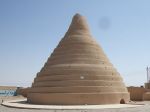
Today in the modern world we take freezers, and the frozen results of freezers for granted. But in ancient times, cold drinks, frozen desserts, and chilled tropical cocktails were a luxury unknown to most people. However the idea of artificially freezing goods is nothing new. As far back as 400 BC, the ancient Persians built special freezers called yakhchals. Yakhchals were large buildings used for storage of ice and foodstuffs during the hot Persian summers. Typically they were around 60 feet tall, and had a large subterranean storage space dug out from under it. The Yakhchal itself was made from a special type of mud clay called sarooj which was composed of clay, sand, lime, goat hair, egg whites, and ash mixed in a special proportion which made it extremely resistant to heat transfer. In other words the inside stayed cool, while heat from the outside was prevented from entering the building because of the thick insulated walls. This combined with the subterranean storage ensured that whatever goods were stored in the pit stayed cool, as temperatures below ground level are usually around the 60 to 65 degree Fahrenheit range. However, these designs were not what made a yakhchal a freezer. There was one other brilliant design feature which ensured that the yakhchal would stay frosty all year long.
At the top of the dome was a small hole, or series of small holes called windcatchers. Typically windcatchers were pointed in the direction of the prevailing winds. Due to its conical shape there was always a negative pressure gradient inside the yakhchal. According to Bernoulli’s Law air flow at a high pressure will always move toward areas of low pressure. Thus air from the outside was constantly flowing through the yakhchal. In addition, according to Venturi’s Principal, whenever air flows through a small hole, the smaller the hole, the greater the speed of the flow. The small hole, or series of holes of the yakhchal ensured that air passed into it at great flows. What resulted was a great amount of outside air entering into the yakhchal at high speeds. While the air itself wasn’t cool, the flows at which it was being entrained into the yakhchal created temperatures that were below freezing. Typically the windcatchers were cut in such a way that the incoming jet of air would be directed onto the storage pit.
The ancient Persians primarily used their yakhchals for storing ice and foodstuffs. During the summer, Persian nobles often enjoyed a frozen treat called faloodeh (pictured above), which is made from thin noodles with syrup made from sugar and rose water, then flavored with lemon, lime, fruits, almond, pistachio, and other flavorings. Due to the Persian’s freezing technology, faloodeh (which is still popular today) goes down in history as one of the first frozen desserts. The practice of building and using yakhchals continued up to the 20th century, when they were eventually replaced with modern freezers and refrigerators.

















 Steel Phoenix Studios