Something that is discussed quite a bit but not often with references in offerings. What they are, how they were approached, what one does with them. I will attempt to do a through overview of sacrifices, particularly food offerings, in ancient Greece and how it might relate to modern day practices. Bloodless sacrifices (often votive or firstfruit offerings) are important but will only be mentioned in passing. This particular masterpost is concerned with food offerings and how they were handled. I am especially looking to answer the question, “Do I eat this sacrifice?”
A sitcom about the modern Greek gods where everyone is wildly miscast
Zeus is played by Michael Cera
😂😂😂😂 Hephaestus is Nikolaj Coster-Waldau
@seerofbirds has cast Danny DeVito as Aphrodite and @qrowxiii has cast Eddie Murphy as Ares, so this is shaping up to be a pretty great TV pitch and if anyone from Hollywood is reading this, could you also consider casting Dwayne ‘the Rock’ Johnson as Hermes and Christopher Walken as Apollo, thanks.
Hera is Oscar Isaac because are you really going to cheat on Oscar Isaac, Michael Cera? Really? You’d do that? You’d look at that man’s face and chase tail somewhere else, Michael Cera, you sack of shit?
I’m dying this is fantastic I NEED THE WHOLE CAST
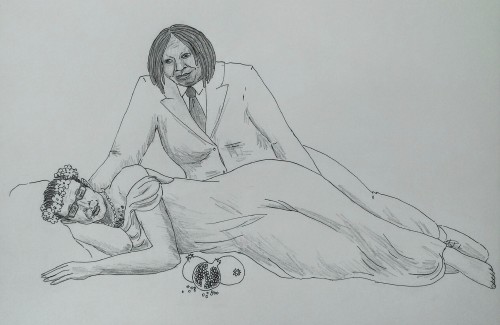
Hades is Whoopi Goldberg and Persephone is Jeff Goldblum and Demeter is Julie Andrews. Their interplay makes up 70% of the film and is all improvised.
Athena is played by Amy Schumer (thanks anon!) and she defeats her enemies by being incredibly loud and annoying and plagiarising all their tactics and eventually they just give up in irritation. She only has 3 minutes of screen time and no dialogue. Thank fuck.
Heracles is played by Jesse Eisenberg because Michael Cera got to be Zeus. Sometimes they swap roles. No-one notices.
Poseidon is played by Daniel Craig but his only scene is when he reenacts the famous Bond scene with speedos.
Artemis is played by Robert Pattinson and all his lines are just slightly amended from Twilight. Dionysus is played by Helen Mirren. It is perhaps the only apt casting in the film.
To clarify, Hestia is absolutely played by Charles Dance, whose costume includes an apron which gets progressively dirtier throughout the series.
In the sitcom, which precedes the feature film and which focuses on certain myths every episode, Narcissus is played by John Goodman. Echo is played by Billy Crystal.
Other episodes include the story of Eros and Psyche, played respectively by Jane Fonda and Shirley MacLaine, the story of Daedalus and Icarus, played respectively by Reese Witherspoon and Laura Dern, and the story of Zeus overthrowing Cronus, in which Michael Cera as Zeus must defeat Cronus, as played by John Cena, in a battle of wits and muscle. Astonishingly, he wins.
this is all very good gud
but who is perseus and medusa? jason , Midas, circe, media, please I NEED TO KNOW
These are very important questions and I will answer them immediately.
Perseus and Medusa are played by Andy Samberg and Glenn Howerton. All their scenes together are just them one upping each other with improvised insults.
Jason and Medea are played by John Boyega and Meryl Streep, and all their scenes are so beautifully acted that they both get nominated for Oscars, despite the fact that one of Jason’s lines is “are you trying to fleece me out of the golden fleece?”, to which Medea replies “me, fleece you? Oh no, me dear.”
Midas is played by Steve Buscemi, obviously. For no discernible reason, everything he touches does not turn to gold, but copper alloy. This is possibly due to budget cuts. Due to their on screen chemistry, he bizarrely has several buddy cop style scenes with Jeff Goldblum’s Persephone.
Circe does not appear. If she did, she would be played by Audrey Hepburn, using that creepy CGI from the Galaxy adverts, but her estate refuse to give their permission.
Important updates:
(Anonymous suggests: Kelsey Asbille Chow playing Achilles, Michelle Obama is Thetis, Danny Trejo as Helen, Terry Crewes as Paris, and Adrien Brody as Hector. olvmpos says: Ganymede is played by Arnold Schwarzenegger, and regularly benchpresses Michael Cera.)
Hey @teashoesandhair I’m not saying that I felt inspired and sketched Whoopi Goldberg and Jeff Goldblum as Hades and Persephone but that’s exactly what I’m saying
OH GOD THIS IS PERFECTION. THANK YOU. JUST THANK YOU. PHENOMENAL.
YOU’RE WELCOME BUT ALSO PLEASE HELP COS I CAN’T STOP
THIS IS GOING TO BE THE POSTER FOR THE SERIES, YOU HEAR ME
I’m mad that people are just reblogging the first post here because YOU’RE MISSING OUT ON THE MOST INCREDIBLE ARTWORK YOU’LL EVER SEE
Okay, I gotta ask, who’s the Hyacinthus to Christopher Walken’s Apollo?
I can already hear Apollo’s relevant lines in Walken’s distinct cadence, but I wanna know who he’s cradling, devastated, while crying out in anguish and also pausing at all the wrong places.
What a great question, and it brings me absolute joy to reveal to you that it’s Jackie Chan. He does all his own stunts. There is only one stunt, and it’s him collapsing into Christopher Walken’s arms. For some reason, there are explosions.
We usually think of ancient Greek religion as taking place in temples, but there was as well a strong aspect of household worship.
For the most part, household gods were not only household gods–they usually had community temples and festivals as well, although the god was often known by a different epithet or epithets within the household.
The following is a short list of gods who were frequently worshipped within the home.
Hestia
Hestia is the household god par excellence. She is far, far more than that–she occupies a central role in the ancient Greek religion and plays a part in not only household worship but civic rites as well, and takes part in the offerings given in rites honoring most other gods–but she was a center of household worship. She received offerings at family meals, and each new child born to a household was presented to her.
The hearth of each home belongs to Hestia.
Hekate
The hekataion was the home of Hekate within the household, and stood before the door, at the threshold of the house. The many small Hekate triformis statues still in existence may have served to represent the goddess in this context.
Hekate protected the household from evil from outside the home.
Hermes
Hermes was represented before a home in the form of a herm, typically a four-sided pillar with the head of the god on top and an erect phallus on the front. The herms within a city brought good fortune to the city (the destruction of the herms in Athens in the 5th century BCE was a serious crime), as a household’s herm did to the individual home. The herm had a practical function as well, serving as a boundary marker for the property on which it stood.
The herm was a home’s guardian, and would be anointed with oil or draped with garlands by individuals before their homes.
Other herms stood by the side of country roads and thoroughfares, again providing both protective and practical functions for travellers. The earliest forms of these were simple piles of stones which served as road markers.
Apollo Agyeius
Apollo Agyeius was represented before the home in the form of a conical stone or pillar. He protected the household from evil.
Zeus Herkeios (Zeus of the Courtyard)
Zeus Herkeios had an altar in the courtyard of the home, out in the open, where he received his offerings. Possession of such an altar was the mark of a good citizen; without it, one would not be eligible to hold certain offices. It is probable that only households of a certain standing would be expected to have an altar to Zeus Herkeios.
While the precise realm of Zeus Herkeios is uncertain, it seems likely that he protected not only the physical house but the family within the household as well; he would be a protector of the family over generations.
Zeus Ktesios (Zeus of the Storeroom, Zeus of Possessions)
Zeus Ktesios was represented in the storeroom of the home in an interesting and unique way; the householder took a two-handled jar with a lid, wrapped it in white wool, and filled it with an “ambrosia” made from water, olive oil and fruits. The jar was closed and kept in the home’s storeroom or larder.
His concern was the prosperity of the household; the presence of Zeus Ktesios within a home would ensure its material security and wealth.
Zeus Meilichios (Kindly Zeus, Zeus the Mild)
Zeus Meilichios was a chthonic or chthonian deity, which is to say that he had power beneath and within the earth. While he could be dangerous, he could also provide great gifts and blessings if treated properly. He was a giver of wealth and abundance and was often represented in the form of a snake, underlining his association with the underworld.
Although Zeus Meilichios was primarily worshipped by individuals, in Athens he was honored with a community festival as well, the Diasia.
Do any of you know about that one painting with Aphrodite being born out of lava with a black swan by her side or did i completely hallucinate that? Been searching for a while but i can’t find it for shit.
I tried googling that description but no luck either, anyone might know what painting this might be (or if it does exist? cause it sounds sick lol)
It took a bit of googling magic, but I think I’ve found it.





 Steel Phoenix Studios