And THIS is why lace was a worn primarily by royalty and aristocracy for so many centuries.. It was expensive and time-consuming to produce. Wearing it, and wearing LOTS of it was a blatant show of wealth and excessive consumption.
Mechanically-produced lace wasn’t really a thing until well into the 20th century, but there remains a wide gap between the quality of mass-produced and hand crafted
In general textile arts are highly underated considering the amount of skill and time needed to execute pretty much anything.
Steve Rogers did, in fact, realize that something was off when he saw the outline of the woman’s odd bra (a push-up bra, he would later learn), but being an officer and a gentleman, he said that it was the game that gave the future away.
No, see, this scene is just amazing. The costume department deserves so many kudos for this, it’s unreal, especially given the fact that they pulled off Peggy pretty much flawlessly.
1) Her hair is completely wrong for the 40’s. No professional/working woman would have her hair loose like that. Since they’re trying to pass this off as a military hospital, Steve would know that she would at least have her hair carefully pulled back, if maybe not in the elaborate coiffures that would have been popular.
2) Her tie? Too wide, too long. That’s a man’s tie, not a woman’s. They did, however, get the knot correct as far as I can see – that looks like a Windsor.
3) That. Bra. There is so much clashing between that bra and what Steve would expect (remember, he worked with a bunch of women for a long time) that it has to be intentional. She’s wearing a foam cup, which would have been unheard of back then. It’s also an exceptionally old or ill-fitting bra – why else can you see the tops of the cups? No woman would have been caught dead with misbehaving lingerie like that back then, and the soft satin cups of 40’s lingerie made it nearly impossible anyway. Her breasts are also sitting at a much lower angle than would be acceptable in the 40’s.
Look at his eyes. He knows by the time he gets to her hair that something is very, very wrong.
so what you are saying is S.H.E.I.L.D. has a super shitty costume division….
Nope, Nick Fury totally did this on purpose.
There’s no knowing what kind of condition Steve’s in, or what kind of person he really is, after decades of nostalgia blur the reality and the long years in the ice (after a plane crash and a shitload of radiation) do their work. (Pre-crash Steve is in lots of files, I’m sure. Nick Fury does not trust files.) So Fury instructs his people to build a stage, and makes sure that the right people put up some of the wrong cues.
Maybe the real Steve’s a dick, or just an above-average jock; maybe he had a knack for hanging out with real talent. Maybe he hit his head too hard on the landing and he’s not gonna be Captain anymore. On the flipside, if he really is smart, then putting him in a standard, modern hospital room and telling him the truth is going to have him clamming up and refusing to believe a goddamn thing he hears for a really long time.
The real question here is, how long it does it take for the man, the myth, the legend to notice? What does he do about it? How long does he wait to get his bearings, confirm his suspicions, and gather information before attempting busting out?
Turns out the answer’s about forty-five seconds.
Sometimes clever posts die a quiet death in the abyss of the unreblogged. Some clever posts get attention, get comments, get better. Then there’s this one which I’ve watched evolve into a thing of brilliance.
it’s sort of funny that the current cultural idea of the flapper dates not from the 1920s, but the 1950s when costume designers took the radical, gender-fluid, sexual, sexually liberated ideas and fashions of the 20s and made them sexy. as in sexual objectifying.
because 1950s and fuck female agency.
If you would like, I would love to hear more about this. What, exactly, happened, and what was the true 1920s aesthetic, untainted by 50s views?
hokay. so it’s the 1950s and it’s the heyday of the studio system and writers and movie makers (and audiences) want rom coms and frolicking films and lighthearted fun, but there’s just one problem.
WWII
but that was the 1940s! you say
you’re right.
but in order to set a film in the 1950s, writers and film makers have to establish what the male lead character did during the war or risk it coming across like he didn’t, well, serve. can’t have a shirker or a coward and rejected for medical reasons really doesn’t fly in the 1950s. and there’s only so many times you can write about soldiers and sailors and airmen and the occasional spy before it starts to become stale. and it doesn’t terribly fit with the fluffy writing because, well, war and death and tens of millions of people dead. contemporary films more fall in the line of what we now call film noir. men and women who have been damaged by war, but that’s another topic.
sooooo, you do period pieces. no one wants to do the 1930s because that’s the great depression. so 1920s. frolicking and gay and fabulous!
(Great War, what Great War?)
but the thing is, the 1920s, especially in Paris and Berlin, were a massively transgressive, reversal, and experimental time period in art, fashion, society, and all over. but only a little bit in america because honestly we were barely touched by wwi so it’s not like we’re partying to forget an entire generation of young men killed off and entire towns wiped off the face of the earth using weapons the likes of which had never been seen before. the us as a whole mostly heard about sarin gas, not see it poison entire landscapes and men and animals dropped to the ground and die in truly horrific ways.
the europe that emerged from wwi was massively shell shocked, angry, and living in a surreal dream of everything being upwards and backwards and live now because tomorrow you may die and it’s all nonsense anyway. it’s a world in which surrealism and dadaism and german expressionism make sense because fuck it all.
you get repudiation of the old, experimentation, deliberate reversals, transgressive behavior, and if there’s an envelope to push, you tear it open. France calls the 1920s “Années folles”, the crazy years.
the things we’re doing now, with fluidity and experimentation and exploration of gender and sexuality and presentation? the 1920s did that already. it’s drag and androgyny and blatant homosexuality. it’s extramarital affairs and sex before or without marriage, it’s rejection of marriage as an idea and an institution, it’s playing with gender and gender roles and working women and unrestrained art and
it’s everything the 1950s hated. or more accurately: absolutely terrified of.
the flappers of the 1920s went to college and cut their hair to repudiate a century of a woman’s hair being her crowning glory. they wore obvious makeup and makeup in ways that are not terribly appealing now and weren’t terribly appealing then, but they signaled you were part of the tribe.
they were women who wanted independence and personal fulfillment.
“She was conscious that the things she did were the things she had always wanted to do.“
so the 1950s didn’t want that. they wanted films with dancing and chorus lines and pretty girls to be looked at. they wanted spaghetti straps and fringed dresses that moved pretty when the chorus girls danced.
1920s fringe doesn’t. 1920s fringe is made of silk, incredibly dense, incredibly heavy, sewn on individually by hand, and rather delicate. the all-over fringe dress didn’t exist until the 1950s invention of nylon and continuous loops that could be sewn on in costume workshops by the mile on machines.
(this is before “vintage” exists. to the 1950s, the 1920s (or earlier) wasn’t vintage, it was old-fashioned. démodé. out of style. last last last last last season.)
1950s 1920s-set movies have clothes that are the 1950s take on it. the dresses have a dropped waist, but they’re form-fitting, figure-revealing. the actresses are pretty clearly wearing bras and 50s girdles under them a lot of the time. they’re not
the woman on the far left is basically wearing a man’s suit with a skirt. la garçonne. some women went full-out and wore pants. you could be arrested for that. they were. still wore pants. and pyjama ensembles in silk and loud prints.
or class photo of ‘25
or even
not that 1920s dresses could be sexy or sexual; they often were. i’ve seen 20s dresses that were basically sideless and held together with straps. but it’s sort of like how the mini skirt went from being a thing of sexual liberation to an item of sexual objectification.
it’s ownership and it’s agency and it’s hard to put a name or finger on it, but you just know. sex goddess versus sex icon.
Forgive me for adding to this, OP, but my favorite movie of all time is Singin’ in the Rain, a 1952 film set in 1927. If you look into the behind-the-scenes stuff about the costuming, the people involved talk a lot about how difficult it was because, quite frankly, 20s fashion was seen as laughably ugly by 50s standards. For them, it was what their parents wore before they were born, so think of just the worst 70s or 80s fashion you can imagine and trying to look glamorous in that. (Or for some of you tumblr kids, the 90s, but I’m here to tell you we looked great in that decade.) The closest they got is probably this:
Even here, Debbie Reynolds’s dress has a sheer overlay so you can see that really rigid, curvy 50s silhouette underneath it.
(Also, the ideal female body type was totally different and fashion hung on those frames very differently – flat and athletic and boyish in the 20s, stacked in the 50s. There’s a joke in the movie version of Thoroughly Modern Millie (1967, set in 1922) where Millie laments that her “fronts” are too “full” to let her long string of beads lie flat against her chest – the joke being that no woman would want to be smaller-busted.)
Anyway, I always thought that contrast between the fashion of the two decades and how the 50s were left struggling to interpret such a different aesthetic in a way that their audiences would find beautiful was fascinating, but I never thought about how that 50s reaction of “this is laughably ugly” might stem from a place of “this is alarmingly androgynous and non-constrictive and not designed for the male gaze.” LET KATHY SELDEN WEAR PANTS AND LIVE IN SIN.
This comes at a great time because my alma mater wants to have a flapper themed jubilee with the gowns and beads and shit, and I am a grumpy queer feminist alumna who will not hesitate to throw this stuff their way.
“The Fashion History Timeline
is an open-access source for fashion history knowledge, featuring
objects and artworks from over a hundred museums and libraries that span
the globe. The Timeline website offers well-researched, accessibly written entries on specific artworks, garments and films
for those interested in fashion and dress history. Started as a pilot
project by FIT art history faculty and students in the Fall of 2015, the
Timeline aims to be an important contribution to public
knowledge of the history of fashion and to serve as a constantly growing
and evolving resource not only for students and faculty, but also for
the wider world of those interested in fashion and dress history (from
the Renaissance scholar to the simply curious).”
Sooooooo as asked @misseccentric here is a post about undergarments (I think I’ll make another one for men’s undergarments later!). Basically are 5 garments (pug not included) that we consider “undergarments” and after a woman was dressed with them she was… well, ready to get dressed (I know, WTF).
1. Shift
Also known as chemise, the shift was the very first layer of clothing for a woman of any class, worn with nothing underneath (no underpants darlings!) it was usually made of white linen (the whiter the finer and more expensive) and it could have simple and discreet lace or very small riffles on the neckline and cuffs. The main function of the shift was to protect the clothing from the body, since daily bathing was not customary (eeewww), that’s why there are not many surviving garments (double eeeeww).
2. Stays
Stays are what people usually call “corset”, but back in the 17th century they were called “body” or “boned body and in the 18th century “stays” or “pair of stays”. Their main purpose was to shape the upper body in a conical form and to support the bosom, so it is not a constrictive garment more than one of support. Most women wore stays of different boning and materials depending on their social and economical situation, but in vague shape and style the stays of a woman from the upper class and the ones from the house maid were not that different from each other. Made of linen, wool or silk they were reinforced with whalebone or cane.
3. Pockets
A pocket (or a pair of them) was tied around the waist since actual pockets stitched to the garments didn’t happen until the 19th century. They could be of plain linen or be beautifully embroidered (even though no one would see them) and have a rather big size since they should hold all the necessities of a woman (think about all a girl would carry in her purse nowadays).
4. Paniers and Bums
The hoops or paniers were also made of linen and reinforced with whalebone or cane. The biggest expression of this garment happened at the court, where even if in the fashionable dress big panniers were no longer in fashion, they kept appearing through the whole century. The hoops are a key for the century silhouette in combo with the stays: the curve-less upper body was the perfect contrast with the big bottom that had volume only on the sides of the dress. That is until the bustle became fashionable.
The bustle (bums, rumps or culs),came as a substitute to the huge panniers and they were only small hoops or pads of different sized and shapes that added volume to the hips, both on sides and back (VERY Georgiana Cavendish).
5. Stockings and Garters
Stockings then and now are pretty much the same in shape but not in materials since they could be made of woven as well as knitted silk or wool. My favourite part of 18th century stockings is the over-the-top decoration and the bright colours these people wore (and here I am with a closet full of black and grey clothes!). Since (obviously) there was no spandex back in the day, you had to use garters (ribbon or tape) to keep the stockings in place, and of course those must have a little colourful party too with embroideries, gilded threads, knitted materials, satin colours and phrases and monograms.
A reblog because undergarments info is always welcome 🙂
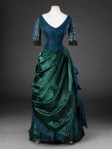
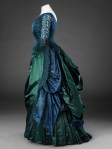
• Evening Dress of Empress Maria Feodorovna.
Place of origin: France, Paris
Manufacture, workshop, firm: Firm of Fromont
Date: 1880-1881
Medium: satin, lace, Brussel lace, beads.









 Steel Phoenix Studios