my favorite thing i’ve learned in college is that way back in ancient china there was this poet/philosopher guy who wrote this whole pretentious poem about how enlightened he was that was like “the eight winds cannot move me” blahblahblah and he was really proud of it so he sent it to his friend who lived across the lake and then his friend sends it back and just writes “FART” (or the ancient Chinese equivalent) on it and he was SO MAD he travels across the lake to chew his friend out and when he gets there his friend says “wow. the eight winds cannot move you, but one fart sends you across the lake”
i googled this bc i desperately wanted this to be real, and guess what…it is.
the dude’s name was su dongpo (also known as su shi). his original poem went like this:
稽首天中天,
毫光照大千,
八風吹不動,
端坐紫金蓮
(Humbly bowed my head below all skies Minutest lights shine through my deepest bounds Immovable by strong winds from eight sides Upon purplish gold lotus I seated straightly by the low mound) (x)
on which his friend wrote “放屁” (fart, literally), and you know the rest.
oxford was built and operational as a college before the rise of the mayans and cleopatra lived in a time nearer to pizza hut’s invention than to the pyramids being built
I need a noncomprehensive history book that covers Known World History in time periods, like “in this century, all this shit was happening concurrently” and not just all spread out so I have to piece it together like some unpaid uneducated scholar
Mongols were fighting Samurai in Japan and Knights in Europe at the same time.
Star Wars a New Hope came out the same year as the last execution in France by Guillotine.
Abraham Lincoln and Edgar Allen Poe were friends in their early 20′s.
When the Great Pyramids were being built there were areas that still had Woolly Mammoths roaming.
Harvard University didn’t teach calculus in its first few years after being established because calculus wasn’t invented yet.
Nintendo was founded two years after the Eiffel Tower was constructed
This is the book you want: The Timetables of History – going year by year (or in the earlier sections, at least century by century) and showing you what was going on in various parts of the world in several categories (e.g. Politics, Literature, Science, etc.) Super useful for visualizing what events were happening at the same time.
Þrymskviða. Compressed down, it goes like this: A Jotun steal Thor’s hammer Mjolnir and says he’ll only give it back if he’s given Freyja to marry, as she is the most beautiful goddess in all of existence. The gods argue over what to do for a while before Heimdall suggests they stick a bridal veil on Thor, says he’s Freyja, and pretend they’re giving Freyja (Thor) to the Jotun to marry so Thor can get close enough to the Jotun to steal Mjolnir back.
Now typically when people talk about this story, it’s with an element of disbelieving comedy. “Oh my god, who would believe Thor was a woman, let alone Freyja, the most beautiful goddess in the world?”
But I propose a different way to look at the story.
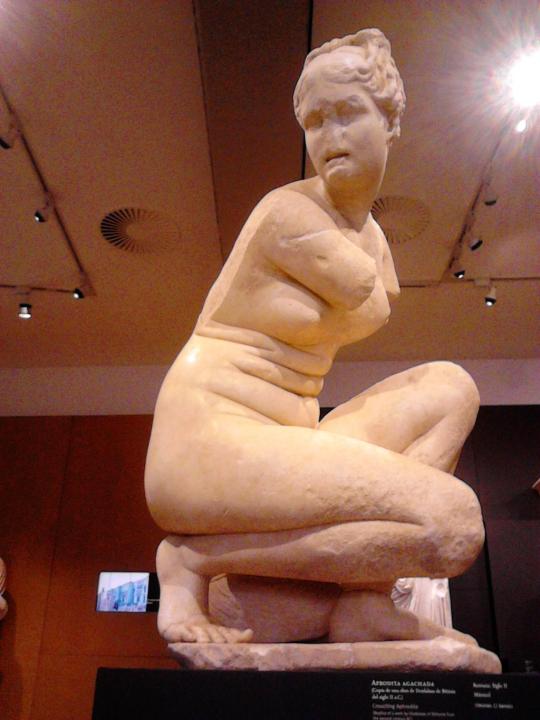
See, different cultures have different beauty standards. Modern western beauty standards may be a delicate hourglass supermodel, but that’s not always been the case. Greece, for instance, depicted Aphrodite like this:
Yeah. A Greek sculptor was told “sculpt the goddess of beauty” and they thought “alright, fat rolls, that’s where beauty is at, let’s do this”. And everybody else apparently agreed with them, because up went the statue. Beauty is a malleable concept is what I’m getting at.
Now this is where it becomes relevant that Freyja is not just the goddess of love, sex, and beauty. She’s also the goddess of war. And the righteous dead. Goddess of war in the same Viking warrior culture that gave us shield maidens, women who wielded seven fucking kilogram (15 lbs) shields in combat.
Sooooo … when the Norse storytellers said, “This is Freyja, goddess of war and the righteous dead, who rode giant murder cats into battle, she is the most beautiful goddess in the world”, I’m guessing they weren’t thinking of her as some willowy waif. No, I’m guessing they probably thought more along the lines of:
190 cm (6′3″), broad shoulders, built like a brick shithouse, with a jawline like whoa, and fully capable of murdering everything in her path.
Put in that context, the story of Thor dressing up as Freyja sounds less like a punchline about “how could anyone ever mistake Thor in a veil for Freyja?” and becomes more a case of “ohhhhhhhhhhh, no wonder all the gods thought this plan would work”.
Le Sommeil [The Sleepers], which depicts two women entwined in a post-coital embrace, caused a stir when it was first shown in the 1870s. The police were called in, and the painting was not shown again until the 1980s. But its brief showing had an influence on a number of contemporary artists, and helped challenge the taboos associated with lesbian relationships. For modern audiences it’s a good reminder that people in the 19th century were not ignorant of lesbian relationships, as we tend to believe. And it’s pretty damn sexy, don’t you think?
Carpathia received Titanic’s distress signal at 12:20am, April 15th, 1912. She was 58 miles away, a distance that absolutely could not be covered in less than four hours.
(Californian’s exact position at the time is…controversial. She was close enough to have helped. By all accounts she was close enough to see Titanic’s distress rockets. It’s uncertain to this day why her crew did not respond, or how many might not have been lost if she had been there. This is not the place for what-ifs. This is about what was done.)
Carpathia’s Captain Rostron had, yes, rolled out of bed instantly when woken by his radio operator, ordered his ship to Titanic’s aid and confirmed the signal before he was fully dressed. The man had never in his life responded to an emergency call. His goal tonight was to make sure nobody who heard that fact would ever believe it.
All of Carpathia’s lifeboats were swung out ready for deployment. Oil was set up to be poured off the side of the ship in case the sea turned choppy; oil would coat and calm the water near Carpathia if that happened, making it safer for lifeboats to draw up alongside her. He ordered lights to be rigged along the side of the ship so survivors could see it better, and had nets and ladders rigged along her sides ready to be dropped when they arrived, in order to let as many survivors as possible climb aboard at once.
I don’t know if his making provisions for there still being survivors in the water was optimism or not. I think he knew they were never going to get there in time for that. I think he did it anyway because, god, you have to hope.
Carpathia had three dining rooms, which were immediately converted into triage and first aid stations. Each had a doctor assigned to it. Hot soup, coffee, and tea were prepared in bulk in each dining room, and blankets and warm clothes were collected to be ready to hand out. By this time, many of the passengers were awake–prepping a ship for disaster relief isn’t quiet–and all of them stepped up to help, many donating their own clothes and blankets.
And then he did something I tend to refer to as diverting all power from life support.
Here’s the thing about steamships: They run on steam. Shocking, I know; but that steam powers everything on the ship, and right now, Carpathia needed power. So Rostron turned off hot water and central heating, which bled valuable steam power, to everywhere but the dining rooms–which, of course, were being used to make hot drinks and receive survivors. He woke up all the engineers, all the stokers and firemen, diverted all that steam back into the engines, and asked his ship to go as fast as she possibly could. And when she’d done that, he asked her to go faster.
I need you to understand that you simply can’t push a ship very far past its top speed. Pushing that much sheer tonnage through the water becomes harder with each extra knot past the speed it was designed for. Pushing a ship past its rated speed is not only reckless–it’s difficult to maneuver–but it puts an incredible amount of strain on the engines. Ships are not designed to exceed their top speed by even one knot. They can’t do it. It can’t be done.
Carpathia’s absolute do-or-die, the-engines-can’t-take-this-forever top speed was fourteen knots. Dodging icebergs, in the dark and the cold, surrounded by mist, she sustained a speed of almost seventeen and a half.
No one would have asked this of them. It wasn’t expected. They were almost sixty miles away, with icebergs in their path. They had a respondibility to respond; they did not have a responsibility to do the impossible and do it well. No one would have faulted them for taking more time to confirm the severity of the issue. No one would have blamed them for a slow and cautious approach. No one but themselves.
They damn near broke the laws of physics, galloping north headlong into the dark in the desperate hope that if they could shave an hour, half an hour, five minutes off their arrival time, maybe for one more person those five minutes would make the difference. I say: three people had died by the time they were lifted from the lifeboats. For all we know, in another hour it might have been more. I say they made all the difference in the world.
This ship and her crew received a message from a location they could not hope to reach in under four hours. Just barely over three hours later, they arrived at Titanic’s last known coordinates. Half an hour after that, at 4am, they would finally find the first of the lifeboats. it would take until 8:30 in the morning for the last survivor to be brought onboard. Passengers from Carpathia universally gave up their berths, staterooms, and clothing to the survivors, assisting the crew at every turn and sitting with the sobbing rescuees to offer whatever comfort they could.
In total, 705 people of Titanic’s original 2208 were brought onto Carpathia alive. No other ship would find survivors.
At 12:20am April 15th, 1912, there was a miracle on the North Atlantic. And it happened because a group of humans, some of them strangers, many of them only passengers on a small and unimpressive steam liner, looked at each other and decided: I cannot live with myself if I do anything less.
I think the least we can do is remember them for it.
The earliest known book-length biography of an African woman, a 17th-century text detailing the life of the Ethiopian saint Walatta Petros, has been translated into English for the first time.
Walatta Petros was an Ethiopian religious leader who lived from 1592 to 1642. A noblewoman, she left her husband to lead the struggle against the Jesuits’ mission to convert Ethiopian Christians to Roman Catholicism. It was for this that the Ethiopian Orthodox Täwaḥədo Church elevated her to sainthood.
Walatta Petros’s story was written by her disciples in the Gəˁəz language in 1672, after her death. Translator and editor Wendy Laura Belcher, an associate professor at Princeton University, came across the biography while she was studying Samuel Johnson’s translation, A Voyage to Abyssinia. “I saw that Johnson was fascinated by the powerful noble Ethiopian women in the text,” said Belcher. “I was speaking with an Ethiopian priest about this admiration and he told me that the women were admired in Ethiopia as well, where some of them had become saints in the Ethiopian church and had had hagiographies written about them.”
Ten years later, Belcher still remembers how “thrilling” this revelation was. “What? Biographies of powerful African women written by Africans in an African language? And to be able to pair European and African texts about the same encounter? I knew then I wouldn’t rest until I had translated this priceless work into English.”
Belcher learned Gəˁəz in order to translate Walatta Petros’s biography, working first with the Ethiopian priest, and then with the translator Michael Kleiner. “As a biography, it is full of human interest, being an extraordinary account of early modern African women’s lives — full of vivid dialogue, heartbreak, and triumph. For many, it will be the first time they can learn about a pre-colonial African woman on her own terms,” she said.
The biography has now been published in English by Princeton University Press as The Life and Struggles of Our Mother Walatta Petros. It has only been translated into two other languages before: Amharic and Italian, the latter in the 1970s.
While researching the text, Belcher discovered that the biography contained the earliest known depiction of same-sex desire among women in sub-Saharan Africa, an element she said was “censored” from the manuscript that the 1970s Italian edition was based on.
Belcher writes in the book’s preface that while she and Kleiner were translating the story from the Italian edition, they came across a “perplexing anecdote about a number of community members dying because some nuns had pushed each other around”. Kleiner suspected the manuscript had “been miscopied, perhaps deliberately, in order to censor the original, or merely by accident”, and speculated that “the nuns were not fighting but flirting with each other”.
After consulting with several Ethiopian scholars and looking at digitised copies of the original manuscripts, Kleiner and Belcher found the uncensored manuscript concurred. They translated the line as Petros seeing “some young nuns pressing against each other and being lustful with each other, each with a female companion.”
“This is the earliest anecdote we know of in which African women express desire for other women,” writes Belcher.
The academic also pointed to Walatta Petros’s relationship with her fellow nun Eheta Kristos, describing their first encounter with each other as “rapturous”. The text says that “love was infused into both their hearts, love for one another, and… they were like people who had known each other” their whole lives. Walatta Petros and Kristos “lived together in mutual love, like soul and body. From that day onward the two did not separate, neither in times of tribulation and persecution, nor in those of tranquillity, but only in death”.
“There is no doubt that the two women were involved in a lifelong partnership of deep, romantic friendship,” Belcher writes.
Identifying them as lesbians would be “anachronistic” partly because Walatta Petros was “deeply committed to celibacy”, she told the Guardian.
“Many Ethiopians are quite upset about my comments about the saint, my interpretations of her relationship with Eheta Kristos,” she said. “Part of this upset is due to not understanding my point. I think she was a sincere, celibate nun, but that she also felt desire for other women and that she was in a life-long celibate partnership with Eheta Kristos.”
I just kept smiling wider and wider the more I read.
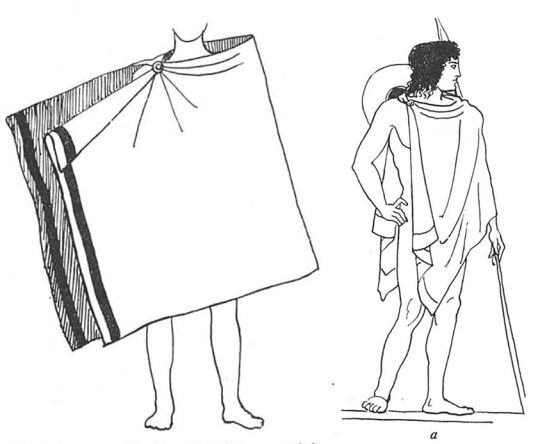
Wait, wait…. Is that seriously it? How their clothes go?
that genuinely is it
yeah hey whats up bout to put some fucking giant sheets on my body
lets bring back sheetwares
also chlamys:
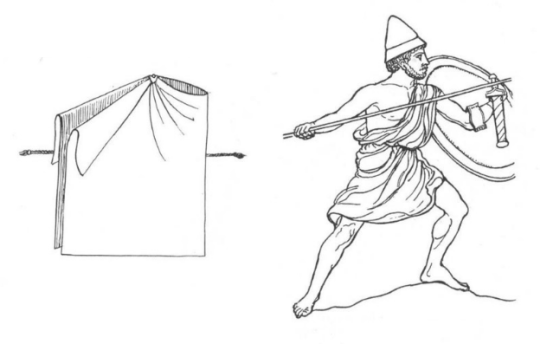
and exomis:
trust the ancients to make a fashion statement out of straight cloth and nothing but pins
Wrap Yourself In Blankets, Call It a Day
Ok, yes, but guys, look
Prior to the Industrial Revolution, fabric was EXTREMELY time consuming to make, and as such, was extremely valuable. You have to grow your fiber, either in the ground or on an animal. You have to process the fiber. You have to spin the fiber. And spin, and spin, and spin. Spinning technology prior to the late Middle Ages consisted of a drop spindle. It takes forever and a day to spin enough thread to make fabric using a drop spindle – 10-30 times longer than to weave it, depending on how thick your yarn is and what weaving technology you are using. Then, once you are done with that endless task, you need to weave it. The examples in this post are all from Greece, where they used the warp-weighted loom, which is actually a rather efficient piece of weaving technology, but it’s still not as fast as the treadle loom (another late Middle Ages invention) and in no way comparable to a modern industrial loom (essentially the same machine as a treadle loom, but automated (except warping, which is still hell on earth even in 2018)). You know the saying “women’s work is never done”? That saying refers to the fact that unlike, say, field work, or mining, or smithing, spinning and weaving were started before dawn and carried on until after dusk, every day of the year, and there was always, always need for more.
After all of this, every piece of fabric that is made represents literally hundreds of hours of work. It is so valuable it was a standard form of currency before the invention of money. Egyptians piled linen high in their tombs as a show of wealth – and that linen was stolen by the grave robbers along with the gold and other precious artifacts. Textiles were one of the most valuable things you could steal when you pillaged a city. A primary reason for the warfare and raiding that was a consistent part of pre-modern Mediterranean/Near Eastern history was to acquire female slaves to produce textiles. Yes, cooking, cleaning, and sex were also reasons to acquire female slaves, but the economic reason was for textile manufacturing.
So if fabric is that valuable, you’re not going to waste it. You’re not going to make something tightly tailored, because as anyone who sews can tell you, cutting fabric to fit produces a lot of waste. In addition, the cloth of the ancient world was often much more loosely woven than cloth today, which is partly to do with weaving technology but most to do with the fact that the denser the cloth, the more threads there are in it, which means the more threads you have to spin for it, which means the time you have to spend making it has just gone up dramatically. Loosely woven cloth ravels like hell when you cut it, again as anyone who sews can tell you, and that makes it much more difficult to sew something nicely tailored. Needles and scissors are also items we take for granted, but are, in their modern form, relatively modern inventions and have, historically, been tricky items to make.
Thus, most of the clothing of the ancient Mediterranean/Near East was based on the rectangles of fabric that come directly off the loom. Much of China’s historical dress is similar, at least in the time frames we’re talking about. Throughout European/North African/Middle Eastern history, and in China until silk changed the game (at least for the rich), tailoring skill and technology has lagged behind cloth production skill and technology.
The famous painting from the early Renaissance where the woman is wearing a dress constructed using a truly obscene amount of fabric? That painting is often held up as an example of the sharp increase in the availability of material goods that is the hallmark of the European Renaissance (especially because it is of a merchant family and not nobles), and it is that. But it is also an example of a mode of dress that was difficult-to-impossible to achieve before the invention of the flyer wheel (for spinning) and treadle loom (for weaving), which made cloth take considerably less time to make and therefore considerably cheaper, and which also made cloth considerably more amenable to tailoring.
So yeah. You too would make fashion out of sheets if it took you most of a month of full-time work to produce one sheet.
I also want to point out that much of the historical dress of Sub-Saharan Africa and the Americas (in the places where cloth was used) is similar, it’s just based on narrow rectangles sewn together rather than large rectangles, because these are places where the backstrap loom and/or tubular loom remained the mainstay of weaving technology. Backstrap looms produce narrow lengths of cloth (15-18 inches is usually the limit), so with that weaving technology + some sewing, you get things like Central and South American ponchos and much of the traditional dress of Central and Western Africa.
so my campus is currently hosting an ENORMOUS conference of scholars who study medieval history. they’ve been completely flooding the tiny cafe where I work and drinking our coffee faster than we can make it, but the good news is that they provide some PRIME people watching, including:
the fact that all of their name tags include pronouns so that I won’t feel bad assuming anyone’s gender in this post
the woman RANTING about one of her colleagues on the following grounds: “he thinks he understands it from some class he took in 1996! FUCK OFF, TOM.”
the man who was loudly and earnestly discussing the “influence of the Harry Potter fandom on our modern political discourse” while he got a soda
before he was out the door he’d switched topics to his preferred methods for teaching students about elves
the two nice extremely polite young British lads who I could not tell apart to save my life. their name tags indicated that they were apparently not twins, but cloning does not seem impossible.
the sheer number of people graciously volunteering to buy lunch for people they’ve just met
an unexpected number of very handsome soft butch women involved in medieval studies. I am bisexual and weak.
the guy in the flannel shirt who had the coldest, softest, most feminine hands I’ve ever encountered. I fell in love with him for a good 60 seconds. I am bisexual and weak.
people who aren’t from America being cheerfully confused by our money, including my favorite, a Canadian woman who told me “I’m slow with American money because it’s all the same color.”
I’ve learned that people who aren’t going to be in the country for more than a few days don’t give a SHIT about their change and will toss all of it in the take a penny/leave a penny jar. I collected so many quarters, y’all.
also a nice British woman called it the penny pot, which is the cutest shit I’ve ever heard and absolutely its new name.
just in general the EXTREMELY good grace and patience with which everyone accepted that we only have 2 cashiers and that it takes about seven minutes to make more coffee.
SEVERAL times after I apologized for the coffee wait (because this is customer service and minor inconveniences mean we have to grovel) the response was ‘lmao no worries this just means I get a fresh pot’
a woman approached me to day with a fucking enamel pin of that old illustration of a nun gathering dicks from a tree (you know the one) and I said immediately “oh my god, is that a pin of the penis tree?” and she looked stoked and said “yes it is the penis tree! you’re only the second person to recognize it!” what kind of boring ass medieval scholars has she been hanging with???? she was probably so fucking excited to finally have company where she could wear that pin and nobody said anything??? rude.
you know, this one
I have more:
every single person who said “cheers” when I gave them their change.
the painfully hip young man who was dressed entirely in standard academic business casual EXCEPT FOR his shiny silver doc martens.
me: “you boots are amazing.”
him: “!!!! thank you!”
the man who walked in, spotted the selection of high octane energy drinks, and nearly cried with relief. when he came to the register to pay for what was probably enough caffeine to kill a horse he looked me dead in the eye and said cheerfully “thanks, I’m jet lagged as shit and I can’t be expected to function right now.”
the dude who overheard my friend Austin listening to Florence and the Machine, started chatting with him about it, and asked him out on a date
I sold a hot dog to An Actual Nun
I have a very important update for everyone who had questions regarding the penis tree pin (and there were many of you):
this post found it’s way to one Dr. Kara Maloney, who is in fact the proud wearer of the penis tree pin
as several people have suggested, it does in fact come from the Marginalia Paraphernalia kickstarter, so we can officially say we solved that mystery.










 Steel Phoenix Studios