So, I recently saw a post on my dash with someone lamenting the fact that in the medieval era, they would have been considered ugly as there was no makeup, and someone else offering a well-meant attempt to reassure them: that since they’d have no pox scars, rotten teeth, filthy hair, etc, all medieval men would think they were amazingly hot. While I appreciate the sentiment, there’s…. more than a little mythology on both sides of this idea, and frankly, our medieval foremothers would be surprised and insulted to hear that they were apparently the stereotyped bunch of unwashed, snaggle-toothed crones who put no care or effort into their appearance, and had no tools with which to do so.
(Or: Yep. Hilary Has More Things To Say. You probably know where this is going.)
I answered an ask a couple weeks ago that was mostly about medieval gynecological care and the accuracy of the “mother dying in childbirth” stereotype, but which also touched on some of the somehow still-widely-believed myths about medieval personal care and cleanliness. Let’s start with bathing. Medieval people bathed, full stop. Not as frequently as we do, and not in the same ways, but the “people never washed in Ye Olde Dark Ages” chestnut needs to be decidedly consigned to the historical dustbin where it belongs. “A Short History of Bathing Before 1601″ is a good place to start, as it follows the development of bathing culture from ancient Rome (where bathhouses were known for their use as gathering places and influential centers of political debate) through to the modern era. Yes, common people as well as the nobility washed fairly frequently. Bathing was a favored social and leisure activity and a central part of hospitality for guests. Hey, look at all these images in medieval manuscripts of people bathing. Or De balneis Puteolanis, which is basically a thirteenth-century travel guide to the best baths in Italy. Or these medieval Spanish civic codes about when men, women, and Jews were allowed to use the public bath house. There was also, as referenced in the above ask, the practice of washing faces, hands, etc daily, and sometimes more than once. Feasts involved elaborate protocol about who was allowed to perform certain tasks, including bringing in the bowls of scented water to wash between courses. They associated filth with disease (logically). Anyway. Let’s move on.
Combs are some of the oldest (and most common) objects found in medieval graves – i.e. they were a standard part of the “grave goods” for the deceased, and were highly valued possessions. Look, it’s a young woman combing her hair (that article also discusses the history of medieval makeup for men, which was totally a thing and likewise also suspected of being “unmanly.”) The Luttrell Psalter, now in the British Library, includes among its many illuminations one of a young woman having her hair elaborately combed and styled by an attendant. There were extensive discourses on what constituted an ideally attractive medieval woman, and the study of aesthetics and the nature of beauty is one of the oldest and most central philosophical enquiries in the world (as were beauty standards in antiquity). Having a pale complexion was a sign of wealth (you didn’t have to work outdoors in the sun) and women used all kinds of pastes and powders to achieve that effect. Remember the Trotula, the medieval gynecological textbook we talked about in the childbirth ask? Well, it is actually three texts, and the entire third text, De ornatu mulierum (On Women’s Cosmetics) is dedicated to makeup and cosmetics. What weird and gross sort of things do they advocate, cry editors of “7 Horrifying Medieval Beauty Tips You Won’t Believe!”-style articles? Well…
First come general depilatories for overall care of the skin. Then there are recipes for care of the hair: for making it long and dark, thick and lovely, or soft and fine. For care of the face, there are recipes for removing unwanted hair, whitening the skin, removing blemishes or abscesses, and exfoliating the skin, plus general facial creams. For the lips, there is a special unguent of honey to soften them, plus colorants to dye the lips and gums. For the care of teeth and prevention of bad breath, there are five different recipes. The final chapter is on hygiene of the genitalia. […] A prescription said to be used by Muslim women then follows.[…] The author gives detailed instructions on how to apply the water just prior to intercourse, together with a powder that the woman is supposed to rub on her chest, breasts, and genitalia. She is also to wash her partner’s genitals with a cloth sprinkled with the same sweet-smelling powder.
Wait so… hair care, skin and facial creams, toothpaste, lipstick, and sexual hygiene?? With the latter based on that used by Muslim women??? Zounds! How strange and unthinkable!
L’ornement des Dames, an Anglo-Norman text of the thirteenth century, offers more tips and tricks, and explicitly references the authority of both the Trotula and Muslim women: “I shall not forget either what I learnt at Messina from a Saracen woman. She was a doctor for the people of her faith […] according to what I heard from Trotula of Salerno, a woman who does not trust her is a fool.” So yes. The beauty regimes of Muslim women were transmitted to and shared by Christian women, especially in diverse places like medieval Sicily, and this was valuable and trusted advice. Gee. It’s almost like women have always a) cared about their appearance, and b) united to flip one giant middle finger at the patriarchy. (You can also read more about skincare and cosmetics.) Speaking of female health authorities, you have definitely (or you should have) heard of Hildegard von Bingen, a twelfth-century abbess and towering genius who was the trusted advisor of kings and popes and wrote treatises on everything from music to medicine to natural science (she is regarded as the founder of the discipline in Germany). This included the vast Physica, a handbook on health and medicine, and Causae et curae, another medical textbook.
Did the church grumble and gripe about women putting on excessive adornments and being too fixated by makeup and the dangers of vanity and etc etc? You bet they did. Did women ignore the hell out of this and wear makeup and fancy clothes anyway? You bet they damn well did. Also, medieval society was fuckin’ obsessed with fashion (especially in the fourteenth century.) The sumptuary laws, which appeared for the first time in the late thirteenth and early fourteenth centuries, regulated which classes of society were allowed to wear what (so that fancy furs and silks and jewels were reserved for the nobility, and less expensive cloth and trimming were the province of the lower classes – the idea was that you could know someone’s station in life just by looking at them). These were insanely detailed, and went down to regulating the height of someone’s high heels. So yes, theoretically, the stiletto police could stop you in fourteenth-century England, whip out a measuring tape, and see if you were literally too big for your britches.
(”But, but,” you stammer. “Surely they had rotten teeth?” Well, this is probably a bad time to note that in addition to the five toothpaste remedies mentioned in the Trotula, there are even more. Jewish and Muslim natural philosophers and herbalists had all kinds of recommendations – see Practical Materia Medica of the Medieval Eastern Mediterranean. Also, since there was no processed sugar in their diet, their dentistry was far better than, say, the Elizabethans, and white and regular teeth were highly prized. There would be wear and tear from grist, but since fine-milled white bread was a status symbol, the wealthy could afford to have bread that did not contain it, and thus good teeth.)
Of course, everyone wasn’t just getting dressed up with, so to speak, nowhere to go. What about sex? It never happened unless it was marital rape, right? (/side-eyes a certain unnamed quasi-medieval television show). Oh no. Medieval people loved the shit out of sex. Pastourelles were an immensely popular poetic genre which almost always included the protagonist having a romp with a pretty shepherdess, and anyone who’s read any Chaucer knows how bawdy it can get. Even Chaucer, however, is put to shame by the fabliaux, which are a vast collection of Old French poems that have titles so ribald that I could not say them aloud to an undergraduate class. (”The Ring That Controlled Erections” and “The Peekaboo Priest” are about the tamest that I can think of, but I gotta say I’m fond of “Long Butthole Berengier” and the one called simply “The Fucker,” because literally people are people everywhere and always. And yes, you perverted person, you can read the lot of them here.) This was incredibly explicit and bawdy popular literature that was pretty much exactly medieval porn (and like usual porn, did not exactly serve as any kind of precursor of feminist media or positive female representation, but Misogyny, Take a Shot.)
So yes. Once more (surprise!) the history of cosmetics goes back at least six thousand years, and is one of the oldest aspects of documented social history in the world. It existed broadly and accessibly in the medieval world, where women had other women writing books on it for them, and was just as much as a concern as it is now. People have always liked to look good, smell good, accessorize, dress fashionably, try weird beauty trends, and so forth. So if by some accident you do stumble into a time machine and end up in medieval Europe, you’ll have plenty of choices. Our medieval foremothers, and the men who loved them and thought they were beautiful, thank you for your time.
This is amazing. So many facts and links! Hope this post blows up big style 🙂
I really enjoyed this post, thank you!
A post about medieval history that’s actually researched and has links to primary sources? I am very here for this.
“However, most of us do lead an unchristian life because most Wiccans are not Christian, but then again neither was Jesus. We follow the moral axioms that were set forth by Jesus in the most fundamental way. Most Wiccans that I know follow the way of Jesus better than some Christians I know. the interpreters of the Bible and other holy documents, have confused and made complex the idea of achieving peace and joy in the world. Wiccans try to lead a life of tolerance and understanding but our ways and customs are not what a Modern Christian might call ‘Christian.’“
(p. 120,Of Witches, Janet Thompson)
What. In. The. Actual. Ass?
It’s 1993 and welcome to the Satanic Panic, where authors took one of two routes to try to calm people down:
1. We’re unrelated to Judeochristian mythos, and therefore don’t believe in “Satan” or the devil.
2. We’re actually, like, waaay more Christian than you are when you think about it? Like, we’re all about tolerance and love, while you know how those Chiiiistians aren’t? Jesus would really be a Wiccan, I just FEEL that would be true. Like, if you look at it hard enough, aren’t Christians the REAL Satanists?
Guess which path shitty writers chose.
For all their faults, I can respect the Church of Satan for doubling down during the Panic.
@traegorn calls it shitty writing. I call it the truth.
It’s shitty writing because Wiccans and Witches don’t need to justify their moral structure in the frame and context of the Judeochristian faiths.
It litetally delegitimizes Wicca while trying to defend it.
It’s shitty writing.
There is absolutely no reason to discredit a religion as a means to uplift another. Most people who pick up a book on Wicca are already jaded by the Christian culture, at least in America. So there’s no need to make comments like that- the author is already going to be interpreted as being on the reader’s side.
So saying that Wiccans make better Christians than Christians is kind of like going to an open-mic night after watching a Comedy Central stand-up special and just going on a rant about how awful married life is.
Lazy. It’s lazy.
Are there Christians who don’t follow the teachings of Jesus even if that should be like… the one thing they’re doing? Yes. Absolutely. But an informational book about Wicca is not the place for that. You got something to say about it, write another book. Now is not the time.
Wicca does not explicitly follow the teachings of Jesus. It follows the general rule of ‘don’t be a jerk.’ That should be about as far as the comparison goes.
And comments like the one the author is making here really twig me because it makes it sound like Wicca and other occult practices don’t have their own shit to fucking examine.
So instead of taking pot-shots at a religion, it would be significantly more effective to draw comparisons between the two and outline the differences. Because comparative religious studies are an important dynamic to discuss in a 101 book.
Love yall for saying what I didnt have the energy to say. It literally exhausted me to read that.
Feeling superior and that you are better at the religion not being in it than actual practitioners of a religion because you meet some random criteria* of that religion is just beyond laughable. Especially when that religion is closed (wrt the mysteries, baptism universally, but also all the other ones included especially in all forms of catholicism [notice all forms of, not just roman]).
Though thats par for the course in the occult communities, “i do it better than them ACTUAL practitioners even though I am not a practitioner!”
These reindeer games gotta stop. We are too old to be doing this.
*(charity work and respecting others btw, for those in the back that dont know the context, the author really fucked up on that with their examples of it but ok then. If you want to join the author is degrading homeless people as being a better Christian way you go right ahead with that one.)
… Judeochristian ain’t a fucking thing except to the Christians who wanted to force the two together.
For those of us who have never belonged to either, it’s a useful term to describe monotheistic faiths that derive moral authority from a god and the ten commandments. I mean, there are shared religious texts – it’s not weird to group them.
But you’re right in one respect – it was the wrong term to use. I probably should have said Abrahamic Faiths,
It was wrong to exclude Islam.
And Judaism and Islam treat Satan differently from how Christianity does. It’s not a useful term.
May I ask a question for my own knowledge?
I tried googling, but I was getting a lot of non answers or lumping Satanism with Judaism and Islam.
My question is how did Judaism and Islam deal with the Satanic Panic of the 1970s through the 1990? Given what you just said there, did it even bleep on the radar?
… Not really even sure. Depends on the person doing the preaching, but tmu Judaism has a VERY wide variety of views on Satan, but not as an opponent of G-d. The scriptures actually treat Satan as one of G-d’s aides (Job) and a prosecutor (Zechariah). Christian understandings of Satan come more from their scriptures treating him as anti-Jesus and anti-G-d. Islam’s equivalent of Satan, Iblis, isn’t considered an adversary (Islam is strictly monotheist).
The vast majority, if not all, of those trying to jump on the concept of Satanic ritual abuse (Satanic Panic) as a true and real thing are Christians.
I otherwise have a NUMBER of objections to Judeochristian being used in the first place by non-Christian gentiles, most of them connecting to “Judaism and Christianity only have scriptures in common and even that is a tenuous connection.”
Interesting! I was wondering then, at that point if it wasn’t even a thing for Judaism or Islam to be really that worried about Satanism, let alone Satanic Ritual abuse. So then the conversation should be directed in a strictly Christian route, rather than including more than that.
Also, I am not here to argue the merits of whether or not Islam, Judaism, or Christianity should be lumped together in a particular term. I know that there are some forms of Christianity that view themselves to be specifically more like Judaism than others – not just that they have scriptures which I could include examples of here but it’s a moot point because I’m not going to argue it. But I know that much of Christianity (including those examples listed above), for example, does not like to be associated with Islam (even pre-9/11) and does not agree that Islam is (my wording) “a continuation” of Christianity.
So the argument that they should not be lumped together, to me, seems valid and correct.
I would understand that a focus purely on Satan and a worship of Satan would instead be considered idolatry in all of the Abrahamic religions, but, with regards to SRA, that was first and foremost Christians doing the panicking.
Given how CLOSELY Satanic Panic mirrors antisemitic blood libel accusations (“they’re sacrificing children! They drink their blood!”) I cannot seriously imagine the Jewish community at large taking part in the same rhetoric that was often used to kill them.
Just like much of the witch hunts and burning times were actually ways to hunt and kill crypto-Jews.
I have no idea what Islam thinks about satanic ritual but Judaism is chiefly concerned with no idol worship, and probably avoiding any and all panic or hysteria about Satan mostly because that used to end up in dead Jewish people.
Actually I’d argue this is DIRECTLY linked – Satanic Panic was a new wave of old hysteria that usually was blatantly antisemitic.
“As Christian theology generally focuses on a dichotomy of heaven and hell, positioning an outsider on the side of demonic supernatural forces has always been a favored tactic.
And so we’ve seen the likes of blood libel in the 12th century and beyond, when Christians accused Jews of using blood from kidnapped Christian children in their rituals. The 1475 Simon of Trent blood libel even saw an entire Jewish community tortured and 15 men executed over the death of a 2-year-old in Trento, Italy. Anti-Semitic violence and moral panic spread across Europe in its wake.”
I’m not the only one who guessed this is the historical precedent and I’m sure I’d find even more sources linking the two if I searched further.
Also there’s the fact that the guy who built the TST temple in Salem is Jewish himself, so double the hysteria there! timesofisrael.com/in-haunted-salem-a-jewish-church-founder-preaches-the-art-of-satanic-social-change/amp/
My mother is a psychiatrist and a Christian who did a lot of community work that was interfaith, because Judaism is big on helping the community and my mom wouldn’t darken the door of a Christian church that wasn’t also. (There were not enough Muslims in her part of West Virginia during the Satanic Panic for them to have a mosque in the area, though some did work with the charity organization my mom was a part of.) So I asked her, and she told me that the big difference between the Jewish and Christian response (in semi-urban Appalachia, an area not known for measured responses) was pretty clear.
There were Jewish children who got talked into thinking they’d been victims of Satanic ritual abuse, just like there were Christian kids. Jewish kids were talked into it by Christian adults they knew, usually teachers and daycare workers, and here, the similarity stops. Christians during the Panic believed their kids and often provided suggestions that furthered the depth, details and perceived reality of the abuse. They took their kids to anyone who claimed to be able to do hypnosis, with or without a degree, and informed people in their churches about the tragedy that had befallen their family, thus keeping the hysteria growing.
Jewish people got actual psychiatrists like my mom, who specialized in working with children, to talk to their children. And eventually the kids would admit they were saying those things because adults really wanted them to, but in the meantime Jewish people didn’t freak out their congregations or make baseless speculation about Satanic cults. They were more reserved and private about the whole thing, which in turn helped their kids snap out of the delusion or admit it was a lie, because their children had no incentive to keep going and didn’t feel pressured to believe an outlandish thing.
TL;DR from what I know of the Jewish reaction to the Panic it was ‘get thee to therapy so we can figure out what’s going on’ instead of ‘I believe you and will not for a second consider that this might not be legit’.
nose ornament with spiders
salinar culture (peru), c.100 BC – 200 AD, gold
Nose…ornament. ….
I really, really want to see this on someone’s face to get a better understanding of the scale, because if it’s teh way I think it is? Those details are hella intricate and awesome.
EDIT:
Anonymous said: According to the metropolitan museumof art the spider nose
ornament is H. 2 x W. 4 3/8 x D. 1/8 in. (5.1 x 11.1 x 0.3 cm). So yes,
that’s delicate!
there’s something poetic about the idea of surviving the most inhospitable environment in the universe and the several-mile fall from it through the power of technology and then being lain low by a fucking bear
I skipped the last part the first time I read this, and I genuinely thought they were carrying weapons to defend themselves from wolves and bears in space. Because you never know where the wildlife might be lurking, right?
Fun Fact: Apparently Oscar Wilde was 6’3”, which in the 1870s would have been the equivalent of like 6’7”-6’9” tall. He was so ridiculously huge and awkward that one of his friends described him as looking like a “great white caterpillar.” That is all.
When his lover’s father ( one of the founding father’s of boxing as a sport) showed up to kick his ass, Oscar stood up, pulled a gun and said something like
“I don’t know what the Queensberry rules are, but the Oscar Wilde rule is to shoot on sight.”
The more I find out about Oscar Wilde the more delighted I am.
As we approach June and the anniversary of Stonewall, I just want to remind everyone that twerfs/terfs have no connection to the spirit of Pride or Stonewall. Those were founded by the very people they want to dehumanize, and twerf ideology aligns with the anti-lgbt.
Trans women were the founders of LGBT liberation and too many people are trying to deny that (these people are transphobes)
I honestly always find the term ‘spinster’ as referring to an elderly, never-married woman as funny because you know what?
Wool was a huge industry in Europe in the middle ages. It was hugely in demand, particularly broadcloth, and was a valuable trade good. A great deal of wool was owned by monasteries and landed gentry who owned the land.
And, well, the only way to spin wool into yarn to make broadcloth was by hand.
This was viewed as a feminine occupation, and below the dignity of the monks and male gentry that largely ran the trade.
So what did they do?
They hired women to spin it. And, turns out, this was a stable job that paid very well. Well enough that it was one of the few viable economic options considered ‘respectable’ outside of marriage for a woman. A spinster could earn quite a tidy salary for her art, and maintain full control over her own money, no husband required.
So, naturally, women who had little interest in marriage or men? Grabbed this opportunity with both hands and ran with it. Of course, most people didn’t get this, because All Women Want Is Husbands, Right?
So when people say ‘spinster’ as in ‘spinster aunt’, they are TRYING to conjure up an image of a little old lady who is lonely and bitter.
But what I HEAR are the smiles and laughter of a million women as they earned their own money in their own homes and controlled their own fortunes and lived life on their own terms, and damn what society expected of them.
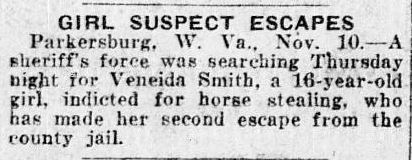
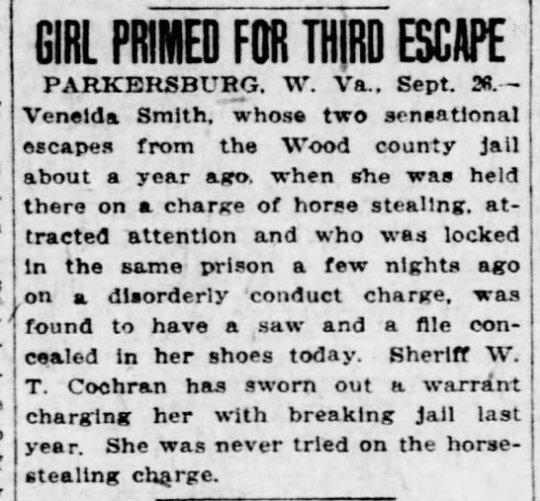
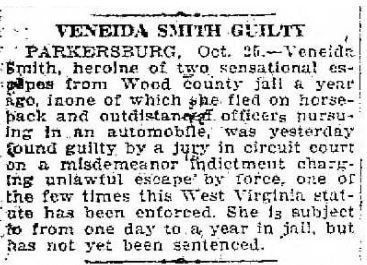
So this whole thing started with this tweet by Twitter user Katie Henry (KT_NRE). I started plowing through newspapers to find every mention of her – and found most that were out there, but a man named Todd Sanders, who had access to Pennsylvania libraries, found quite a few more. All of this takes place in October and November of 1922, before timeskipping to September 1923 (her third escape), October 1923 (her guilty verdict), and March 1924 (her escape attempt with Roxie Starcher).
I have been unable to find her obituary or anything else out there about my new hero.



 Steel Phoenix Studios

