I’m reading this queer anthology and the first story is a fairytale about a queer Latina girl whose anger was so fierce it literally poisoned the rich white men who unfairly captured the transgender soldier she was in love with and my heart is literally bursting I’m going to cry
the second story is about two queer girls who leave their husbands-to-be at the altar and flee together on a boat to become pirates IM FUCKING SCREAMING THIS IS EXACTLY THE KIND OF GAY CONTENT I SIGNED UP FOR
okay this is the anthology and it’s entirely written by queer authors and inspired by the stories of real queer teens in history and it’s the most wholesome and epic thing I’ve read in a long while
They’ve Always Been Watching Us: From COINTELPRO and Martin Luther King, Jr to the NSA’s surveillance program, the US Government has been keeping a close watch on the American Left for a long time.
I know I’ve built a follower base around drawing ship art for a specific fandom, but it’s time I finally pivoted and announce my new fanzine shipping the bois from chinese/russia propoganda posters
what I love about buying clothes is how nothing ever fits! wait hang on, what I love about buying clothes is the expense and inconvenience! uh, no, what I love about buying clothes is the crappy materials and shoddy workmanship!
look I’ll come in again and start over
[insert discourse about pockets]
…there’s discourse about pockets? How? Are there people who are against pockets? Are pockets problematic?
pockets, aphobic and possibly terfy??
Noooooooooooooooooo I thought I was safe here!
You fools, what have you started?
(I’m not joking or exaggerating, it was pockets on dog sweaters that made me angry enough to become an Internet Feminist)
Okay. Okay.
So the thing is that pockets used to be big for everybody in Western Europe (and specifically England is where a lot of this is sourced) – they were large pouches worn on a belt (think the kind of purse a cutpurse would cut if a cutpurse could cut purses). Men wore these on belts outside their clothes, women wore them under their overdresses on a belt; the pockets could be accessed through slits in the overdress near the hips. These types of pockets were huge, large enough to carry snacks and money and oranges and workbags.
There were a couple of problems with this (from an upper-class, high society perspective). One: Nice Young Ladies Shouldn’t Grab At Their Crotches In Public What Will People Think? Two: My Daughter Or Wife May Be Planning On Running Away And Her Pockets Are Full Of Secrets (this is a plot point in the 1740 novel Pamela, in which the titular character has a change of clothes hidden in her pocket under her pillow to escape from her abusive master).
The both problems became less of a problem in the early Regency era, when the dresses shifted from being big poofy things with a wide hip to a slim, Roman-era-inspired gauzy dress like this:
You see that little bag that looks like a medallion? That’s what started a lot of the shit that was to follow. That’s a recticule and it was basically an purse that was so fashionable that it made the whole concept of purses fashionable.
Anyway, back to a chat about privacy real quick: did you know that the concept of a post office used to be controversial because women could receive correspondence that their parents or spouse didn’t know about? There was not a hell of a lot of privacy for women in this era – a very rich woman might have a desk that she could lock, but women basically didn’t own very much or have rights to own very much so if a woman was married or lived with her parents her shit was their shit and they could do with it what they liked. Enter pockets – large bags worn constantly on the person and put under a pillow at night. Got a secret love-letter? Put it in your pocket. Saving a few coins to run away? Pocket. There’s a thesis that I can’t for the life of me find online but that I read in college called “Tye’d about my middle next to my smock: The cultural context of women’s pockets” by Yolanda Van der Krol that discusses the importance of having this private space where you could keep a bit of yourself hidden.
Which brings us again to recticules. Not only were the small, the were worn outside of the clothes and therefore were less private (it would have been much stranger to put a recticule under your pillow than a pocket – if only because being under clothes prevented pockets from getting as dirty). Recticules were “hold a couple of coins” small. They were “maybe a needle case and scissors, but not yarn that’s for sure” small.
They also came into fashion right as men’s clothing was finally settling into the three-piece suit as the standard that would last for the next three hundred-ish years. As breeches and ruffled shirts were going out recticules were coming in – as were slacks and coats and vests each with their own set of pockets for a unique purpose. In the Victorian era a full suit might have as many as seventeen pockets dedicated to things like watches and snuff-boxes and wallets and pen-knifes. Between the Regency Era and the first World War women’s clothing lost its large pockets and went through a variety of purses and small pockets sewn into dresses to fit with the changing styles (surprise surprise, the Victorians were the first to introduce “fake” pockets on women’s clothing, small flaps of fabric meant to be mostly decorative). Meanwhile men’s clothing settled into the pants (though pockets in pants became more popular post-regency), shirt, vest, tie (cravat during regency, ties as we know them later), coat, and hat style that would remain standard business wear until basically now (we have largely ditched the vest in casual environments and the hat altogether). And that outfit has a fuckload of pockets. Even in the most sedate coat-and-slacks look today you’ve got a breast pocket, an inside coat pocket, two pockets on the front of the coat and four pockets on the pants (if you add a vest and a dress shirt with pockets you’ve got even more). That is an embarrassment of pockets!
Because what happened after WWI that people basically stopped making their own clothes and started buying ready-made clothes. And at that point it had become conventional for women to carry purses. And to have small pockets. And to wear tighter clothes.
AND WE NEVER CAME THE FUCK BACK FROM THAT.
Designers and manufacturers excuse the lack of pockets on women’s clothing today by saying “well, women carry purses, don’t they? they don’t need pockets.” There’s a rather infamous quote by Christian Dior just post WWII saying “men have pockets to keep things in, women for decoration.” That attitude still holds. Having too many pockets “ruins the line” of a piece of clothing – a dress with pockets is a beautiful, difficult-to-find thing (it’s getting better in the last five years). You can get “mom jeans” with pockets but it’s harder to find skinny jeans with pockets (though the men’s skinny jeans have pockets).
When you DO have pockets they’re smaller. When I first got angry about this I compared my husband’s pockets to mine by trying to put my large women’s wallet in them and found that it wouldn’t fit completely inside of a single pocket that I owned and it was overwhelmed and lost in all but the smallest of his pockets. Oh, look, I found the pictures:
This is extremely potato quality but top to bottom (women’s clothing on the left, men’s on the right) we’ve got the back pocket on a pair of slacks, the outside pocket on a fleece sweater, the back pocket on a pair of jeans, the front pocket on a pair of jeans, and the largest pocket of my jacket compared to the smallest pocket of his jacket. The photos where the wallet is on top of his clothing is where you couldn’t even see the wallet in the picture because it was buried so deeply in the pocket. I didn’t include the front pocket on the slacks because my slacks didn’t have a front pocket.
ANYWAY.
Ahem.
So what started all of this was a pair of dog jackets and a pair of jeans. I’d purchased a pair of jeans and was upset to have discovered that the pockets on the front were fake (infuriating). I happened upon some dog jackets in a store – there were “girl” and “boy” jackets. The girl dog jacket had a fake pocket. The boy dog jacket had a real pocket.
Anyway I bought the “boy” dog jacket for my female dog, bought a men’s wallet (which is much smaller but doesn’t have an awesome unicorn skeleton on it) and wrote up my very first angry blog about the patriarchy.
I’ve been something of a grind on the subject of pockets ever since.
(And to anyone who is going to drop in with “just wear men’s clothing” thank you for the helpful suggestion, I find men’s sweaters and jackets quite comfortable but I have yet to find a pair of men’s pants that fits my hips, waist, and thighs simultaneously and doesn’t have an uncomfortably low crotch that chafes my thighs. Also I’ve tried that shit and as it turns out there are plenty of employers who are happy to write you up for not meeting dress code because your clothing is “sloppy or ill-fitting for an office environment.” The boss is perfectly happy when I come into the office with half my head shaved and a skater minidress over skull-patterned tights with platform boots but can’t hang when I put on a suit.)
Thank you for sitting through another session of Yelling with Alli.
GIVE WOMEN’S CLOTHING POCKETS YOU FUCKING COWARDS.
@ms-demeanor I did not know this history and it makes me EVEN ANGRIER THAN I ALREADY WAS on the subject of pockets in women’s clothing.
I learned something new and horrifying today which is… that… no submarine is ever considered “lost” … there is apparently a tradition in the U.S. Navy that no submarine is ever lost. Those that go to sea and do not return are considered to be “still on patrol.”
?????
There is a monument about this along a canal near here its… the worst thing I have ever seen. it says “STILL ON PATROL” in huge letters and then goes on to specify exactly how many WWII submarine ghosts are STILL OUT THERE, ON PATROL (it is almost 2000 WWII submarine ghosts, ftr). Here is the text from it:
“U.S. Navy Submarines paid heavily for their success in WWII. A total of 374 officers and 3131 men are still on board these 52 U.S. submarines still on patrol.”
THANKS A LOT, U.S. NAVY, FOR HAVING THIS TOTALLY NORMAL AND NOT AT ALL HORRIFYING TRADITION, AND TELLING ALL OF US ABOUT IT. THANKS. THANK YOU
anyway now my mother and I cannot stop saying STILL ON PATROL to each other in ominous tones of voice
There’s definitely something ominous about that—the implication that, one day, they will return from patrol.
Actually, it’s rather sweet. I don’t know if this is common across the board, but my dad’s friend is a radio op for subs launched off the east coast, and he always is excited for Christmas, because they go through the list of SoP subs and hail them, wishing them a merry Christmas and telling them they’re remembered.
Imagine a country whose seamen never die, and whose submarines can’t be destroyed…because no ones sure if they exist or not.
No but imagine. It’s Christmas. A black, rotting corridor in a forgotten submarine. The sound of dripping water echoes coldly through the hull. You can’t see very far down the corridor but then, a man appears, he’s running, in a panic, but his footsteps make no noise. The spectral seaman dashes around the corner and slips through a rusty wall. He finds himself at the back of a crowd of his cadaverous crew-mates. They part to let him through. He feels the weight of their hollow gaze as he reaches the coms station. Even after all these years a sickly green light glistens in the dark. The captain’s skeleton lays a sharp hand on his shoulder and nods at him encouragingly, the light sliding over the bones of his skull. The ghost of the seaman steadies himself and slips his fingers into the dials of the radio, possessing it. It wails and screeches. A bombardment of static. And then silence. The deathly crew mates look at each other with worry, with sadness; could this be the year where there is no voice in the dark? No memory of home? The phantasm of the sailor pushes his hand deeper into the workings of the radio, the signal clears, and then a strong voice, distant with the static but warm and kind, echoes from the darkness; “Merry Christmas boys, we’re all thinking of you here at home, have a good one.” A sepulchral tear wafts it’s way down the seaman’s face. The bony captain embraces him. The crew grin through rotten jaws, laughing silently in their joy. They haven’t forgotten us. They haven’t forgotten.
I am completely on board with this. It’s not horrifying, it’s heartwarming.
Personal story time: whenever I go to Field Museum’s Egypt exhibit, I stop by the plaque at the entrance to the underground rooms. It has an English translation of a prayer to feed the dead, and a list of all the names they know of the mummies on display there. I always recite the prayer and read aloud the list of names. They wanted to live forever, to always have their souls fed and their names spoken. How would they feel about being behind glass, among strangers? Every little thing you can do to give respect for the dead is warranted.
I love the idea of lost subs still being on patrol. Though if you really want something ominous, let me say that the superstitious part of me wonders: why are they still on patrol? If they haven’t been found, do they not consider their mission completed? What is it out there that they are protecting us from?
There’s been something in the water since we first learned to float on it. Not marine life, although there’s more of that than we’ll ever know. Not rocks and currents and sand bars and icebergs either, although they’ve all taken more than their share of human life.
But something deeper. Something Other. Something not natural.
Sailors have always been superstitious.
Not one of them described it right.
You don’t hear about it so much now that we don’t lose ships anymore, really, not like we did at the height of the sea trade when barely an inch of ocean floor didn’t bear some wreck or other. And better ships and GPS and weather satellites have all played their part in that.
But we have protection now that we didn’t before. They don’t interfere with war and battle, even on behalf of what used to be their country, or with rocks and weather and human stupidity. Those are concerns for the living.
But the Other Things, the Things that shouldn’t be there – They can’t get to us now without a fight. It’s a fight They haven’t won in a very long time.
As long as we remember them, as long as we call out to them – not very often, just once a year will do – they will keep protecting us from the Things that go bump in the deep.
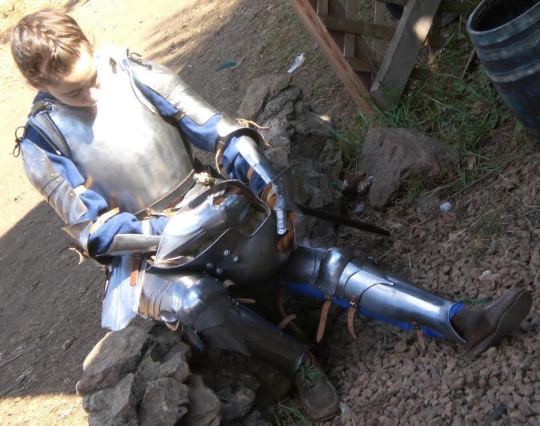
So sometimes I see bros on the internet talk about how women couldn’t have worn armor historically, because it was too heavy for them.
Here is a picture of me wearing armor when I was a nerdy 14-year-old girl who was about 5 feet tall and weighed less than 95 pounds. I sometimes wore it for 6 hours straight in summer heat, and I would run and turn summersaults in it for fun.
And before you start asking: this was authentic full steel plate with a padded arming doublet underneath. It weighed so much that I couldn’t carry the plastic tub it was stored in on my own. It was heavy. But once I was wearing it I just felt like I was being hugged or wrapped up in a really heavy blanket. That’s how armor works. The whole point is that the weight is distributed across your whole body, and your whole body can lift a huge amount. It has nothing to do with how strong you are or how much you can bench.
So if you think women are too weak to wear armor, you are wrong on so many levels. It does not even matter if you believe in your little misogynistic heart that all women are defined by their physical inferiority when compared to men, because you are also just wrong about how armor works. Even skinny teen girls can wear armor just fine. Everyone can wear armor.





 Steel Phoenix Studios