it’s sort of funny that the current cultural idea of the flapper dates not from the 1920s, but the 1950s when costume designers took the radical, gender-fluid, sexual, sexually liberated ideas and fashions of the 20s and made them sexy. as in sexual objectifying.
because 1950s and fuck female agency.
If you would like, I would love to hear more about this. What, exactly, happened, and what was the true 1920s aesthetic, untainted by 50s views?
hokay. so it’s the 1950s and it’s the heyday of the studio system and writers and movie makers (and audiences) want rom coms and frolicking films and lighthearted fun, but there’s just one problem.
WWII
but that was the 1940s! you say
you’re right.
but in order to set a film in the 1950s, writers and film makers have to establish what the male lead character did during the war or risk it coming across like he didn’t, well, serve. can’t have a shirker or a coward and rejected for medical reasons really doesn’t fly in the 1950s. and there’s only so many times you can write about soldiers and sailors and airmen and the occasional spy before it starts to become stale. and it doesn’t terribly fit with the fluffy writing because, well, war and death and tens of millions of people dead. contemporary films more fall in the line of what we now call film noir. men and women who have been damaged by war, but that’s another topic.
sooooo, you do period pieces. no one wants to do the 1930s because that’s the great depression. so 1920s. frolicking and gay and fabulous!
(Great War, what Great War?)
but the thing is, the 1920s, especially in Paris and Berlin, were a massively transgressive, reversal, and experimental time period in art, fashion, society, and all over. but only a little bit in america because honestly we were barely touched by wwi so it’s not like we’re partying to forget an entire generation of young men killed off and entire towns wiped off the face of the earth using weapons the likes of which had never been seen before. the us as a whole mostly heard about sarin gas, not see it poison entire landscapes and men and animals dropped to the ground and die in truly horrific ways.
the europe that emerged from wwi was massively shell shocked, angry, and living in a surreal dream of everything being upwards and backwards and live now because tomorrow you may die and it’s all nonsense anyway. it’s a world in which surrealism and dadaism and german expressionism make sense because fuck it all.
you get repudiation of the old, experimentation, deliberate reversals, transgressive behavior, and if there’s an envelope to push, you tear it open. France calls the 1920s “Années folles”, the crazy years.
the things we’re doing now, with fluidity and experimentation and exploration of gender and sexuality and presentation? the 1920s did that already. it’s drag and androgyny and blatant homosexuality. it’s extramarital affairs and sex before or without marriage, it’s rejection of marriage as an idea and an institution, it’s playing with gender and gender roles and working women and unrestrained art and
it’s everything the 1950s hated. or more accurately: absolutely terrified of.
the flappers of the 1920s went to college and cut their hair to repudiate a century of a woman’s hair being her crowning glory. they wore obvious makeup and makeup in ways that are not terribly appealing now and weren’t terribly appealing then, but they signaled you were part of the tribe.
they were women who wanted independence and personal fulfillment.
“She was conscious that the things she did were the things she had always wanted to do.“
so the 1950s didn’t want that. they wanted films with dancing and chorus lines and pretty girls to be looked at. they wanted spaghetti straps and fringed dresses that moved pretty when the chorus girls danced.
1920s fringe doesn’t. 1920s fringe is made of silk, incredibly dense, incredibly heavy, sewn on individually by hand, and rather delicate. the all-over fringe dress didn’t exist until the 1950s invention of nylon and continuous loops that could be sewn on in costume workshops by the mile on machines.
(this is before “vintage” exists. to the 1950s, the 1920s (or earlier) wasn’t vintage, it was old-fashioned. démodé. out of style. last last last last last season.)
1950s 1920s-set movies have clothes that are the 1950s take on it. the dresses have a dropped waist, but they’re form-fitting, figure-revealing. the actresses are pretty clearly wearing bras and 50s girdles under them a lot of the time. they’re not
the woman on the far left is basically wearing a man’s suit with a skirt. la garçonne. some women went full-out and wore pants. you could be arrested for that. they were. still wore pants. and pyjama ensembles in silk and loud prints.
or class photo of ‘25
or even
not that 1920s dresses could be sexy or sexual; they often were. i’ve seen 20s dresses that were basically sideless and held together with straps. but it’s sort of like how the mini skirt went from being a thing of sexual liberation to an item of sexual objectification.
it’s ownership and it’s agency and it’s hard to put a name or finger on it, but you just know. sex goddess versus sex icon.
Forgive me for adding to this, OP, but my favorite movie of all time is Singin’ in the Rain, a 1952 film set in 1927. If you look into the behind-the-scenes stuff about the costuming, the people involved talk a lot about how difficult it was because, quite frankly, 20s fashion was seen as laughably ugly by 50s standards. For them, it was what their parents wore before they were born, so think of just the worst 70s or 80s fashion you can imagine and trying to look glamorous in that. (Or for some of you tumblr kids, the 90s, but I’m here to tell you we looked great in that decade.) The closest they got is probably this:
Even here, Debbie Reynolds’s dress has a sheer overlay so you can see that really rigid, curvy 50s silhouette underneath it.
(Also, the ideal female body type was totally different and fashion hung on those frames very differently – flat and athletic and boyish in the 20s, stacked in the 50s. There’s a joke in the movie version of Thoroughly Modern Millie (1967, set in 1922) where Millie laments that her “fronts” are too “full” to let her long string of beads lie flat against her chest – the joke being that no woman would want to be smaller-busted.)
Anyway, I always thought that contrast between the fashion of the two decades and how the 50s were left struggling to interpret such a different aesthetic in a way that their audiences would find beautiful was fascinating, but I never thought about how that 50s reaction of “this is laughably ugly” might stem from a place of “this is alarmingly androgynous and non-constrictive and not designed for the male gaze.” LET KATHY SELDEN WEAR PANTS AND LIVE IN SIN.
This comes at a great time because my alma mater wants to have a flapper themed jubilee with the gowns and beads and shit, and I am a grumpy queer feminist alumna who will not hesitate to throw this stuff their way.
“The Fashion History Timeline
is an open-access source for fashion history knowledge, featuring
objects and artworks from over a hundred museums and libraries that span
the globe. The Timeline website offers well-researched, accessibly written entries on specific artworks, garments and films
for those interested in fashion and dress history. Started as a pilot
project by FIT art history faculty and students in the Fall of 2015, the
Timeline aims to be an important contribution to public
knowledge of the history of fashion and to serve as a constantly growing
and evolving resource not only for students and faculty, but also for
the wider world of those interested in fashion and dress history (from
the Renaissance scholar to the simply curious).”
GUYS. THERE WAS DRIVE-THROUGH IN ANCIENT ROME. FINDING OUT THIS ALONE IS WORTH THE COST OF MY MASTERS IN HISTORY.
[From Daily Life of the Ancient Romans by David Matz]
*rolls up to the window* yeah gimme a number V combo
“I’ll have two number IXs, a number IX large, a number VI with extra ambrosia, a number VIII, two number XLVs, one with cheese, and a large goblet of wine.”
hail, I am Gaius Furius, welcome to Diners, Drive-ins, and Dives
“YEAH CAN I GET A FVCKIN VVVVHHH….VVVVVVVVVVVVVVVVVVVVVVVVVVVVVVVVVVVVVVHHHHHHHHH…BVRGER?”
“Make sure to stay healthy. We should definitely meet up again.”
“Take care and see you someday.”
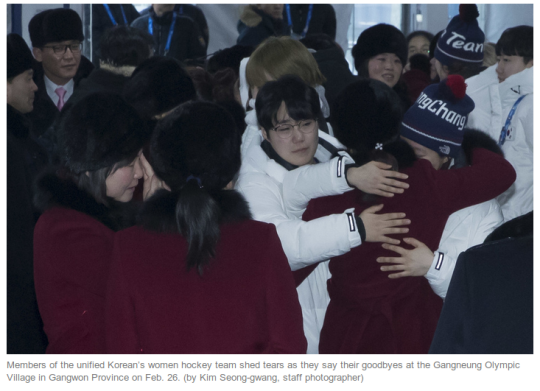
It was around 7:40 am on Feb. 26, and the welcome center in front of the Olympic athletes’ village in Gangneung was awash in tears. The bus was just 20 meters away, but it took the North Korean players on the unified women’s ice hockey team ten minutes to reach it. The South Korean athletes who had come to see them off embraced them tightly and would not let go. Team coach Sarah Murray and North Korean coach Pak Chol-ho also shared a tearful embrace. As they boarded the bus, the North Korean players opened the windows and reached their arms out to ease the pain of their goodbye.
“Who makes athletes cry? It’s just heartbreaking,” a Korea Ice Hockey Association (KIHA) official said.
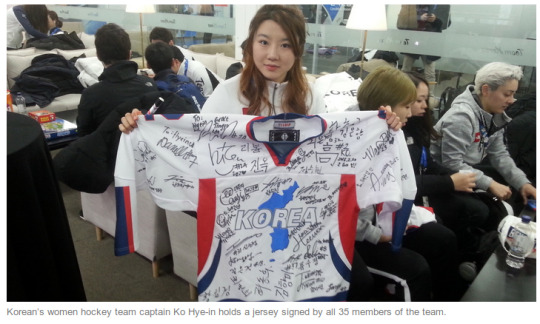
On Feb. 23 and 24, the Hankyoreh visited Murray and the South Korean athletes at the Korea House in Gangneung’s Olympic Park to hear their fond memories of 33 days as a unified team.
When the 12 North Korean players first joined them at the Jincheon athletes’ village in North Chungcheong Province on Jan. 25, few truly understood how “peace” would become the 2018 Pyeongchang Olympics’ greatest legacy.
“The unified team was put together two weeks ahead of the Olympics, so there was a lot of concern,” Murray recalled.
But the unified Korean team proved the key driving force behind the Olympics’ success. The International Olympic Committee (IOC), which emphasizes the legacy of individual Olympics events, is certain to remember the Pyeongchang event as a “peace Olympics.” The puck used to score the team’s first goal in a Group B match against Japan is to be enshrined in the International Ice Hockey Federation (IIHF) Hall of Fame. Many foreign reporters could be seen cheering on the unified team members as they watched their matches. …
A
dozen women’s hockey players from North Korea hit the ice for the first
time with their new South Korean teammates this week, learning to
compete as a combined squad just days before the Winter Olympics start
this month.
Practice time is just one focus. They’re also still learning to talk about the sport together.
That’s
because the shared Korean language spoken by the two nations — divided
into the communist North and the capitalist South after World War II —
has diverged in the last seven decades, just like their respective
political ideologies.
Hockey is no different.
The
Korean-speaking athletes from the South, like others in the
Western-friendly nation, use English-influenced words in their postwar
vocabulary. Those from the isolated North, however, lace up their skates
while carrying a glossary of indigenous terms.
Take the “box out,” a term used for preventing opposing players from lingering near the net for rebounds.
South
Koreans say “bagseu-aut,” a Korean-accented version of the English
words that is foreign to North Koreans. They prefer the more literal
“munbakk-eu-ro mil-eonaegi” — or, “push out the door.”
18 years ago a man walked into a school in Dunblane, Scotland with four handguns and killed 16 students all under 6 years old, a teacher and then himself.
This led to a debate on gun control and in 1997 2 firearms amendment acts were passed making it illegal to own a handgun for personal use in the United Kingdom. We have had no shooting on a similar scale to this since.
6 weeks later in Australia was the massacre in Port Arthur when 35 people were killed and 23 wounded, which led to the imposing strict gun control. There have been no shootings on a similar scale to this since, either.
If I hear one more person tell me that there’s nothing that can be done in the US when there are massacres after massacre I will scream because it is so clear and people are pretending to be blind.
We should be more pro-active or we’ll see more of such sad fates of honest people.
And the utterly ironic thing is I’ve seen repeated tumblr posts of that iconic photo absolutely slagging the shit out of Peter Norman as “lol white guy so uncomfortable” “Why the fuck isn’t he supporting them”, etc etc.
for the first like 14 years of my life i thought that the story of saint valentine and valentines day were a celebration of a massive gay polyamorous marriage and let me tell you, i was sorely disappointed when i learned i had massively misunderstood that story
i was told the basic story of “the king had made it illegal for young men to get married so that they could be drafted off to go to war (as married men with families were not, apparently)” and that “saint valentine thought this was cruel, and married the young men in secret”
what this was supposed to communicate to me was “saint valentine would marry young men to their girlfriends in secret as a priest at his own risk and thats why we celebrate valentines day”
what i got out of it was “saint valentine married a shitton of dudes so he could protect his army of husbands from having to go to war and it was beautiful and love can halt war in its tracks and thats why we celebrate valentines day”
and thats why the assumption that a child would automatically get a hetero interpretation of the story and the innate unclarity of the english language made me think that valentines day was about mass gay poly marriage until i was like fourteen and recited the story to a friend who stared at me like id grown three extra heads
They are the equivalent to strippers here. They never engaged in sex acts but if you look throughout their history they were not treated well. Most being sold into that profession.
If by “here” you mean Japan, i’d just like to say that it is well known that not even the average Japanese citizen is aware of the true nature of the Geisha, Geiko and Maiko. they are not strippers and to say things like this is demeaning to the women who work hard and are trained in the arts (dance, music, tea ceremony, etc.).
Geisha became what they are known as today in the mid-1700s. the first actual geisha were men and they entertained shogun and samurai (and other wealthy men) with dance, music and the art of tea ceremony and theater. when courtesans were losing money to these male geisha, a few of them broke away from being in the sex business and became female geisha. therefore, geisha as an occupation never was a thing of the sex trade/prostitution and absolutely NOT stripping.
let me dispel some common misconceptions:
so, geisha were never prostitutes, never perform sex acts or even accept relationships/marriage proposals until after they retire from being a geisha (usually in their 30s, tho some women stay geisha until death by choice).
while geisha in the past (we are talking almost 100 years ago by now) have been given to Okiya (geisha houses) by their families, it was usually due to the families inability to afford their child and rather than let the child be homeless and starve, they gave them to an Okiya where they would live a much better life (Okiya housed other geisha within that Okiya’s special “familiy”; the Okasan–”Mother”–of the house protected them, gave them a comfortable living, fed them, sent them to all their classes, spent money on their personal kimono and make-up, and who arrange their finances and plan their parties and events). Nowadays, and pretty much since the 1940s, Geisha become Geisha by choice and enter into the profession after they graduate middle school (it is even required in most cases that they complete at least that level of schooling before becoming a Geisha) willingly.
GEISHA wear their Obi belts tied tightly in the back to hold together their Kimono; these belts are so long and heavy that the Okiya hires a male dresser to assist in tying these Obi every night before a party or event. a geisha could not strip or easily take off her many layers of Kimono/undergarments and so the assumption that they are strippers just doesn’t make any sense. a traditional courtesan or TAYUU/OIRAN wore her Obi belt loosely tied in the front so that she could easily untie it for a customer.
There is no empirical evidence of there being any such thing as “mizuage” (as referred to by Arthur Golden in ‘Memoirs of a Geisha’) in the geisha world. there is however evidence of the ritual of mizuage in the Tayuu (or Oiran depending on the region, i think) courtesan tradition. a courtesan who was being initiated would have a ceremony where wealthy men bid for her virginity, with the highest bid being the winner. These Tayuu (or Oiran) are absolutely NOT in any form in relation to a Geisha. i will also mention that prostitution in Japan has been illegal since 1959, officially.
“Comfort Women” from the WWII era were prostitutes that told American GIs that they were “geisha” in order to make more money and to play on the exoticism that was so popular in the US at the time. this is where a big portion of the “Geisha are prostitutes” misconception came from.
“Hot Springs Geisha” and Bar Hostesses in Tokyo are trained in a similar way to traditional Geisha in that they have skills in the art of conversation and even some musical skill, however these women are NOT Geisha. “Hot Springs Geisha” are also known to engage in sex acts with hot springs patrons (though it is frowned upon) and so bring another incorrect image of sex-acts to the name of Geisha.
While there have I’m sure been cases of abuse from an Okasan to her Geisha throughout the history of the profession, this is usually not the case, and to say that “many or all Okasan are abusive and manipulative to their Geisha” is ignorant and offensive.
DO NOT READ “MEMOIRS OF A GEISHA”!! If you already have, I would strongly suggest you read other books on the subject of Geisha. Arthur Golden (a white man) wrote this book to make money off of the many misconceptions about Geisha, Geiko and Maiko. Everything he says about the Geisha tradition is incorrect, from the part where he explains why “some Geisha” wear lipstick only on the bottom lip (this actually signifies that a Maiko has only been in training for under a year) to his horrible, offensive and incorrect description of a Geisha going through mizuage. He interviewed a very well-known geisha named Mineko Iwasaki for his book, which he then exploited and changed around for his benefit. She even tried to sue him for libel for taking stories from her personal life, twisting it and turning it into a book that lies about the fundamentals of being a Geisha. I would recommend reading, “Geisha, A Life” by Mineko Iwasaki. she has written about what it really means to be a Geisha.
Here are is a picture of a Geiko (a fully-fledged Geisha who has completed most of her training and has become a professional):
Here is a picture of a Maiko (a Geisha-in-training who is still an apprentice and usually works alongside her “Older Sister” or her assigned Geiko partner; her Older Sister is in charge of most of a Maiko’s social training):
Here is the difference in dress between a Geiko and a Maiko:
Here is a Tayuu courtesan (high end prostitute); this profession no longer exists, any modern photographs of one is of an actress for historical theater purposes. Notice the Obi belt tied in front and the overall difference in dress. This was what courtesans looked like:
This is a photo of “Hot Springs Geisha” in the 60s. Notice the women serving drinks and entertaining men at the tables:
Here is a picture of an Ozashiki (party, event or gathering where Geisha are hired to entertain with music, dance, conversation and drink serving) today. It is much, much, much different (and more expensive) than an average hostess bar, and takes place within an Ochaya (traditional teahouse). As you can see, men are not the only ones who have booked an Ozashiki with Geisha:
Please do not spread misconceptions about these hard-working women artists. They deserve respect and have persevered for centuries with women at the forefront of these professions. Not only are these women trained to entertain party patrons, but they are also highly skilled in theater and the performing arts. Surrounding the Geisha are women wigmakers, female Shamisen, drum, flute ensembles, hairdressers, kimono artisans, well-respected dance/music/tea ceremony teachers, jewelry and hair accessory makers, Okobo and Zori footwear artisans, teahouse staff and Ozashiki planners, instrument craftsmen, and many, many more. If you would like to know more about Geisha, there are many books written by former Geisha out there.
Here is a short video of a Geisha performance, it is the annual Miyako Odori (”Cherry Blossom” Dance):
^ I still want to thank this person for giving me a knowledge blast so I can correct other people for having my original opinion.
I actually just finished ‘Memoirs of a Geisha’, thank you so much for writing this post and sharing correct knowledge.
Comfort Women were not prostitutes. They were victims of the japanese army, forced into sexual slavery. Calling them prostitutes is a filthy fucking lie which attempts to hide what was done to them.
There’s nothing wrong with sex work. But comfort women weren’t sex workers. They were rape victims.
…that was during the Japanese occupation of Korea, right? The same term was used for the prostitutes who worked military bases, including American ones, which is how the phrase first came to America. That’s what was referred to in the above post.
Not that the American GIs didn’t have a rape problem, it was a major political issue in Okinawa for some time, but they were also major patrons of the local sex trade.
This is secret code used by 19th-century diarist Anne Lister to record her lesbian relationships! And underneath, and sample of her diaries. Anne wrote 6600 pages, or almost 4 million words of these diaries, giving us a treasure trove of information about her life, and one of the only first-hand accounts we have of female same-sex relationships in the 19th century.
Now you too can communicate with your friends in secret lesbian code!




 Steel Phoenix Studios