Fun History Fact: The overwhelming majority of cowboys in the U.S. were Indigenous, Black, and/or Mexican persons. The omnipresent white cowboy is a Hollywood studio concoction meant to uphold the mythology of white masculinity.
Thank you.
I will always re-blog this
I think it was high school when i overheard some white girl put on her best semi-disgusted and confused voice and go “why do so many Mexicans dress up like cowboys?” and I had to be the person to tell her.
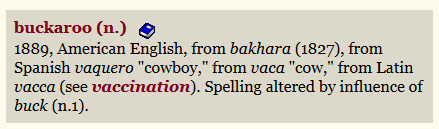
Why do you think the whites say buckero? Cause they couldn’t say vaquero.
I dunno if I reblogged this before but fuck it, y’all gon learn today.
Teach the children.
also, cowboy culture was hella gay. like, write-poems-about-your-cowboy-partner gay.
IF people acknowledge it, they play the necessity card– there weren’t any women out on the range, so they had to “resort to men.” this claim completely erases 1) the romantic (not just sexual) writings of actual cowboys, 2) the acknowledgement of cowboys’ potential homosexual activity by writers at the time, and 3) the possibility that some men would deliberately become cowboys with the intent to seek out homosexual encounters.
no one wants to admit it, but cowboy culture was just. so inherently gay.
Im here for the gay POC cowboys
Guys: “vamoose,” “hoosegow,” “calaboose” it’s all Spanish.
Women have more power and agency in Shakespeare’s comedies than in his tragedies, and usually there are more of them with more speaking time, so I’m pretty sure what Shakespeare’s saying is “men ruin everything” because everyone fucking dies when men are in charge but when women are in charge you get married and live happily ever after
I think you’re reading too far into things, kiddo. Take a break from your women’s studies major and get some fresh air.
Right. Well, I’m a historian, so allow me to elaborate.
One of the most important aspects of the Puritan/Protestant revolution (in the 1590’s in particular) was the foregrounding of marriage as the most appropriate way of life. It often comes as a surprise when people learn this, but Puritans took an absolutely positive view of sexuality within the context of marriage. Clergy were encouraged to lead by example and marry and have children, as opposed to Catholic clergy who prized virginity above all else.Through his comedies, Shakespeare was promoting this new way of life which had never been promoted before. The dogma, thanks to the church, had always been “durr hburr women are evil sex is bad celibacy is your ticket to salvation.” All that changed in Shakespeare’s time, and thanks to him we get a view of the world where marriage, women, and sexuality are in fact the key to salvation.
The difference between the structure of a comedy and a tragedy is that the former is cyclical, and the latter a downward curve. Comedies weren’t stupid fun about the lighter side of life. The definition of a comedy was not a funny play. They were plays that began in turmoil and ended in reconciliation and renewal. They showed the audience the path to salvation, with the comic ending of a happy marriage leaving the promise of societal regeneration intact. Meanwhile, in the tragedies, there is no such promise of regeneration or salvation. The characters destroy themselves. The world in which they live is not sustainable. It leads to a dead end, with no promise of new life.
And so, in comedies, the women are the movers and shakers. They get things done. They move the machinery of the plot along. In tragedies, though women have an important part to play, they are often morally bankrupt as compared to the women of comedies, or if they are morally sound, they are disenfranchised and ignored, and refused the chance to contribute to the society in which they live. Let’s look at some examples.
In Romeo and Juliet, the play ends in tragedy because no-one listens to Juliet. Her father and Paris both insist they know what’s right for her, and they refuse to listen to her pleas for clemency. Juliet begs them – screams, cries, manipulates, tells them outright I cannot marry, just wait a week before you make me marry Paris, just a week, please and they ignore her, and force her into increasingly desperate straits, until at last the two young lovers kill themselves. The message? This violent, hate-filled patriarchal world is unsustainable. The promise of regeneration is cut down with the deaths of these children. Compare to Othello. This is the most horrifying and intimate tragedy of all, with the climax taking place in a bedroom as a husband smothers his young wife. The tragedy here could easily have been averted if Othello had listened to Desdemona and Emilia instead of Iago. The message? This society, built on racism and misogyny and martial, masculine honour, is unsustainable, and cannot regenerate itself. The very horror of it lies in the murder of two wives.
How about Hamlet? Ophelia is a disempowered character, but if Hamlet had listened to her, and not mistreated her, and if her father hadn’t controlled every aspect of her life, then perhaps she wouldn’t have committed suicide. The final scene of carnage is prompted by Laertes and Hamlet furiously grappling over her corpse. When Ophelia dies, any chance of reconciliation dies with her. The world collapses in on itself. This society is unsustainable. King Lear – we all know that this is prompted by Cordelia’s silence, her unwillingness to bend the knee and flatter in the face of tyranny. It is Lear’s disproportionate response to this that sets off the tragedy, and we get a play that is about entropy, aging and the destruction of the social order.
There are exceptions to the rule. I’m sure a lot of you are crying out “but Lady Macbeth!” and it’s a good point. However, in terms of raw power, neither Lady Macbeth nor the witches are as powerful as they appear. The only power they possess is the ability to influence Macbeth; but ultimately it is Macbeth’s own ambition that prompts him to murder Duncan, and it is he who escalates the situation while Lady Macbeth suffers a breakdown. In this case you have women who are allowed to influence the play, but do so for the worse; they fail to be the good moral compasses needed. Goneril, Regan and Gertrude are similarly comparable; they possess a measure of power, but do not use it for good, and again society cannot renew itself.
Now we come to the comedies, where women do have the most control over the plot. The most powerful example is Rosalind in As You Like It. She pulls the strings in every avenue of the plot, and it is thanks to her control that reconciliation is achieved at the end, and all end up happily married. Much Ado About Nothing pivots around a woman’s anger over the abuse of her innocent cousin. If the men were left in charge in this play, no-one would be married at the end, and it would certainly end in tragedy. But Beatrice stands up and rails against men for their cruel conduct towards women and says that famous, spine-tingling line – oh God, that I were a man! I would eat his heart in the marketplace. And Benedick, her suitor, listens to her. He realises that his misogynistic view of the world is wrong and he takes steps to change it. He challenges his male friends for their conduct, parts company with the prince, and by doing this he wins his lady’s hand. The entire happy ending is dependent on the men realising that they must trust, love and respect women. Now it is a society that it worthy of being perpetuated. Regeneration and salvation lies in equality between the sexes and the love husbands and wives cherish for each other. The Merry Wives of Windsor – here we have men learning to trust and respect their wives, Flastaff learning his lesson for trying to seduce married women, and a daughter tricking everyone so she can marry the man she truly loves. A Midsummer Night’s Dream? The turmoil begins because three men are trying to force Hermia to marry someone she does not love, and Helena has been cruelly mistreated. At the end, happiness and harmony comes when the women are allowed to marry the men of their choosing, and it is these marriages that are blessed by the fairies.
What of the romances? In The Tempest, Prospero holds the power, but it is Miranda who is the key to salvation and a happy ending. Without his daughter, it is likely Prospero would have turned into a murderous revenger. The Winter’s Tale sees Leontes destroy himself through his own jealousy. The king becomes a vicious tyrant because he is cruel to his own wife and children, and this breach of faith in suspecting his wife of adultery almost brings ruin to his entire kingdom. Only by obeying the sensible Emilia does Leontes have a chance of achieving redemption, and the pure trust and love that exists between Perdita and Florizel redeems the mistakes of the old generation and leads to a happy ending. Cymbeline? Imogen is wronged, and it is through her love and forgiveness that redemption is achieved at the end. In all of these plays, without the influence of the women there is no happy ending.
The message is clear. Without a woman’s consent and co-operation in living together and bringing up a family, there is turmoil. Equality between the sexes and trust between husbands and wives alone will bring happiness and harmony, not only to the family unit, but to society as a whole. The Taming of the Shrew rears its ugly head as a counter-example, for here a happy ending is dependent on a woman’s absolute subservience and obedience even in the face of abuse. But this is one of Shakespeare’s early plays (and a rip-off of an older comedy called The Taming of a Shrew) and it is interesting to look at how the reception of this play changed as values evolved in this society.
As early as 1611 The Shrew was adapted by the writer John Fletcher in a play called The Woman’s Prize, or The Tamer Tamed. It is both a sequel and an imitation, and it chronicles Petruchio’s search for a second wife after his disastrous marriage with Katherine (whose taming had been temporary) ended with her death. In Fletcher’s version, the men are outfoxed by the women and Petruchio is ‘tamed’ by his new wife. It ends with a rather uplifting epilogue that claims the play aimed:
To teach both sexes due equality
And as they stand bound, to love mutually.
The Taming of the Shrew and The Tamer Tamed were staged back to back in 1633, and it was recorded that although Shakespeare’s Shrew was “liked”, Fletcher’s Tamer Tamed was “very well liked.” You heard it here folks; as early as 1633 audiences found Shakespeare’s message of total female submission uncomfortable, and they preferred John Fletcher’s interpretation and his message of equality between the sexes.
So yes. The message we can take away from Shakespeare is that a world in which women are powerless and cannot or do not contribute positively to society and family is unsustainable. Men, given the power and left to their own devices, will destroy themselves. But if men and women can work together and live in harmony, then the whole community has a chance at salvation, renewal and happiness.
The Panthers used to ride around and follow the police.
So the cops would pull over some sorry black person, and get ready to rough him up, but then there were the Panthers right behind them. Watching, armed to the teeth, and citing legal statutes. It’s inspirational.
Bring it back.
Bring this back.
For real.
That’s why the FBI broke them up, isn’t it ?
That among other community initiatives. They had weapons training, self defense, their free breakfast program and ran a newspaper. They raised money to pay for bail and legal funding for people. And they used to notify the community of their rights and encourage people to know the laws and protest the one which were unjust. That type of shit irked the local police and damned sure struck a nerve with the FBI. They were taking back the streets and providing the protection the police were never interested in bringing to their neighborhoods from the very start. So it’s always fuck the FBI for me.
Also let’s be starkly clear about this: under COINTELPRO the FBI raided the homes of Black Panthers and outright murdered them. They conspired with local police forces to harass, assault, and concoct false evidence against anybody affiliated with the BPP. And they didn’t keep their operations confined to the black community directly. When a white woman working in civil rights was killed by the KKK (they were aiming at her black passenger) the FBI excused the KKK by claiming that she was a communist and slept with black men. They refused to accept the reports of white agents who said that the BPP were no threat and demanded that the agents falsify information to paint the BPP as violent domestic terrorists. The FBI was determined to quash revolutionary black movements that were chiefly devoted to community protection and development and they stopped at nothing in their attempts to reach this goal.
One thing we don’t talk about even in our own retellings and reclaimings of BPP history is that a large part of the reason the government worked to break them up wasn’t because of armed action, but because they provided so many necessary social services and programs: free breakfast for children, walking the elderly to and from banks safely to cash their social security checks, free medical centers, door-to-door sickle cell testing, blood drives, raising money for bail, clothing donations, legal aide, busing people to and from prisons to visit, commissary for prisoners. Not only did they fight back against state violence in their confrontations with police, but also by resisting the forced conditions of poverty, criminality and scarcity created by the state to further destroy their communities. J. Edgar Hoover genuinely wrote in an FBI memo that:
“The Breakfast for Children Program B represents the best and most influential activity going for the BPP and, as such, is potentially the greatest threat to efforts by authorities B to neutralize the BPP and destroy what it stands for.”
When I need a good example of the antiblackness that is fundamental to this country’s history and how it persists even now, I remember that the BPP were viewed as a threat to national security, not because they were armed, but because they wouldn’t allow black children to die from starvation and malnutrition.
I went into some buildings and you heard the boos and the racial remarks but that kinda geared me up. I was called the N-word so many times that I thought it was a compliment, you know (laughs) So I just went out and played. […] They had never seen a black man on the ice. I just told myself: “Just go out and play and try to represent the hockey club at the best of your ability. And if the fans can’t see that then don’t worry about it.” I am a black man. I know when I look in the mirror that I am a black man. Nobody needs to tell me that. — Willie O’Ree, who became in 1958 the first black player in the National Hockey League
In May 1939, as the Nazis were tightening their chokehold on Europe, the United States government rejected the SS St. Louis, a German passenger vessel carrying 937 refugees who were trying to dock at the Port of Miami.
Almost all of those refugees were Jews fleeing violence in Germany and Eastern Europe, according to the U.S. Holocaust Memorial Museum. The ship was eventually forced to return to Europe, where 254 of its passengers were killed.
On Friday, to commemorate International Holocaust Remembrance Day, a pair of Jewish scholars — Russel Neiss and Charlie Schwartz — started tweeting the names of the people who were aboard the SS St. Louis, under the handle @Stl_Manifest. Read more
“Knowing that they were losing “valuable product” due to their slaves’ propensity to swim, slave owners began taking drastic steps to protect their property. One of these steps was to instill a fear of the water by dunking disobedient slaves in water until they nearly drowned and by creating fear through stories of creatures living in the water. Thus it didn’t take long to excise or destroy the West African swimming tradition from African- American culture. The Jim Crow laws that were enacted after The Civil War prohibited blacks from the popular seaside resorts in places like Atlantic City, N.J. and Revere Beach, Mass. And by the 20th Century, as the swimming pool began to gain in popularity in the United States, the color line prohibited blacks from enjoying this pleasant recreational skill.
In addition, self-segregation also played a role in limiting those of African ancestry from getting in the water. I remember my Aunt saying to stay away from the pool because, “black folk don’t swim.””
Next time you hear someone ask questions like, “Why don’t black people swim?” Or “Why are so many black people afraid of dogs?” And, “Why are there do so many black people live in poverty?”…..let ‘em know that those aren’t coincidences. These things didn’t just happen naturally, all on their own. There’s a reason for it, and you don’t have to be an historian to know they’re all interconnected through slavery, endemic racism and persistently racist cultural norms.
my great-grandfather had to leave italy in the 20′s because he hit a fascist with a tuba, so if you think I am going to take this sitting down you are going to have to catch these hands and also this tuba
Daughter of a gun (ノ´ヮ´)ノ*:・゚✧ No idea if such a thing existed but surely there had to be girls born on board in the Age of Sail?
*puts on obnoxious historian hat*
*clears throat*
there were actually tons of women and girls on board ships during the age of sail and it’s really cool history that no one!!! ever!!! talks about!!!
like captains of merchant ships used to bring their wives and children on board for long voyages all the time (and of course there were plenty of well known female pirate ship captains, and women cross-dressing as men, and prostitutes that more people seem to know of)
there’s actually a really amazing story of one woman, Mary Ann Patten who was the wife of the captain of this ship called Neptune’s Car. Captain Patten decided that he wanted her onboard with him and she was super about this and learned all about navigation and sailing and everything. so this one voyage they’re going around the tip of south america when her husband gets sick and is bed ridden with a fever right as the ship sails into one of the worst storms any of the crew had ever seen and it looks like they might lose the ship or have to stop
so you know who takes over??? the first mate???
no.
MARY
she took over the whole crew and sailed that ship through freezing water and pack ice and had it coasting smoothly into the san francisco harbour like it was nothing. and she did this all at age 19. while pregnant.
at one point the first mate tried to get the crew to mutiny against her but they all rallied with her and told him to shut the heck up because she obv knew what she was doing.
there’s a great book about women in the age of sail called ‘female tars’ by suzanne stark that i cannot recommend enough and has way more amazing stories and insights about the myriad roles women and girls played aboard ship during that time period.
(sorry i totally didn’t mean to hijack your post i love all of your art and this is gorgeous i just got over excited sorry sorry sorry)
I know, I know If you could go back you would walk with Jesus You would march with King Maybe assassinate Hitler At least hide Jews in your basement It would all be clear to you But people then, just like you were baffled, had bills to pay and children they didn’t understand and they too were so desperate for normalcy they made anything normal Even turning everything inside out Even killing, and killing, and it’s easy for turning the other cheek to be looking the other way, for walking to be talking, and they hid in their houses and watched it on television, when they had television, and wrung their hands or didn’t, and your hands are just like theirs. Lined, permeable, small, and you would follow Caesar, and quote McCarthy, and Hoover, and you would want to make Germany great again Because you are afraid, and your parents are sick, and your job pays shit and where’s your dignity? Just a little dignity and those kids sitting down in the highway, and chaining themselves to buildings, what’s their fucking problem? And that kid That’s King. And this is Selma. And Berlin. And Jerusalem. And now is when they need you to be brave. Now is when we need you to go back and forget everything you know and give up the things you’re chained to and make it look so easy in your grandkids’ history books (they should still have them, kinehora) Now is when it will all be clear to them.


 Steel Phoenix Studios