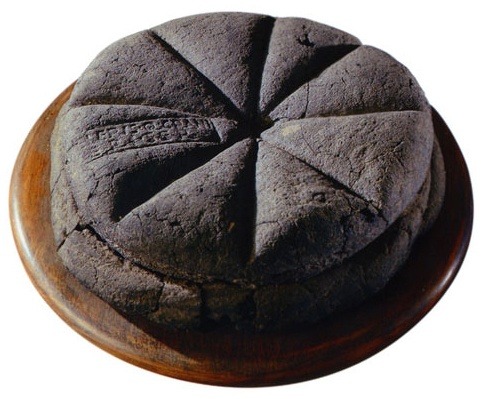
A loaf of bread made in the first century AD, which was discovered at Pompeii, preserved for centuries in the volcanic ashes of Mount Vesuvius. The markings visible on the top are made from a Roman bread stamp, which bakeries were required to use in order to mark the source of the loaves, and to prevent fraud. (via Ridiculously Interesting)
(sigh) I’ve seen these before, but this one’s particularly beautiful.
I feel like I’m supposed to be marveling over the fact that this is a loaf of bread that’s been preserved for thousands of years, and don’t get me wrong, that’s hella cool. But honestly, I’m mostly struck by the unexpected news that “bread fraud” was apparently once a serious concern.
Bread Fraud was a huge thing, Bread was provided to the Roman people by the government – bakers were given grain to make the free bread, but some of them stole the government grain to use in other baked goods and would add various substitutes, like sawdust or even worse things, to the bread instead. So if people complained that their free bread was not proper bread, the stamp told them exactly whose bakery they ought to burn down.
Bread stamps continued to be used at least until the Medieval period in Europe. Any commercially sold bread had to be stamped with an official seal to identify the baker to show that it complied with all rules and regulations about size, price, and quality. This way, rotten or undersized loaves could be traced back to the baker. Bakers could be pilloried, sent down the streets in a hurdle cart with the offending loaf tied around their neck, fined, or forbidden to engage in baking commercially ever again in that city. There are records of a baker in London being sent on a hurdle cart because he used an iron rod to increase the weight of his loaves, and another who wrapped rotten dough with fresh who was pilloried. Any baker hurdled three times had to move to a new city if they wanted to continue baking.
If you have made bread, you are probably familiar with a molding board. It’s a flat board used to shape the bread. Clever fraudsters came up with a molding board that had a little hole drilled into it that wasn’t easily noticed. A customer would buy his dough by weight, and then the baker would force some of that dough through the hole, so they could sell and underweight loaf and use the stolen dough to bake new loafs to sell. Molding boards ended up being banned in London after nine different bakers were caught doing this. There were also instances of grain sellers withholding grain to create an artificial scarcity drive up the price of that, and things like bread.
Bread, being one of the main things that literally everyone ate in many parts of the world, ended up with a plethora of rules and regulations. Bakers were probably no more likely to commit fraud than anyone else, but there were so many of them, that we ended up with lots and lots of rules and records of people being shifty.
Check out Fabulous Feasts: Medieval Cookery and Ceremony by Madeleine Pelner Cosman for a whole chapter on food laws as they existed in about 1400. Plus the color plates are fantastic.
ALL OF THIS IS SO COOL
I found something too awesome not share with you!
I’m completely fascinated by the history of food, could I choose a similar topic for my Third Year Dissertation? Who knows, but it is very interesting all the same!
Bread fraud us actually where the concept of a bakers dozen came from. Undersized rolls/loaves/whatever were added to the dozen purchased to ensure that the total weight evened out so the baker couldn’t be punished for shorting someone.
activists at barnard college providing “labels”, photographed by susan rennie and published in off our backs: a women’s newsjournal vol. 3 no. 6, february 1973
Black an white photo of two women, one standing, one seated.
Behind them is a hand-written sign reading,
“YEA – It’s a heavy trip. BUT! This is a chance to CHOOSE YOUR OWN LABEL instead of having someone else do it for you:
“the Bible says homosexuality is a sin” well the Bible also has a lot of sexism, rape, incest, violence and a lot of contradictory messages in general because it was written by people and people have agendas
I don’t really think that God even has the time to care about if people are gay like if he’s got a whole world to run there are more important things anyway
And if God is love, he’s not just loving me if I am what he wants; he’s loving me as the person he made me to be, which is a queer person
You can’t say “I love you, and I made you gay but I’m sending you to hell you awful sinner” my dude that doesn’t make sense it’s not like hell has a low population is it
The god I believe in loves queer people because that’s how he made us
the bible doesn’t condemn homosexuality anyway. It’s content taken out of context and misinterpreted over hundreds of years of translations, re-translations, and mis-translations.
Hell, in Kenneth Davis’s Don’t Know Much About The Bible, there’s a passage that absolutely blows my mind and proves just how much we can misinterpret with simple translation mistakes:
“In researching the world’s oldest city, for instance, I learned that Joshua’s Jericho is one of the oldest human settlements. It also lies on a major earthquake zone. Could that simple fact of geology have had anything to do with those famous walls tumbling down? Then I discovered that Moses and the tribes of Israel never crossed the Red Sea but escaped from Pharaoh and his chariots across the Sea of Reeds, an uncertain designation which might be one of several Egyptian lakes or a marshy section of the Nile Delta. This mistranslation crept into the Greek Septuagint version and was uncovered by modern scholars with access to old Hebrew manuscripts.”
The bible is one long-ass game of telephone, whispered around the world in dozens if not hundreds of languages, for thousands of years. I have a hard time knowing what my grandpa is talking about, when he starts going on about the technology or practices of his youth, and that was only about 80 years ago, in the same country and in the same language as me. So why every Joe on the streets thinks they can take one or two verses, completely out of context and probably mis-translated several times to boot, and use it to spout propaganda and hatred for an entire group of people will forever be beyond me.
You’re all valid, and frankly, if there is a ‘loving God,’ then that God will be happy to see you happy. Seriously.
I needed that. Thank you.
The Bible wasn’t faxed down from the sky, people, it’s been compiled and formulated for hundreds of years until it became what it is today. And yes, misinterpreted by whoever with whatever agenda-of-the-day.
And hypocrites always stick to the word and not the spirit of any religion: to love, to help, to respect, to protect, and to strive to make the world a better place.
Yup, Jesus never said ANYTHING against LGBT people. All he said was don’t be greedy, don’t be lustful and don’t be wrathful. The fact that LGBTphobes took those instructions out of context to justify their LGBTphobia is pretty telling!
Hey, your friendly neighborhood Jew here!
You guys know that verse in Leviticus that homophobes like to trot out? Well, I’m here to tell you:
They don’t read Hebrew and they don’t know shit.
And now here’s something you probably won’t hear from any of those Fine Christian Folks ™ anytime soon, either:
We do read Hebrew and we still don’t know shit.
Here’s the thing. The most “accurate” word-for-word translation of that verse would say “a man shall not lie with another man; it is forbidden.”
Here’s the issue.
The grammar surrounding “men” in that sentence isn’t correct, and the word I’ve translated as “forbidden” is “toevah,” a word so fucking old we literally don’t know what it meant anymore.
The strange sentence construction suggests that “lie with another man” uses a feminine construction you wouldn’t normally find in a sentence that’s entirely about men, and while “toevah” means “forbidden,” it’s not actually clear what is forbidden. Here’s an incomplete list of possibilities:
Pederasty (adult male/adolescent male sex) is full-stop forbidden, a man sleeping with a male prostitute is full-stop forbidden, a man sleeping with a man as part of any kind of sex magic or fertility ritual is forbidden.
And my rabbi’s personal interpretation, based on the sentence construction: a man shouldn’t sleep with another man in a woman’s bed. (So basically: don’t cheat on your wife with a dude, which is probably treated separately from “don’t commit adultery” because adultery would come with the risk of an illegitimate child.)
You’ll notice none of these involve “ew, you disgusting gays.”
Unless you accept a word-for-word literal translation with zero consideration for the social mores and other tribes surrounding Israel contemporary with the writing of Torah, nothing about this commandment has anything to do with our modern understanding of queer people having committed relationships. Once you start taking the rituals and practices of Israel’s contemporaries into account, it suddenly becomes clear why these prohibitions would have been put into place (sex magic was common in the cult of Ba’al, for example, while pederasty was practically a requirement in Greece).
If you’re just a person out there loving other people of the same gender as you?The Torah says nothing against you. But do you know what our literary tradition does say?
It puts you in the company of Naomi and Ruth.
Ruth is considered the first convert, and her vow to her mother-in-law Naomi (after Ruth’s husband’s death) forms the basis of our modern marriage vows. “Where you go, I shall go, and where you lodge, I shall lodge; your people shall be my people, and your G-d my G-d; and where you die I shall die, and there shall I be buried.” Ruth remarries as prescribed by law at the time, but even when a child is born of that new union, nobody calls it “Ruth’s and Boaz’s child”–they all say a child has been born to Ruth and Naomi.
You are in the company of a woman whose name we invoke in our prayers and whose life we celebrate. I wear her words around my shoulders on my tallit, my sacred prayer shawl. Since we consider that everything in the Tanakh is intended for learning and study, what might we take from this story, but that a queer person can be virtuous and beloved of G-d?
I will never not be delighted by the first English description of an opossum:
“An Opassom hath an head like a Swine, and a taile like a Rat, and is of the bignes of a Cat. Under her belly she hath a bagge, wherein she lodgeth, carrieth, and sucketh her young.”
Crop circles? Nope – cropmarks. Incredibly hot, dry weather across Wales this summer is revealing remnants of ancient settlements as patterns of growth in crops and grasslands.
1. Medieval castle mound at Castell Llwyn Gwinau, Tregaron 2. Cross Oak Hillfort, Talybont on Usk 3. Trewen Roman farmstead or villa, Caerwent, south Wales
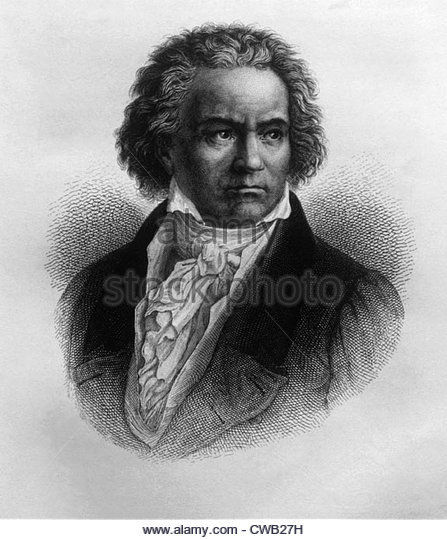
“Ludwig van Beethoven was of African descent, and the truth of his ethnic origins was covered up through a mixture of white powder worn on his face when out in public, the use of body doubles for portraits, and “euro-centric” historians, hiding the truth of his genetic heritage.“ – src
I’m mad that we aren’t taught this
Okay, that’s just the coolest and most frustrating thing because now I’m trying to get the mental picture of how he’d have really looked.
i love that one old timey 1910s trans dude who has a tiny wikipedia page for himself that he earned entirely due to him starting fights in bars and being the city’s hottest casanova
Like this glorious jerk got arrested so many times that was literally ALL THEY HAD TO WRITE IN THE PAPER
He was a vagrant street kid and Seattle girls were all over this guy, to the point where it caused a moral panic. There’s a famous anecdote about a women proclaiming her love in Denny Park and then trying to shoot herself, but most of these reports were falsely worded in a way that suggest his female admirers were “upset about being deceived” when really they were upset that he was wooing other women, or trying to get his attention by being as extra as possible.
What you also should know is that back in the day “seduction” was a literal crime that could put you in prison (unless you married the woman you seduced) but since he wasn’t cis they couldn’t really CHARGE HIM with anything. Legend.
I especially like “Seattle Woman Appears in Men’s Clothes Because She Says Her Features Make it Possible.” I can’t imagine anything but someone going “Hey! You can’t dress like that!” and him responding “Oh yes I can. You see, I look very good.”
Steve Rogers did, in fact, realize that something was off when he saw the outline of the woman’s odd bra (a push-up bra, he would later learn), but being an officer and a gentleman, he said that it was the game that gave the future away.
No, see, this scene is just amazing. The costume department deserves so many kudos for this, it’s unreal, especially given the fact that they pulled off Peggy pretty much flawlessly.
1) Her hair is completely wrong for the 40’s. No professional/working woman would have her hair loose like that. Since they’re trying to pass this off as a military hospital, Steve would know that she would at least have her hair carefully pulled back, if maybe not in the elaborate coiffures that would have been popular.
2) Her tie? Too wide, too long. That’s a man’s tie, not a woman’s. They did, however, get the knot correct as far as I can see – that looks like a Windsor.
3) That. Bra. There is so much clashing between that bra and what Steve would expect (remember, he worked with a bunch of women for a long time) that it has to be intentional. She’s wearing a foam cup, which would have been unheard of back then. It’s also an exceptionally old or ill-fitting bra – why else can you see the tops of the cups? No woman would have been caught dead with misbehaving lingerie like that back then, and the soft satin cups of 40’s lingerie made it nearly impossible anyway. Her breasts are also sitting at a much lower angle than would be acceptable in the 40’s.
Look at his eyes. He knows by the time he gets to her hair that something is very, very wrong.
so what you are saying is S.H.E.I.L.D. has a super shitty costume division….
Nope, Nick Fury totally did this on purpose.
There’s no knowing what kind of condition Steve’s in, or what kind of person he really is, after decades of nostalgia blur the reality and the long years in the ice (after a plane crash and a shitload of radiation) do their work. (Pre-crash Steve is in lots of files, I’m sure. Nick Fury does not trust files.) So Fury instructs his people to build a stage, and makes sure that the right people put up some of the wrong cues.
Maybe the real Steve’s a dick, or just an above-average jock; maybe he had a knack for hanging out with real talent. Maybe he hit his head too hard on the landing and he’s not gonna be Captain anymore. On the flipside, if he really is smart, then putting him in a standard, modern hospital room and telling him the truth is going to have him clamming up and refusing to believe a goddamn thing he hears for a really long time.
The real question here is, how long it does it take for the man, the myth, the legend to notice? What does he do about it? How long does he wait to get his bearings, confirm his suspicions, and gather information before attempting busting out?
Turns out the answer’s about forty-five seconds.
Sometimes clever posts die a quiet death in the abyss of the unreblogged. Some clever posts get attention, get comments, get better. Then there’s this one which I’ve watched evolve into a thing of brilliance.
THOU is the subject (Thou art…) THEE is the object (I look at thee) THY is for words beginning in a consonant (Thy dog) THINE is for words beginning in a vowel (Thine eyes)
this has been a psa
Also, because H was sometimes treated as a vowel when the grammar rules for thou/thee/thy/thine were formed,THINE can also be used for words beginning with H. For example, both “thy heart” and “thine heart” appear in Elizabethan poetry.
For consistency, however, if you’re saying “thine eyes”, make sure you also say “mine eyes” instead of “my eyes”.
Further to the PSA:
Thou/thee/thine is SINGULAR ONLY.
Verbs with “thou” end in -st or -est: thou canst, thou hast, thou dost, thou goest. Exception: the verbs will, shall, are, and were, which add only -t: thou wilt, thou shalt, thou art, thou wert.
Only in the indicative, though – when saying how things are (“Thou hast a big nose”). Not in the subjunctive, saying how things might be (“If thou go there…”) nor in the imperative, making instructions or requests (“Go thou there”).
The -eth or -th ending on verbs is EXACTLY EQUIVALENT TO THE -(e)s ENDING IN MODERN ENGLISH.
I go, thou goest, she goeth, we go, ye go, they go.
If you wouldn’t say “goes” in modern English, don’t say “goeth” in Shakespearean English.
“Goeth and getteth me a coffee” NO. KILL IT WITH FIRE.
Usually with an imperative you put the pronoun immediately after the verb, at least once in the sentence (“Go thou” / “Go ye”).
YE is the subject (Ye are…). YOU is the object.
Ye/you/your is both for PLURALS and for DEFERENCE, as vous in French.
There’s more, but that’ll do for now.
Oh wow. Reblogging for reference.
i haven’t had my coffee yet, so all i can think of when i read through this is:
th’ain’t
th’dstn’t’ve
AND ANOTHER THING “thee/thou/thy” is informal “ye/you/your” is formal Also also…all of this is NOT Old English but is actually referred to as Early Modern English. If you were speaking Old English, it would sound closer to German.
^That.
And IT’S NOT MORE FORMAL to use THEE.
if you address someone you should use Thee or Ye (sometime used as the plural, sometimes it’s still Thee, rules are iffy) to as You, it’s an insult by intentional distance. If you call someone you should call You by Thee, it can be an insult via assumed intimacy.
(This is why some religions insist on still using Thee and Thou when talking to their Father God. Many of them modernly think it makes them sound more formal, but that’s not why the usage began, or why the more linguistically aware still do it. Not because it’s more formal, but because it’s LESS formal. You wouldn’t call your own Father “You” unless you wanted to imply disowning Him.)
Anyone you’re close to or on first name terms with can be Thee. Friends, family members, etc.
Anyone you want to point out is NOT your friend, respectfully or otherwise, is You. Which is why the King is still Your Majesty. You are decidedly not his friend unless you know each other really well. (See “Henry V”. If you can also call Henry by Harry or Hal, you can probably call him Thee.
One more note! “Ye Olde- as you see on shop signs is not prounounced Yee. There’s a character called a Thorn that was going out of style and being replaced by a curly thing that looks like a Y and IS NOT. It’s pronounced Th. THe olde apothecary shoppe. Not Ye Olde. That itself promptly went out of style as well but the error remains almost traditional.
and I am not addressing claims that I might be a vampire, lycanthrope, or other immortal just because I am fluent in Modern Middle English.
This whole post is a blessing because I read so much “ye olde” speak in historical stuff and everyone always gets their thee’s and thou’s wrong. Even big name authors with accuracy editors who ought to know better.
It’s more accurate to have your “poor folk” in your historical novel saying “thou” than it is to have the scholar or rich man with an education rooted in Latin, unless he’s down the pub with his mates, merry as a knave.
The whole thing just reminds me of people using Polonius’ speech in Hamlet (“to thine own self be true”), completely out of context, not realizing that the speech is intended to show Polonius as a foolish old hypocrite who enjoys dishing out council but rarely follows his own convoluted advice, which is often contradictory and falsely pious.
Which, I mean, Shakespeare often isn’t taught well outside of higher education, lets be honest. So why would they know unless they’ve studied it beyond the passing glance it gets that one year in high school before been relegated to the position of “too posh and old to be relevant” which is entirely not true.
Shakespeare is written in the language of the people, and is often more insightful and progressive than certain types of academics would like you to believe.










 Steel Phoenix Studios