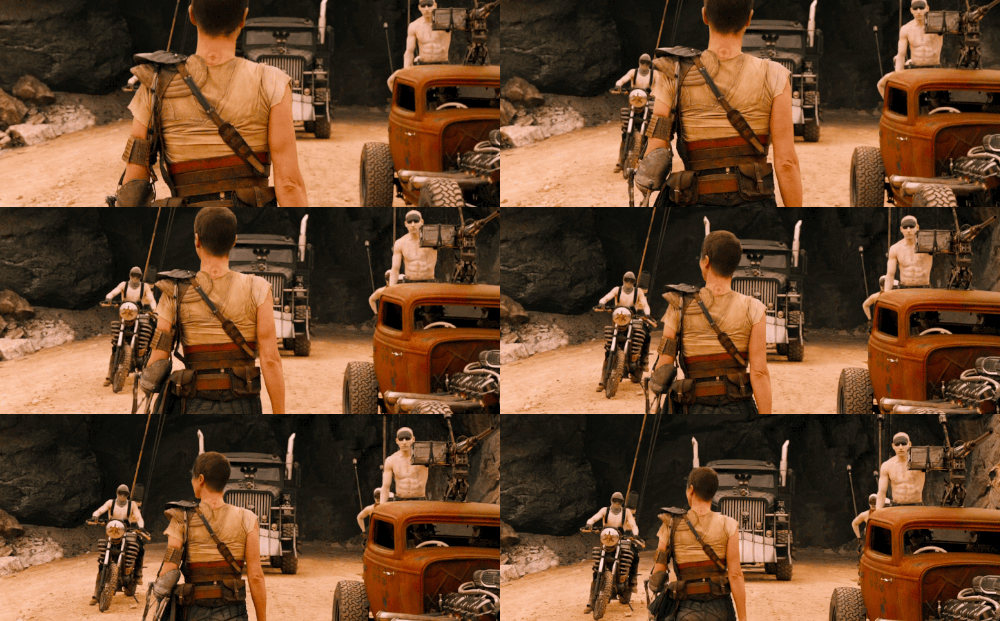
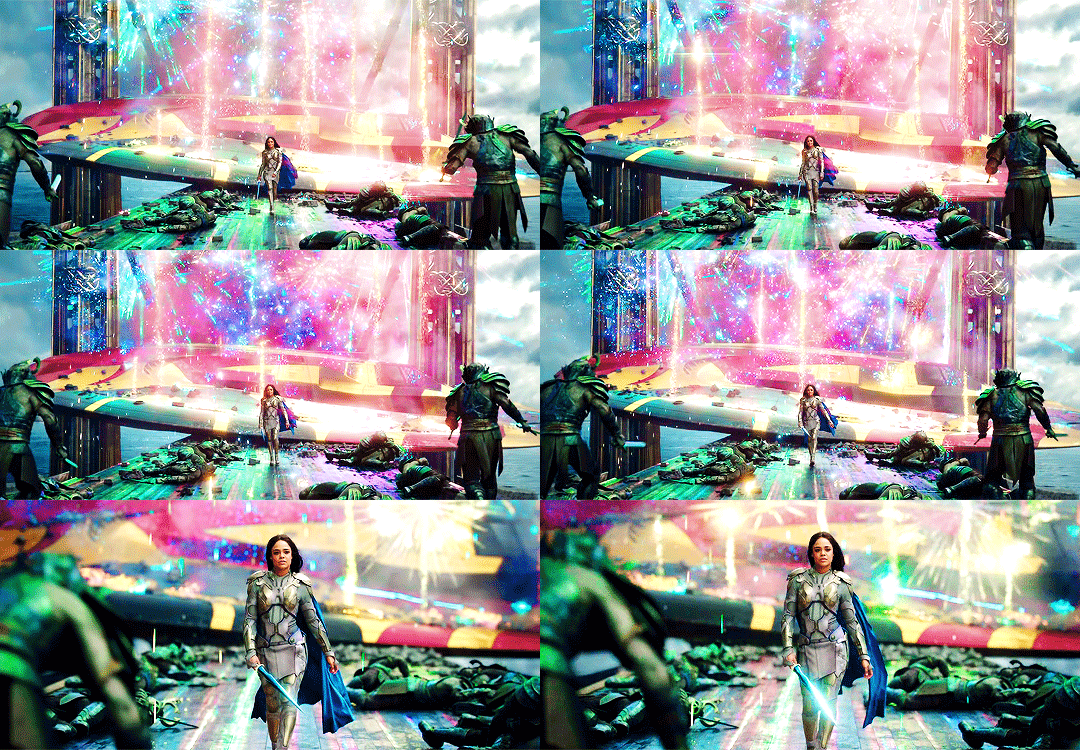
my favorite thing about this is that each of them is walking in a different direction, it’s like these girls are off to conquer the entire goddamn world
They’re gonna meet in the middle
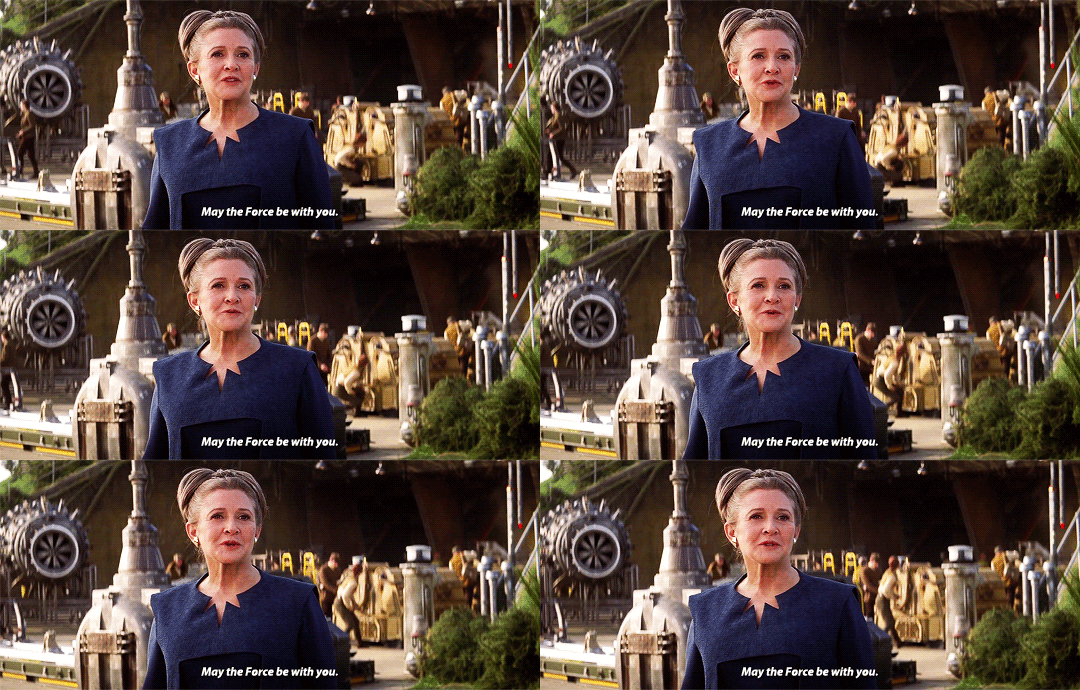
In the middle they will find the avatar, master of all elements and the force:
No, no, let’s talk about this more! I brought this up a while ago in regards to the music box Toast has during the final chase, but let’s talk about it! Because the costuming in this movie is so great and has a lot of meaning in it.
Up until they meet the Vuvalini, the Sisters have only been seen wearing their white “robes” (for lack of a better word). It looks like there might be some stolen shoes among them (the Dag has a pair, so does Capable) and maybe a wrist wrap (Capable), but otherwise they have essentially no adornment. Just their layers and layers of gauzy white fabric and a few braids in their hair. No jewelry, no pins, no rings, no real adornment, no real ornamentation. Just these wasteland bridal gowns (Angharad basically has a bridal veil over her head when she first sneaks into the cab of the rig, let’s not joke, and Cheedo deliberately dresses like a bride when she tries to go back to Joe). It reinforces the idea that they’re simultaneously important and unimportant–they’re dressed better than the Wretched but they don’t get to wear crowns or ribbons or badges. Joe sure likes to wear badges and ribbons and signs of office. Their plain dress reinforces the idea that they are, as Angharad says, “breeding stock.” It’s a uniform. It signifies what they are in Joe’s power-structure, not who they are as people (they’re not seenas people in that structure).
But as they progress, they shed more and more of their white clothes: Capable loses her scarf to Nux, the Dag stops wearing the little white cap, their clothes get stained for sure, Cheedo starts wearing a wrapped dress not so unlike Angharad’s, &c.
Events happen, as we all know, and they meet the Vuvalini (who are so important to me that I almost can’t articulate it). And by the time the sun has gone down after their meeting the Vuvalni, the Many Mothers have taken them in, given them shelter, made them welcome, and even given them clothing.
But more than clothing–because one could say, well, it’s the desert and it gets cold at night. You need to wrap up. But it’s not just clothing out of necessity. It’s ornamentation. It’s not just necessity but also, I think, what they want to wear. It’s symbolic in that regard. Capable started wearing a pair of goggles early on–a first step in this direction. And then the Vuvalini give them things like belts with pouches, woven and patterned headbands, capelets, patterned quilts, even outright jewelry like necklaces and fringed belts that serve no purpose but ornamentation. The Dag, when she talks to the Keeper of the Seeds, has an animal’s jawbone among other small objects tied into her hair with cords. She’s not wrapped in blankets for warmth or anything. She’s wearing a belt with a zillion pouches on it and ornaments tied into her hair. This is huge! This is important!
For one thing, it means that the Sisters have been accepted among the Vuvalini. They are dressing like the Vuvalini and being dressed by them. They’re wearing the same kinds of things–gifts, perhaps–and it makes them all of a kind. They’re essentially one community, sharing material items, food, ideas, and information.
For another thing, it makes the “wives” into individuals, not four women wearing what essentially amounts to a uniform that signifies “what” they are–now it’s about who they are.
They start off, all five of them, wearing these not quite identical but identifiably similar gauzy gowns. They end up, the remaining four, wearing piecemeal outfits with things that one hopes they chose or were given and that they themselves love. They are becoming, in this way, individual women with their own tastes and desires and opinions. Not that they weren’t before, of course, but this is finally an exterior manifestation of their interior lives.
Furiosa does not, it should be noted, adopt or go back to Vuvualini-style clothes. She keeps her Citadel “uniform,” though she wraps herself in a borrowed blanket that night (which, as some amazing posts point out, still makes her physically isolated in very important ways). In this way, she is still “outside” of her former community at this point, and she may remain “outside” for some time. It’s hard to say. But she’s definitely still in her old clothes when they set out across the salt. No additions there…
…in stark contrast to the newcomers to the Vuvalini, who are quite decorated and dressed up there on the bikes. And I love it. I love it.
So here’s another wrinkle: Cheedo strips off most of the things the Vuvalini have given her when she (seems to) beg Rictus to get her onto Joe’s vehicle. But she doesn’t strip off all of it–just the most obvious parts. It looks for all the world like she’s given up and gone back to Joe–she’s even gone back to how he would dress her. But she’s still wearing a necklace from the Vuvalini–so she hasn’t given it all up, as she makes plain just a few moments after (but it’s a great moment given her actions after Angharad died: smeared lipstick and veil and all).
So all these ornaments and headbands are these tangible things that break the Sisters from their former existence and connect them with these other women and all the history they carry among themselves. It’s a sign of separation from what they were and of progressing into what they are and will be. They take on a new appearance as they take on new roles.
(Another argument could be made that the Vuvalini hold things in common, which would be in direct opposition to the repeated imagery of ownership and control that appears everywhere else in the film [“that’s my wheel” “my treasures” the chastity belts the bank vault door, “that’s mine!” &c]–and that’s a post for another time too.)
I want a scene where we see the Vuvalini laying things out and telling the Sisters who the pieces used to belong to and giving them a little Vuvalini history lesson as they choose.
Toast trades away her Wife whites the first chance she gets. Within the first week of the New Citadel she’s wearing a patched and greasy shirt, swapped with a wide-eyed kitchen worker for the flimsy white linen, a pair of War Boy trousers, and the leather moccasins Eves had been carrying tucked in her storage bags since there was no one left alive among the Vuvalini with small enough feet to fit them. She puts tools in her pockets and her gun in a holster and accumulates enough belts that they seem to be spawning amongst themselves.
Capable keeps her cloth, fashions a practical blouse with long sleeves to keep her skin from burning in the sun. She makes underwear and a wrap for her breasts and a scarf to keep the sand out of her mouth or her hair tied back while she works in the infirmary. The remainder gets turned into bandages.
Dag makes a clever wrapped dress out of a Vuvalini shawl, turns scraps into pockets that are full of seeds and pebbles. She twines lizard bones into her hair, and when her daughter is born, her whites get shredded for nappies and burping cloths.
Cheedo, born Wretched, saves everything. But on top of her whites that flow like morning fog she adds a red-and-ochre scarf and a leather vest stamped with leaves and flowers. (Janey tells her the names, and how they used to grow in the Green Place, and which ones might be among the newest seedlings Dag is planting up above.) She lets the old women show her ten different ways to braid her hair up, and when she starts writing history, not on her skin but in bound sheafs of hemp-paper, she is rarely without a pen behind her ear and a bottle of ink in her pocket.
Furiosa takes off the sigil and chains, hands them over to be melted down into something useful without a second thought. She mostly doesn’t wear the grease, except when she thinks it will tip the situation in her favor. She changes nothing else.
“Oh, this was Mellie’s, it would fit you, child,” says Eves, extracting a linen tunic from the depths of a bag during an evening of sock-darning and hair-braiding.
“I don’t need anything,” Furiosa says. Her once-white wrapped top stopped being anything more than a shirt to her long ago, and she’s practiced in tugging it off and pulling it on with one hand. Changing her clothes won’t change the past.
“If you decided to grow your hair out…” Janey muses another night, smoothing a fine woven headband across her knee.
“It’s practical this way.” Nothing to get caught in a fight or an engine.
The Vuvalini give gifts. It’s an honor to receive a gift when no one has anything, a sign of connection to the tribe. The Wives and the Milkers and eventually a War Boy or two end up with tokens passed down from mother to daughter, reclaimed from a fallen sister when it was time to return her body to the earth. Even Max accepts a pair of hand-knitted socks with a surprised grunt and a slight flush in his cheeks.
Furiosa is aware that she’s taken nothing. Even the blanket she’d wrapped around her shoulders that night on the edge of the salt was packed into Janey’s motorcycle bag the next morning.
I am one of the Vuvalini, of the Many Mothers. My initiate mother was Katie Concannon. I am the daughter of Mary JoBassa. My clan was Swaddle Dog.
How many times had she whispered it to herself, in the Vault or the War Boy bunks, reciting her lineage like an invocation? When had she stopped?
She had been Vuvalini, and then she had been Joe’s, and now…
When Janey takes the rifle strap out of a hidden pocket Furiosa recognizes it instantly, the cloth woven with a repeating pattern of leaves, faded and sun-bleached but still reliable and strong after all these years.
“It was Katie’s,” Janey says.
Furiosa swallows. “I remember.” She had learned to shoot with it over her shoulder, the weight of Katie’s ancient Winchester heavy in her ten-year-old hands.
“She would have loved to see you,” Janey says with a wistful smile, and she holds out the strap in the flickering light of the terrace campfire. And Furiosa cannot say that she is sure of that at all, not with thousands of days of Imperator blood on her hands. But she takes the piece of cloth and tucks it into a pocket.
I don’t think I’ll ever be over the blood donation scene in Fury Road. The way Furiosa’s dying, and she uses her last moments of consciousness to tell Max “get them home.” That she, ferocious warrior, imperator, stolen child, is, in her last moments of life, so loved, and so full of love and the selfless need to protect these women and get them home. The way Max’s hands are huge, rough and dirty – hands that have snapped necks and fired guns – but they are so gentle when he cradles her. The way he mutters “I’m so sorry, sorry” every time he has to hurt her to make it better. That he’s barely spoken all film but now he’s feverishly muttering to her, “there you go, okay” and stringing together as many syllables as he can muster because the silence is just unbearable. That his body has been abused and exploited and drained of blood without his consent so many times, but now at last he’s free, he has a choice and he chooses to giveher his blood. The way his name – his identity – was the last thing he could call his own, but as he holds her in his arms and waits for his blood to run into her and fill her with life again, as he finally fixes what’s broken, he goes, here, you can have it, Max. My name is Max. That’s my name. And it’s yours.
Because before he met her, he was a man reduced to a single instinct: survive. He was a muzzled animal, a raging feral, and treated as such. But then he got caught up in their escape and she gave him the tools to free himself. She asks him “what’s your name? What do I call you?” She treated him like a human being and in protecting and loving Furiosa and these abused women without asking for anything in return, he recovers his humanity, so of course, here, it’s yours, my name is Max, it’s the last thing I have and it belongs to you.
It’s an extraordinarily beautiful scene visually too, and I honestly think it might be the most profound declaration of love that’s ever occurred in an action film.
This is not “I’m too fucking macho to tell you”, it’s “I can’t handle identity right now or maybe ever”.
IIRC, Furiosa naming him “Fool” is the only time in the whole show that one character teases another. It’s not completely devoid of jokes – Toast makes a sex joke about a pistol, Dag tells her baby to stay put, it’s lost it’s novelty out here. We see affection and care between different characters, especially the five, but we don’t see any teasing in the forms of status games – no physical play, or insults, or reminders of past embarrassments, except this one.
And this is an incredibly high stakes moment. Why does Furiosa do it? She’s insulting Max when he’s already really damn on edge, and she’s about to give him control of the rig and make him responsible for their escape plan. At first glance it looks like a really stupid idea to take a poke at a guy who’s currently holding a gun on you.
The obvious reason is that teasing (when it’s not bullying) is an indicator of a close social bond. You only tease people you’re comfortable with. She’s giving Max an insulting nickname because when you act as though you’re comfortable, it helps you become comfortable. She’s trying hard to deescalate the situation and win him over, and this is one tool for doing so.
I think there’s a more subtle reason too, and it’s that Furiosa sees right through him. She already knows that Max was human once, and is afraid to be human again. Teasing isn’t unique to the human species, but it’s one of our higher order functions and it’s very, very relational. Furiosa isn’t just trying to fake a bond with Max that doesn’t exist yet, she’s trying to remind him of his humanity. He’s just denied his humanity and avoid relationship by refusing to give his name. She’s going to drag him back into humanity by the scruff of his neck if he has to, and by calling him a fool she’s pointing out that she sees his attempts to avoid attachment and that it’s, well, foolish. Not helpful for survival, either physically or emotionally, and she needs him, dammit.
The obvious Doylist explanation of the scene is that names are important in this show (such good meta about that today!), and naming Max ‘Fool’ is symbolic on a number of different levels. It’s one of a million pieces of heart-rending meaning that Miller and co. packed into this thing. But I think that explanation works on a Watsonian level as well. Furiosa doesn’t have time to think all of this through rationally, but she intuitively knows how to draw Max into the group and she does it with consummate skill. By calling him names.







 Steel Phoenix Studios