hey man i haven’t seen a single similar post (concerning???) so i feel like it’s important to make this.
tomorrow is ramadan. your eating disorder will not magically disappear in ramadan.
allah will not hate you if you relapse in ramadan. be it that you faint or you binge, if you need to break your fast because of your eating disorder THEN YOU BREAK YOUR FAST.
You are not supposed to fast when you are sick. YOU ARE NOT SUPPOSED TO FAST WHEN YOU ARE SICK. IT IS HARAM TO FAST IF YOU ARE SICK BECAUSE IT BRINGS HARM TO YOUR BODY. If you start feeling horribly sick and you know, you haven’t had sufficient suhoor or iftar for a few days or anything of the sort, it is okay to break your fast and even go to the hospital if you need to.
habaybi that have eating disorders, PLEASE take care of yourself during ramadan. It is a month of cleansing and forgiveness, so forgive yourself if you relapse. You can always redo your fast after ramadan.
Jazakallah please reblog this post and ramadan mubarak to you all! ♡
It took me days to get time together to read this whole thing, but I have finally done it.
This is it. This is the one article you need to read to understand just what is going on in Britain, America, and Russia.
This is the one piece of writing you need and can use to reference the very chilling reality that these countries have been tied together in the machinations of just a few billionaires, and how Facebook and Google tie in insidiouslyi.
I keep telling y’all to stop fucking with facebook but that’s moot now. It’s so much bigger than this.
“Was that really what you called it, I ask him. Psychological warfare? “Totally. That’s what it is. Psyops. Psychological operations – the same methods the military use to effect mass sentiment change. It’s what they mean by winning ‘hearts and minds’. We were just doing it to win elections in the kind of developing countries that don’t have many rules.”Why would anyone want to intern with a psychological warfare firm, I ask him. And he looks at me like I am mad. “It was like working for MI6. Only it’s MI6 for hire. It was very posh, very English, run by an old Etonian and you got to do some really cool things. Fly all over the world. You were working with the president of Kenya or Ghana or wherever. It’s not like election campaigns in the west. You got to do all sorts of crazy shit.”“
This is not just a story about social psychology and data analytics.
It has to be understood in terms of a military contractor using military strategies on a civilian population.
Us. David Miller, a professor of sociology at Bath University and an authority in psyops and propaganda, says it is “an extraordinary scandal that this should be anywhere near a democracy. It should be clear to voters where information is coming from, and if it’s not transparent or open where it’s coming from, it raises the question of whether we are actually living in a democracy or not.”
“And it was Facebook that made it possible. It was from Facebook that Cambridge Analytica obtained its vast dataset in the first place. Earlier, psychologists at Cambridge University harvested Facebook data (legally) for research purposes and published pioneering peer-reviewed work about determining personality traits, political partisanship, sexuality and much more from people’s Facebook “likes”. And SCL/Cambridge Analytica contracted a scientist at the university, Dr Aleksandr Kogan, to harvest new Facebook data. And he did so by paying people to take a personality quiz which also allowed not just their own Facebook profiles to be harvested, but also those of their friends – a process then allowed by the social network.”
Read this. Read the entire thing. It will take you a while and it’s a lot to digest but you need to know.
Signal boost.
@sunderlorn we’re finally completely united in propaganda, isn’t that nice!?
So, after thinking about this over night, I’ve decided to share something that happened at the WORLD SCIENCE FESTIVAL yesterday afternoon in NYC that changed me. Or rather made me step into who I am in a larger way.
As some on my feed have seen, I was live-feeding the beginning of the panel discussion on FB. That panel was made up of some of the greatest and most famous minds in the world in Inflationary Cosmology, String Theory, Cosmology and Physics based Philosophy. The panel was made up of 5 men and 1 woman. And the moderator was a science writer and journalist for The New Yorker.
In the first hour of the panel discussion you can see clearly, if watching the video, that Veronika Hubeny, the only woman on the panel is barely given any opportunity to speak. And the Moderator, Jim Holt even acknowledges this.
In the last 20-30 minutes of the 90 minute discussion Jim Holt finally pushes the conversation to Hubeny’s field of expertise, string theory, and this is what ensued:
He asked her to describe her two theories of string theory that seem to contradict one another.
And THEN, without letting her answer, proceeded to answer for her and describe HER theories in detail without letting her speak for herself.
We could clearly see that she was trying to speak up. But he continued to talk over her and dominate the space for several minutes.
I should say that this panel was taking place in a large auditorium as it is an extremely high-profile and always sold-out event. And the panel discussion was being live-streamed across the world and they say that millions of people watch these videos after they are made public. (Which they already are).
So at this point, after seeing very clearly that she was not going to be given space to speak and in fact having her own theories described to the audience by the moderator, I am in full outrage. My body is actually beginning to shake. The sexism is beyond blatant. It is happening on stage and NO ONE, not a single other physicist or panelist is stepping in to say anything about it. And I can hear other audience members around me, both men and women becoming more and more agitated with what is happening. Jim Holt, even at one point, asks Veronica a question and she laughs because he has been answering his own questions about her work…and he makes fun of her for ‘giggling’.
So at some point while he is Still talking about Her theories, I just can’t handle it any longer.
With my hands shaking,
I finally say from my seat in the 2nd row of the audience, as clearly, directly and loudly as possible;
“Let. Her. Speak. Please!”
The moderator stops.
They all stop.
The auditorium drops into silence.
You could hear a pin drop.
And then the audience explodes with applause and screams.
Jim Holt eventually sat back, only after saying I was heckling him And he let her speak. And of course, she was brilliant.
———————–
So, the panel discussion ends.
My hands are still shaking. I’m still upset by the incredible sexism that has been demonstrated this afternoon. But I also realize that I just spoke up in an auditorium full of people that are listening to people that are considered gods in the international science world. I was just overwhelmed by it all
We get up to leave.
And then it happens.
Person after person come up to me. Both men and women.
The first woman, right behind me, reaches over and embraces me and says, “Oh my god. what you said was the most important thing that was said all day. Thank you. Thank you.”
And then people start filing out of their aisles and wind their way over to me:
“Was that you? Thank you so much for speaking up. Thank you.”
“Was that you? Oh god, what he was doing was horrific. Thank you. I wanted to do something but didn’t know how”
“Was that you? I wish I had the courage to say something, thank you! Thank you so much”
“Was that you? You said what everyone here was thinking. Look I had even been writing in my notebook what you eventually said (shows me his notebook with ‘let her speak’ written over and over.) But you said it. You said it. Thank you.”
“Was that you? Thank you! I felt so powerless to do anything.”
And on.
So we were all thinking this.
—- So I walked out. And my friend who was sitting about 8 rows behind me, came up to me with a huge grin and said “That was you, wasn’t it? Of course it was. YES!!!!! I will be telling this story for years.”
And the whole time, my hands are still shaking. And I’m felling light-headed. And I just want to scream out into the lobby “WHY IS THIS SEXISM STILL HAPPENING? WHY, does someone like me, with No status in that room, have to be so extraordinarily bold and speak up? And why was it so frightening to do so?”
And I’m thinking. “God, please god let this be an opening for those that were here today and the tens of thousands that watched the live-streaming of the panel yesterday and the hundreds of thousands that will watch the video this year- to speak up when we see this happening. And please let me not be afraid to do this again …and again …and again” Because it was scary.
Please keep giving me courage.
Emotional abuse works like this:
You are screamed at, and then, not knowing any better, you stand up for yourself.
You think this is a way of being strong. You think this is a defense tactic.
But this only provokes more screaming. Going silent provokes more screaming too, but usually it keeps the threats to the minimum. It keeps it just at screaming and not: a shove down the stairs, or order to pack your stuff and get out.
So you learn how to go silent. How to play dead. How to cry without making a noise. How to swallow noise. How to wipe your cheeks, get out of the car, and go about your day. How to dismantle the lump in your throat so you stop choking in the grocery store. How to perk up when people look at your straight-line brows and teeth-sucking frown and say, smile! How to go into a corner and hide in your head.
You learn.
And when the screaming has stopped, when the two of you are in the car or out to dinner and they’re all smiles, all asking for favors, all questions, you are still sucking on your shaky-shouldered anger. You are still hurt and annoyed and want to ask them, how? How can you speak to me like that? How can you pretend you did not say those things? How can you have forgotten?
But you’ve learned. So you listen to, “Can I borrow your key”s and “how was your day”s and you go silent. You play dead. You swallow the noise. And sometimes it doesn’t matter who is speaking to you, it doesn’t matter if they’ve told you “stop talking or I’ll do something I’ll regret,” it doesn’t matter if they’re a friend, it doesn’t matter if their criticism is constructive, it doesn’t matter. You’ve learned. Any sort of speaking, any raising of the voice, any insult and you play dead.
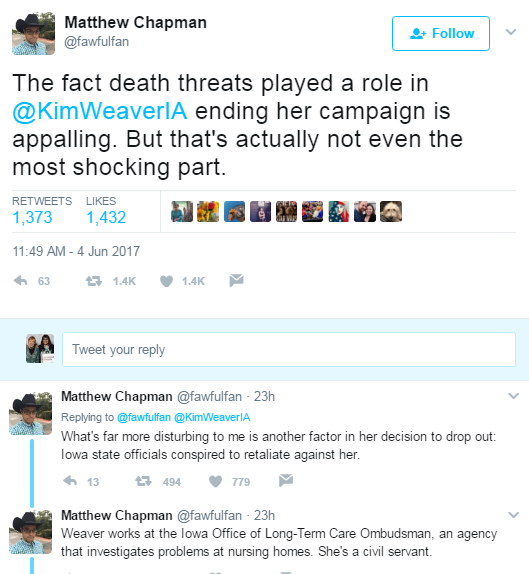
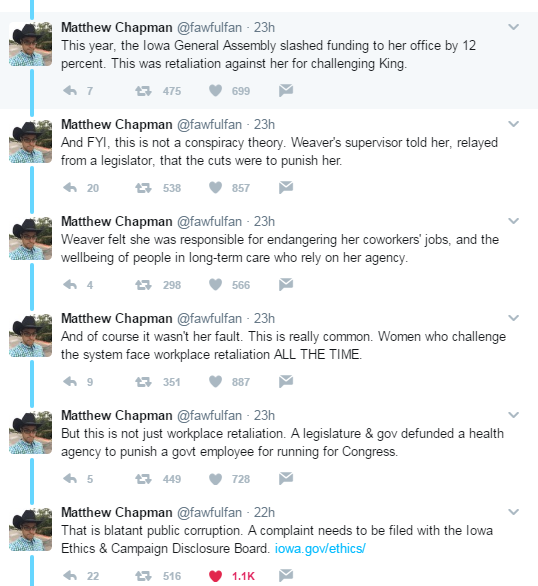
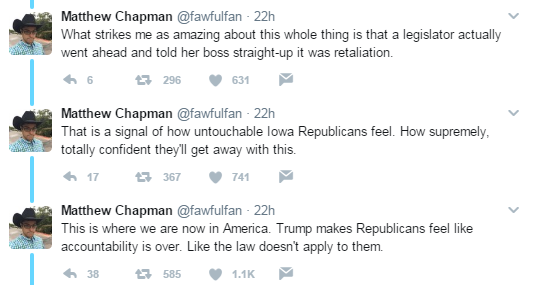
The Democratic candidate running against anti-immigrant Republican Congressman Steve King (IA) announced Saturday that she is dropping out of the race for her own safety.
Hey so
Part of Fascisms early roots was using violence to scare away potential candidates against their power.
my night manager (who is a gay man) and i sometimes sit down and exchange stories and tidbits about our sexuality and our experiences in the queer cultural enclave. and tonight he and i were talking about the AIDS epidemic. he’s about 50 years old. talking to him about it really hit me hard. like, at one point i commented, “yeah, i’ve heard that every gay person who lived through the epidemic knew at least 2 or 3 people who died,” and he was like “2 or 3? if you went to any bar in manhattan from 1980 to 1990, you knew at least two or three dozen. and if you worked at gay men’s health crisis, you knew hundreds.” and he just listed off so many of his friends who died from it, people who he knew personally and for years. and he even said he has no idea how he made it out alive.
it was really interesting because he said before the aids epidemic, being gay was almost cool. like, it was really becoming accepted. but aids forced everyone back in the closet. it destroyed friendships, relationships, so many cultural centers closed down over it. it basically obliterated all of the progress that queer people had made in the past 50 years.
and like, it’s weird to me, and what i brought to the conversation (i really couldn’t say much though, i was speechless mostly) was like, it’s so weird to me that there’s no continuity in our history? like, aids literally destroyed an entire generation of queer people and our culture. and when you think about it, we are really the first generation of queer people after the aids epidemic. but like, when does anyone our age (16-28 i guess?) ever really talk about aids in terms of the history of queer people? like it’s almost totally forgotten. but it was so huge. imagine that. like, dozens of your friends just dropping dead around you, and you had no idea why, no idea how, and no idea if you would be the next person to die. and it wasn’t a quick death. you would waste away for months and become emaciated and then, eventually, die. and i know it’s kinda sophomoric to suggest this, but like, imagine that happening today with blogs and the internet? like people would just disappear off your tumblr, facebook, instagram, etc. and eventually you’d find out from someone “oh yeah, they and four of their friends died from aids.”
so idk. it was really moving to hear it from someone who experienced it firsthand. and that’s the outrageous thing – every queer person you meet over the age of, what, 40? has a story to tell about aids. every time you see a queer person over the age of 40, you know they had friends who died of aids. so idk, i feel like we as the first generation of queer people coming out of the epidemic really have a responsibility to do justice to the history of aids, and we haven’t been doing a very good job of it.
Younger than 40.
I’m 36. I came out in 1995, 20 years ago. My girlfriend and I started volunteering at the local AIDS support agency, basically just to meet gay adults and meet people who maybe had it together a little better than our classmates. The antiretrovirals were out by then, but all they were doing yet was slowing things down. AIDS was still a death sentence.
The agency had a bunch of different services, and we did a lot of things helping out there, from bagging up canned goods from a food drive to sorting condoms by expiration date to peer safer sex education. But we both sewed, so… we both ended up helping people with Quilt panels for their beloved dead.
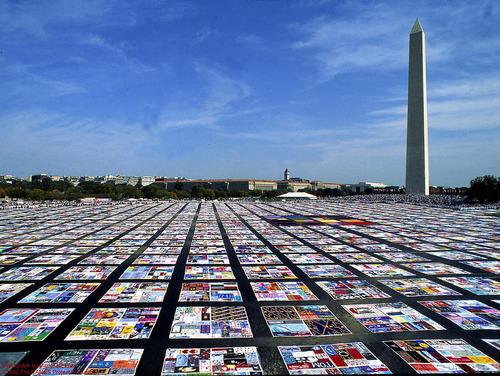
Do the young queers coming up know about the Quilt? If you want history, my darlings, there it is. They started it in 1985. When someone died, his loved ones would get together and make a quilt panel, 3’x6’, the size of a grave. They were works of art, many of them. Even the simplest, just pieces of fabric with messages of loved scrawled in permanent ink, were so beautiful and so sad.
They sewed them together in groups of 8 to form a panel. By the 90s, huge chunks of it were traveling the country all the time. They’d get an exhibition hall or a gym or park or whatever in your area, and lay out the blocks, all over the ground with paths between them, so you could walk around and see them. And at all times, there was someone reading. Reading off the names of the dead. There was this huge long list, of people whose names were in the Quilt, and people would volunteer to just read them aloud in shifts.
HIV- people would come in to work on panels, too, of course, but most of the people we were helping were dying themselves. The first time someone I’d worked closely with died, it was my first semester away at college. I caught the Greyhound home for his funeral in the beautiful, tiny, old church in the old downtown, with the bells. I’d helped him with his partner’s panel. Before I went back to school, I left supplies to be used for his, since I couldn’t be there to sew a stitch. I lost track of a lot of the people I knew there, busy with college and then plunged into my first really serious depressive cycle. I have no idea who, of all the people I knew, lived for how long.
The Quilt, by the way, weighs more than 54 tons, and has over 96,000 names. At that, it represents maybe 20% of the people who died of AIDS in the US alone.
There were many trans women dying, too, btw. Don’t forget them. (Cis queer women did die of AIDS, too, but in far smaller numbers.) Life was and is incredibly hard for trans women, especially TWOC. Pushed out to live on the streets young, or unable to get legal work, they were (and are) often forced into sex work of the most dangerous kinds, a really good way to get HIV at the time. Those for whom life was not quite so bad often found homes in the gay community, if they were attracted to men, and identified as drag queens, often for years before transitioning. In that situation, they were at the same risk for the virus as cis gay men.
Cis queer women, while at a much lower risk on a sexual vector, were there, too. Helping. Most of the case workers at that agency and every agency I later encountered were queer women. Queer woman cooked and cleaned and cared for the dying, and for the survivors. We held hands with those waiting for their test results. Went out on the protests, helped friends who could barely move to lie down on the steps of the hospitals that would not take them in — those were the original Die-Ins, btw, people who were literally lying down to die rather than move, who meant to die right there out in public — marched, carted the Quilt panels from place to place. Whatever our friends and brothers needed. We did what we could.
OK, that’s it, that’s all I can write. I keep crying. Go read some history. Or watch it, there are several good documentaries out there. Don’t watch fictional movies, don’t read or watch anything done by straight people, fuck them anyway, they always made it about the tragedy and noble suffering. Fuck that. Learn about the terror and the anger and the radicalism and the raw, naked grief.
I was there, though, for a tiny piece of it. And even that tiny piece of it left its stamp on me. Deep.
2011
A visual aid: this is the Quilt from the Names Project laid out on the Washington Mall
I was born (in Australia) at the time that the first AIDS cases began to surface in the US. While I was a witness after it finally became mainstream news (mid-85), I was also a child for much of it. For me there was never really a world Before. I’m 35 now and I wanted to know and understand what happened. I have some recommendations for sources from what I’ve been reading lately:
And the Band Played On: Politics, People and the AIDS Epidemicby Randy Shiltsis a seminal work on the history of HIV/AIDS. It’s chronological and gives an essential understanding of all the factors that contributed to the specific history of the virus’ spread through the US and the rest of the world, the political landscape into which it landed (almost the worst possible)*. Investigative journalism and eyewitness account. Shilts was himself an AIDS casualty in 1994.
Larry Kramer is a pretty polarising figure and he had issues with the sexual politics of gay New York to begin with (see: Faggots) but he’s polarising for a reason: he’s the epidemic’s Cassandra. Reports from the Holocaustcollects his writings on AIDS.
I don’t think I can actually bring myself to read memoirs for the same reason I can’t read about the Holocaust or Stalinist Russia any more. But I have a list:
Read or watchThe Normal Heart. Read or watch Angels in America. Read The Mayor of Castro Streetor watchMilk. Dallas Buyers Clubhas its issues but it’s also heartbreaking because the characters are exactly the politically unsavory people used to justify the lack of spending on research and treatment. It’s also an important look at the exercise of agency by those afflicted and abandoned by their government/s, how they found their own ways to survive. There’s a film of And the Band Played Onbut JFC it’s a mess. You need to have read the book.
Everyone should read about the history of the AIDS epidemic. Especially if you are American, especially if you are a gay American man. HIV/AIDS is not now the death sentence it once was but before antiretrovirals it was just that. It was long-incubating and a-symptomatic until, suddenly, it was not.
Read histories. Read them because reality is complex and histories attempt to elucidate that complexity. Read them because past is prologue and the past is always, in some form, present. We can’t understand here and now if we don’t know about then.
*there are just SO MANY people I want to punch in the throat.
They’ve recently digitized the Quilt as well with a map making software, I spent about three hours looking through it the other day and crying. There are parts of it that look like they were signed by someone’s peers in support and memoriam, and then you realize that the names were all written in the same writing.
That these were all names of over 20 dead people that someone knew, often it was people who’d all been members of a club or threatre group.
As well, there are numerous people who were buried in graves without headstones, having been disenfranchised from their families. I read this story the other day on that which went really in depth (I would warn that it highlights the efforts of a cishet woman throughout the crisis): http://arktimes.com/arkansas/ruth-coker-burks-the-cemetery-angel/Content?oid=3602959
I’ve had several conversations recently with younger guys for whom this part of our history isn’t well known. Here are some resources for y’all. Please, take care of one another.
Adding that in the US, And The Band Played On is on the monthly discounted Kindle ebooks list for June 2017.
Legit, THIS is why I sometimes get short with the younger generations of LGBTQ folks who don’t understand what it was like growing up queer decades ago. Even in the late 90′s/early 00′s, the despair we felt around this issue. It hit very close to home.
One of the most terrifying parts of this new administration is knowing that knowing that a second wave of this is coming. When Mike Pence took office as governor in Indiana, they saw a surge in HIV outbreaks in that state. We actually were starting to see AIDS become manageable, and I’m so angry that this progress will very likely go backwards.
I’m not even that old, and I’m a cis woman, but I remember. I had friends. We can’t go back to this. I think any queer person who was alive in those times knows someone who was affected. The despair we felt when this death sentence was put on someone. The grieving. It’s unbearable. I grew up with sparse role models because of how many we lost. It was a cloud hanging over the heads of every queer person.
Please, LGBTQ community, find a way to solidify and fight together. Arguing about who is “gay enough,” or whether we can use the word “queer” or not, or excluding trans people is detrimental to our cause. If we keep dividing ourselves we will be conquered.
I love my community. I can’t stand the thought of a second wave of AIDS crisis hitting us.
As Pride Month begins, let’s not forget who paved the way for us. We have a lot to thank Marsha P. Johnson & Sylvia Rivera for.
No offense but why do many folks leave out Miss Major? Maybe that’s why she’s struggling to get money to settle down and retire because folks are praising the dead rather than trying to keep the living live good… but maybe I’m just ranting.
Wheelchairs are used for many disabilities; it could be very painful to walk, one may lack the strength to walk, have hyperflexibility, shortness of lung capacity, fragility of joints, muscles, skin etc.
REBLOG so people STOP harassing wheelchair users when they stand up and even WALK out their chairs in public.
I hardly ever add comments to posts but i feel the need to add on. A couple years ago i was in a wheel chair because of my chronic illness. I went to an amusement park with my school and each time we’d go on a ride the people who work there must ask if i was able to walk onto the ride. A lot of people found this offensive (my sister is working at disney world and she told me that whenever there is a wheel chair the cast members must ask if they are able to walk.) I of course told them i was able to walk and when i got out of my wheel chair i got so many bad glares. After that field trip i was bullied the rest of my highschool life because people thought i was faking it. It got to the point where these girls from church ended up breaking my wheel chair. Please please stop harassing people who use wheelchairs.
There are many times when due to breathing difficulities I’ve had to use a wheelchair or motor cart in the store or other places. That doesn’t mean I can’t walk or others can’t walk but it does mean we can’t go far and we do need the assistance. It’s no ones business judging people who need the help. No one should feel bad for using what the need when they need it.
I grew up with a bone deformity in my feet in ankles that was not visible to the eye and I was still able to walk. After walling for any more than about 30 ft my feet would begin to hurt so bad I could barely function. My family took a trip to disney world when I was 9 and I needed to use a wheel chair. I specifically remember hearing a woman scoff and growl about how lazy and disgraceful I was but also my family for raising such a lazy child. And this was just because I got out of my chair to go hug Tinker Bell. Please stop harassing wheelchair users who can still walk. You made an 8 year olds first trip to disney a lot worse than it should have been.
Keep telling your stories ❤
I remember a trip to the museum back when I was 10 and my Complex Regional Pain Syndrome was just starting to spread. I hadn’t been able to be in school much, so I was so excited to finally be able to be a part of a normal, exciting day with all of my friends. I hesitantly borrowed a museum wheelchair in lieu of using crutches; I felt very vulnerable and sort of embarrassed needing to be pushed around, but I wanted so so badly to be a part of the big day. After a couple hours, I set the wheelchair aside to go to the bathroom, and then lowered myself into it when I got back out. A museum guard went fucking ham, telling me I was lazy and entitled. I hadn’t fully explained my disability to a lot of my classmates, so when they gathered around to watch the shit show, I was so crushed and embarrassed. Because of that one incident, for years, I was hesitant to ask for extra help when I needed it and I ended up worsening my condition long-term. Respect ALL wheelchair users. Treat everyone you come across with respect. You are not always entitled to an explanation.
Gonna reblog this every time I see some foolishness on or offline about someone thinking a wheelchair user is “faking” because they stood up and walked some. This time it was a YouTube video and the comment section, a curse on both their houses!!!!
Dear folks who think these sorts of posts don’t do anything: A few years back, one of these kinds of posts was circulating in response to a that meme about “fakers” with the woman standing from her wheelchair. The folks talking there really opened my eyes to how common it is for a wheelchair user to still be able to walk (this despite the fact that I’d used one temporarily when flying with a bad knee injury and that my gran needs one occasionally when her arthritis is bad). Before that, it wasn’t really something I’d thought about much, and I admit I’d made those jokes and shared those memes out of ignorance and societal ableism/fatphobia.
A few months later, I happened to be with someone in the store and we saw a guy in a wheelchair get up to reach something. The person I was with was really offended and started making some fatphobic comment about how he was probably “just too lazy” to walk. I relied, “How do you know? There’s a lot of things that can make you need a wheelchair that aren’t paralysis. Heck, I used one when I was fifteen and had a really bad sprained knee because the airport wouldn’t let crutches past security and I couldn’t walk.”
“Oh. I didn’t really think of it that way.”
“It’s ok, just… do think of it that way next time. I can tell you from experience using one of those is a total pain in the ass. Trust me, he wouldn’t use it unless he needs it.”
Telling your story and how that shit affects you in real life has real-world consequences. So keep telling your stories. You make the world a better place because at least some of the folks reading them take it to heart.

 Steel Phoenix Studios