Every time a post on queerplatonic relationships makes its way around tumblr, the comments are inevitably filled with a flood of “IT’S CALLED FRIENDSHIP” or “WHY DO YOU NEED A WORD FOR THIS.”
Do you honestly think society regards friendship as an acceptable substitute for romance and marriage? The thing is, most aros would LOVE if it could just be called friendship.
Because that would mean a world where:
Friendships are considered equal to or sometimes *SHOCK HORROR* more important than romantic relationships. This is not an exceptional occurrence.
Romantic partners know that they might not be their datemate’s Most Important Person and are not bothered by this.
People commonly plan major life events around their friends up to and including housing, finances, employment, ect.
It is common for people to be in their 30s, 40s, 50s, hell even old age having lived with friends that entire time and no one has ever asked them why they’re not married.
It is common for people to have a committed lifelong partnership with their friend and no one bats an eye.
Having a life friend is considered something that can be regarded as equally close to marriage. It is also taken just as seriously.
Until the day that those are true, friendship is unfortunately not an accurate word to convey the types of relationships we’re talking about.
The level of vitriol and condescension in some of the notes to this post are really striking. Direct quotes:
“So…all of this is common?? Unless you are very young or are living under a rock?”
“PLEASE go outside and quit posting this fucking nonsense”
“lmaoo how is the solution to this making up a ridiculous word to describe committed friendships”
“FOR FUCKS SAKE. PLEASE LEAVE YOUR FUCKING HOUSE ONCE IN A WHILE AND TALK TO SOMEONE, LITERALLY ANYONE. MAKE. SOME. FRIENDS.”
“i’m 100% convinced that none of u on this site have ever left the house or had a friend”
And so on. There are also plenty of folks positioning the OP and others who relate to this kind of language and/or this kind of relationship as in opposition to the “real” LGBT+ community, presumably due to an assumption that only asexual or aromantic people find themselves in relationships like this, or would want a word to describe them (and the accompanying assumption that aromantic and asexual people aren’t “really” queer). There seems to be a feeling that, by creating this word or attempting to articulate a particular subset of the larger category “friendship,” OP and folks like them are taking something away from some other group of people—whether that’s because they’re usurping the language of queerness undeservedly, or just making an annoying bid for attention, or because they’re somehow impoverishing the social perception of friendships that don’t fall into this category.
As a data point: I’m neither very young nor living under a rock. I’m 37; hold down a human-interaction-heavy, management-level job at a nonprofit; have a regular Ashtanga yoga practice and am training for a 10K run; formerly owned a clothing design business; have lived in three major, extremely left-leaning, west-coast cities over the past four years and still maintain friendships with a wide diversity of people in all of those places as well as in many other places across the world; just visited one of my best friends since kindergarten, who now lives in Manhattan: also a major, left-leaning metropolis. It happens that I am neither asexual nor aromantic, and generally have active lovers/friends-with-benefits relationships going with between one and three women at any given time. I also live with my best friend/writing partner/committed life collaborator/Best Person (@greywash/Gins)—I have done for four years now, across three different apartments in two different cities, and I have concrete plans to continue doing so in the future. We eat together; write together; do projects together; go on vacation together; take each other to doctor appointments; we’ve gone on trips with both sets of our parents; the two of us just visited my hometown for a major family event, where I reconnected with a wide network of family & friends, and introduced her to all of them, etc.
As such, I’ve spent a lot of time talking with a lot of different people—real, meatspace humans, in face-to-face conversations—about my domestic situation. And I’m here to tell you: arrangements like this are not, in my experience, “really common,” even in the big liberal city. And for many people, they’re not intuitive to grasp. People are extremely uncomfortable with relationships that tick some of their Relationship Escalator buttons but not others, and they work very hard to find a way to make the thing they’re observing fit their preexisting relationship models. I’ve frequently encountered:
People telling me we shouldn’t get too “serious,” because what will happen when one of us falls in love with one of our sexual partners? (Assumptions: having sex is the universal falling-in-love trigger; being in love is necessarily accompanied by having sex and doesn’t happen in its absence; sexual/romantic relationships are intrinsically more stable/serious than relationships that are only one or neither of these things; seriousness is synonymous with long-term stability; long-term stability is the universal goal.)
Sexual partners being extremely over-invested in knowing whether Gins and I have sex, even though they know I am otherwise non-monogamous, and only feeling secure if the answer to this question is no. (Assumptions: a relationship, however close or committed, doesn’t become a “real threat” unless sex is in the picture; also that there is an easy yes/no answer to the question “Are you sexually involved?”)
People positing a dichotomous understanding where either (a) she and I are roommates, implying a relationship of convenience that carries little to no commitment (“What will you do when Gins moves to the Bay?”), or (b) we’re romantic/sexual partners, which carries an assumption of jealous monogamy (“Is Gins okay with you going out to the lesbian bar with your BFF?”). (Assumptions: relationships come in pre-packaged units, with levels of commitment, exclusivity, and sexual and romantic expression pre-set.)
People making all kinds of hurtful and often stereotypical assumptions about our interpersonal dynamics in order to explain why our relationship doesn’t look more “normal.”
On the “bid for attention” front: because we don’t want to have this kind of involved conversation with every person with whom we casually interact, Gins and I often use other shorthands to refer to one another. I don’t go around introducing her as my “queerplatonic life partner” or even my “hard-to-define life partner” unless I have a pretty good idea that the person I’m talking to will understand what I mean by that, or they have a genuine need to know. (Though, on the flip side: if they do understand what I mean by that, it’s usually a good sign we’ll get along.) Depending on the context, we tend to either use the word “roommate,” which feels painful to me because it downplays our importance to one another, or the catch-all word “partner,” which at least to me feels a lot truer and more validating, but can come with some inconvenient assumptions about our sexual/romantic involvement since many people process “partner” as essentially meaning “wife/girlfriend,” and “wife/girlfriend” as essentially meaning “monogamously sexual/romantic.” In any case, it’s not my goal to get on a relationship terminology soapbox with everyone I meet; quite the contrary. But that doesn’t mean that there isn’t value in being able to articulate to myself and my close circle how the relationship actually works.
I do understand the instinctive reaction against a perceived insistence on granular labels. I sometimes feel this way when I feel pressured to label my own sexuality. The term I’m most comfortable with is simply “queer,” because while I am now and always have been near-exclusively sexually and romantically interested in women, I also spent 12 years of my life in a relationship with my male band-mate and art-making partner, a connection which continues to be very important to me. “Lesbian” feels erasing of that important relationship, whereas “bisexual” radically overstates my interest in men. I exist in a place where neither label is all that usefully descriptive of my lived experience—which incidentally makes the frequent intra-queer bickering which assumes a clear experiential line between bi women and lesbians, pretty confusing for me. So I get how labels can feel constricting when they’re not useful to you personally. But I also understand that many people find granular sexuality labels to be extremely meaningful! Nobody should be pressuring me to adopt them, but on the other hand, it’s no skin off my nose that other people find power and useful descriptive force in claiming their bisexual or lesbian or gay or whatever identities. Calling myself queer doesn’t invalidate folks who call themselves lesbians, and them calling themselves lesbians doesn’t devalue my use of queer.
Similarly, articulating a term for a specific type of friendship doesn’t devalue the blanket “friendship” category. And I’d like to point out that there are already granular terms for many different kinds of friendship currently in use, and historically there have been many more—including terms that, like “queerplatonic,” explicitly seek to straddle or complicate the division between friendship and another category. I quite like the idea of repurposing the 19th-century term “Boston marriage” to describe my own arrangements, and the 18th-century concept of a “romantic friendship” or “passionate friendship” resonates with many other sapphic women I know. None of these terms are simple synonyms for modern-day terms like “lesbian lovers” or “best friends”—although there was undoubtedly overlap among those concepts—but unique historical formulations of their own. At some point, someone had to come up with these terms to describe what they were living through and observing around them, and that process applies just as much to the present day as it did in 1890 or 1780. Right now, scrolling through my contacts list in my phone, I see people that I would categorize as: acquaintances, college friends, friends with benefits, former friends with benefits, art friends, yoga friends, fandom friends, knitting friends, activism friends, childhood friends, best friends, family friends, work friends, potential friends, ex-friends, Portland friends, LA friends, close friends, and casual friends. And my queerplatonic life partner, who feels different to me than these other categories, just as they are all different from one another.
Thanks for this. I find it extremely helpful in articulating some experiences that I’ve had in the past couple of years—experiences that don’t have easy, pre-existing language around them, and are thus apparently unintelligible to a lot people. Namely: the experience of falling in non-romantic love with female friends. How do you even talk about that? Queerplatonic is … yeah. That works for me, but the problem is that no one really knows what it means. I’ve tried to explain this experience to a very close friend (of the BFF variety), and she sort of fixated on the idea that I was cheating on my husband, or that I was having an “emotional affair,” or was about to cheat, and like… Number one, that implies an enforced emotional hierarchy of intimacy that I do not find natural, and number two, as hbbo states above, it privileges sexual contact over anything else, and number three… Okay, I don’t even know. I think a lot of it has to do with rendering women’s emotional relationships into parcels that are comprehensible and therefore controllable by patriarchal systems, right? I have committed, long-term, emotional, loving, variably sensual, okay queerplatonic relationships with women that are more vital and more intimate to me (to ME, and not visible elsewhere) than my official marriage. And honestly, I think this would be the case regardless of the health of that marriage, although it might not feel quite as desperately necessary? I don’t know.
The bullet points in the original post up there? Those are attitudes that feel natural to me, and I have and do live my life by several of them.
I have been frustrated by an inability to explain or talk about this.
Not coincidentally, this is what my long-promised next novel is about. I should, like, write that. Or something.
The only way we’re ever going to solve homelessness is by giving free housing to homeless people.
Not cots in homeless shelters. Not beds in domestic violence shelters. Real, actual, permanent housing, with a door they can lock and the freedom to come and go as they please.
It seems like a stupidly simple solution to an incredibly complicated problem, but this is the only way we’re ever going to end homelessness for good. Everything we’re doing right now is like flinging thimbles of water onto a house fire, and it’s time to call the fire department. Don’t believe me? Consider that:
Providing free housing is actually cheaper than what we’re doing right now. Even when you factor in the cost of having round-the-clock mental health staff on hand in housing facilities, giving the homeless housing costs about one-third as much as leaving them on the streets. How is that possible? People who sleep on the streets go to the hospital a whole lot more than anyone else. Being homeless is hard on your health – you are more likely to be assaulted, experience frostbite or heatstroke, or fail to manage a medical condition like diabetes. Homeless people are also more likely to get arrested for minor things like public urination or loitering, and it’s hugely expensive to arrest them, process them, put them in prison and put them through court dates. We save so much money and eliminate so many problems by just giving them somewhere to live.
It’s extremely difficult to get a job when you don’t have an address. There’s a huge amount of prejudice against homeless people, and the same people who shout “get a job!” are the first to toss someone’s application in the trash as soon as they see “no fixed address”. Having an address also makes it easier to vote, open a bank account, keep up with your taxes and obey the terms of your probation.
Homeless people waste a lot of time standing in line for shelters and services. Shelters have limited space available, and if you want to make sure you have a bed for the night, you need to be there long before the doors open. The same thing applies to soup kitchens. When your whole life revolves around being in line for vital services for hours on end, it’s hard to make much progress in getting your life together. Providing people with housing gives them more time and more flexibility to return to school, find jobs, or reconnect with family.
It’s virtually impossible to manage a mental health condition or recover from addiction when you have no permanent housing. It’s just not going to happen. Recovering from a mental health issue requires stability, routine and a safe place to retreat to, which are impossible when you live on the streets. Living rough makes it extremely difficult to show up to appointments, hang on to your prescription medications and avoid trauma. It’s more efficient for everyone involved to provide housing to the mentally ill first, and bring mental health services right to their doors.
It’s hard to make much progress in life when you can’t accumulate possessions. Think about how hard your life would be if you had no safe place to store your things. When you’re homeless and sleeping in shelters, you can only keep as much stuff as you can carry with you, and most of your energy is going to go towards keeping that stuff safe. You can’t take advantage of clothing drives, because you can’t carry too many clothes. You eat a lot of fast food, because you have nowhere to store or prepare groceries. Showing up to appointments, interviews or shifts is difficult, because you have to lug everything you own with you to ensure nothing is stolen. Having a room with a lock changes everything.
It keeps children out of the foster system. Ending up on the streets often means losing your children – if you can’t provide children with a stable home, that’s grounds to take them away. Families fleeing domestic violence can find themselves re-traumatized when children are placed in foster care due to inadequate housing. Providing stable housing allows families to stay together and minimizes trauma for children and parents, as well as foster care costs.
It preserves basic human dignity. It’s hard for most of us to imagine how humiliating and dehumanizing it is to be homeless. Imagine not having access to regular showers, or even toilets. Having nowhere to clean your laundry. Having your schedule dictated by a homeless shelter. Sleeping in rooms with dozens or hundreds of other people, with absolutely no privacy. Being chased out of businesses and public places. Enduring the crushing boredom of having nowhere to go. Being treated as less than human. It’s impossible to maintain hope and dignity in those conditions, and no human being should have to endure that.
We live in a society that treats housing like something you have to “earn” by proving yourself worthy of it, and that toxic thinking has put us in a position where we’re literally willing to spend more money to have people sleeping in the streets. It has to stop. Housing is a bare minimum requirement for human dignity, and it should be a human right. Everyone deserves a safe and private space of their own, regardless of their abilities, mental health or circumstances. No one is asking for luxury condos here – dorm-style settings with private rooms and shared bathroom and kitchen facilities have proven to be effective. This isn’t about who “deserves” housing; if you are a human being, you deserve a safe place to call home.
*valid does not mean healthy, or good, or to be privileged above common sense and kindness
A distinction for anyone who is young and hasn’t figured this out yet:
You are allowed to have whatever emotions you want. No one can control your emotions. Emotions are healthy responses to things.
You are not allowed to have behaviors that are harmful just because you have certain emotions. Your behaviors are what you can control, and they are far easier to control than your emotions.
You can be jealous about someone or their talents until you turn green, but it is harmful to yourself and to that person if you try to sabotage them because of it. You can be so angry you can literally feel your temperature rise, but this does not give you permission to rage at others.
Your emotions are valid. They are always valid. You are a person of value. However, you behaviors are not always justified just because of those emotions. You may not be able to control you emotions, but you can certainly control your behaviors.
“You may not be able to control your emotions, but you can certainly control your behaviors.”
I firmly believe that unless the couple has discussed and agreed to marriage ahead of time, nobody has any business making a surprise public proposal.
Okay except some people want a surprise public proposal.
Girl my husband took me to Spain and gave me a kinder egg on the beach, the ring was inside the capsule (Lord knows how he did that) if any feminist tried to take that away from me I may cut a bitch. Best surprise of my life.
I wish people were capable of analyzing larger social trends and figuring that a significant number of women end up getting pressured into engagements or marriages they don’t want bc the audience that comes along with a public proposal will think she’s a bitch if she says no – instead of thinking “i liked it when it happened to me, therefore it could never turn out badly for anyone, not ever!!!!”
I think what people are misunderstanding here is that agreeing to marriage ahead of time doesn’t need to be like, asking permission to propose? I surprised my now spouse with a proposal in Disneyland but before that we had several conversations about the future of our relationship, future plans for our retirements and how we’d have to get married eventually for immigration purposes. I didn’t go to her and say “so would you say yeah if I proposed?” or hash out deets ahead of time, but we had enough of a mutual understanding and communicated desire to get married that, although it was a surprise for when and how I proposed, it wasn’t out of left field at all.
This is exactly like conversations about consent, people get up in arms thinking that it means you have to have contracts and serious sit down conversations before doing anything when its REALLY EASY to simply COMMUNICATE with your partner so things like this are done properly, yeesh
“proposal can be a surprise, engagement shouldn’t be“ – saw that somewhere, thought it was the most accurate
Okay but the first set of gifs is not a joke like that’s literally how it goes.
One of the girls at work won’t get in the guy’s car unless he agrees to let her take photos of him and his license plate to text to her mother. If he gets mad or makes a fuss she cancels the date and goes back inside.
Reblogging for that 👆🏼👆🏼👆🏼
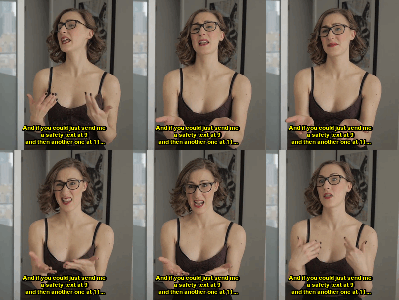
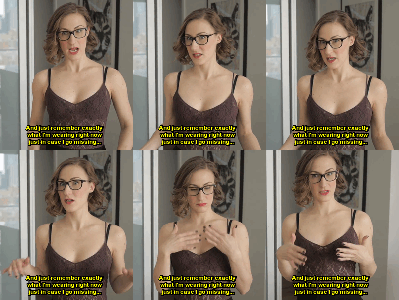
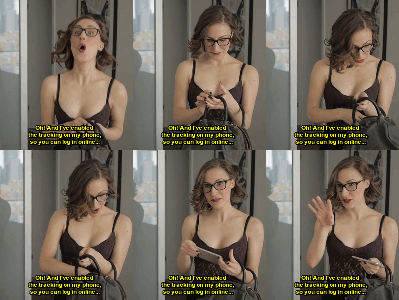
I’ve had someone take pics of me and my license plate on a first date before & I was okay with it. I’ve also had a friend allow me to view the tracking on her phone when she went to meet up with a guy the first time. This isn’t a joke at all & women have good reason to worry.
i have only ever met 2 people online, and made sure that we met up somewhere that was 1) public 2) close to my home.
After, I walked to the dollar store that was a couple shops down until I knew they were gone, before walking home.
Louis C.K. kind of nailed it. Men worry that their date won’t measure up to their aesthetic preferences. Women worry that they’re going wind up dead.
The disparity is RIDICULOUS, and the fact that dudes get offended when women try to protect themselves is hard proof that way too many guys Do Not Understand how dangerous it is to be a woman. (Not to mention it’s fucking insulting. “How dare you not trust your life and safety to a complete stranger whose intentions you have no way of knowing”?)
Lookin’ at the notes on this post following my earlier reblog and just
going….
Wow. WOW. Look at all these sheltered people and their internalized misogyny.
The point isn’t, “NOT ALL MEN ARE OUT TO GET YOU.”
The point is, “WE HAVE NO WAY OF KNOWING A NICE GUY FROM A SERIAL KILLER.”
It’s
not like they fucking wear nametags, okay? Moreover, the most awful people with the worst intentions often put on the nicest face or deliberately make themselves seem harmless and likeable, to lull potential victims into a false sense of security. (Read up on Ted Bundy sometime. It’s horrifying shit. Or read any thread on the “Let’s Not Meet” subreddit.)
In order to protect ourselves, we are forced to assume the worst of every man we meet, because statistically speaking, the biggest danger to women…IS MEN. Saying “not all men are out to get you, you’re just being paranoid” is like saying “not every car you ride in is going to crash, so buckling your seatbealt is stupid.”
When dealing with an unknown situation, in the absence of absolute proof of safety, exercising a little extra caution can be the difference between life and death. Shaming women for being what you may view as overly cautious is every bit as horrid as blaming them if something goes wrong later on.
And refusing to go to a
secluded location with a complete stranger without letting someone know
where you’re going, who you’re with, and how to find you is just common street sense, whether you’re on a date or just going out for business or social purposes.
If your life has been so sheltered (or your coping skills so incredible) that you see no need to distrust strangers or worry about the potential for violence, you should thank your lucky stars.
And you should also be aware that just because it hasn’t happened to you or anyone you know does not mean that it doesn’t happen.
Lemme say that louder for the people in the back.
Just because it hasn’t happened to you or anyone you know does not mean that it doesn’t happen.
Re-Reblog for relevant commentary.
And if you won’t take a woman’s word for it because you are some kind of asshat, men who sleep with men also mirror these rituals because even men are afraid of other men based on men’s behavior and inability to understand “no” or take rejection well.
I’ll stop reblogging this when it stops being relevant
Alllll of this. Being paranoid will often save your life. Assholes who say otherwise need to shut their noise holes and stop acting like they know better.
PSA
If I ever get in a new guy’s car I ALWAYS take a pic of him, the vehicle, the plate #, and send it to numerous ppl.
Also, it’s story time! I’m pretty certain I saved my mom’s fucking LIFE by convincing her do this on a date with a fucking COP (which she thought was safer than going out with other men, but let me tell you, cops are the WORST partner abusers around, so pls be safe!!!!).
She had only talked with him online and they were gonna go for a drive somewhere remote for some reason and she wasn’t going to take any precautions at all. I, being a well seasoned internet dater, was terrified by this prospect and warned her about how cops are actually much more dangerous than civilians and that getting in his car and going somewhere remote was even more dangerous. SO, I told her the best thing to do is to take a pic of him, his plates, then send it to me, and make sure you do it all right in front of him SO HE SEES IT. I warned her too that as a cop he should KNOW how dangerous this date would be for her, so if he kicks up a fuss about it AT ALL I told her to run like the fucking wind.
So when she gets there, he is already in his fucking truck, doesn’t get out to greet her, so she takes the pics of his car, plates, and him and sends it to me and I thank her profusely. Then apparently she gets in his car, sees there’s a fucking BAT in the back, and doesn’t this fucker just kick up a damn fuss about her doing this. AND MY MOM DOESN’T GET OUT OF THE CAR!!!!!! OMFGWLJELWNLWEJFANMDS
So he starts the car and they drive away and she can already tell he’s a fucking creeper. At one point, he even tells her a truly sad story of his life and she reacts sadly and doesn’t this dickhead say “why aren’t you smiling?” as if that’s what women are FOR. She responds “You had just told me a very sad, personal story, smiling didn’t seem appropriate”, as if she’s just there for smile back at him and look pretty!!!!
She texts me throughout all of this, telling me she’s increasingly getting uncomfortable and scared. He’s becoming increasingly hostile and unpleasant. She eventually texts me to ask me to call her and pretend to be my younger sister that lives with her saying that I’m sick (my mom’s a nurse). But my younger sis is 26, has a baby, is a personal support worker with some medical knowledge; and that didn’t seem like something strong enough to me that would make this dangerous fucker give up my mom.
So what do I do?
I called her and pretended I was my little sister crying and freaking out because her baby is super sick and she needs her nurse mom at her side bc this is WAY beyond her knowledge or comfort level. Thankfully that worked and he turned around. But he wasn’t happy and that bat was still in the back, staring mom in the goddamn face.
Later she called me and thanked me profusely and she STILL talks about it and how scary it was and how she is CERTAIN the real reason he turned around was bc I had insisted she send me those pictures.
Everyone, please be safe, definitely definitely take precautions! But also know that if something bad ever has or does happen to you, it’s NEVER your fault, even if you “didn’t take the right precautions”. That victim blaming rape culture nonsense is bullshit.
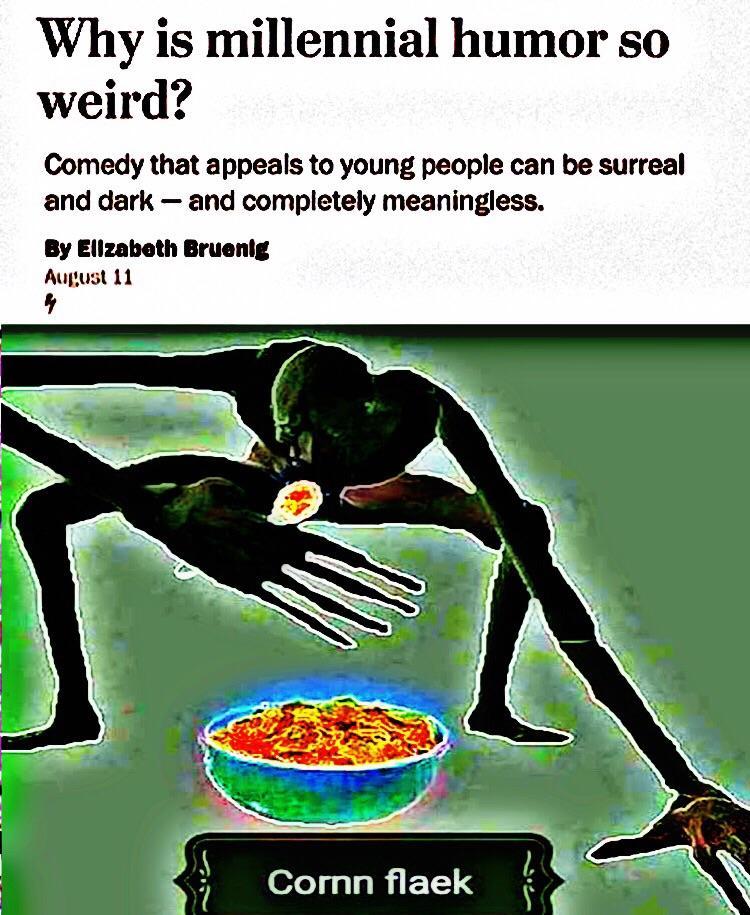
it’s because reality is terrifying and our world’s dying, and our developmental years were spent in a constant state of using increasingly nonsensical humor to cope
It’s called the rise of neo-dadaism and the same thing happened during WWII
well that’s not concerning At All
Max Ernst. The Murdering Airplane, 1920
This is what you get when you have most of an entire generation that goes off to a war of attrition and drowns in the mud of the trenches or is chewed to death by rats, among other similarly interesting ways to die. They come home, and it means nothing. Nothing means anything anymore, everything is meaningless, fuck the rules lets get drunk and make art. They had theatrical performances where the actor sat on a single chair on the stage and reacted to the audience. They made money at those shows by selling things to throw at the stage, because why the fuck not? They created art that reflected both their emptiness, and in a sideways sort of way, a sort of hope.
A century later and nothing has really changed aside from the technology of the medium. And I’m certain that most of these artists would have loved smartphones and memes.
Max Ernst painted pictures using fish (not of fish – using fish to paint) and the entire Week of Kindness was basically pre-computer photoshopping. He would have loved all this shit.
anyway here’s your reminder that lgbt muslims exist and islamophobia shouldnt be tolerated within lgbt communities!
shout out to lgbt muslims living in places where our identities are still criminalised.
btw i encourage everyone especially non muslim lgbt ppl to reblog this. if you see islamophobia within the community, you should help us instead of telling us our religion is ‘horrible’







 Steel Phoenix Studios