When you look around the world and throughout human history, the Western style of parenting is WEIRD. We are outliers. In
many instances, what we think is “necessary” or “critical” for
childhood is actually not present in any other cultures around the world
or throughout time.
Perhaps
most striking is how Western society segregates children from adults.
We have created two worlds: the kid world and the adult world. And we go
through great pains to keep them apart. […] But in many indigenous cultures,
children are immersed in the adult world early on, and they acquire
great skills from the experience. They learn to socialize, to do
household chores, cook food and master a family’s business, Lancy
writes.
Of course, just because a practice is ancient, “natural” or universal
doesn’t mean it’s necessarily better, especially given that Western kids
eventually have to live — and hopefully succeed — in a WEIRD society.
But widening the parenting lens, even just a smidgen, has a practical
purpose: It gives parents options.
One of the things I notice about having spent so much time out of the country is that a lot of the parenting discourse here just… makes no sense to me. Of course you should breastfeed whenever and wherever you damn well please? Of course whatever adult is around should take care of the kid who scraped her knee? Of course you shouldn’t expect mothers to stay home and take care of babies by themselves? Of course you should expect kids to run around in packs and play in the dirt more-or-less unsupervised? And yes, it’s more complicated in the US where you don’t usually have networks of friends and family living in close proximity, but maybe we should think about how we could make that happen more often? Or get to know some neighbors? And actually it is safer for kids here than it used to be, and safer than in a whole lot of other places, and while no, we shouldn’t be reckless or fatalistic about it, sometimes shit happens. There’s no way to 100% protect a kid from the whole world, and that shouldn’t even be the goal.
Anyway, one reason i don’t want kids is that I’ve internalized too many “poor country” parenting philosophies so while I wouldn’t let my 2-year-old play with machetes, I would totally get sent to jail for letting a 6-year-old walk to the store by herself because why on earth would that be a problem?
“However, most of us do lead an unchristian life because most Wiccans are not Christian, but then again neither was Jesus. We follow the moral axioms that were set forth by Jesus in the most fundamental way. Most Wiccans that I know follow the way of Jesus better than some Christians I know. the interpreters of the Bible and other holy documents, have confused and made complex the idea of achieving peace and joy in the world. Wiccans try to lead a life of tolerance and understanding but our ways and customs are not what a Modern Christian might call ‘Christian.’“
(p. 120,Of Witches, Janet Thompson)
What. In. The. Actual. Ass?
It’s 1993 and welcome to the Satanic Panic, where authors took one of two routes to try to calm people down:
1. We’re unrelated to Judeochristian mythos, and therefore don’t believe in “Satan” or the devil.
2. We’re actually, like, waaay more Christian than you are when you think about it? Like, we’re all about tolerance and love, while you know how those Chiiiistians aren’t? Jesus would really be a Wiccan, I just FEEL that would be true. Like, if you look at it hard enough, aren’t Christians the REAL Satanists?
Guess which path shitty writers chose.
For all their faults, I can respect the Church of Satan for doubling down during the Panic.
@traegorn calls it shitty writing. I call it the truth.
It’s shitty writing because Wiccans and Witches don’t need to justify their moral structure in the frame and context of the Judeochristian faiths.
It litetally delegitimizes Wicca while trying to defend it.
It’s shitty writing.
There is absolutely no reason to discredit a religion as a means to uplift another. Most people who pick up a book on Wicca are already jaded by the Christian culture, at least in America. So there’s no need to make comments like that- the author is already going to be interpreted as being on the reader’s side.
So saying that Wiccans make better Christians than Christians is kind of like going to an open-mic night after watching a Comedy Central stand-up special and just going on a rant about how awful married life is.
Lazy. It’s lazy.
Are there Christians who don’t follow the teachings of Jesus even if that should be like… the one thing they’re doing? Yes. Absolutely. But an informational book about Wicca is not the place for that. You got something to say about it, write another book. Now is not the time.
Wicca does not explicitly follow the teachings of Jesus. It follows the general rule of ‘don’t be a jerk.’ That should be about as far as the comparison goes.
And comments like the one the author is making here really twig me because it makes it sound like Wicca and other occult practices don’t have their own shit to fucking examine.
So instead of taking pot-shots at a religion, it would be significantly more effective to draw comparisons between the two and outline the differences. Because comparative religious studies are an important dynamic to discuss in a 101 book.
Love yall for saying what I didnt have the energy to say. It literally exhausted me to read that.
Feeling superior and that you are better at the religion not being in it than actual practitioners of a religion because you meet some random criteria* of that religion is just beyond laughable. Especially when that religion is closed (wrt the mysteries, baptism universally, but also all the other ones included especially in all forms of catholicism [notice all forms of, not just roman]).
Though thats par for the course in the occult communities, “i do it better than them ACTUAL practitioners even though I am not a practitioner!”
These reindeer games gotta stop. We are too old to be doing this.
*(charity work and respecting others btw, for those in the back that dont know the context, the author really fucked up on that with their examples of it but ok then. If you want to join the author is degrading homeless people as being a better Christian way you go right ahead with that one.)
… Judeochristian ain’t a fucking thing except to the Christians who wanted to force the two together.
For those of us who have never belonged to either, it’s a useful term to describe monotheistic faiths that derive moral authority from a god and the ten commandments. I mean, there are shared religious texts – it’s not weird to group them.
But you’re right in one respect – it was the wrong term to use. I probably should have said Abrahamic Faiths,
It was wrong to exclude Islam.
And Judaism and Islam treat Satan differently from how Christianity does. It’s not a useful term.
May I ask a question for my own knowledge?
I tried googling, but I was getting a lot of non answers or lumping Satanism with Judaism and Islam.
My question is how did Judaism and Islam deal with the Satanic Panic of the 1970s through the 1990? Given what you just said there, did it even bleep on the radar?
… Not really even sure. Depends on the person doing the preaching, but tmu Judaism has a VERY wide variety of views on Satan, but not as an opponent of G-d. The scriptures actually treat Satan as one of G-d’s aides (Job) and a prosecutor (Zechariah). Christian understandings of Satan come more from their scriptures treating him as anti-Jesus and anti-G-d. Islam’s equivalent of Satan, Iblis, isn’t considered an adversary (Islam is strictly monotheist).
The vast majority, if not all, of those trying to jump on the concept of Satanic ritual abuse (Satanic Panic) as a true and real thing are Christians.
I otherwise have a NUMBER of objections to Judeochristian being used in the first place by non-Christian gentiles, most of them connecting to “Judaism and Christianity only have scriptures in common and even that is a tenuous connection.”
Interesting! I was wondering then, at that point if it wasn’t even a thing for Judaism or Islam to be really that worried about Satanism, let alone Satanic Ritual abuse. So then the conversation should be directed in a strictly Christian route, rather than including more than that.
Also, I am not here to argue the merits of whether or not Islam, Judaism, or Christianity should be lumped together in a particular term. I know that there are some forms of Christianity that view themselves to be specifically more like Judaism than others – not just that they have scriptures which I could include examples of here but it’s a moot point because I’m not going to argue it. But I know that much of Christianity (including those examples listed above), for example, does not like to be associated with Islam (even pre-9/11) and does not agree that Islam is (my wording) “a continuation” of Christianity.
So the argument that they should not be lumped together, to me, seems valid and correct.
I would understand that a focus purely on Satan and a worship of Satan would instead be considered idolatry in all of the Abrahamic religions, but, with regards to SRA, that was first and foremost Christians doing the panicking.
Given how CLOSELY Satanic Panic mirrors antisemitic blood libel accusations (“they’re sacrificing children! They drink their blood!”) I cannot seriously imagine the Jewish community at large taking part in the same rhetoric that was often used to kill them.
Just like much of the witch hunts and burning times were actually ways to hunt and kill crypto-Jews.
I have no idea what Islam thinks about satanic ritual but Judaism is chiefly concerned with no idol worship, and probably avoiding any and all panic or hysteria about Satan mostly because that used to end up in dead Jewish people.
Actually I’d argue this is DIRECTLY linked – Satanic Panic was a new wave of old hysteria that usually was blatantly antisemitic.
“As Christian theology generally focuses on a dichotomy of heaven and hell, positioning an outsider on the side of demonic supernatural forces has always been a favored tactic.
And so we’ve seen the likes of blood libel in the 12th century and beyond, when Christians accused Jews of using blood from kidnapped Christian children in their rituals. The 1475 Simon of Trent blood libel even saw an entire Jewish community tortured and 15 men executed over the death of a 2-year-old in Trento, Italy. Anti-Semitic violence and moral panic spread across Europe in its wake.”
I’m not the only one who guessed this is the historical precedent and I’m sure I’d find even more sources linking the two if I searched further.
Also there’s the fact that the guy who built the TST temple in Salem is Jewish himself, so double the hysteria there! timesofisrael.com/in-haunted-salem-a-jewish-church-founder-preaches-the-art-of-satanic-social-change/amp/
My mother is a psychiatrist and a Christian who did a lot of community work that was interfaith, because Judaism is big on helping the community and my mom wouldn’t darken the door of a Christian church that wasn’t also. (There were not enough Muslims in her part of West Virginia during the Satanic Panic for them to have a mosque in the area, though some did work with the charity organization my mom was a part of.) So I asked her, and she told me that the big difference between the Jewish and Christian response (in semi-urban Appalachia, an area not known for measured responses) was pretty clear.
There were Jewish children who got talked into thinking they’d been victims of Satanic ritual abuse, just like there were Christian kids. Jewish kids were talked into it by Christian adults they knew, usually teachers and daycare workers, and here, the similarity stops. Christians during the Panic believed their kids and often provided suggestions that furthered the depth, details and perceived reality of the abuse. They took their kids to anyone who claimed to be able to do hypnosis, with or without a degree, and informed people in their churches about the tragedy that had befallen their family, thus keeping the hysteria growing.
Jewish people got actual psychiatrists like my mom, who specialized in working with children, to talk to their children. And eventually the kids would admit they were saying those things because adults really wanted them to, but in the meantime Jewish people didn’t freak out their congregations or make baseless speculation about Satanic cults. They were more reserved and private about the whole thing, which in turn helped their kids snap out of the delusion or admit it was a lie, because their children had no incentive to keep going and didn’t feel pressured to believe an outlandish thing.
TL;DR from what I know of the Jewish reaction to the Panic it was ‘get thee to therapy so we can figure out what’s going on’ instead of ‘I believe you and will not for a second consider that this might not be legit’.
Intuition is real. Vibes are real. Energy doesn’t lie. Tune in.
This is actually called thin slicing. Your brain recognizes patterns from very small “slices” of information by comparing them to things you have experienced before. This all happens very quickly on a subconscious level without our conscious mind being involved. So intuition is actually really fast pattern recognition, and it can be very accurate. So yeah, if you have a gut feeling that a person or situation is not good, get the hell out. Your brain knows what’s up.
When I was young – because I’ve always been a big skeptical pain in the ass – I thought that when people were talking about interpersonal “energy,” they were on some Gay Ass Shit.
Years later, after spending hundreds of hours reading studies about intuition and neuroscience and pattern recognition and the processing power of the subconscious mind, I realized that that kind of talk – “she has such good energy,” “you need to read the energy of the room,” “I just got some really bad energy off of that guy” – is a convenient shorthand for the lightning-fast, weirdly-accurate, real-as-fuck subconscious processing of the probability of positive or negative social outcomes likely to result from hundreds or thousands of variables. That “energy” isn’t a tangible thing floating around in the air. It’s your brain updating you constantly with information about your situation. Listen to it. Especially if it’s telling you to be nervous or scared. Your brain is very good at recognizing danger. Let the enormous processing power of your subconscious mind protect you. It’s better at spotting patterns than you are.
“Bad energy” isn’t some hippie shit. It’s your brain setting off a claxon because it knows something’s not right.
Thin slicing is wonderfully helpful, but be aware that if it’s doing its pattern recognition from bad sources, you need to actively override it. We’re raised in a racist society, inundated with racist media, and bombarded with subtly (or unsubtly) racist advice. Thin slicing can save your life, but it’s also the cause behind the unconscious elements of racism (and misogyny/ableism/antisemitism/islamophobia/etc.) that we all suffer from
Trust your instincts, but if your instincts tell you something that seems prejudicial, double check their work.
What if birthmarks are the places that actually killed us in our past life? Like there’s this girl from school whose birthmark is a line on her neck. What if her throat was cut? I know this guy who has his birthmark on his whole left cheek. What if he was shot? My little sisters birthmark is a line straight down her stomach. What if she died on the operating table?
Funny enough, there’s a long history of worker’s struggle in the Appalachians and South.
Redneck Revolt is a good group organizing in these areas around this identity and history.
Yeah regions where mining, agriculture, and similar industries are dominant tend to have a history of socialist organizing and labor agitation, funny how that works
i love how many people are commenting on this basically saying it’s an oxymoron for rednecks to be communists like… in what universe is it an oxymoron for… actual poor and working-class people… to be invested in an ideology & movement that centers around working-class/labor struggle… lmao ????
literally the only reason why there has been a shift in later years is cus of fear mongering to the point where capitalist criticism has become a taboo even for lower class poor people. like many the southern states are some of the poorest states in usa??
“Let’s show these fascists what a couple of hillbillies can do!”
-Woody Guthrie
coming from a non-informed point of view i feel like once again this is Reagan’s fault because he targeted workers unions a good deal…
People are saying its a oxymoron because “redneck” is usually synonymous with “racist/stupid af” in america. And “racist/stupid af” in america tends to steer very far right.
But there is a actually a whole population of “redneck” that isnt racist at all. They’re actually pretty well educated, theyre just poor and do poor people stuff. They’re the ones who end up introducing black people to white people shit. Like moonshine, mudding and camping. Theyre a trip to hang around.
Theres actually a lot of overlap in the “redneck” and the “hood” culture (large tight knit families, general disdain for authorities, love of bbq…etc), but the rich white people in power dont want people to know that because if the all the poor people reguardless of color realize they have shared interests band together and raise hell. Its over for the 1%. So they try their hardest to emphasize and exaggerate the cultural differences, in hopes of convincing the low income disenfranchized whites to vote right.
I LOVE capitalist critical Appalachian culture. One of the first things i learned that fueled my interest was the origin of the word ‘redneck.’
Coal mining was HUGE from the mid 1700s to the early 1900s in states like Virginia and Pennsylvania as coal was a primary source of fuel for a lotta shit. Unsurprisingly, mine owners were capitalist pigs and exploited the hell outta coal miners. Like, paying them by the pound of coal they brought in rather than by hours worked, paying them in vouchers that could only be used at the store owned by the mining company, and offering no kind of health assistance when workers would inevitably succumb to illness and injury caused by the work they did. So miners began to unionize in the mid 1840s. To show solidarity and to make their employers take notice, unionists would wear red bandanas around their necks. And thus, the term ‘redneck’ was coined to describe the union supporters who eventually dismantled a lot of the exploitive practices used by the coal industry.
Love these! Just discovered the hillbilly leftie podcast the Trillbilly Worker’s Party, and I am so excited to see more leftist organizing in these parts. We have an amazing history of labor struggle, and a fair amount of labor wins, in this region.
There is a specific and terrifying difference between “never were” monsters and “are not anymore” monsters
“The thing that was not a deer” implies a creature which mimics a deer but imperfectly and the details which are wrong are what makes it terrifying
“The thing that was not a deer anymore” on the other hand implies a thing that USED to be a deer before it was somehow mutated, possessed, parasitically controlled or reanimated improperly and what makes THAT terrifying is the details that are still right and recognizable poking out of all the wrong and horrible malformations.
hey I totally fucked up and forgot the 3rd type, which is “Is Not Anymore And Maybe Never Was” monsters
“The thing which was no longer a deer and maybe never was” implies a creature that, at first glance, completely appears to be a deer, but over time degrades very slowly until you realize (probably too late) that it is not a deer anymore, and had you seen it in this state first, you wouldn’t have recognized it as a deer at all, and there’s a decent chance that it was never actually a deer to begin with but only a very good mimic, and what makes this one scary is the slow change from everything being right to everything being wrong, happening slowly enough that you don’t even notice it until its too late, as well as the fact that something now so clearly not a deer could have fooled you to begin with.
And the fourth type, which is, “I dunno, but it sure ain’t a deer.” Which implies complete confusion about what the creature could be, to the point that even a person as comfortable in this world as someone who would use the word ain’t unironically is uncertain, which should horrify you to the deepest depths of your soul.
one that i particularly enjoyed was the ‘nonesuch’, a beast which when you see it your brain convinces you ‘nope, no way that shit is real’. on some level it becomes less real after having been seen by someone who disbelieves its existence as well
May I propose the additional type of “that’s definitely a deer but deer are much more fucked up than previous realized”, because turning the corner on a trail and having half a dozen deer suddenly turn and look up from eating Thier companion’s remains is a special kind of spooky.
Yeah, that is a good question – why do some scifi twist endings fail?
As a teenager obsessed with Rod Serling and the Twilight Zone, I bought every single one of Rod Serling’s guides to writing. I wanted to know what he knew.
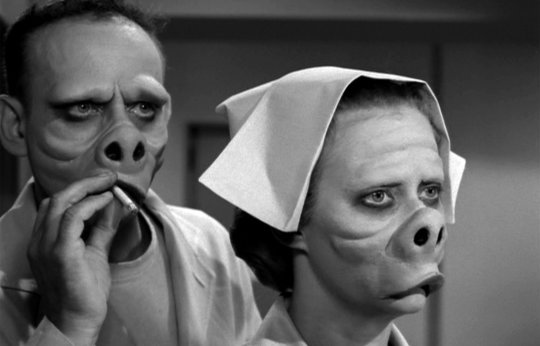
The reason that Rod Serling’s twist endings work is because they “answer the question” that the story raised in the first place. They are connected to the very clear reason to even tell the story at all. Rod’s story structures were all about starting off with a question, the way he did in his script for Planet of the Apes (yes, Rod Serling wrote the script for Planet of the Apes, which makes sense, since it feels like a Twilight Zone episode): “is mankind inherently violent and self-destructive?” The plot of Planet of the Apes argues the point back and forth, and finally, we get an answer to the question: the Planet of the Apes was earth, after we destroyed ourselves. The reason the ending has “oomph” is because it answers the question that the story asked.
According to Rod Serling, every story has three parts: proposal, argument, and conclusion. Proposal is where you express the idea the story will go over, like, “are humans violent and self destructive?” Argument is where the characters go back and forth on this, and conclusion is where you answer the question the story raised in a definitive and clear fashion.
The reason that a lot of twist endings like those of M. Night Shyamalan’s and a lot of the 1950s horror comics fail is that they’re just a thing that happens instead of being connected to the theme of the story.
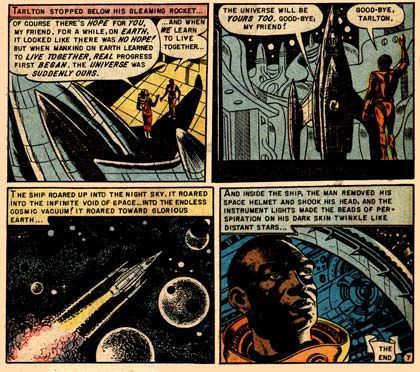
One of the most effective and memorable “final panels” in old scifi comics is EC Comics’ “Judgment Day,” where an astronaut from an enlightened earth visits a backward planet divided between orange and blue robots, where one group has more rights than the other. The point of the story is “is prejudice permanent, and will things ever get better?” And in the final panel, the astronaut from earth takes his helmet off and reveals he is a black man, answering the question the story raised.












 Steel Phoenix Studios