
the fact that the Russian language doesn’t have articles makes me go ??????????????? because in a native English speaker’s head it sounds like a hilarious shitpost type thing
so when you ask someone “Где водка?” it translates to “where is the vodka?”
but in my horrible backwards english brain if I don’t see any articles I assume they aren’t there, so yelling “ГДЕ ВОДКА” translates to “WHERE VODKA” like some kind of drunken maniac who you definitely should not give vodka to
Speaking as a Russian-American who speaks the language and knows a fair share of Russian-Russians, even if Russians did have articles they would still slam open the door yelling “WHERE VODKA” at all times.
I see nothing inaccurate here.
Fun fact from learning Church Slavic Russian (? Церковнославянский, если чо) and Old Russian back in 2013:
Russian language DID have auxilary verbs back in the day. The key difference is every language’s tendency to shortcut as much as possible, rendering auxilary verbs into useless within a couple of centuries.
Аз есмъ Анна – Я Анна
I am Anne – I Anne
Basically Russian people did the “new phone who dis” instead of “New phone, who is this?” thing and made it gramatically correct just to save those 0.0036 secs it takes to pronounce articles.
so yeah
WHERE VODKA
Tag: language
How to pronounce Celtic words and names
Step 1: Read the word.
Step 2: Wrong.A REAL LIST OF ACTUAL NAMES AND THEIR (approximate) PRONUNCIATIONS:
Siobhan — “sheh-VAWN”
Aoife – “EE-fa”
Aislin – “ASH-linn”Bláithín – “BLAW-heen”
Caoimhe – “KEE-va”
Eoghan – Owen (sometimes with a slight “y” at the beginning)
Gráinne – “GRAW-nya”
Iarfhlaith – “EER-lah”
Méabh – “MAYV”
Naomh or Niamh – “NEEV”
Oisín – OSH-een or USH-een
Órfhlaith – OR-la
Odhrán – O-rawn
Sinéad – shi-NAYD
Tadhg – TIEG (like you’re saying “tie” or “Thai” with a G and the end)I work with an Aoife and I have been pronouncing it SO WRONG
As someone who is trying and failing to learn Gaelic, I feel like is an accurate portrayal of my pain.
This is the Anglicized spelling of a people who really fucking hate the English.
No, no, this is the orthographic equivalent of installing Windows on Mac.
The Latin alphabet was barely adequate for Latin by the time it got to the British Isles, but it’s what people were writing with, so somebody tried to hack it to make it work for Irish. Except, major problem: Irish has two sets of consonants, “broad” and “slender” (labialized and palatalized) and there’s a non-trivial difference between the two of them. But there weren’t enough letters in the Latin alphabet to assign separate characters to the broad and slender version of similar sounds.
Instead, someone though, let’s just use the surrounding vowels to disambiguate–but there weren’t enough vowel characters to indicate all the vowel sounds they needed to write, so that required some doubling up, and then adding in some silent vowels just to serve as markers of broad vs. slender made eveything worse.
They also had to double up some consonants, because, for example, <v> wasn’t actually a letter at the time–just a variation on <u>–so for the /v/ sound they <bh>. AND THEN ALSO Irish has this weird-ass system where the initial consonant sound in a word changes as a grammatical marker, called “mutation,” so they had to account somehow for mutated sounds vs. non-mutated sounds, which sometimes meant leaving a lot of other silent letters in a word to remind you what word you were looking at.
And then a thousand years of sound change rubbed its dirty little hands all over a system that was kind of pasted together in the first place.
My point is, there is a METHOD to the orthography of Irish besides “fuck the English.” The “fuck the English” part is just a delightful side-effect.
(As if Anglophones had much room to talk; time has also had her grubby way with our orthography, and we don’t have the excuse of an overly complex phonological system.)
When English isn’t your first language, reading fanfics in your first language (if there are even any) becomes so much more embarrassing???? And sometimes I wonder why native English speakers don’t get that feeling when they are reading in their native language???
scrolling through the comments on this people with at least three separate native languages have chimed in to agree that English is the porn language. This… is amazing. I never knew.
oh oui. tu m’étonnes.
a common inscription that we find on roman tombstones is “non fui; fui; non sum; non curo” (often abbreviated N F F N S N C) and that means something along the lines of “i wasn’t; then i was; now i’m not- and i don’t give a shit” and i just really sympathize with that
a song called ‘disco inferno’ just came up on my dash and i automatically registered it as “i learn by means of hell” before i realised the title was actually english and not latin
“I learn by means of hell,” forthcoming rap album from Doctor Faustus
When we figured out that’s what Disco Inferno meant (we translated it as “I learn through suffering”), it became the motto of our Latin class at college, and the unofficial motto of my undergrad.
one of my friends went up to my portuguese dad and asked “you’re portuguese right?” and he said “no im portugoose there is only one of me” and I started crying
Part of the New Internet Grammar: using question marks not to denote questions, but upturns in voice, so that a tentative statement gets a question mark but a flatly delivered question doesn’t.
why would you do this
It just seems right?
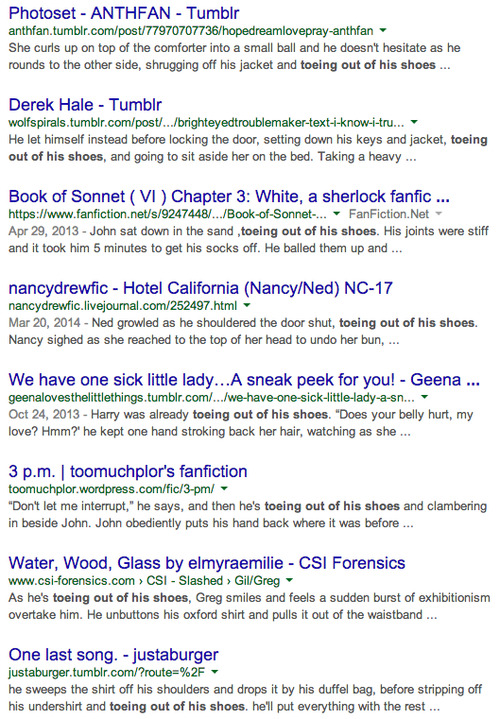
so i just googled the phrase “toeing out of his shoes” to make sure it was an actual thing
it’s all fanfiction
which reminds me that i’ve only ever seen the phrase “carding fingers through his hair” and people describing things like “he’s tall, all lean muscle and long fingers,” like that formula of “they’re ____, all ___ and ____” or whatever in fic
idk i just find it interesting that there are certain phrases that just sort of evolve in fandom and become prevalent in fic bc everyone reads each other’s works and then writes their own and certain phrases stick
i wish i knew more about linguistics so i could actually talk about it in an intelligent manner, but yeah i thought that was kinda cool
Ha! Love it!
One of my fave authors from ages ago used the phrase “a little helplessly” (like “he reached his arms out, a little helplessly”) in EVERY fic she wrote. She never pointed it out—there just came a point where I noticed it like an Easter egg. So I literally *just* wrote it into my in-progress fic this weekend as an homage only I would notice. ❤
To me it’s still the quintessential “two dudes doing each other” phrase.
I think different fic communities develop different phrases too! You can (usually) date a mid 00s lj fic (or someone who came of age in that style) by the way questions are posed and answered in the narration, e.g. “And Patrick? Is not okay with this.” and by the way sex scenes are peppered with “and, yeah.” I remember one Frerard fic that did this so much that it became grating, but overall I loved the lj style because it sounded so much like how real people talk.
Another classic phrase: wondering how far down the _ goes. I’ve seen it mostly with freckles, but also with scars, tattoos, and on one memorable occasion, body glitter at a club. Often paired with the realization during sexy times that “yeah, the __ went all they way down.” I’ve seen this SO much in fic and never anywhere else
whoa, i remember reading lj fics with all of those phrases! i also remember a similar thing in teen wolf fics in particular – they often say “and derek was covered in dirt, which. fantastic.” like using “which” as a sentence-ender or at least like sprinkling it throughout the story in ways published books just don’t.
LINGUISTICS!!!! COMMUNITIES CREATING PHRASES AND SLANG AND SHAPING LANGUAGE IN NEW WAYS!!!!!!!
I love this. Though I don’t think of myself as fantastic writer, by any means, I know the way I write was shaped more by fanfiction and than actual novels.
I think so much of it has to do with how fanfiction is written in a way that feels real. conversations carry in a way that doesn’t feel forced and is like actual interactions. Thoughts stop in the middle of sentences.
The coherency isn’t lost, it just marries itself to the reader in a different way. A way that shapes that reader/writer and I find that so beautiful.
FASCINATING
and it poses an intellectual question of whether the value we assign to fanfic conversational prose would translate at all to someone who reads predominantly contemporary literature. as writers who grew up on the internet find their way into publishing houses, what does this mean for the future of contemporary literature? how much bleed over will there be?
we’ve already seen this phenomenon begin with hot garbage like 50 shades, and the mainstream public took to its shitty overuse of conversational prose like it was a refreshing drink of water. what will this mean for more wide-reaching fiction?
QUESTIONS!
I’m sure someone could start researching this even now, with writers like Rainbow Rowell and Naomi Novik who have roots in fandom. (If anyone does this project please tell me!) It would be interesting to compare, say, a corpus of a writer’s fanfic with their published fiction (and maybe with a body of their nonfiction, such as their tweets or emails), using the types of author-identification techniques that were used to determine that J.K. Rowling was Robert Galbraith.
One thing that we do know is that written English has gotten less formal over the past few centuries, and in particular that the word “the” has gotten much less frequent over time.
In an earlier discussion, Is French fanfic more like written or spoken French?, people mentioned that French fanfic is a bit more literary than one might expect (it generally uses the written-only tense called the passé simple, rather than the spoken-only tense called the passé composé). So it’s not clear to what extent the same would hold for English fic as well – is it just a couple phrases, like “toeing out of his shoes”? Are the google results influenced by the fact that most published books aren’t available in full text online? Or is there broader stuff going on? Sounds like a good thesis project for someone!
See also: the gay fanfiction pronoun problem, ship names, and the rest of my fanguistics tag.
the fact that the Russian language doesn’t have articles makes me go ??????????????? because in a native English speaker’s head it sounds like a hilarious shitpost type thing
so when you ask someone “Где водка?” it translates to “where is the vodka?”
but in my horrible backwards english brain if I don’t see any articles I assume they aren’t there, so yelling “ГДЕ ВОДКА” translates to “WHERE VODKA” like some kind of drunken maniac who you definitely should not give vodka to
Speaking as a Russian-American who speaks the language and knows a fair share of Russian-Russians, even if Russians did have articles they would still slam open the door yelling “WHERE VODKA” at all times.
I see nothing inaccurate here.
Nicaraguan Sign Language is a sign language largely spontaneously developed by deaf children in Nicaragua in the 1970s and 1980s. It is of particular interest to the linguists who study it, because it offers a unique opportunity to study what they believe to be the birth of a new language.
Click HERE for more facts
It’s not ‘what they believe to be a new language’, it is a new language. As in that’s not under dispute and it’s not rare for new languages to come into being. It’s not amazing as an exception but as proof of a rule: that humans invent language anew even when isolated from linguistic input, in only two short generational hops (pidgin and creole stages). What’s amazing is how easily and determinedly humans do it. Our brains are hard-wired for language. The NSL case allowed linguists to see this happen in almost lab-like conditions and thus prove the theory of language acquisition because of the children’s isolation from linguistic input, due to their deafness.
So the case of NSL is amazing (and it is pretty heartwarming in its particulars it has to be said) but not because it is exceptional, but because of what it shows us about our universal experience. We all did this. Every child acquiring their first language invents it anew. It’s an extraordinary process, and the thing that makes humans human.
 Steel Phoenix Studios