One of my absolute favourite concepts Vedic Sanskrit has introduced me to is the comparison by negation – basically, instead of being introduced by a comparative preposition such as like or as, the compared noun (phrase) is simply negated.
For example, “She, like a wolf, hunted them all down,” is instead “She, not a wolf, hunted them all down” (but in the former meaning).
An example from Rigveda: the Hymn to the Goddess of Night (RV X.127 Rā́trī), verse 4, lines 2 and 3:
नि ते यामन्नविक्ष्महि । वृक्षे न वसतिँ वयः ॥
ní te yā́mann_ávikṣmahi down into [our] homes we retired, vr̥kṣé ná vasatím̐ váyaḥnot birds to [their] nests on trees
(→supply like for not for an accurate translation)
The principle being that the comparison is invoked by the mere presence of the noun (phrase) the original thing is compared to, while the negation reinforces the mere comparison as opposed to it being actually real, thus “She, not [literally, but figuratively] a wolf, hunted them all down.”
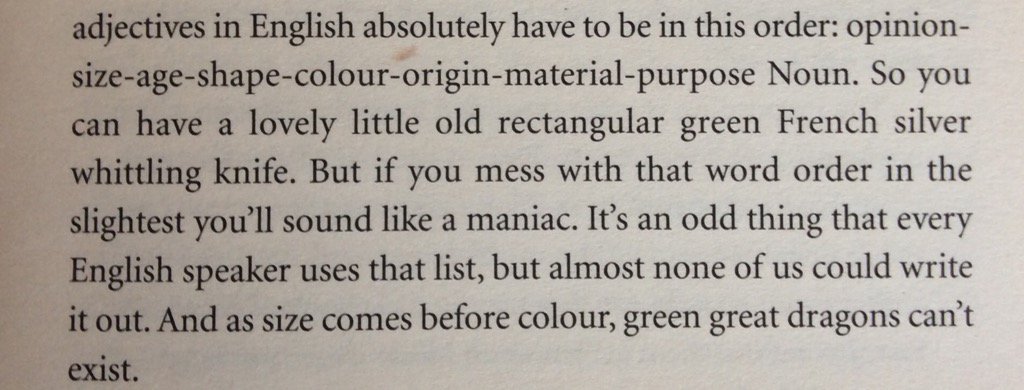
things english speakers know, but don’t know we know.
WOAH WHAT?
That is profound. I noticed this by accident when asked about adjectives by a Japanese student. She translated something from Japanese like “Brown big cat” and I corrected her. When she asked me why, I bluescreened.
What the fuck, English isn’t even my first language and yet I picked up on that. How the fuck. What the fuck.
Reasoning: It Just Sounds Right
Oooh, don’t like that. Nope, I do not even like that a little bit. That’s parting the veil and looking at some forbidden fucking knowledge there.
Probably something to do with one of English’s many root languages.
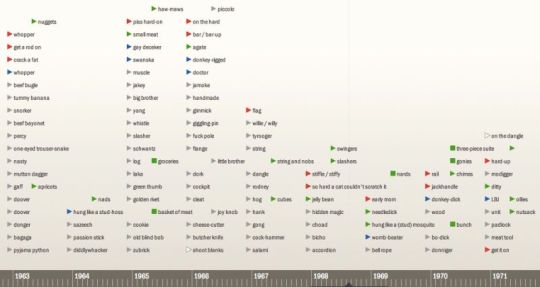
Ok so I was looking for historical slang terms for penis (gotta be era-accurate when writing vintage dick jokes) and I came across….something
some linguist compiled a literal timeline of genitalia slang–a cock compendium, if you will–that dates back all the way to the fucking 13th CENTURY. This motherfucker tracked the evolution of erection etymology through 800+ years, because if he doesn’t do it, who else will? Thank you for your service, Johnathon Green.
Some of my favorites include:
Shaft of Delight (1700s)
Womb Sweeper (1980s)
Master John Goodfellow (1890s)
Nimble-Wimble (1650s)
Corporal Love (1930s)
Staff of Life (1880s)
Spindle (1530s)
As good as ever twanged (1670s)
Gaying Instrument (1810s)
Beef Torpedo (1980s)
and last but not least, the first recorded use of the word Schlong, which was in 1865 CE. Tag yourself, I’m Nimble Wimble
And are the lovely ladies feeling left out? not to worry! Johnathon’s got you covered, gals, because he also made one for vaginas. Highlights:
Mrs. Fubb’s Parlor (1820s)
Poontang (1950s)
Spunk Box (1720s)
Ringerangroo (1930s)
Ineffable (1890s)
Itching Jenny (1890s)
Carnal Mantrap (1890s – a busy decade apparently)
Bookbinder’s Wife (1760s)
Rough Malkin (1530s)
Socket (1460s)
and a personal favorite, crinkum-crankum, circa approximately 1670.
So I used to have a Russian friend who had a pretty thick accent and like a lot of Russians tended to eschew articles. She would say things like “Get in car.” And stuff.
Well one day this asshole who had been kind of tagging along with us asks her why she talks like that because it makes her sound dumb and I still remember her response word for word.
“Me? Dumb? Maybe in America you have to say get in THE car because you are so stupid that people might just get in random car, but in Russia we don’t need to say that. We just fucking know because we are not stupid.”
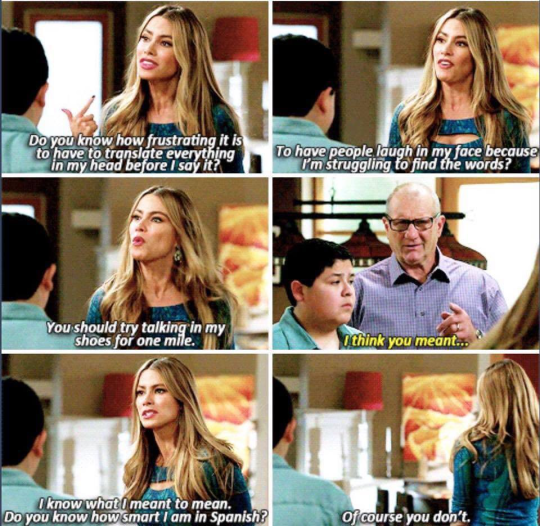
One time I was proof reading a paper for a Russian student. As I was correcting her paper with her, the many mistakes in her grammar started weighing on her. I asked her what was wrong, and she said, almost sobbing,
“In Russian I am so intelligent and clear. In English I am like [an] idiot”
Respect to anyone trying to master a foreign language. I get so sad thinking about that student.
Full offense but people who make fun of someone else’s accent or belittle their limited vocabulary when they’re speaking a language not native to them are fucking disgusting and are just begging to be punched.
They’re speaking your language because you don’t know theirs. That’s not something they should be made fun of, it’s something that should be commended because learning a language is hard fucking work.
An assignment I actually wrote on the board this week:
In groups, write 2 sentences (in Latin) using only the
vocabulary in your textbook. Make sure to include:
1 irregular verb
1 imperfect verb
5 cases
BEES?
I’ll elaborate in a minute, but I need to stop laughing
first.
So I’d originally planned on a 20-minute grammar lesson,
followed by a handout to be finished in pairs, but I’d made the mistake of telling
this class about Latin Day in April and how we were encouraging them to come to
school in costume. All they wanted to do was talk about costume opportunities
(and since I would like to keep my job, I had to explain why staging Caesar’s assassination
in the middle of the lunchroom would be a Bad Idea), so I shifted gears and decided
to channel that creative/social energy into a different assignment.
After lugging them through a condensed version of the
grammar lesson on irregular verbs in the imperfect tense, I split them into
groups and pulled an assignment out of the air.
The requirements:
Write two sentences in Latin
Use ONLY vocabulary from the textbook
Include at least ONE irregular verb
Include at least ONE verb in the imperfect tense
Include 5 (out of 6, including the vocative)
cases
The goal:
To write them on the board for their ‘rival’
groups to translate
They are a competitive bunch, so I knew this would be enough
to encourage them to go All Out. But then one student raised her hand.
“Can our sentences be about bees?” she asked.
Bees. I swear this class has a thing with Bees. I hesitated.
“There are no bees in your textbook.”
“Yes, but you taught us that word.”
I had, back when this same student had asked me how to say “the
bees are suffering” for a kahoot she was writing. Granted, this same student is
planning on coming in on Latin Day dressed as Caligula’s horse, so none of this
surprises me.
I opened it up to the other ‘groups’. “What do you think?” I
asked. “Should we let them write about bees?”
“No,” said one student with a heavy sort of solemnity, looking
me dead in the eye. “We should all be required
to write about bees.”
As the rest of the class eagerly cheered and nodded in
agreement, three things occurred to me.
The word for bee, “apis”, is a 3rd-declension
i-stem noun, which they could use more practice on.
They’re going to want to describe the bees,
which means they will likely also be practicing noun-adjective agreement with a
3rd-declension i-stem noun, which they could also use more practice
on.
This could be flipping hilarious.
And so I added “BEES?” to the list.
The results:
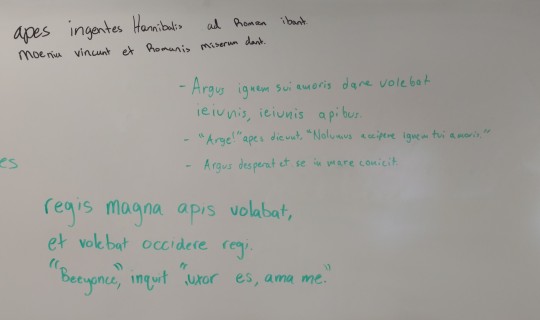
1. apes ingentes Hannibalis ad Romam ibant. Moenia vincunt et Romanis miserum dant.
“The giant bees of Hannibal
were going to Rome. They conquer the walls and give misery to the Romans.” In hindsight the noun miseriam would have been better, but still solid. Mentions bees AND misery. Implies an AU where Hannibal brought giant bees
across the Alps instead of elephants. Carthage wins the Punic Wars. 10/10
2. Argus ignem sui amoris dare volebat ieiunis, ieiunis apibus. “Arge!” apes dicunt. “Nolumus accipere ignem tui amoris.” Argus desperat et se in mare conicit.
“Argus was wishing to give
the fire of his love to the hungry, hungry bees. ‘Argus!’ the bees say. ‘We do
not want to accept the fire of your love.’ Argus despairs and hurls himself
into the sea.” Descriptive. Tragic. Mentions fire. Has something for
everyone. Also 10/10
3. regis magna apis volabat, et volebat occidere regi. “Beeyonce,” inquit, “uxor es. Ama me.”
“The great bee of the king
was flying, and he was wishing to kill for the king. ‘Beeyonce,’ he said. ‘You
are my wife. Love me.’ ” 100/10 for Beeyonce.
“So Bob said […]” indicates that I am directly quoting Bob.
“Then Bob was like […]” indicates that I am paraphrasing Bob.
“And Bob was all […]” indicates that I am paraphrasing Bob, and additionally I am being a dick about it.
I don’t know about you, but I think it’s fantastic that we have a specific grammatical convention for that.
What I find most frustrating is when people don’t understand this! I don’t know if it’s a generation thing, but sometimes I’ll be talking and say “So I was like “are you fucking kidding me” and the person will look at me all horrified and say “you didn’t actually say that, did you?”
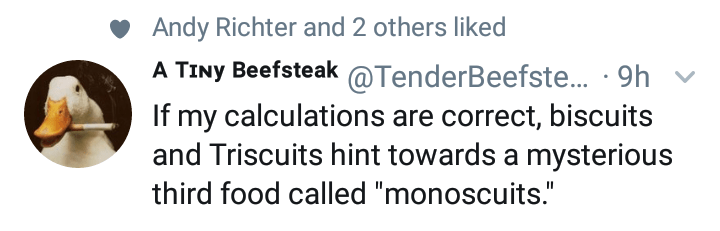
an edible cracker with just one side. mathematically impossible and yet here I am monching on it.
‘scuit’ comes from the french word for ‘bake’, ‘cuire’ as bastardized by adoption by the brittish and a few hundred years
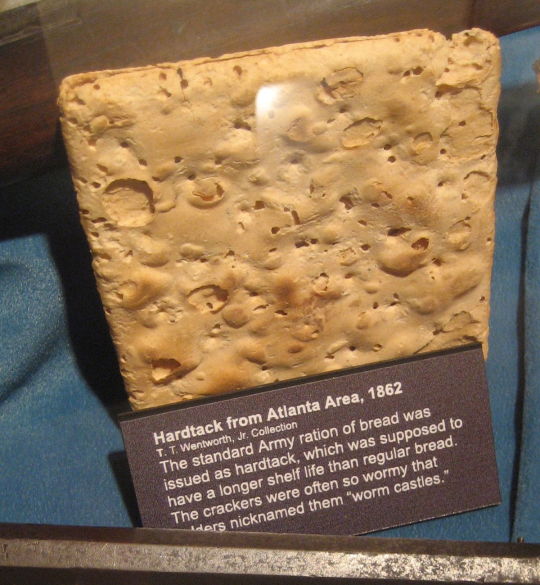
‘biscuit’ meant ‘twice-baked’, originally meaning items like hardtack which were double baked to dry them as a preservative measure long before things like sugar and butter were introduced. if you see a historical doccument use the word ‘biscuit’ do not be fooled to think ‘being a pirate mustve been pretty cool, they ate nothing but cookies’ – they were made of misery to last long enough to be used in museum displays or as paving stones
‘triscuit’ is toasted after the normal biscuit process, thrice baked
thus the monoscuit is a cookie thats soft and chewy because it was only baked once, not twice
behold the monoscuit/scuit
Why is this called a biscuit:
when brittish colonists settled in the americas they no longer had to preserve biscuits for storage or sea voyages so instead baked them once and left them soft, often with buttermilk or whey to convert cheap staples/byproducts into filling items to bulk out the meal to make a small amount of greasy meat feed a whole family. considering hardtack biscuits were typically eaten by dipping them in grease or gravy untill they became soft enough to eat without breaking a tooth this was a pretty short leap of ‘just dont make them rock hard if im not baking for the army’ but didnt drop the name because its been used for centuries and people forgot its french for ‘twice baked’ back in the tudor era, biscuit was just a lump of cooked dough that wasnt leavened bread as far as they cared
thus the buttermilk biscuit and the hardtack biscuit existed at the same time. ‘cookies’ then came to america via german and dutch immigrants as tiny cakes made with butter, sugar/molasses, and eggs before ‘tea biscuits’ as england knew them due to the new availability of cheap sugar- which is why ‘biscuit’ and ‘cookie’ are separate items in america but the same item in the UK
the evolution of the biscuit has forks on its family tree
I love it when a shitpost turns into an actually interesting post.




 Steel Phoenix Studios