So if my students finish a quiz/test early, I ask them to draw me stuff on the back (partly so those who need more time are less self-conscious about still having the test out, partly because fuck yeah, pictures), and it may be the single best decision of my career.
In the past couple of weeks, I’ve told these kids that (a) the Romans believed there were demons in their public toilets and (b) the word for “janitor” comes from “ianitor”, which means “(door) guard”.
So now I’m getting drawings of superhero janitors taking on toilet demons, and it’s so beautiful.
Aaaaand today a student showed me a video of himself lighting a fire in his toilet while chanting the conjugation of the word “to be”.
He said he wanted to recreate the ancient toilet demons, and I have concerns.
K… but why conjugations of to be?
My students kept forgetting how to conjugate esse, so I turned it into a rhythmic chant that I had them say over and over. The problem is that when you chant ANYTHING in Latin it sounds like you’re summoning a demon, which they decided was awesome, so uh. Now I’ll just be randomly walking through the hallway and hear voices chanting, “sum es est! sumus estis sunt!”
I’m 99% sure my colleagues think I’ve started a cult.
Keep doing what you’re doing. I’m sure everyone will turn out all the better for it.
Roses are red, that much is true, but violets are purple, not fucking blue.
I have been waiting for this post all my life.
They are indeed purple, But one thing you’ve missed: The concept of “purple” Didn’t always exist.
Some cultures lack names For a color, you see. Hence good old Homer And his “wine-dark sea.”
A usage so quaint, A phrasing so old, For verses of romance Is sheer fucking gold.
So roses are red. Violets once were called blue. I’m hugely pedantic But what else is new?
My friend you’re not wrong
About Homer’s wine-ey sea!
Colours are a matter
Of cultural contingency;
Words are in flux
And meanings they drift
But the word purple
You’ve given short shrift.
The concept of purple,
My friends, is old
And refers to a pigment
once precious as gold.
By crushing up molluscs
From the wine-dark sea
You make a dye:
Imperial decree
Meant that in Rome,
to wear purpura
was a privilege reserved
For only the emperor!
The word ‘purple’,
for clothes so fancy,
Entered English
By the ninth century
.
Why then are voilets
Not purple in song?
The dye from this mollusc,
known for so long
Is almost magenta;
More red than blue.
The concept of purple
is old, and yet new.
The dye is red,
So this might be true:
Roses are purple
And violets are blue
.
While this song makes me merry, Tyrian purple dyes many a hue From magenta to berry And a true purple too.
But fun as it is to watch this poetic race The answer is staring you right in the face: Roses are red and violets are blue Because nothing fucking rhymes with purple.
Hirple – To limp or walk awkwardly
Cirple – An old Scots word for the hindquarters of a horse
how did they learn to translate languages into other languages how did they know which words meant what HOW DID TH
English Person: *Points at an apple* Apple
French Person: Non c’est une fucking pomme
*800 years of war*
Fun fact: There are a lot of rivers in the UK named “avon” because the Romans arrived and asked the Celts what the rivers were called. The Celts answered “avon.”
“Avon” is just the Celtic word for river.
Fan Fact #2: When Spanish conquistadors landed in the Yucatán peninsula, they asked the natives what their land was called and they responded “Yucatán”. In 2015, it was discovered that in those mesoamerican languages, “Yucatán” meant “I don’t understand what you are saying”
W H E E Z E
I love entomology so much because so many words kind of happened by accident or by a native speaker trying to say “WTF are you saying?“
I said ‘aluminum’ today rather than ‘aluminium’, and I felt so ashamed.
This is some NEXT LEVEL nerd-ing and I nearly cried reading it.
I don’t get it
Please explain ;_;
There is a star trek TNG episode where Picard encounters a race that doesn’t speak in actual structured sentences but conveys ideas through story parralels. The ones referenced here are “Darmok and Jalad at Tanagra” – cooperation, “Shaka, when the walls fell” – failure and Temba, his arms wide/open" – signifying a gift.
OK, but here’s what’s awesome/hilarious about this.
The whole point about why communicating with the Tamarians was so frustrating was because all of their communication was contextual. The problem wasn’t that Picard couldn’t understand what words they were saying (the universal translator worked fine) the problem was that he didn’t understand what THOSE WORDS TOGETHER HAD TO DO WITH ANYTHING.
Why is this hilarious/fascinating to me? Because this is essentially what people are doing today with memes. They are posting pictures and writing sentences THAT MAKE NO SENSE WITHOUT PRIOR CONTEXT.
If Picard beamed down right now, and you told him that Data is a cinnamon roll… you are a Tamarian.
Reblogging because A) YES! and B) That commentary. It’s so true, it’s scary.
I also just want more. ^_^
Actually, this isn’t something just present in memes but it seems to be a foundation of human language and partly why a universal translator could never work (or if it somehow did, it should be programmable to handle Tamarian). It’s just that most metaphors in language are so accepted or necessary to fluency that we don’t really notice them (or they seem to be a common human perspective… which aliens don’t necessarily have to share).
It is why when speaking German I have to remember it is, “How much Clock is it?” and not “What time is it?”. The metaphor in English seems to be that moments are separate entities/temporal locations that we visit through the day so we need to determine what one we are visiting now. Whereas in German, leaving aside the fact the “clock” can clearly be a stand-in metaphor for “time” the overall metaphor there seems to be that moments in time are accumulative entities that we collect through the day and we need to determine how much we’ve collected.
And speaking of time, human languages tend towards two metaphors, either favouring one or the other or happily indulging in both… either time is a stationary path which the focus moves along (”… as we’re traveling into the month February…”) or time is a river the flows past a stationary focus (”his birthday is rapidly approaching”). Technically those are metaphors to handle an abstract concept, time could just as easily be metaphorically an object that “appears” rather than “approaches” or a location you “turn towards” instead of “move into”… and I don’t know if any human language allows you to metaphorically be a man in a boat traveling up a river (or what that would look like/imply) but it is a possibility (especially if you are considering an alien perspective on time).
Leaving behind time, some emotions are metaphorically a direction. Happy is up, sometimes way up ‘til you’re “on Cloud 9″ (and there’s no obvious reason for it to be the 9th cloud but you accept it) and on the opposite end of that spectrum sadness is down (in the dumps) when it isn’t busy being a colour (blue). And naturally you yourself are a container for your emotions, or more specifically your heart is (at least in English, in Indonesian it’s your liver) and the container can be put under pressure until it is “bursting with joy” or it “explodes in anger”.
And then there are true idioms which actually do reference historic events (which is what I assume is happening in Tamarian’s “Shaka, when the walls fell”) like “Read The Riot Act” or if you “heard it through the grapevine” your people had a mess of telegraph wires at some point and grapevines to compare them to. And “apple of one’s eye” is weird for being a double metaphor… the pupil was once believed to be a solid object metaphorically called an “apple” but then, after Shakespeare popularized the phrase in reference to a person in terms of affection, and science let us know the pupil is not apple-like at all, it came to exclusively mean “this person is very dear to me” and we all forgot why apples were involved in the first place.
Of course, I am far from a linguistic expert so you should take this all “with a grain of salt” 😉
Yes, and there’s even an Official Academic name for this: intertextuality! Aka “texts referring to other texts” – whether those texts are song lyrics, proverbs, historical references, movie quotes, clichés, memes, metaphors, in-jokes, parody, fanfic, and so on.
It doesn’t even have to be as explicit as an idiom or metaphor: even a turn of phrase will do. For example, saying something “is a truth universally acknowledged” invokes Pride and Prejudice, or “a thing of beauty and a joy forever” invokes Keats (although for me it invokes Mary Poppins, because obviously as a kid I watched that movie long before I’d ever heard of Keats), or “Strange women lying in rivers distributing words” invokes Monty Python. Intertexuality is one of the reasons people study literary works within the context of what other literary works were important at that place and time, so as to catch the intertextual references that the author may be making.
obi-wan never meaningfully cooperated with a skywalker on tatooine tho
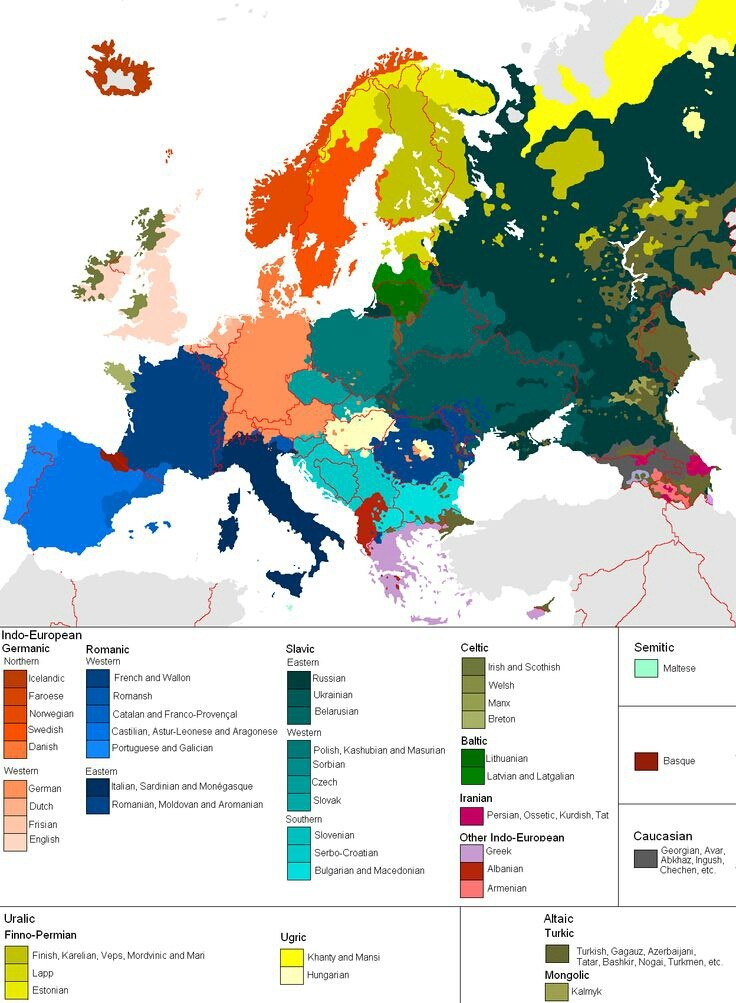
A rather good linguistic map of Europe. Seen in red, the Basque are the sole remnant of the prehistoric Atlantic European megalith builders who once stretched arguably from Crete to Scandinavia. They now only remain on the western reaches of the Pyrenees and the eastern Cantabrian mountain ranges in northern Spain and southwestern France.
The Indo-European speakers on the other hand seem to have originated in the Caspian Sea region of Eurasia, spreading out in all directions in a series of waves beginning as early as 4000 B.C.E., with a final phase around 400 CE known as the great migratory period of the Huns, Germanic tribes and Alans – which brought the Roman Empire to it’s knees.
-H.J.N.
I finally managed to get hold of a copy of my dissertation! You can read it on Google Docs HERE. Please feel free to download and cite the work if it helps you with your own studies. 🙂
You guys, this is 70 pages of analysis of tumblr language and you should probably read it. I know I’m going to.



 Steel Phoenix Studios