Shout out to my Arabic teacher that looked at us yesterday mid-lesson and said, “I’m worried. You all look exhausted and depressed.”
Of we were all like, “Oh yeah we’re dead inside, you haven’t noticed?”
And he snapped shut the textbook, threw up his hands and said, “That’s not healthy! No more vocab! Time for dancing!”
And he taught us a dance from Iraq and we danced instead of doing vocab. We didn’t stop dancing until he saw all of us laughing and was satisfied that we were all feeling better. It was perhaps the coolest, most kind-hearted thing I’ve ever seen a college instructor do.
An assignment I actually wrote on the board this week:
In groups, write 2 sentences (in Latin) using only the
vocabulary in your textbook. Make sure to include:
1 irregular verb
1 imperfect verb
5 cases
BEES?
I’ll elaborate in a minute, but I need to stop laughing
first.
So I’d originally planned on a 20-minute grammar lesson,
followed by a handout to be finished in pairs, but I’d made the mistake of telling
this class about Latin Day in April and how we were encouraging them to come to
school in costume. All they wanted to do was talk about costume opportunities
(and since I would like to keep my job, I had to explain why staging Caesar’s assassination
in the middle of the lunchroom would be a Bad Idea), so I shifted gears and decided
to channel that creative/social energy into a different assignment.
After lugging them through a condensed version of the
grammar lesson on irregular verbs in the imperfect tense, I split them into
groups and pulled an assignment out of the air.
The requirements:
Write two sentences in Latin
Use ONLY vocabulary from the textbook
Include at least ONE irregular verb
Include at least ONE verb in the imperfect tense
Include 5 (out of 6, including the vocative)
cases
The goal:
To write them on the board for their ‘rival’
groups to translate
They are a competitive bunch, so I knew this would be enough
to encourage them to go All Out. But then one student raised her hand.
“Can our sentences be about bees?” she asked.
Bees. I swear this class has a thing with Bees. I hesitated.
“There are no bees in your textbook.”
“Yes, but you taught us that word.”
I had, back when this same student had asked me how to say “the
bees are suffering” for a kahoot she was writing. Granted, this same student is
planning on coming in on Latin Day dressed as Caligula’s horse, so none of this
surprises me.
I opened it up to the other ‘groups’. “What do you think?” I
asked. “Should we let them write about bees?”
“No,” said one student with a heavy sort of solemnity, looking
me dead in the eye. “We should all be required
to write about bees.”
As the rest of the class eagerly cheered and nodded in
agreement, three things occurred to me.
The word for bee, “apis”, is a 3rd-declension
i-stem noun, which they could use more practice on.
They’re going to want to describe the bees,
which means they will likely also be practicing noun-adjective agreement with a
3rd-declension i-stem noun, which they could also use more practice
on.
This could be flipping hilarious.
And so I added “BEES?” to the list.
The results:
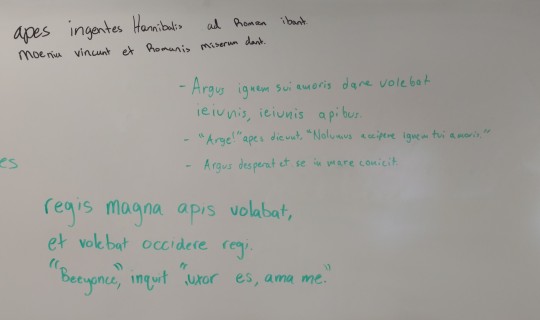
1. apes ingentes Hannibalis ad Romam ibant. Moenia vincunt et Romanis miserum dant.
“The giant bees of Hannibal
were going to Rome. They conquer the walls and give misery to the Romans.” In hindsight the noun miseriam would have been better, but still solid. Mentions bees AND misery. Implies an AU where Hannibal brought giant bees
across the Alps instead of elephants. Carthage wins the Punic Wars. 10/10
2. Argus ignem sui amoris dare volebat ieiunis, ieiunis apibus. “Arge!” apes dicunt. “Nolumus accipere ignem tui amoris.” Argus desperat et se in mare conicit.
“Argus was wishing to give
the fire of his love to the hungry, hungry bees. ‘Argus!’ the bees say. ‘We do
not want to accept the fire of your love.’ Argus despairs and hurls himself
into the sea.” Descriptive. Tragic. Mentions fire. Has something for
everyone. Also 10/10
3. regis magna apis volabat, et volebat occidere regi. “Beeyonce,” inquit, “uxor es. Ama me.”
“The great bee of the king
was flying, and he was wishing to kill for the king. ‘Beeyonce,’ he said. ‘You
are my wife. Love me.’ ” 100/10 for Beeyonce.
this one’s a shitpostgenerator folks, we’ve gone full circle
I kinda wish this was in Greek so I could say that this was posted outside Troy in circa 1179 BC.
My friend if you could get me a reliable translation into ancient Greek I would be happy to put a shitload of effort into making it into a small clay inscription sign
mnemeion ti philion: hoi hippoi hypoptoi kai megaloi ouk enthade menein exestin.
Literally: [a] friendly thing-to-remember: it is not possible for [the category of] large and suspicious horses to remain here.
The accentuation is beyond me, but in my defence the actual ancient Greeks didn’t bother writing accents either. I’m cross that tumblr won’t render the breathings properly, though: the ones that are representing an h sound should curve to the right like (, and the others should curve to the left like ).
At last! The semester of Greek comp comes in useful! The semester in which we were marked off for every single error in accent use! Accentuation, if one wishes to bother with it, would be as such:
I’d be inclined to put the horses in the dative, since it’s not permitted to them to remain,and ἔξεστιν usually takes dative of person allowed plus the infinitive of allowance; but I’m not sure if it works differently for inanimate objects, and don’t have the Giant Dictionary at hand.
I feel a little uneasy about the ordering of the adjectives, but frankly, I have always overcorrected for tucking everything between the article and the noun when it comes to those sorts of things.
oh shit no you’re right the horses should DEFINITELY be in the dative that’s really embarrassing. so it should be:
except that probably makes the accents wrong again. I was always shit at accents. please fix them for me!
the adjectives are ok where they are imo. I’m pretty sure there are some rules about adjectives of size vs adjectives of quality which i’m handwaving by turning them into a cute little kai phrase, but it’s all attributive so it’s all good.
we, in a manner akin to that of a man who once was, in Rome, an orator of significant skill, who was then for his elegance of speech renowned and now for his elaborate structure of sentences cursed by generations of scholars of Latin, the language which he spoke and we now study, Cicero, write, rather than by any efficiency, functionality, or ease of legibility have our words, our honors, the breaths of our hearts, be besmirched.
Not many jnſtances of Punctuation – but for many Daſhes – et words Capitaliz’d for emphavſis, but not logicaly – ſpeeling and word Endings varied Gratelie – and the long S – ſ – vſed in at the ſtart and Centre of wordes – & the short “s” vſed only at the end – as with the U and V, and the I and J – but v and j only at the ſtart of wordes (we diſtinguishe not between Vouels and Conſonants, only decoratiue Letteres). Ye letter “y” being in lookes cloſe to an Olde letter “þ” which is vſed as “th” – Y may be vſed in the place of TH – but only ſparingly – and ſtill Pronounc’d the ſame as TH. Long and rambling ſentences – ſeeminglie without end – a paragraph can conſiſt of One whole ſentence, and ſhort ſentences are rare – we ſcribe like hiſtorical Modern English – and other european Languages.
@deadcatwithaflamethrower I know you have fun bitching about the evolution of English, but at least it’s not like this?
…Am I gonna disappoint you by saying that it’s actually EXACTLY like this?
Old English did not:
Give a fuck about punctuation
Give a fuck about sentence structure
Give a fuck about word order; the declension, conjugation, and genus of each word told people everything they needed to know, punk rock, oi oi oi
Give a fuck if the gender they were giving a word actually matched the gender of the object/persontitle or not (wife is gender neutral despite being a woman’s title)
Give a fuck about consistency in their alphabet: Letters often did not look like they sounded because it was half-Latin and half old Brythonic runes
Give a fuck about vowels and consonents having devoted sounds until late, late, late in the language’s period, right before it became a dead language
Give a fuck about letter direction in regards to writing on monuments; this was a thing that happened sometimesand it is still driving linguists to drink because they don’t know if it was done to fuck with people or if it had religious significance, or both
tl;dr The Mediterranean influence basically made certain that everyone in the West had THE SAME BAD HABITS in regards to writing shit down.


 Steel Phoenix Studios