yall
remember that post that went like…… “why is french… Like
That”?
well,
time for An Education from ur
local french literature student
SO,
BASICALLY, WHAT HAPPENED
first
of all, well, it’s like the 9th
century and the king is like…… hey what if….. and bear with me
on this one but….. what if…….. we wrote………. the
things about our country………… in the language……. actual
people living in this country….. speak?
and
people were like “holy shit youre the king so okay” and then the
king was like “i want YOU to write this laws and THINGS in FRENCH!”
and the monks were like “aw okay” so they started doing that
EXCEPT
that
they had a big fucking problem. what
was that problem, you may ask? well,
the problem was thaT THOSE MOTHERFUCKERS DIDNT HAVE AN ALPHABET TO
WRITE THIS FUCKING EXCUSE OF A LANGUAGE
lemme
explain. all
they knew was latin and the latin alphabet. bc
like knowing latin was the whole thing when u were a monk. also
latin was like… the Serious Language. but
french doesnt sound like
latin like at all. french
sounded like some bitch ass demon had bitten their tongue and was
trying to order a latte in the middle of an exorcism incantation. and
i
say “sounded” on purpose bc their pronunciation was wild, man. like
ultra wild. like
even WORSE than what we have to deal with now. and
it had NOTHING to do with motherfucking
latin.
so
what did the monks do? well,
they were like “aw this is a mcfucking embarrassment of a
situation, ay” and had a choice. basically,
they could invent a whole new mode of transcription for french weird
ass sounds… OR they could do their best to try and adapt the latin
alphabet to its demonic sprouting.
which
is, pretty sadly if you ask me, what they went for.
so
they started planning strategies that were complex at shit bc like
how tf are you gonna write “cheval” with
a fucking LATIN ALPHABET???
so basically they all went with whatever felt best to write in
the moment and there were no
rules and it was a weird fucking mess of a situation lemme tell you,
ive seen the manuscripts, those men went APE SHITT
and
like…. some
of them never used the same spelling twice. also
there were like no accent and punctuation and things that allow you
to write like a fucking normal human being so jot that down
so,
that was a big fucking mess and they started adding letters e v e r y
w h e r e like……….. ok some of them were actually smart like
they did their best to add letters that no one pronounced
but it made it look like some latin thing. like
basically they put up a pink hairband on a fucking DEMON CHILD and
went “aaaawww look how CUTE it is, looks like its mommy so
much!!!!” and prayed to god it would end up
well (spoiler: no. no
it didnt. bitch)
so
you got things like “veult” for “veut” bc the “l” made it
look a bit like the latin “vult” or something. but
then as i said
some of them went APE SHITT and were like, WOOHOO FREE LETTERS and
started adding weird letters to words that had literally no
etymological link to that letter. so
they were writing “peut” like “peult” just because….. idk
they felt like to??
so
its Like That in the middle ages and then people started thinking
about french as a language and they went like….. MAAAAW THERES A
WEIRD FUCKING STRAY WRITING OUTSIDE!!! MAAAAAAAW!!!! IS THAT EVEN A
FUCKING LANGUAGE???? BLINK
MOTHERFUCKER!! AAAAAAAAAAAA
and everyone was losing their shit alright
so like english students started
going to college in france and they were like “bitch
you live like
this??” and the french were like :/// whelp
and like they did their best to like
help non-native writing
french but it had no rules so it didnt work out well and like….. in
the 1500’s some guys were like “okay guys this makes no
sense from now on well use a
RATIONALIZED WRITING i
built MYSELF” and their idea was basically to write french as they
spoke it which i
know SOUNDS like a good idea but actually AINT
bc first of all there are a shitton
of words that have the same pronunciation in french and you
need those weird spellings to actually know what the word is there
for like….. they wrote like “me” for “mai” and “mais”
and “mes” and “met” and basically that was wild
and some
of those guys who knew a lot about grammar went like “ooookayyyyy
so were removing those letters we dont pronounce buuuuuuuuuut its not
alwayyyyyys like thiiiiiiiiis” and like…. right-wing
people like the 1550 equivalent of republicans or some shit went
like, foaming at the mouth like rabid fucking dogs when they saw “pe”
instead of “peult” “oooooohhhhhh but you DIDNT and its not EVEN
REALLY RATIONAL” and like they had a ton or arguments and it
actually became a kinda linguistic war and all
plus they didnt pronounce the same
things everywhere in france so in paris they wrote “otr” for
“autre” and in lyon they wrote “aotr” and they were like………
“we got a problem here” bc the whole thing was to get a language
that was the same everywhere in the country basically
so u got those reformist guys on the
one side and the reactionaries on the other side and honestly,
reactionaries’ arguments are so fucking funny they were like…
“okay so some of the letters are
useful bc it helps understanding that the word comes from latin”
this ones rational alright
“also some mute letters are used to
link the words from an
identical background together and
create semantic links like
“sang” (blood) does have a mute “g” bc it links it to
“sanguin” (sanguine) and other words like this” alright cool
but THEN you got some weird fucking
ideas like
“but actually writing IS the
standard bc written things Are More Noble, Actually” which is
like……. weird
flex but ok
“yes, it makes it harder to learn,
but so it repels women and non-educated people who would soil The
Language if they could write
it” like DUDE are you
FUCKING SERIOUS
and finally – their main idea –
“bUt iT loOkS FaNcY” aka
#aesthetics and thats basically it
also. the
printing press workers were like……… guys are you SURE you
want to get us to COMPLETELY CHANGE AND UNLEARN OUR WHOLE JOB LIKE
C’MON so it kinda weighed in favor of the reactionaries
also the reactionaries won in the
long term
tl;dr so french is Like That because 1.
its a demonic language that monks desperately tried to tie back to
latin and 2. old white men with bizarre aesthetic tastes hated women and The Poor
thanks for coming to my ted talk my
language makes no sense and neither does its history
An assignment I actually wrote on the board this week:
In groups, write 2 sentences (in Latin) using only the
vocabulary in your textbook. Make sure to include:
1 irregular verb
1 imperfect verb
5 cases
BEES?
I’ll elaborate in a minute, but I need to stop laughing
first.
So I’d originally planned on a 20-minute grammar lesson,
followed by a handout to be finished in pairs, but I’d made the mistake of telling
this class about Latin Day in April and how we were encouraging them to come to
school in costume. All they wanted to do was talk about costume opportunities
(and since I would like to keep my job, I had to explain why staging Caesar’s assassination
in the middle of the lunchroom would be a Bad Idea), so I shifted gears and decided
to channel that creative/social energy into a different assignment.
After lugging them through a condensed version of the
grammar lesson on irregular verbs in the imperfect tense, I split them into
groups and pulled an assignment out of the air.
The requirements:
Write two sentences in Latin
Use ONLY vocabulary from the textbook
Include at least ONE irregular verb
Include at least ONE verb in the imperfect tense
Include 5 (out of 6, including the vocative)
cases
The goal:
To write them on the board for their ‘rival’
groups to translate
They are a competitive bunch, so I knew this would be enough
to encourage them to go All Out. But then one student raised her hand.
“Can our sentences be about bees?” she asked.
Bees. I swear this class has a thing with Bees. I hesitated.
“There are no bees in your textbook.”
“Yes, but you taught us that word.”
I had, back when this same student had asked me how to say “the
bees are suffering” for a kahoot she was writing. Granted, this same student is
planning on coming in on Latin Day dressed as Caligula’s horse, so none of this
surprises me.
I opened it up to the other ‘groups’. “What do you think?” I
asked. “Should we let them write about bees?”
“No,” said one student with a heavy sort of solemnity, looking
me dead in the eye. “We should all be required
to write about bees.”
As the rest of the class eagerly cheered and nodded in
agreement, three things occurred to me.
The word for bee, “apis”, is a 3rd-declension
i-stem noun, which they could use more practice on.
They’re going to want to describe the bees,
which means they will likely also be practicing noun-adjective agreement with a
3rd-declension i-stem noun, which they could also use more practice
on.
This could be flipping hilarious.
And so I added “BEES?” to the list.
The results:
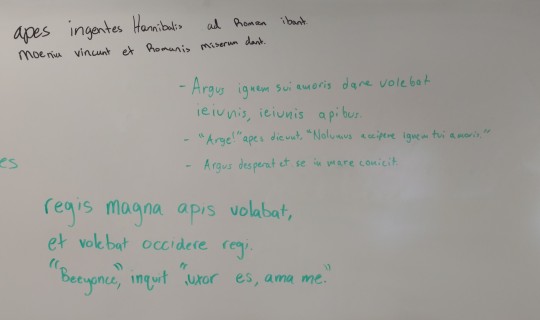
1. apes ingentes Hannibalis ad Romam ibant. Moenia vincunt et Romanis miserum dant.
“The giant bees of Hannibal
were going to Rome. They conquer the walls and give misery to the Romans.” In hindsight the noun miseriam would have been better, but still solid. Mentions bees AND misery. Implies an AU where Hannibal brought giant bees
across the Alps instead of elephants. Carthage wins the Punic Wars. 10/10
2. Argus ignem sui amoris dare volebat ieiunis, ieiunis apibus. “Arge!” apes dicunt. “Nolumus accipere ignem tui amoris.” Argus desperat et se in mare conicit.
“Argus was wishing to give
the fire of his love to the hungry, hungry bees. ‘Argus!’ the bees say. ‘We do
not want to accept the fire of your love.’ Argus despairs and hurls himself
into the sea.” Descriptive. Tragic. Mentions fire. Has something for
everyone. Also 10/10
3. regis magna apis volabat, et volebat occidere regi. “Beeyonce,” inquit, “uxor es. Ama me.”
“The great bee of the king
was flying, and he was wishing to kill for the king. ‘Beeyonce,’ he said. ‘You
are my wife. Love me.’ ” 100/10 for Beeyonce.
So if my students finish a quiz/test early, I ask them to draw me stuff on the back (partly so those who need more time are less self-conscious about still having the test out, partly because fuck yeah, pictures), and it may be the single best decision of my career.
In the past couple of weeks, I’ve told these kids that (a) the Romans believed there were demons in their public toilets and (b) the word for “janitor” comes from “ianitor”, which means “(door) guard”.
So now I’m getting drawings of superhero janitors taking on toilet demons, and it’s so beautiful.
Aaaaand today a student showed me a video of himself lighting a fire in his toilet while chanting the conjugation of the word “to be”.
He said he wanted to recreate the ancient toilet demons, and I have concerns.
K… but why conjugations of to be?
My students kept forgetting how to conjugate esse, so I turned it into a rhythmic chant that I had them say over and over. The problem is that when you chant ANYTHING in Latin it sounds like you’re summoning a demon, which they decided was awesome, so uh. Now I’ll just be randomly walking through the hallway and hear voices chanting, “sum es est! sumus estis sunt!”
I’m 99% sure my colleagues think I’ve started a cult.
Keep doing what you’re doing. I’m sure everyone will turn out all the better for it.
An assignment I actually wrote on the board this week:
In groups, write 2 sentences (in Latin) using only the
vocabulary in your textbook. Make sure to include:
1 irregular verb
1 imperfect verb
5 cases
BEES?
I’ll elaborate in a minute, but I need to stop laughing
first.
So I’d originally planned on a 20-minute grammar lesson,
followed by a handout to be finished in pairs, but I’d made the mistake of telling
this class about Latin Day in April and how we were encouraging them to come to
school in costume. All they wanted to do was talk about costume opportunities
(and since I would like to keep my job, I had to explain why staging Caesar’s assassination
in the middle of the lunchroom would be a Bad Idea), so I shifted gears and decided
to channel that creative/social energy into a different assignment.
After lugging them through a condensed version of the
grammar lesson on irregular verbs in the imperfect tense, I split them into
groups and pulled an assignment out of the air.
The requirements:
Write two sentences in Latin
Use ONLY vocabulary from the textbook
Include at least ONE irregular verb
Include at least ONE verb in the imperfect tense
Include 5 (out of 6, including the vocative)
cases
The goal:
To write them on the board for their ‘rival’
groups to translate
They are a competitive bunch, so I knew this would be enough
to encourage them to go All Out. But then one student raised her hand.
“Can our sentences be about bees?” she asked.
Bees. I swear this class has a thing with Bees. I hesitated.
“There are no bees in your textbook.”
“Yes, but you taught us that word.”
I had, back when this same student had asked me how to say “the
bees are suffering” for a kahoot she was writing. Granted, this same student is
planning on coming in on Latin Day dressed as Caligula’s horse, so none of this
surprises me.
I opened it up to the other ‘groups’. “What do you think?” I
asked. “Should we let them write about bees?”
“No,” said one student with a heavy sort of solemnity, looking
me dead in the eye. “We should all be required
to write about bees.”
As the rest of the class eagerly cheered and nodded in
agreement, three things occurred to me.
The word for bee, “apis”, is a 3rd-declension
i-stem noun, which they could use more practice on.
They’re going to want to describe the bees,
which means they will likely also be practicing noun-adjective agreement with a
3rd-declension i-stem noun, which they could also use more practice
on.
This could be flipping hilarious.
And so I added “BEES?” to the list.
The results:
1. apes ingentes Hannibalis ad Romam ibant. Moenia vincunt et Romanis miserum dant.
“The giant bees of Hannibal
were going to Rome. They conquer the walls and give misery to the Romans.” In hindsight the noun miseriam would have been better, but still solid. Mentions bees AND misery. Implies an AU where Hannibal brought giant bees
across the Alps instead of elephants. Carthage wins the Punic Wars. 10/10
2. Argus ignem sui amoris dare volebat ieiunis, ieiunis apibus. “Arge!” apes dicunt. “Nolumus accipere ignem tui amoris.” Argus desperat et se in mare conicit.
“Argus was wishing to give
the fire of his love to the hungry, hungry bees. ‘Argus!’ the bees say. ‘We do
not want to accept the fire of your love.’ Argus despairs and hurls himself
into the sea.” Descriptive. Tragic. Mentions fire. Has something for
everyone. Also 10/10
3. regis magna apis volabat, et volebat occidere regi. “Beeyonce,” inquit, “uxor es. Ama me.”
“The great bee of the king
was flying, and he was wishing to kill for the king. ‘Beeyonce,’ he said. ‘You
are my wife. Love me.’ ” 100/10 for Beeyonce.
I was told recently about a school that was shamed into changing its school motto. The motto was “I hear, I see, I learn.” Nothing wrong with that per se. Unfortunately the motto was in Latin, and the Latin for “I hear, I see, I learn” is “audio, video, disco”.
What the fuck that’s the best school motto ever change it back
Your yearly reminder that “I learn through suffering” can be translated into Latin as “Disco Inferno.”
Latin has this word, sic. Or, if we want to be more diacritically accurate, sīc. That shows that the i is long, so it’s pronounced like “seek” and not like “sick.”
You might recognize this word from Latin sayings like “sic semper tyrannis” or “sic transit gloria mundi.” You might recognize it as what you put in parentheses when you want to be pass-agg about someone’s mistakes when you’re quoting them: “Then he texted me, ‘I want to touch you’re (sic) butt.’”
It means, “thus,” which sounds pretty hoity-toity in this modren era, so maybe think of it as meaning “in this way,” or “just like that.” As in, “just like that, to all tyrants, forever,” an allegedly cool thing to say after shooting a President and leaping off a balcony and shattering your leg. “Everyone should do it this way.”
Anyway, Classical Latin somewhat lacked an affirmative particle, though you might see the word ita, a synonym of sic, used in that way. By Medieval Times, however, sic was holding down this role. Which is to say, it came to mean yes.
Ego: Num edisti totam pitam?
Tu, pudendus: Sic.
Me: Did you eat all the pizza?
You, shameful: That’s the way it is./Yes.
This was pretty well established by the time Latin evolved into its various bastard children, the Romance languages, and you can see this by the words for yes in these languages.
In Spanish, Italian, Asturian, Catalan, Corsican, Galician, Friulian, and others, you say si for yes. In Portugese, you say sim. In French, you say si to mean yes when you’re contradicting a negative assertion (”You don’t like donkey sausage like all of us, the inhabitants of France, eat all the time?” “Yes, I do!”). In Romanian, you say da, but that’s because they’re on some Slavic shit. P.S. there are possibly more Romance languages than you’re aware of.
But:
There was still influence in some areas by the conquered Gaulish tribes on the language of their conquerors. We don’t really have anything of Gaulish language left, but we can reverse engineer some things from their descendants. You see, the Celts that we think of now as the people of the British Isles were Gaulish, originally (in the sense that anyone’s originally from anywhere, I guess) from central and western Europe. So we can look at, for example, Old Irish, where they said tó to mean yes, or Welsh, where they say do to mean yes or indeed, and we can see that they derive from the Proto-Indo-European (the big mother language at whose teat very many languages both modern and ancient did suckle) word *tod, meaning “this” or “that.” (The asterisk indicates that this is a reconstructed word and we don’t know exactly what it would have been but we have a pretty damn good idea.)
So if you were fucking Ambiorix or whoever and Quintus Titurius Sabinus was like, “Yo, did you eat all the pizza?” you would do that Drake smile and point thing under your big beefy Gaulish mustache and say, “This.” Then you would have him surrounded and killed.
Apparently Latin(ish) speakers in the area thought this was a very dope way of expressing themselves. “Why should I say ‘in that way’ like those idiots in Italy and Spain when I could say ‘this’ like all these cool mustache boys in Gaul?” So they started copying the expression, but in their own language. (That’s called a calque, by the way. When you borrow an expression from another language but translate it into your own. If you care about that kind of shit.)
The Latin word for “this” is “hoc,” so a bunch of people started saying “hoc” to mean yes. In the southern parts of what was once Gaul, “hoc” makes the relatively minor adjustment to òc, while in the more northerly areas they think, “Hmm, just saying ‘this’ isn’t cool enough. What if we said ‘this that’ to mean ‘yes.’” (This is not exactly what happened but it is basically what happened, please just fucking roll with it, this shit is long enough already.)
So they combined hoc with ille, which means “that” (but also comes to just mean “he”: compare Spanish el, Italian il, French le, and so on) to make o-il, which becomes oïl. This difference between the north and south (i.e. saying oc or oil) comes to be so emblematic of the differences between the two languages/dialects that the languages from the north are called langues d’oil and the ones from the south are called langues d’oc. In fact, the latter language is now officially called “Occitan,” which is a made-up word (to a slightly greater degree than that to which all words are made-up words) that basically means “Oc-ish.” They speak Occitan in southern France and Catalonia and Monaco and some other places.
The oil languages include a pretty beefy number of languages and dialects with some pretty amazing names like Walloon, and also one with a much more basic name: French. Perhaps you’ve heard of it, n’est-ce pas?
Yeah, eventually Francophones drop the -l from oil and start saying it as oui. If you’ve ever wondered why French yes is different from other Romance yeses, well, now you know.
I guess what I’m getting at is that when you reblog a post you like and tag it with “this,” or affirm a thing a friend said by nodding and saying “Yeah, that”: you’re not new
this is all amazing, but I’m now waiting for people to start reblogging posts with the additional comment “SIC”.
original theory: succubi are always women, incubi are always men
facts: in fact succubus comes from the latin word “succubare” which means “to lie under” and incubus comes from the latin word “incubare” which means “to lie on”
new improved theory: incubi are always tops and succubi are always bottoms. gender doesn’t matter at all.
addendum: if the sex demon in question is versatile, they’re a concubus, from the latin for ‘to lie with/beside’.
So if my students finish a quiz/test early, I ask them to draw me stuff on the back (partly so those who need more time are less self-conscious about still having the test out, partly because fuck yeah, pictures), and it may be the single best decision of my career.
In the past couple of weeks, I’ve told these kids that (a) the Romans believed there were demons in their public toilets and (b) the word for “janitor” comes from “ianitor”, which means “(door) guard”.
So now I’m getting drawings of superhero janitors taking on toilet demons, and it’s so beautiful.
Aaaaand today a student showed me a video of himself lighting a fire in his toilet while chanting the conjugation of the word “to be”.
He said he wanted to recreate the ancient toilet demons, and I have concerns.
K… but why conjugations of to be?
My students kept forgetting how to conjugate esse, so I turned it into a rhythmic chant that I had them say over and over. The problem is that when you chant ANYTHING in Latin it sounds like you’re summoning a demon, which they decided was awesome, so uh. Now I’ll just be randomly walking through the hallway and hear voices chanting, “sum es est! sumus estis sunt!”
I’m 99% sure my colleagues think I’ve started a cult.
Keep doing what you’re doing. I’m sure everyone will turn out all the better for it.

 Steel Phoenix Studios
