This is secret code used by 19th-century diarist Anne Lister to record her lesbian relationships! And underneath, and sample of her diaries. Anne wrote 6600 pages, or almost 4 million words of these diaries, giving us a treasure trove of information about her life, and one of the only first-hand accounts we have of female same-sex relationships in the 19th century.
Now you too can communicate with your friends in secret lesbian code!
Chinese emperor Ai of Han, fell in love with a minor official, a man named Dong Xian, and bestowed upon him great political power and a magnificent palace. Legend has it that one day while the two men were sleeping in the same bed, the emperor was roused from his sleep by pressing business. Dong Xian had fallen asleep across the emperor’s robe, but rather than awaken his peaceful lover, the Emperor cut his robe free at the sleeve. Thus “the passion of the cut sleeve” became a euphemism for same-sex love in China. — R.G.L.
get you a dude who will fuck up his own clothing for you
NO OKAY THIS IS REALLY COOL SO SHUT UP AND LISTEN KIDS. Ancient China was super chill about homosexuality okay. Like we have gay emperors and feudal lords, lesbian princesses who were girlfriends with their serving maids, gay ass poets who wrote lots of poems about that one courtesan who played the guzheng so well.
In fact homosexuality was so okay that in Shiji, which is basically the Bible of Ancient Chinese history, there is an entire section dedicated to the gay lovers of emperors. What’s the best part? All the laws and criticism about homosexuality in Ancient China were all about shit like prostitution and rape. These laws were outlawing homosexual stuff were all very specific.
For example, there were laws banning male prostitution, but no laws against homosexuality. These laws were passed to stop the spread of prostitution and laws targeting prostitution in general were pretty common in Chinese history. There were also really strict laws about male rape. Rape was punishable by death, regardless of the gender of the victim. Rape a girl, you die. Rape a guy, you die. Have sex with a minor, you die regardless of whether it was consensual. The lightest sentence you could get was slavery where you were bound to the army.
Also scholars wrote essays criticising the boyfriends of emperors, saying that they distracted the emperor from work blah blah blah but THEY ALSO DID THE SAME FOR THE CONCUBINES. That’s right – the issue wasn’t homosexuality but rather the hormones of the emperor. They didn’t care about the gender of the emperor’s favourite lover but rather the fact that the emperor was too horny to get shit done.
“But WAIT, Modern China is a hardass about homosexuality!!!! How do you explain that!”
Yes. That. That’s because of the late Qing years where Western influences entered the country and brought their gross ass homophobic attitudes with them. And the Qing government was so anxious to seem modern and be seen as equals to their Western counterparts. So they adopted Western ways and discarded their previous attitudes about homosexuality. Hence you have Modern China.
So the next time someone tries to tell you that being LGBT is wrong because it goes against traditional Chinese values, tell them to go fuck themselves with 3000 years of Chinese queerness.
“Tell them to go fuck themselves with 3000 years of Chinese queerness.”
I’ve been trying to think of a good term for the “weepy movies about tragic queer people aimed at straight audiences” subgenre, and I think I’ve got it:
dead gays for the straight gaze
eh? eh??
queers die for the straight eye
SO YOOOO who wants to learn why this is a thing because the history is actually really fascinating and ties into some of my favorite shit ever?
Okay, so like, back in the mid-twentieth century, when being queer was still totally a crime everywhere in the United States, queer writers started working in pulp fiction–starting with Vin Packer (she is awesome)–and writing pulps to tell our stories.
So one day over lunch, her editor asks her, “Hey, Vin, what’s the story you most want to write?”
And she goes, “Well, I’d like to write a love story about lesbians because I’m, you know, gay.”
He says, “Hey, that’s awesome, I will publish it. One thing, though, the homosexuality has to end badly and the main character has to realize she was never gay in the first place. We can’t seem to support homosexuality. I don’t actually think that’s cool, but the government will literally seize our book shipments and destroy them on the basis of the books being ‘obscene’ if you don’t, so if we want this story actually out there, and not burning in a bonfire somewhere, it’s what you gotta do.”
So Vin goes home and writes Spring Fire, the book that launched the entire lesbian pulp genre. And while one character ends up in an insane asylum and the other ends up realizing she never loved her at all, it’s massively successful, and queer women everywhere snap it up and celebrate quietly in their closets across the nation because HOLY SHIT THERE’S A BOOK ABOUT ME? I’M NOT ALONE and it starts a huge new genre.
But: every publisher is subject to those same government censorship rules, so every story has to end unhappily for the queer characters, or else the book will never see the light of day. So, even though lesbian pulp helps solidify the queer civil rights movement, it’s having to do so subversively or else it’ll end up on the chopping block.
So blah blah blah, this goes on for about twentyyears, until finally in the seventies the censorship laws get relaxed, and people can actually start queer publishing houses! Yay! But the lesbian pulps, in the form they’d been known previously, basically start dying out.
MEANWHILE, OVER IN JAPAN! Yuri, or the “girls love” genre in manga, starts to emerge in the 1970s, and even starts dealing with trans characters in the stories. But, because of the same social mores that helped limit American lesbian pulp, the stories in Japan similarly must end in tragedy or else bad shit will go down for the authors and their books. Once more: tragic ends are the only way to see these stories published rather than destroyed.
The very first really successful yuri story has a younger, naive girl falling into a relationship with an older, more sophisticated girl, but the older girl ends up dying in the end, and subsequent artists/writers repeated the formula until it started getting subverted in the 1990s–again, twenty years later.
And to begin with cinema followed basically the same path as both lesbian pulps and yuri: when homosexuality is completely unacceptable in society, characters die or their stories otherwise end in tragedy, just to get the movies made, and a few come along to subvert that as things evolve.
But unlike the books and manga before them, even though queer people have become sightly more openly accepted, movies are stuck in a loop. See, pulps and yuri are considered pretty disposable, so they were allowed to evolve basically unfettered by concerns of being artistic or important enough to justify their existence, but film is considered art, and especially in snooty film critic circles, tragedy=art.
Since we, in the Western world, put films given Oscar nods on a pedestal, and Oscar nods go to critical darlings rather than boisterous blockbusters (the film equivalent of pulps, basically), and critics loooove their tragedy porn, filmmakers create queer stories that are tragic and ~beautiful~ that win awards that then inspire more queer stories that are tragic and ~beautiful~ until the market is oversaturated with this bullshit.
The Crying Game? Critical darling, tragic trans character.
Brokeback Mountain? Critical darling, tragic queer (? not totally sure if they’d consider themselves gay or bi, tbh?) characters.
And so on and so on VOILA, we now have a whole genre of tragedy porn for straight people, that started out as validation for us and sometimes even manages to slip some more through the cracks occasionally, but got co-opted by pretentious ~literary~ types. While tragic ends made these stories more acceptable to begin with, and in the mid-to-late nineties that started getting subverted a little bit (Chasing Amy, But I’m a Cheerleader), eventually that became the point, as more straight audiences started consuming these narratives and got all attached to the feels they got from the ~beauty of our pain~.
Queer history is crucial
I actually have a copy of Spring Fire. I read a lot of lesbian pulp when I was a teenager, and I loved the drama of it but hated the tragedy. Then I found neo-pulp, modern stories in the pulp style where queers got happy endings! Check out Monica Nolan and Mabel Maney. They were hugely influential on me and were very inspirational when I was working on I Was Kidnapped by Lesbian Pirates from Outer Space in particular.
i wonder how many historic trans men we’ve lost to “this WOMAN went by a man’s name, wore men’s clothes, took the job of a man, lived as a man… GIRL POWER!”
this isn’t a “pushing my identity on historic people” thing, it’s the fact that every single time i or another person brings up the possibility of someone like us in history, we’re immediately shut down, told that we didn’t “exist yet”, given a billion different reasons why we aren’t ALLOWED to see these people as reflective of us and our struggles and experiences – i get that we didn’t have the vocabulary back then but for so many of you the IDEA that someone who went to the same stretches that we do today to separate from their dead selves and identify similar to the way trans people do is too “far out there” and “disrespectful” to them somehow. they’re dead. we’re alive. we’re trying to connect the pieces. go get your kicks out of isolating us from history somewhere else, away from me.
yeah, there were women who did crossdress in order to take up jobs they would not have been permitted to access
but when people say it about Albert Cashier, who donned Union uniform, bound his chest, and lived as a man even after the Civil War, when he was reclusive and lived in a tiny village, after there would have been no incentive for him to do so, I question their motives.
I also question their motives when they list Alan L Hart, who legally changed his name and was one of the first trans men to pursue a hysterectomy, referring to himself as “a fellow.”
people DONT want historical figures to be trans. they WANT to interpret these historical figures as women, not trans men, because that makes them uncomfortable.
I started writing this as a comment on another post, but it got too long so fuck it, this is going to be its own post, and it’s going to be a collection of basically everything I can get my hands on about asexual oppression, history, and the shit aphobes say. Yeah, this is going to be long, heavy with links to a lot more reading, but I’ve had it up to here with the “discourse”.
Everyone who wants to is free to reblog this post and use it as a reference when arguing with aphobes. (fyi, I created the blog @asexuality-and-aphobia in the middle of this project to be a reliable source for my links.)
Asexuality was listed in the DSM as HSDD (Hypoactive Sexual Desire Disorder) until 2013, making it officially a mental illness that would be treated with therapy and medication. It is still in the DSM, except that you can ‘opt out’ if you self-identify as asexual, which is great except that asexuality is still so unknown that there undoubtedly many people who are asexual but don’t know that it’s “a thing”. This means that who knows how many asexuals have been sent to therapy and told they’re sick, then been “treated” for their orientation to try and force them to experience sexuality “correctly”.
Posts of people describing the hardship they’ve faced for their asexuality: x, x, x, x, x, x, x, x, x, x, x, x, x, x, x, x
The blog @acephobia-is-real has so many submissions and examples of hatred, harassment, hostility, and abuse, of aces who have been raped and/or sexually assaulted in an attempt to ‘fix’ them, and made suicidal due to aphobia and/or their own perceived brokenness, that it would be pointless for me to try and link any. Just go and start reading. Try their suicide tag.
There may be dissatisfyingly little research done on asexuality, but there has been enough done to prove that they do face discrimination, no matter how hard some may find that to believe. But guess what? You, an allosexual person, do not get to say shit like “aces don’t get kicked out” or “aces don’t _____” any more than I as a white person get to say that things I don’t experience must not happen to black people either. Just because you haven’t experienced it personally or witnessed it with your own eyes doesn’t mean it doesn’t happen. You haven’t walked in an ace’s shoes, you don’t know what they deal with. Period.
Not even other aces can tell asexuals that their experiences aren’t real or aren’t valid. Different people can deal with different amounts of oppression, that doesn’t mean the lack of oppression is the default “truth”.
Nobody is trying to say that asexuals have it “as bad” or worse than gay or trans people, but we don’t HAVE to “have it worse” to be included and for our experiences to have merit without being compared to anyone else’s. Let me say that again: our experiences have merit without being compared to anyone else’s.
Told asexuals to die: x, x, x, x, x (tbh this is only a tiny sample and I don’t have the heart to go digging for more)
Are all aphobes this vile? Maybe not, but this is still the disgusting, hateful attitude festering in the gatekeeping community, and it stinks like shit. The examples I have provided above are only a fraction of the harassment and abuse that is perpetrated on a regular basis.
“Het aces/aroaces are straight”
Some het aces identify as straight. Some het aces don’t identify as straight, they identify as asexual, and it’s not your place to label them against their will. There is no world in which aroaces, people who experience no attraction to anyone, are straight.
“We accept SGA (same-gender attracted) and trans aces”
Firstly, SGA (same-gender attraction) is a term that was used and is still used in Mormon conversion therapy, so as one can understand, a lot of people are very uncomfortable being labeled with this description. Secondly, it enforces a gender binary of “same” and “opposite” gender that leaves a large number of nonbinary people out in the cold. Is a genderfluid person only “same-gender attracted” if they’re attracted to other genderfluid people who are genderfluid in exactly the same way? How about agender, intergender, demigirl/boy people? And before the argument “well they’re included as trans” is made, there are plenty of nonbinary people who do not identify as trans. I’m one of them.
The standard of “SGA and trans” as requirement for entry to the LGBTQ community is used nowhere outside of aphobic tumblr, and it seems crafted specifically for the purpose of excluding aces, aros, NBs, intersex people, and others not deemed “gay enough”.
The modern American movement was first known as the “gay community” when cis gay men refused to even accept lesbians, then the “gay and lesbian community”. (Good reading on the subject.)
“After the elation of change following group action in the Stonewall riots in New York, in the late 1970s and the early 1980s, some gays and lesbians became less accepting of bisexual or transgender people.
Critics said that transgender people were acting out stereotypes and bisexuals were simply gay men or lesbian women who were afraid to come out and be honest about their identity.
Each community has struggled to develop its own identity including whether, and how, to align with other gender and sexuality-based communities, at times excluding other subgroups; these conflicts continue to this day.” (source)
“From about 1988, activists began to use the initialism LGBT in the United States.
Not until the 1990s within the movement did gay, lesbian, bisexual and transgender people gain equal respect.” (ibid)
Insisting that LG people have always been accepting of bi and trans people is incredibly revisionist and does a great deal of injustice to those who have been excluded.
Despite the fact that bisexual and transgender people have always been around, and have done great things for the community, they have faced a great deal of lateral oppression from the LG part of the group that did not want to see them get an equal share of attention, support, or legitimacy. This post is not about proving LG transphobia and biphobia, but it’s so rampant that I don’t feel like I need to provide sources whatsoever. Nevertheless, here’s a collection of biphobia, and the blog @terf-callout documents some of the violent transphobia on this site, particularly in the lesbian community. This post is an example.
“The A stands for Ally so that closeted people can be the community without being outed”
No one is saying that we don’t care about closeted people, but a) even if you’re a closeted L, G, B, or T, you are still a L, G, B, or T. Allies do not need to be part of the acronym to be intrinsically welcomed. As someone said, this is like saying the ‘B’ in BLT stands for ‘bread’. We can pretty much safely assume that a sandwich is going to include bread, we don’t have to go of our way to give it a letter. Either you are outing every “ally” as a closeted queer person, or you are giving 100% cis straight people an LGBTQ member card, the very thing you are arguing against by trying to exclude asexuals.
Furthermore, this puts forth the argument “I’m willing to let cishet straight people into the community for the sake of a few closeted people” while at the same time stating “I’m not willing to let the A stand for asexuals because I don’t think letting cis heteroromantic asexuals into the community is worth giving all asexuals representation and support”. Which says that you consider asexuals less valuable and more of a threat than cis straight people.
“I have proof of an asexual being homophobic/transphobic/racist/a terrible person”
Of course there are asexuals who are terrible people. There are legions of gays and lesbians who are racist and transphobic. Does that make them not gay/lesbian? Does their bigotry invalidate their sexual orientation, or remove the L and G from the acronym? No, I don’t think so. Some asexuals being bad people doesn’t justify you trying to invalidate all of us.
“’Allosexual’ is a bad word because ____”
I actually have an ‘allosexual’ tag just for posts about why ‘allosexual’ is a perfectly fine word: x, x, x, x, x. x
“The split-attraction model is homophobic”
What we call the split-attraction model was first described by Karl Heinrich Ulrichs, a gay advocate from the 1800s, as “disjunctive uranodioning”. (source) (credit to this post)
“The term ‘corrective rape’ was coined by South African lesbians and should only be used by lesbians”
No one means any disrespect to lesbians or other victims of corrective rape, but this is not a correct statement.
“We’ll Show You You’re a Woman” describes the violence directed towards LGBT people in South Africa, stating, “Negative public attitudes towards homosexuality go hand in hand with a broader pattern of discrimination, violence, hatred, and extreme prejudice against people known or assumed to be lesbian, gay, and transgender, or those who violate gender and sexual norms in appearance or conduct (such as women playing soccer, dressing in a masculine manner, and refusing to date men).” It goes on to say, “Much of the recent media coverage of violence against lesbians and transgender men has been characterized by a focus on “corrective rape,” a phenomenon in which men rape people they presume or know to be lesbians in order to “convert” them to heterosexuality.”
The Wikipedia article on corrective rape in South Africa states that, “A study conducted by OUT LGBT Well-being and the University of South Africa Centre for Applied Psychology (UCAP) showed that “the percentage of black gay men who said they have experienced corrective rape matched that of the black lesbians who partook in the study”.”
It is not only lesbians, but also bisexual women, transgender men, gay men, and
gender non-conforming people
in South Africa who experience corrective rape. This is not in any way meant to minimize the horror of the epidemic or shift attention away from lesbians, but other victims, including asexuals, deserve attention as well. Do not silence or speak over victims of rape by policing their language.
“Aces are valid, they’re just not queer/LGBTQ”
You cannot in one breath say “Asexuals are valid” and in the next deny their experiences. Spend five minutes in the community and you will see testimony after testimony from aces describing their abuse, their sexual assault(s), the countless times people have called them confused, broken, wrong, mentally ill, inhuman, sinful, and how these experiences have left them feeling hopeless, alone, alienated, subhuman, depressed, and suicidal. Almost every asexual out there will tell you a story of how their orientation has caused them pain and struggle, and you can’t call them valid while at the same time calling these experiences invalid and nonexistent.
“Aces take resources from other LGBTQ who need them”
I’ve seen some pretty wild claims about this one, insisting that asexuals “steal” things such as scholarships, beds at homeless shelters, food and space at pride events, suicide hotlines, and so on, yet I have never seen any actual proof that any “stealing” has ever taken place. For one thing, I thought “you’ll never get kicked out or fired for being ace”, “no one is suicidal because they’re asexual”, so why would you think aces need these resources? Either we don’t need them or we don’t use them, you can’t have it both ways.
For another, how heartless do you have to be to tell asexuals that they can’t use suicide hotlines? Do you realize that you’re saying that asexuals should be denied life-saving services? That, in essence, asexuals are suicidal due to their orientation, but you think they’re not “queer enough” so they deserve to die? Because that is the logical progression of refusing someone suicide prevention, and that’s the message aces receive when you tell them they are “stealing” suicide prevention.
Lastly, do you not realize we are also PROVIDING resources? We are bringing bodies and minds to the community, we are here to be voices, to volunteer, to bring encouragement, information, and support. We earn our keep. You just have to admit that you don’t WANT us here.
“Nobody wants to hear about your nonexistent sex life”
my night manager (who is a gay man) and i sometimes sit down and exchange stories and tidbits about our sexuality and our experiences in the queer cultural enclave. and tonight he and i were talking about the AIDS epidemic. he’s about 50 years old. talking to him about it really hit me hard. like, at one point i commented, “yeah, i’ve heard that every gay person who lived through the epidemic knew at least 2 or 3 people who died,” and he was like “2 or 3? if you went to any bar in manhattan from 1980 to 1990, you knew at least two or three dozen. and if you worked at gay men’s health crisis, you knew hundreds.” and he just listed off so many of his friends who died from it, people who he knew personally and for years. and he even said he has no idea how he made it out alive.
it was really interesting because he said before the aids epidemic, being gay was almost cool. like, it was really becoming accepted. but aids forced everyone back in the closet. it destroyed friendships, relationships, so many cultural centers closed down over it. it basically obliterated all of the progress that queer people had made in the past 50 years.
and like, it’s weird to me, and what i brought to the conversation (i really couldn’t say much though, i was speechless mostly) was like, it’s so weird to me that there’s no continuity in our history? like, aids literally destroyed an entire generation of queer people and our culture. and when you think about it, we are really the first generation of queer people after the aids epidemic. but like, when does anyone our age (16-28 i guess?) ever really talk about aids in terms of the history of queer people? like it’s almost totally forgotten. but it was so huge. imagine that. like, dozens of your friends just dropping dead around you, and you had no idea why, no idea how, and no idea if you would be the next person to die. and it wasn’t a quick death. you would waste away for months and become emaciated and then, eventually, die. and i know it’s kinda sophomoric to suggest this, but like, imagine that happening today with blogs and the internet? like people would just disappear off your tumblr, facebook, instagram, etc. and eventually you’d find out from someone “oh yeah, they and four of their friends died from aids.”
so idk. it was really moving to hear it from someone who experienced it firsthand. and that’s the outrageous thing – every queer person you meet over the age of, what, 40? has a story to tell about aids. every time you see a queer person over the age of 40, you know they had friends who died of aids. so idk, i feel like we as the first generation of queer people coming out of the epidemic really have a responsibility to do justice to the history of aids, and we haven’t been doing a very good job of it.
Younger than 40.
I’m 36. I came out in 1995, 20 years ago. My girlfriend and I started volunteering at the local AIDS support agency, basically just to meet gay adults and meet people who maybe had it together a little better than our classmates. The antiretrovirals were out by then, but all they were doing yet was slowing things down. AIDS was still a death sentence.
The agency had a bunch of different services, and we did a lot of things helping out there, from bagging up canned goods from a food drive to sorting condoms by expiration date to peer safer sex education. But we both sewed, so… we both ended up helping people with Quilt panels for their beloved dead.
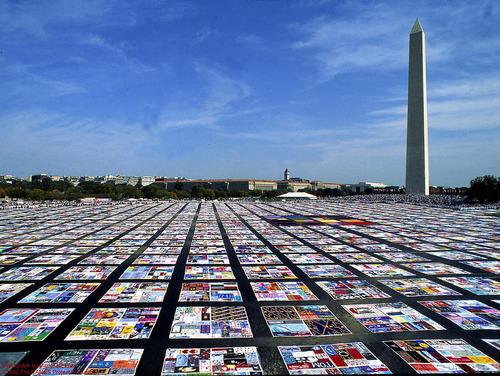
Do the young queers coming up know about the Quilt? If you want history, my darlings, there it is. They started it in 1985. When someone died, his loved ones would get together and make a quilt panel, 3’x6’, the size of a grave. They were works of art, many of them. Even the simplest, just pieces of fabric with messages of loved scrawled in permanent ink, were so beautiful and so sad.
They sewed them together in groups of 8 to form a panel. By the 90s, huge chunks of it were traveling the country all the time. They’d get an exhibition hall or a gym or park or whatever in your area, and lay out the blocks, all over the ground with paths between them, so you could walk around and see them. And at all times, there was someone reading. Reading off the names of the dead. There was this huge long list, of people whose names were in the Quilt, and people would volunteer to just read them aloud in shifts.
HIV- people would come in to work on panels, too, of course, but most of the people we were helping were dying themselves. The first time someone I’d worked closely with died, it was my first semester away at college. I caught the Greyhound home for his funeral in the beautiful, tiny, old church in the old downtown, with the bells. I’d helped him with his partner’s panel. Before I went back to school, I left supplies to be used for his, since I couldn’t be there to sew a stitch. I lost track of a lot of the people I knew there, busy with college and then plunged into my first really serious depressive cycle. I have no idea who, of all the people I knew, lived for how long.
The Quilt, by the way, weighs more than 54 tons, and has over 96,000 names. At that, it represents maybe 20% of the people who died of AIDS in the US alone.
There were many trans women dying, too, btw. Don’t forget them. (Cis queer women did die of AIDS, too, but in far smaller numbers.) Life was and is incredibly hard for trans women, especially TWOC. Pushed out to live on the streets young, or unable to get legal work, they were (and are) often forced into sex work of the most dangerous kinds, a really good way to get HIV at the time. Those for whom life was not quite so bad often found homes in the gay community, if they were attracted to men, and identified as drag queens, often for years before transitioning. In that situation, they were at the same risk for the virus as cis gay men.
Cis queer women, while at a much lower risk on a sexual vector, were there, too. Helping. Most of the case workers at that agency and every agency I later encountered were queer women. Queer woman cooked and cleaned and cared for the dying, and for the survivors. We held hands with those waiting for their test results. Went out on the protests, helped friends who could barely move to lie down on the steps of the hospitals that would not take them in — those were the original Die-Ins, btw, people who were literally lying down to die rather than move, who meant to die right there out in public — marched, carted the Quilt panels from place to place. Whatever our friends and brothers needed. We did what we could.
OK, that’s it, that’s all I can write. I keep crying. Go read some history. Or watch it, there are several good documentaries out there. Don’t watch fictional movies, don’t read or watch anything done by straight people, fuck them anyway, they always made it about the tragedy and noble suffering. Fuck that. Learn about the terror and the anger and the radicalism and the raw, naked grief.
I was there, though, for a tiny piece of it. And even that tiny piece of it left its stamp on me. Deep.
2011
A visual aid: this is the Quilt from the Names Project laid out on the Washington Mall
I was born (in Australia) at the time that the first AIDS cases began to surface in the US. While I was a witness after it finally became mainstream news (mid-85), I was also a child for much of it. For me there was never really a world Before. I’m 35 now and I wanted to know and understand what happened. I have some recommendations for sources from what I’ve been reading lately:
And the Band Played On: Politics, People and the AIDS Epidemicby Randy Shiltsis a seminal work on the history of HIV/AIDS. It’s chronological and gives an essential understanding of all the factors that contributed to the specific history of the virus’ spread through the US and the rest of the world, the political landscape into which it landed (almost the worst possible)*. Investigative journalism and eyewitness account. Shilts was himself an AIDS casualty in 1994.
Larry Kramer is a pretty polarising figure and he had issues with the sexual politics of gay New York to begin with (see: Faggots) but he’s polarising for a reason: he’s the epidemic’s Cassandra. Reports from the Holocaustcollects his writings on AIDS.
I don’t think I can actually bring myself to read memoirs for the same reason I can’t read about the Holocaust or Stalinist Russia any more. But I have a list:
Read or watchThe Normal Heart. Read or watch Angels in America. Read The Mayor of Castro Streetor watchMilk. Dallas Buyers Clubhas its issues but it’s also heartbreaking because the characters are exactly the politically unsavory people used to justify the lack of spending on research and treatment. It’s also an important look at the exercise of agency by those afflicted and abandoned by their government/s, how they found their own ways to survive. There’s a film of And the Band Played Onbut JFC it’s a mess. You need to have read the book.
Everyone should read about the history of the AIDS epidemic. Especially if you are American, especially if you are a gay American man. HIV/AIDS is not now the death sentence it once was but before antiretrovirals it was just that. It was long-incubating and a-symptomatic until, suddenly, it was not.
Read histories. Read them because reality is complex and histories attempt to elucidate that complexity. Read them because past is prologue and the past is always, in some form, present. We can’t understand here and now if we don’t know about then.
*there are just SO MANY people I want to punch in the throat.
They’ve recently digitized the Quilt as well with a map making software, I spent about three hours looking through it the other day and crying. There are parts of it that look like they were signed by someone’s peers in support and memoriam, and then you realize that the names were all written in the same writing.
That these were all names of over 20 dead people that someone knew, often it was people who’d all been members of a club or threatre group.
As well, there are numerous people who were buried in graves without headstones, having been disenfranchised from their families. I read this story the other day on that which went really in depth (I would warn that it highlights the efforts of a cishet woman throughout the crisis): http://arktimes.com/arkansas/ruth-coker-burks-the-cemetery-angel/Content?oid=3602959
I’ve had several conversations recently with younger guys for whom this part of our history isn’t well known. Here are some resources for y’all. Please, take care of one another.
Adding that in the US, And The Band Played On is on the monthly discounted Kindle ebooks list for June 2017.
Legit, THIS is why I sometimes get short with the younger generations of LGBTQ folks who don’t understand what it was like growing up queer decades ago. Even in the late 90′s/early 00′s, the despair we felt around this issue. It hit very close to home.
One of the most terrifying parts of this new administration is knowing that knowing that a second wave of this is coming. When Mike Pence took office as governor in Indiana, they saw a surge in HIV outbreaks in that state. We actually were starting to see AIDS become manageable, and I’m so angry that this progress will very likely go backwards.
I’m not even that old, and I’m a cis woman, but I remember. I had friends. We can’t go back to this. I think any queer person who was alive in those times knows someone who was affected. The despair we felt when this death sentence was put on someone. The grieving. It’s unbearable. I grew up with sparse role models because of how many we lost. It was a cloud hanging over the heads of every queer person.
Please, LGBTQ community, find a way to solidify and fight together. Arguing about who is “gay enough,” or whether we can use the word “queer” or not, or excluding trans people is detrimental to our cause. If we keep dividing ourselves we will be conquered.
I love my community. I can’t stand the thought of a second wave of AIDS crisis hitting us.
As Pride Month begins, let’s not forget who paved the way for us. We have a lot to thank Marsha P. Johnson & Sylvia Rivera for.
No offense but why do many folks leave out Miss Major? Maybe that’s why she’s struggling to get money to settle down and retire because folks are praising the dead rather than trying to keep the living live good… but maybe I’m just ranting.


 Steel Phoenix Studios