Knowing that trans women of color started the movement in the united states and were literally immediately erased and excluded from what they started is the most deeply jading knowledge.
It is the original sin of the so-called queer community and it damns it from the cradle.
So, the last couple years y’all may have noticed a movement taking hold on both conservative and radical exclusionist gay circles called “Drop the T.” This movement, started possits that the LGBTQ movement is only the Gay movement and everything else is “appropriation” of Gay History.
This is, of course, total horse shit for a large number of reasons, so I’m going to go in point by point deconstructing this shit:
1) These people say, “It was gay people, not BTQ, that were targeted.” This is false even on it’s face. Even if you want to say trans people weren’t there because Stonewall happened in a time when the term trans wasn’t in popular usage (more on that in point 4), there were sure as shit crossdressers there, and they were ALWAYS the first ones targeted and carted off. The night of Stonewall, Storm DeLaverie, who wasn’t trans, was “Crossdressing” and the first arrested, so we’re Marsha Johnson and Sylvia Rivera, who were trans. And guess what? Those three were the first to fight back. We owe this movement to them, and how dare you revise and erase our history for you ideology.
2) They point to Sodomy laws as proof it was gay people specifically targeted, while forgetting the existence of Crossdressing Laws, which were on the books LONGER THAN SODOMY LAWS. In New York, y’know where Stonewall happened, there were Anti Crossdressing Laws on the books until 2011 while they eliminated sodomy laws in the 1970’s! There was a federal ban on sodomy laws in 2003, Lawrence v Texas, but still none for Anti-Crossdressing laws.
3) People were arrested because they were homosexual, not bi or trans.“ No, they just didn’t care if were apart of the L, G, B, or T, we were Queers that had to be Taken Care Of. Why do you think we banded together in the first place?
4) The Nazis’ first target for book burnings was Institut für Sexualwissenschaft, which was the first medical institute to perform Sex Reassignment Surgery in the 1930s and the works of Magnus Hirchfeld, who coined the term “Transsexual.” The reason “trans people didn’t exist” in the time of Stonewall is because it took us almost half a century for us to recover. You’ll notice quite a few of Stonewall Veterans who were “crossdressers” back in the day, ID’d as translater in life when the language became available again. The Nazis were the first to try this, and they wiped us off the face of the Earth for decades.
5) Divide and Conquer. We are strong together, and weak apart. It is an attempt to weaken our movement now that it isn’t specifically focused on helping topass legislation benefit only cis gay people. We fought for your rights, and now you got yours so screw us? Fuck that. It’s ENDA, when Barney Frank and the HRC pushed to exclude trans people so they could have it for themselves, all over again.
6) It’s apart of a larger transphobic movement in which conservatives and radical exclusionists teamed up. Remember when the Reagan administration banned funding for trans healthcare? Yeah, they used writings of Janice Reymond as supporting evidence. These groups wrote to the fucking UN to have trans rights removed from International Human Rights laws. They team up for bathroom legislation, including sending cis men into women’s bathrooms to scare cis women into supporting bathroom legilsation. ENDA. What did we do that’s equivalent to that? Why do you despise us so much?
You have no basis for your movement, not histrocial, not political, not anything other than pure hatred. Go fuck yourselves. We’ll eliminate exclusionist before trans people.
ancient guy: i want all the dicks of persia in my ass, i love dicks, give me dicks until i drown modern historian: well what you have to keep in mind is that ancient cultures had different ideas of how to show affection and express themselves, so it’s actually probable he was talking about his brotherly affection for his people
Fact: Bisexual women and lesbians used to give each other violets to symbolize their love in the early 20th century, referencing a poem by Sappho. Gay and bisexual men used to wear carnations, a trend started by Oscar Wilde. Gay and bisexual communities have always been intertwined, sharing in each other’s love and struggles and creating history together.
Carnations are red Violets are blue But both used to mean I’m so gay for you
reblogging for the most romantic poem i’ve ever read.
The other thing about the word “queer” is that almost everyone I’ve seen opposed to it have been cis, binary gays and lesbians. Not wanting it applied to yourself is fine, but I think people underestimate the appeal of vague, inclusive terminology when they already have language to easily and non-invasively describe themselves.
Saying “I’m gay/lesbian/bi” is pretty simple. Just about everyone knows what you mean, and you quickly establish yourself as a member of a community. Saying “I’m a trans nonbinary bi woman who’s celibate due to dysphoria and possibly on the ace spectrum”… not so much. You’re lucky to find anyone who understands even half of that, and explaining it requires revealing a ton of personal information. The appeal of “queer” is being able to identify yourself without profiling yourself. It’s welcoming and functional terminology to those who do not have the luxury of simplified language and occupy complicated identities. *That’s* why people use it – there are currently not alternatives to express the same sentiment.
It’s not people “oppressing themselves” or naively and irresponsibly using a word with loaded history. It’s easy to dismiss it as bad or unnecessary if you already have the luxury of language to comfortably describe yourself.
There’s another dimension that always, always gets overlooked in contemporary discussions about the word “queer:” class. The last paragraph here reminds me of a old quote: “rich lesbians are ‘sapphic,’ poor lesbians are ‘dykes’.”
The reclaiming of the slur “queer” was an intensely political process, and people who came up during the 90s, or who came up mostly around people who did so, were divided on class and political lines on questions of assimilation into straight capitalist society.
Bourgeois gays and lesbians already had “the luxury of language” to describe themselves – normalized through struggle, thanks to groups like the Gay Liberation Front.
Everyone else, from poor gays and lesbians to bi and trans people and so on, had no such language. These people were the ones for whom social/economic assimilation was not an option.
The only language left, the only word which united this particular underclass, was “queer.” “Queer” came to mean an opposition to assimilation – to straight culture, capitalism, patriarchy, and to upper class gays and lesbians who wanted to throw the rest of us under the bus for a seat at that table – and a solidarity among those marginalized for their sexuality/gender id/presentation.
(Groups which reclaimed “queer,” like Queer Patrol (armed against homophobic violence), (Queers) Bash Back! (action and theory against fascism, homophobia, and transphobia), and Queerbomb (in response to corporate/state co-optation of mainstream Gay Pride), were “ultraleft,” working-class, anti-capitalist, and functioned around solidarity and direct action.)
The contemporary discourse around “queer” as a reclaimed-or-not slur both ignores and reproduces this history. The most marginalized among us, as OP notes, need this language. The ones who have problems with it are, generally, among those who have language – or “community,” or social/economic/political support – of their own.
Fun History Fact: The overwhelming majority of cowboys in the U.S. were Indigenous, Black, and/or Mexican persons. The omnipresent white cowboy is a Hollywood studio concoction meant to uphold the mythology of white masculinity.
Thank you.
I will always re-blog this
I think it was high school when i overheard some white girl put on her best semi-disgusted and confused voice and go “why do so many Mexicans dress up like cowboys?” and I had to be the person to tell her.
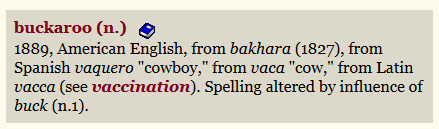
Why do you think the whites say buckero? Cause they couldn’t say vaquero.
I dunno if I reblogged this before but fuck it, y’all gon learn today.
Teach the children.
also, cowboy culture was hella gay. like, write-poems-about-your-cowboy-partner gay.
IF people acknowledge it, they play the necessity card– there weren’t any women out on the range, so they had to “resort to men.” this claim completely erases 1) the romantic (not just sexual) writings of actual cowboys, 2) the acknowledgement of cowboys’ potential homosexual activity by writers at the time, and 3) the possibility that some men would deliberately become cowboys with the intent to seek out homosexual encounters.
no one wants to admit it, but cowboy culture was just. so inherently gay.
Im here for the gay POC cowboys
Guys: “vamoose,” “hoosegow,” “calaboose” it’s all Spanish.
I’m a qpoc, This is what I’m talking about when white people straight wash POC.
@hijabby may I hop on this post to make a point? You’re quite a bit younger than me, which isn’t a problem or a bad thing, it just means you will have still been in kindergarten or not even born yet when the events I am about to discuss took place and given the nature of queer history, it’s totally possible I learned stuff that’s faded into ephemera for your generation.
QUEER WAS THE ACCEPTABLE, ACADEMIC TERM FOR “LGBTQIA” IN THE EARLY-TO-MID 2000s.
I took classes in Queer Literature. We discussed Queer History. Some of my professors–who were themselves gay, lesbian, and bisexual, mind you–referred to historical figures as queer on the basis that those figures did not exist in societies that had a modern-day understanding of sexuality, and so trying to box them into modern labels is an exercise in futility. I went to marches where we screamed “we’re here, we’re queer, we want our civil rights.”
All of this, by the way, spawns out of the Genderqueer and ACT UP movements of the 1990s; they’re the ones who invented the chant on which the above chant was based, the one you may have heard elsewhere: “we’re here, we’re queer, get over it.” I’m proud of my own part in queer history, but those people, the ones who created the AIDS quilt and the die-ins and the fierce demands for same-sex marriage so they could visit partners dying in the hospital, they’re the real heroes. And they called themselves queer.
And?
Most of them were not white.
I am. The radical activism of my generation looks very different from generations past because, I’m sorry to say, white queer folks sat back and let queer folks of color do the hard part, and then we grabbed the baton and charged over the first big finish line while the sportscasters talked about the stunning race we’d run. I’m not sorry to be an activist or to be working in my own generation, but I’m very deeply sorry that queer activism en masse has widely ignored the nonwhite, noncis people who got us where we are.
“Queer” has more uses than just being a slur that was reclaimed 30+ years ago. Queer is a useful term if, say, you’re 15 and you’re not sure if you’re asexual or a late bloomer, but you don’t want to just say “oh yeah, I’m gay/straight.” Queer is a useful term if, like me, you escaped a fundamentalist church and your whole life has been defined by strict labels, and you just want out. Queer is a useful term if you’re from a country where gender doesn’t fit a Western binary but you want a quick term to describe yourself to Western people.
And do you know what else queer is?
Queer is hated by TERFs because it encompasses trans people.
Because it embraces aroace people.
Because it says “you are here, you are welcome, you belong” to people who say “I know I’m not straight, but I don’t know what I AM.” What you are is queer, and queer is enough. Queer is the place you can sit, rest, and figure it out at your own pace.
TERFs started the narrative of “queer is only a slur, has never been anything else, and was never reclaimed and you should never ever say it ever” in order to gatekeep our community. When you try to deny this term, YOU ARE DOING THE WORK OF TERFS.
Queer is not a slur. Queer is a reclaimed word that is of huge help to people across the community, but most especially to our fellows who aren’t “just” LGB, and to the nonwhite members of our community who do not fit into the gender binary.
Stop. STOP. Stop listening to TERFs who pretend nothing of queer rights existed between 1880 and 2015. Stop being ahistorical and disenfranchising.
We’re here, we’re queer, get the fuck over it.
I never head of TERFS rejecting queer for gatekeeping, but honestly? It sounds very likely, and Prismatic-Bell makes an important point.
I have seen aphobes do this exact thing first-hand. I’ve had an aphobe insist to me that I was homophobic for using the word queer to describe myself and my community (i.e. the community that is inclusive of aro/ace, trans, and multisexual people).
Aphobes really like to insist on LGBT or “gay” as the only acceptable umbrella terms, because that allows them to exclude aro/ace people while pretending to be more inclusive of bisexual and trans people than they actually are.
But oh, just wait five minutes, push them on their own internal logic a little bit, and they’ll show their true colors.
Hint: their true colors are TERF.
Queer is definitely still a slur in the UK, but I know that the LGBTQIA+ community is reclaiming it for themselves, so… yeah. The above still applies.
As someone who originally trained as a social historian of the Medieval Period, I have some things to add in support of the main point. Most people dramatically underestimate the economic importance of Medieval women and their level of agency. Part of the problem here is when modern people think of medieval people they are imagining the upper end of the nobility and not the rest of society.
Your average low end farming family could not survive without women’s labour. Yes, there was gender separation of labour. Yes, the men did the bulk of the grain farming, outside of peak times like planting and harvest, but unless you were very well off, you generally didn’t live on that. The women had primary responsibility for the chickens, ducks, or geese the family owned, and thus the eggs, feathers, and meat. (Egg money is nothing to sneeze at and was often the main source of protein unless you were very well off). They grew vegetables, and if she was lucky she might sell the excess. Her hands were always busy, and not just with the tasks you expect like cooking, mending, child care, etc.. As she walked, as she rested, as she went about her day, if her hands would have otherwise been free, she was spinning thread with a hand distaff. (You can see them tucked in the belts of peasant women in art of the era). Unless her husband was a weaver, most of that thread was for sale to the folks making clothe as men didn’t spin. Depending where she lived and the ages of her children, she might have primary responsibility for the families sheep and thus takes part in sheering and carding. (Sheep were important and there are plenty of court cases of women stealing loose wool or even shearing other people’s sheep.) She might gather firewood, nuts, fruit, or rushes, again depending on geography. She might own and harvest fruit trees and thus make things out of that fruit. She might keep bees and sell honey. She might make and sell cheese if they had cows, sheep, or goats. Just as her husband might have part time work as a carpenter or other skilled craft when the fields didn’t need him, she might do piece work for a craftsman or be a brewer of ale, cider, or perry (depending on geography). Ale doesn’t keep so women in a village took it in turn to brew batches, the water not being potable on it’s own, so everyone needed some form of alcohol they could water down to drink. The women’s labour and the money she bought in kept the family alive between the pay outs for the men as well as being utterly essential on a day to day survival level.
Something similar goes on in towns and cities. The husband might be a craftsman or merchant, but trust me, so is his wife and she has the right to carry on the trade after his death.
Also, unless there was a lot of money, goods, lands, and/or titles involved, people generally got a say in who they married. No really. Keep in mind that the average age of first marriage for a yeoman was late teens or early twenties (depending when and where), but the average age of first marriage for the working poor was more like 27-29. The average age of death for men in both those categories was 35. with women, if you survived your first few child births you might live to see grandchildren.
Do the math there. Odds are if your father was a small farmer, he’s been dead for some time before you gather enough goods to be marrying a man. For sure your mother (and grandmother and/or step father if you have them) likely has opinions, but you can have a valid marriage by having sex after saying yes to a proposal or exchanging vows in the present (I thee wed), unless you live in Italy, where you likely need a notary. You do not need clergy as church weddings don’t exist until the Reformation. For sure, it’s better if you publish banns three Sundays running in case someone remembers you are too closely related, but it’s not a legal requirement. Who exactly can stop you if you are both determined?
So the less money, goods, lands, and power your family has, the more likely you are to be choosing your partner. There is an exception in that unfree folk can be required to remarry, but they are give time and plenty of warning before a partner would be picked for them. It happened a lot less than you’d think. If you were born free and had enough money to hire help as needed whether for farm or shop or other business, there was no requirement of remarriage at all. You could pick a partner or choose to stay single. Do the math again on death rates. It’s pretty common to marry more than once. Maybe the first wife died in childbirth. The widower needs the work and income a wife brings in and that’s double if the baby survives. Maybe the second wife has wide hips, but he dies from a work related injury when she’s still young. She could sure use a man’s labour around the farm or shop. Let’s say he dies in a fight or drowns in a ditch. She’s been doing well. Her children are old enough to help with the farm or shop, she picks a pretty youth for his looks instead of his economic value. You get marriages for love and lust as well as economics just like you get now and May/December cuts both ways.
A lot of our ideas about how people lived in the past tends to get viewed through a Victorian or early Hollywood lens, but that tends to be particularly extreme as far was writing out women’s agency and contribution as well as white washing populations in our histories, films, and therefore our minds eyes.
Real life is more complicated than that.
BTW, there are plenty of women at the top end of the scale who showed plenty of agency and who wielded political and economic power. I’ve seen people argue that the were exceptions, but I think they were part of a whole society that had a tradition of strong women living on just as they always had sermons and homilies admonishing them to be otherwise to the contrary. There’s also a whole other thing going on with the Pope trying to centralized power from the thirteenth century on being vigorously resisted by powerful abbesses and other holy women. Yes, they eventually mostly lost, but it took so many centuries because there were such strong traditions of those women having political power.
Boss post! To add to that, many historians have theorised that modern gender roles evolved alongside industrialisation, when there was suddenly a conceptual division between work/public spaces, and home/private spaces. The factory became the place of work, where previously work happened at home. Gender became entangled in this division, with women becoming associated with the home, and men with public spaces. It might be assumable, therefore, that women had (have?) greater freedoms in agrarian societies; or, at least, had (have?) different demands placed on them with regard to their gender.
(Please note that the above historical reading is profoundly Eurocentric, and not universally applicable. At the same time, when I say that the factory became the place of work, I mean it in conceptual sense, not a literal sense. Not everyone worked in the factory, but there is a lot of literature about how the institution of the factory, as a symbol of industrialisation, reshaped the way people thought about labour.)
I am broadly of that opinion. You can see upper class women being encouraged to be less useful as the piecework system grows and spreads. You can see that spread to the middle class around when the early factory system gears up. By mid-19th century that domestic sphere vs, public sphere is full swing for everyone who can afford it and those who can’t are explicitly looked down on and treated as lesser. You can see the class system slowly calcify from the 17th century on.
Grain of salt that I get less accurate between 1605-French Revolution or thereabouts. I’ve periodically studied early modern stuff, but it’s more piecemeal.
I too was confining my remarks to Medieval Europe because 1. That was my specialty. 2. A lot of English language fantasy literature is based on Medieval Europe, often badly and more based on misapprehension than what real lives were like.
I am very grateful that progress is occurring and more traditions are influencing people’s writing. I hate that so much of the fantasy writing of my childhood was so narrow.
This is great!
Adding that quite a bit of recent research suggests that a significant portion of European women in the Middle Ages never married at all, and they didn’t all become nuns. Plenty of “singlewomen” lived on their own, or in households with a few other women, or as domestic servants in larger households. If they lived on their own, they too might raise some chickens, spin, brew, take in laundry, or do other manual tasks for wages. In some places they could practice specific skilled crafts (often textile-related) and join guilds. Were a good number of these women lesbians, or ace? Quite probably.
There is a lot more to the past than what we think we know from seeing the same canned images in media over and over again.
This is why I tend to jump up and down like I am slightly unhinged and tell people to READ PRIMARY SOURCES. (In translation if you’re not an academic; I’m not nuts.) But even the primary sources from a fairly basic medieval history class will give you a much wider view of history as it was lived than the flat recycled stuff we see filtered through the mesh of (a very specific kind of) nostalgia.
If you want to really stretch your idea of who a medieval/renaissance woman was or what she could do, read Marie de France or Margery Kempe or Christine de Pizan–or any number of Norse sagas (ask me about
Hallgerthr and Bergthóra!). But even if you stick to the “mainstream” classics, your Canterbury Tales or your Gawain and the Green Knight or your Two Lives of Charlemagne, if you pay attention, you will notice a lot of women doing a lot of fascinating things that do not boil down to ‘being pretty’ and ‘being assaulted,’ which is what a lot of historical fiction and historical fantasy would like to boil us down to.
Also, let me be honest here, primary sources are just fun. They can be slow going at first, but the thing that really sold me on history when I was in college was not sweeping descriptions of battles. It was this one bit in a history by Notker the Stammerer (and how can you beat that as an author’s name?) where Charlemagne was bitching and moaning about Kids These Days and their inadequate cloaks, which aren’t even long enough to keep you warm when you have to get down off your horse and pee.
History is a million times richer than most of us give it credit for, including in the lives of women, I guess is my point. Also: READ PRIMARY SOURCES. They will upturn a lot of your assumptions about the lives of women, and of people in general–and they’re just a delight.
Fun little European history lesson; love this!
I don’t know if it was ever translated in english, but I would highly recommend to anyone who can read italian or can find someone who reads italian and is willing to translate if for them to read La Ragazza Col Falcone (The Girl With The Falcon) by italian author Bianca Pitzorno.
It’s an YA book centered in the time of Frederick II Holy Roman Emperor and it centers around the family of Messer Rufo and his wife Madam Yvette, spanning through most of the life of their two elder daughters.
Long post but damn if it isn’t amazong to the very end
Reblogging again ‘cause I found a copy of the book I was talking about and I wanted to translate a bit of it, which relates to the duties of a woman in a rich but not particularly noble household.
This is a lot spoilery for the book so I’m putting it under a cut:

 Steel Phoenix Studios