why are there so many posts about asexuals being immune to sirens. people. sirens don’t lure you in with sex (necessarily). they sing about whatever it is that you want most. they could sing about mothman or cinnamon toast crunch and guess what then your asexual pirate is fucking dead
this is the only kind of ace discourse i ever want to see on my dash. the only kind. ever again. good job
Do you think the sirens would be grateful that they finally get some variety?
“Oh my god we can finally just sing about pasta thank the fucking gods.”
I’m not asexual but I’m fairly certain sirens would do a far better job luring me into the depths with a song about pasta rather than sex…
I mean.
“WHAT THE FUCK STAY AWAY FROM THE ROCKS.”
“FUCKER THEY SAID THEY HAVE FETTUCCINE CARBONARA AND HOT GARLIC BREAD OVER THERE HANG ON BITCH.”
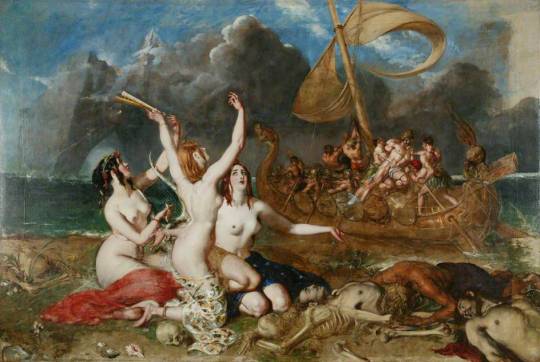
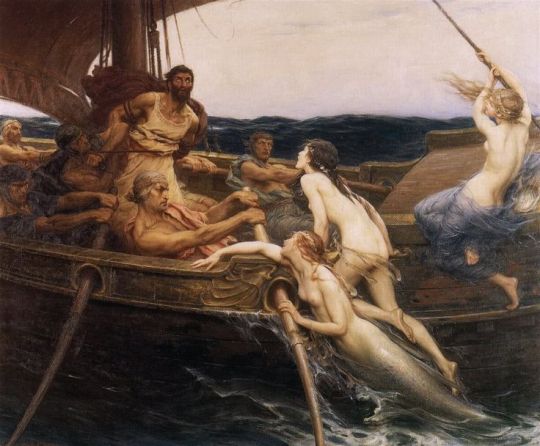
This is true; Odysseus heard them promising him knowledge of the future. So the next time you see artwork like this:
Remember those sultry naked chicks are saying “We’ll tell you the winning lotto numbers.”
This might currently be the most unifying and heartwarming post on this website. This crosses a multitude of societal differences and invokes a mass sense of camaraderie….and, really, I think it was the pasta that did it.
i hope all bi girls are having a beautiful day and if ur a bi girl who’s not having a good day i am sending u my love u deserve all the good days in the world
The other thing about the word “queer” is that almost everyone I’ve seen opposed to it have been cis, binary gays and lesbians. Not wanting it applied to yourself is fine, but I think people underestimate the appeal of vague, inclusive terminology when they already have language to easily and non-invasively describe themselves.
Saying “I’m gay/lesbian/bi” is pretty simple. Just about everyone knows what you mean, and you quickly establish yourself as a member of a community. Saying “I’m a trans nonbinary bi woman who’s celibate due to dysphoria and possibly on the ace spectrum”… not so much. You’re lucky to find anyone who understands even half of that, and explaining it requires revealing a ton of personal information. The appeal of “queer” is being able to identify yourself without profiling yourself. It’s welcoming and functional terminology to those who do not have the luxury of simplified language and occupy complicated identities. *That’s* why people use it – there are currently not alternatives to express the same sentiment.
It’s not people “oppressing themselves” or naively and irresponsibly using a word with loaded history. It’s easy to dismiss it as bad or unnecessary if you already have the luxury of language to comfortably describe yourself.
There’s another dimension that always, always gets overlooked in contemporary discussions about the word “queer:” class. The last paragraph here reminds me of a old quote: “rich lesbians are ‘sapphic,’ poor lesbians are ‘dykes’.”
The reclaiming of the slur “queer” was an intensely political process, and people who came up during the 90s, or who came up mostly around people who did so, were divided on class and political lines on questions of assimilation into straight capitalist society.
Bourgeois gays and lesbians already had “the luxury of language” to describe themselves – normalized through struggle, thanks to groups like the Gay Liberation Front.
Everyone else, from poor gays and lesbians to bi and trans people and so on, had no such language. These people were the ones for whom social/economic assimilation was not an option.
The only language left, the only word which united this particular underclass, was “queer.” “Queer” came to mean an opposition to assimilation – to straight culture, capitalism, patriarchy, and to upper class gays and lesbians who wanted to throw the rest of us under the bus for a seat at that table – and a solidarity among those marginalized for their sexuality/gender id/presentation.
(Groups which reclaimed “queer,” like Queer Patrol (armed against homophobic violence), (Queers) Bash Back! (action and theory against fascism, homophobia, and transphobia), and Queerbomb (in response to corporate/state co-optation of mainstream Gay Pride), were “ultraleft,” working-class, anti-capitalist, and functioned around solidarity and direct action.)
The contemporary discourse around “queer” as a reclaimed-or-not slur both ignores and reproduces this history. The most marginalized among us, as OP notes, need this language. The ones who have problems with it are, generally, among those who have language – or “community,” or social/economic/political support – of their own.
I had an interesting series of thoughts at work today.I started off thinking of a solarpunk zombie apocalypse story – society has collapsed, survivours rebuild from the ashes with solarpunk tech and the like while dealing with zombies, marauders, bandits and other threats. I was enjoying the idea until I realised something:
The post apocalypse genre is inherently ableist.
How often do you see disabled people in post apocalypse fiction anyway? Not very – off the top of my head I can think of Eli from The Book of Eli, Tomonaga Ijiro and Joe Muhammad from World War Z (the book) and Davis, Jodie and Jennifer from Dead State. Everyone else, able-bodied and neurotypical, with nary a chronic illness in sight – anyone who isn’t 100% mentally and physically “normal” is left behind or dragged along with reluctance and openly considered “dead weight,” with no consideration given to that person’s skillset or other qualities they might have that could come in handy. Even people with PTSD – a perfectly understandable thing to have after the apocalypse – are often looked down on as being “weak” or “unable to handle it” and are rarely given any decent help or support from those around them.
The entire genre feels like it’s designed with this ableistic outlook in mind and while I acknowledge there is limited realism to it – a lot of people with chronic illnesses or disabilities do need support to work at their best ability, and most post apocalypse settings won’t have anything like this in place which will put many of them at risk – that doesn’t mean we have to drag it all along in our stories with no questioning of why. Just because some may not make it through doesn’t mean every single person who has a condition that isn’t 100% curable is going to vanish with them.
We can do better than stories that tell disabled people that they’ll be better off dead so they don’t drag everyone else down; that tell people with chronic illnesses that they are worthless; that tell people with mental illnesses that they are a drain on resources; that tell the neuroatypical that they are nothing more than liabilities. Even people that stay behind to care for their loved ones who have such a condition are seen as noble but naive and generally condemned by the narrative as unfit to survive unless they leave the person “holding them back.”
Given that (in my opinion) post apocalypse stories are about how we’d like to rebuild society if we had to start over, the fact that disabled and neuroatypical representation is so rare in the stories across this genre says so much about society, and none of it positive. Neuroatypical and non-able bodied people aren’t all magically going to go away just because society has, and their absence in your story just says more about your attitude than about any “harsh realities” of the setting you’ve created.
This is such a great observation, and I definitely think a big part of the appeal of post-apocalyptic fiction for a certain kind of reader and writer is that you get to wipe out huge swaths of human complexity with “They all just die but it’s not eugenics because the zombies did it.”
But I don’t think it has to be that way, and I think a solarpunk approach could be a great way to bring that out. It would be harder to write, sure, because if the nature of a setting is to say “any shortcoming is a justification for letting someone die,” then it’s got to be a much bigger deal to the protagonists to resist that kind of thinking.
But that also makes it a great kind of story to showcase exactly the kind of values it’s often used to condemn: to show a group retrofitting their friend’s wheelchair with a solar powered motor and all-terrain wheels, or using precious power and backpack space to keep a supply of insulin refrigerated, or all learning sign language to accommodate their deaf teammate.
You could show people not failing because they chose compassion over pragmatism — maybe even succeeding because of it. All three of those accommodations have advantages, too: the group member with a powered wheelchair can probably carry more than other group members,* if you’re hauling a fridge you can refrigerate more than just insulin, and sign language is a valuable silent form of communication if you’re in a world filled with hostile zombies.
The important thing is to show groups choosing to stick up for their disabled or neurodivergent** members and not be punished for it. Those group members don’t need to ultimately be the climactic key to success — in fact, that’d probably be a problematic way to take it, because it would end up re-emphasizing the idea that their value comes from their ability to be useful.
But showing them as fully realized contributing characters in the story, whose teammates care about and support them (and vice versa), and showing them all make it out alive, flies in opposition to the ableist nature of apocalyptic fiction.
Of course, fiction where the world as it exists doesn’t have to end for things to start to get better is also important. But I can see a lot of value in post-apocalyptic fiction that isn’t a thinly veiled excuse to start gleefully describing the tragic deaths of everybody not optimally equipped to serve the new libertarian/military grim utopia.
* I’m not actually sure about this point — if anyone reading has personal experience with the physics and practical concerns of using a wheelchair re: carrying capacity, and wants to correct me, please do.
** I know I don’t actually have any examples of neurodivergence in the post. I’m gonna keep thinking about that aspect of this but I don’t have anything atm.
This is all spot-on and speaks to an understanding of the genre I’ve developed, having formerly been part of the problem.
I used to be really into post-apocalyptic fiction, especially zombie-apocalypse settings. I actually had discussions with one of my coworkers about the suitability of our workplace for survival during such an event (conclusion: too many windows, we were probably screwed). From the perspective of where I was in my life at the time, it seemed like a good bit of fun and, hey, if it did happen, at least I’d be ready, right?
Then I became medication-dependent. Now, when I thought about the logistics of survival in a post-apocalyptic situation, I had to consider where the hell I would be getting my anti-androgens and estrogen from. I didn’t think about it before, even though I knew I was trans, because I didn’t realize how fundamentally I needed to be on the right hormones. These meds doesn’t exactly grow on trees, and I’d hardly be the only trans woman who needs the stuff and, well… suddenly it’s not as fun as it used to be.
Moving from one category to the other really soured me on the genre. I still watch it, read it, hell, I even write it, but it doesn’t have the same appeal to me that it used to. I think that’s the problem, really. Cisgender, able-bodied, neurotypical people don’t think about this sort of thing because it doesn’t affect them personally, just like I didn’t think about it when I didn’t think it affected me. To them, survival is a bootstraps thing — if you’re HARD and MAN enough (but not TOO MAN, as Walking Dead’s perfectly shaven ladies helpfully illustrate), you are rewarded with continued life. At least, until the writers decide there’s too many black men on the show and whoops, time for one to get bitten. If you’re not HARD or MAN enough? Well, that’s your own problem!
If we could get post-apocalyptic media to a less relentlessly heteromasculist and individualist place, I think that would improve things immeasurably. Right now it basically exists to soothe the fears of men that they are not, in fact, HARD or MAN enough, and if the world would just give them the chance they could prove it. I don’t think this is the cause of the ablism in the genre, but it sure feeds into it.
All this to say that an inclusive community-oriented solarpunk post-apocalyptic setting sounds amazing and I would read the hell out of it.
Self-reblogging to add that there’s an anthology about this very subject!
“Defying Doomsday is an anthology of apocalypse fiction featuring
disabled and chronically ill protagonists, proving it’s not always the
“fittest” who survive – it’s the most tenacious, stubborn, enduring and
innovative characters who have the best chance of adapting when
everything is lost.
In stories of fear, hope and survival, this anthology gives new
perspectives on the end of the world, from authors Corinne Duyvis, Janet
Edwards, Seanan McGuire, Tansy Rayner Roberts, Stephanie Gunn, Elinor
Caiman Sands, Rivqa Rafael, Bogi Takács, John Chu, Maree Kimberley,
Octavia Cade, Lauren E Mitchell, Thoraiya Dyer, Samantha Rich, and K L
Evangelista.”
It’s going to be out on the 30th of May (two days from now) and you can get it from Twelfth Planet Press or Amazon.
I don’t have the full story and I refuse to pry further because that just spreads possible misinformation but from what I understand
A player has potentially (I say potentially because the name is not going around, but that doesn’t make it any less severe) been outed as queer by a partner
This. Is. So. Fucked.
Period. End of sentence.
Like I don’t care if you think “well they were on x dating app, they had to see this as a possibility”
No.
Sharing any sort of information from any sexual partner on social media is disgusting, disrespectful, and wrong. I don’t care if they’re it’s a regular person, a pro-athlete, or the fuckin Queen of England. Posting anything online that you have not been given explicit consent, by every party involved, to post is wrong and straight up illegal.
This is not me defending whatever player this is. This is me defending the fucking personal privacy of another human being.
If you think anything to the contrary or think that this was okay on even a microscopic level you can fuck right off
shout out to my fave under-appreciated unbreakable transgender hero
The thing that gets me is he didn’t ASK for the impenetrable skin. Poseidon was just like “cool cool but you know what you need? skin of IRON. don’t worry bud it’s on the house”


 Steel Phoenix Studios