I don’t often get political… but something has happened
Trump. He and his administration are trying to change the law so that whatever gender you were “born as” is your unchangeable sex/gender.
[1.4 MILLION AMERICANS]
This is from a new New York Times article, regarding the technicalities of what has been said. They go even further to discuss what they accurately call “biggest battlegrounds” for transgender students: the bathrooms and locker rooms.
We can’t be quiet about this. They are trying to erase who we are. To make it so that we just DON’T EXIST. As a transgender male who lives in America, this scares the shit out of me.
As I said, I don’t normally get political on my blog, but you all need to know about this.
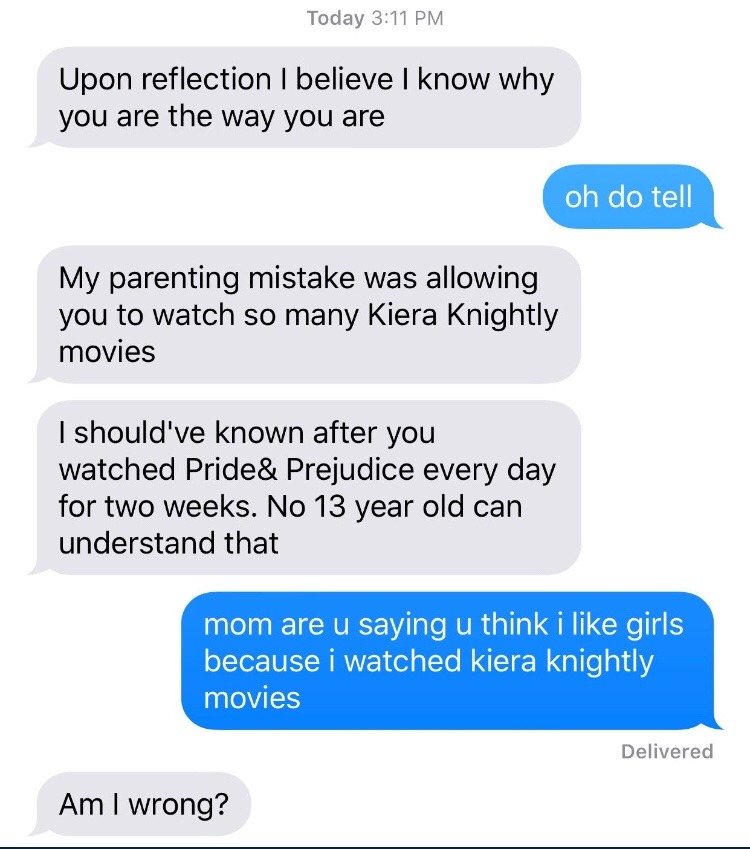
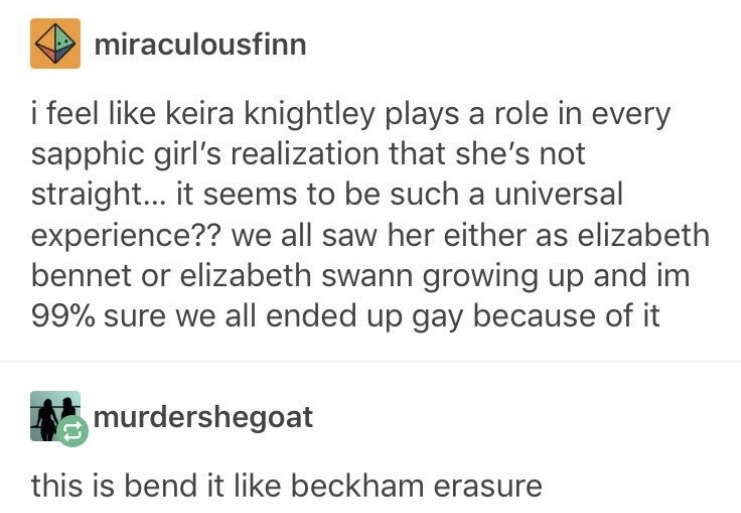
Does anyone else remember the story about that poor lesbian who came out to her mother and her mother cried and said “it’s all that damn Keira Knightley’s fault, I knew I shouldn’t have let you watch pride and prejudice as a child” because I’m really feeling that now
recently i taught one of my eighth grade classes about sappho. the main focus was on the structure and fragmentation of her poetry, but of course it’s hard to talk about sappho without talking about her love of women (though straight people manage to pull this off all the time, somehow)
i was very upfront with them about it. i didn’t dance around the topic. i told them that sappho was known for loving women romantically, and i showed them one of her poems about a woman. hearing the word lesbian did not blow their minds. they did not freak out at the idea of a woman loving other women. they were respectful and mature. they asked some questions- and they were smart questions, too, like whether sappho’s sexuality was part of the reason her poetry doesn’t survive. we even got into some of the dicier parts of ancient greek sexuality, like pederasty. when class was over, none of them were freaking out about having to learn about an ancient lesbian. they were arguing about taylor swift on their way out, because they’re in 8th grade and that’s what 8th graders do
if anyone ever tries to tell you that we shouldn’t tell students about queer people because they “can’t handle it,” that’s absolutely not true. students are absolutely capable of discussing lgbt issues, and they can even want to talk about it, because it’s something they might not feel comfortable bringing up on their own if they have questions. there’s no reason why students can’t be introduced to queer rights and queer people, even in middle school. even in elementary school. queer does not mean “not child friendly”
and if you don’t think middle schoolers should learn about queer folk…well, then i know a bunch of 8th graders who are far more mature than you
The other thing about the word “queer” is that almost everyone I’ve seen opposed to it have been cis, binary gays and lesbians. Not wanting it applied to yourself is fine, but I think people underestimate the appeal of vague, inclusive terminology when they already have language to easily and non-invasively describe themselves.
Saying “I’m gay/lesbian/bi” is pretty simple. Just about everyone knows what you mean, and you quickly establish yourself as a member of a community. Saying “I’m a trans nonbinary bi woman who’s celibate due to dysphoria and possibly on the ace spectrum”… not so much. You’re lucky to find anyone who understands even half of that, and explaining it requires revealing a ton of personal information. The appeal of “queer” is being able to identify yourself without profiling yourself. It’s welcoming and functional terminology to those who do not have the luxury of simplified language and occupy complicated identities. *That’s* why people use it – there are currently not alternatives to express the same sentiment.
It’s not people “oppressing themselves” or naively and irresponsibly using a word with loaded history. It’s easy to dismiss it as bad or unnecessary if you already have the luxury of language to comfortably describe yourself.
There’s another dimension that always, always gets overlooked in contemporary discussions about the word “queer:” class. The last paragraph here reminds me of a old quote: “rich lesbians are ‘sapphic,’ poor lesbians are ‘dykes’.”
The reclaiming of the slur “queer” was an intensely political process, and people who came up during the 90s, or who came up mostly around people who did so, were divided on class and political lines on questions of assimilation into straight capitalist society.
Bourgeois gays and lesbians already had “the luxury of language” to describe themselves – normalized through struggle, thanks to groups like the Gay Liberation Front.
Everyone else, from poor gays and lesbians to bi and trans people and so on, had no such language. These people were the ones for whom social/economic assimilation was not an option.
The only language left, the only word which united this particular underclass, was “queer.” “Queer” came to mean an opposition to assimilation – to straight culture, capitalism, patriarchy, and to upper class gays and lesbians who wanted to throw the rest of us under the bus for a seat at that table – and a solidarity among those marginalized for their sexuality/gender id/presentation.
(Groups which reclaimed “queer,” like Queer Patrol (armed against homophobic violence), (Queers) Bash Back! (action and theory against fascism, homophobia, and transphobia), and Queerbomb (in response to corporate/state co-optation of mainstream Gay Pride), were “ultraleft,” working-class, anti-capitalist, and functioned around solidarity and direct action.)
The contemporary discourse around “queer” as a reclaimed-or-not slur both ignores and reproduces this history. The most marginalized among us, as OP notes, need this language. The ones who have problems with it are, generally, among those who have language – or “community,” or social/economic/political support – of their own.
Oh hey look it’s the story of my growing up.
All of this is true.
Yes.
also, “qpoc” is a thing, like how about we not take away a term that a lot of people of color id with? thanks :))))
It’s the only word I have for what I am, that encompasses both identity and sexuality. It’s literally the only word. I’m not calling myself a “slur”, I’m using literally the only term that works to define me.
I’m not LGBTQ+. I’m not a catchall. I am a very specific thing.
I know there are people who don’t want it applied to them and I try to be considerate of that because I’m not a total asshole, but we CANNOT throw the term away.
Today is National Coming Out day and I wanted to reflect on my personal experience coming out.
If you would have told me 10+ years ago, that I would be an out and proud Transman inspiring others to live their authentic lives… I would have said, “You must have mistaken me with someone else.”
You see, courage doesn’t happen overnight. It takes time, and for me it took over a decade. I was in your shoes at one point, terrified of what the world had in store for me as a member of the LGBTQ community. I would pray to not be the way that I was and hope to wake up the next morning “cured.”
When I realized that wouldn’t happen, I had to figure out ways to be happy the way that I am. I began to love myself for me and found pride in my identity. I took baby steps coming out to trusted friends and made my own little support system. Through them I gained my strength and am able to stand in front of you today unafraid and unapologetically myself.
Was coming out difficult?
Extremely.
Was it worth it?
Every second of it.
My only regret in my coming out process was that I didn’t do it sooner.
To anyone that has come out: I applaud you on your courage and wish you all the best on your journey.
To anyone who has yet to come out: Know that in time you will find your strength and that you have a whole community waiting for you.
OKAY SO PEOPLE WANTED TO KNOW SO I DID MY BEST TO REWRITE IT!
(I HOPE IT MAKES SENSE I AM VERY TIRED AND THIS IS A LOT OF TEXT.)
My HC for Dwarf Beards and Gender Presentation
So the first thing you need to know is the average dwarf will have a primary braid and a secondary pair of braids to either side of it. These two sets of braids denote different things so
Primary Braid
The Primary Braid is the large braid down the center of the beard. Traditionally there are three recognized genders in Dwarven Society, though they do acknowledge an individual’s desire to express themselves in new ways. A traditional 3-strand braid denotes male preferred pronouns, a 4-strand braid denotes female preferred pronouns, and a 2-strand twist denotes a non-binary dwarf with gender-neutral pronouns. These are entirely based on gender expression and not related to sex or genitalia of the dwarf, which is considered a private matter that matters to no one but the dwarf and their mate.
It is possible for a dwarf not to have a primary braid, but this style is considered a time of transition or change in a dwarf’s life, and gender-neutral pronouns should be used until otherwise stated. Some dwarves cut off their primary braid when moving away from their home so as to reevaluate and reinvent themselves in their new residence, but it is not something all dwarves do.
The majority of dwarves use he/him pronouns outside of all-dwarven societies due to gender stigma against female presenting dwarves by other species, but in an all-dwarven society the mix of genders will be fairly even.
To save timelines I put the rest under the cut, but I talk about more below!
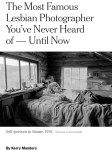
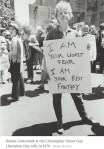
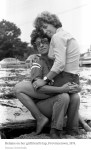
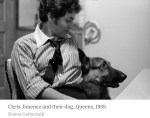
Donna Gottschalk’s “Brave, Beautiful Outlaws” is opening at Leslie-Lohman Museum of Gay and Lesbian Art on Aug. 29. While Ms. Gottschalk doesn’t identify as a documentary photographer or a photojournalist, she has been making pictures since she was 17. Photos selected from her 50-year personal archive will be made public for the first time.
Her work documents her closeness with her working class family and her involvement with the radical lesbian, sometimes separatist, communities in the late ’60s and ’70s.
The photos are tinged with mourning and mystery. She’s been holding their memory for decades, “fiercely protective” and unwilling to “subject them to scrutiny, judgment and abuse” from the outside world.
”Understand, people didn’t care about them or my pictures of them back in the day,” she said. “These people were all very dear to me, and they were beautiful. These pictures are the only memorial some of these people will ever have.”
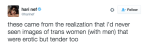
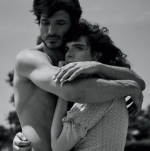
Nef goes on to explain the difference between her photoshoot with Velencoso, versus how transgender women are typically photographed in fashion editorials. “images of trans femmes being loved rarely exist outside of pornography,” Nef wore. “We tend to be hyper-sexualized and objectified within the cisgender gaze. Either that or we’re dehumanized as scum or (just as bad) untouchable goddesses.”
















 Steel Phoenix Studios