good morning everyone have an absolutely furious mongoose
It’s cuter when you recognize that the lion with visible spots is a juvenile. There’s a very high chance the other lion that runs over to investigate is the MOTHER.
The first lion is asking for comfort because she was given a big spook!!! and she needs mommy to tell her it’s safe and ok!!!! (What’s cuter is that mommy clearly reassures her, and goes on to take the parent role of ‘deal with the scream rat in order to protect my large and easily frightened daughter’)
The opposite of albinism called melanism, a recessive trait where the skin and fur are all black.
nature & real talk
Holy shit that’s majestic.
Yes, the powers of Photoshop are indeed majestic
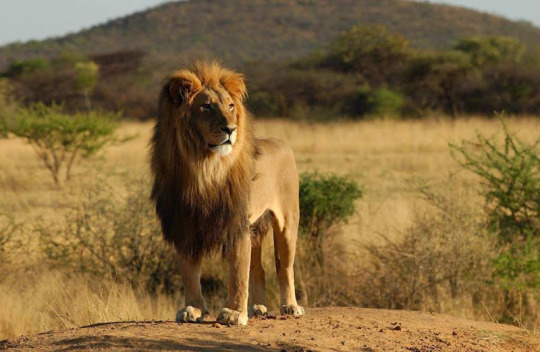
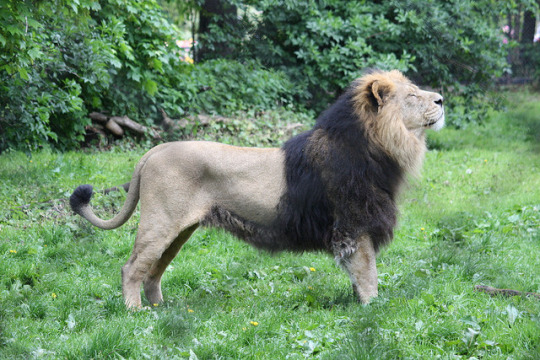
So far the closest thing we have to melanistic lions are the black-mained Asiatic lions
(Panthera leo persica), and it’s not known whether lions are even able to be melanistic!
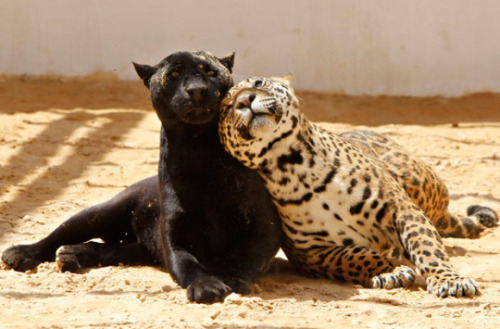
The only melanistic big cats we know of are jaguars…
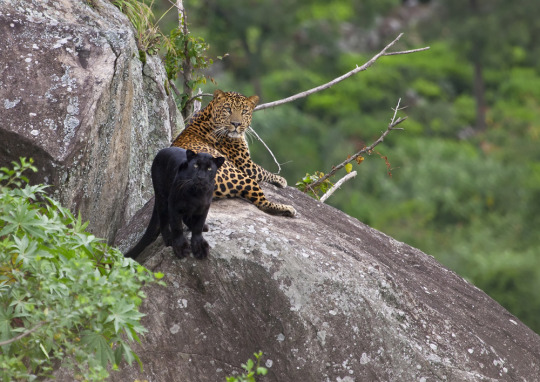
…and leopards.
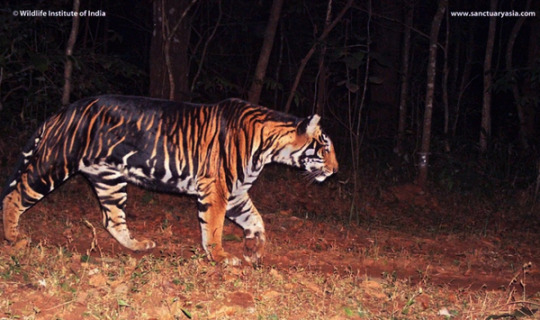
We do, however, know of abundism in other big cats! What’s abundism you may ask? Well, it’s basically when places that normally have a lot of melanin end up producing an abundance of it. So an abundistic tiger looks like this:
And an abundistic cheetah looks like this:
And just for good measure, here’s an abundistic leopard:
This has been a PSA!
Oooh okay, I want to jump in here, purely because I saw this and it brought back my childhood fascination with king cheetahs so I had to infodump.
As far as I can tell, that is actually a king cheetah, not an abundistic cheetah. From a brief bit of research, the king cheetah coat pattern isn’t strictly caused by abundism, but is actually caused by a recessive mutation in a gene responsible for coat patterning.
It was found that a mutation in the Taqpep gene is what causes the king cheetah coat pattern where “the black spots coalesce into larger areas, and multiple longitudinal black stripes appear on the dorsum“. Just to illustrate this a little better, here’s a regular cheetah on the left, with a king cheetah on the right
The scientists who discovered that this mutation was responsible for king cheetah patterning actually first discovered the mutation in domestic cats. It is the same gene that causes the blotched tabby mutation (as opposed to the striped/mackerel tabby coat pattern).
It gets slightly more complicated after that. The scientists also found that, while the Taqpep gene is responsible for patterning the areas of yellow vs black coat colour, it isn’t directly responsible for producing a darker coat (the taqpep gene is found in low levels in both light and dark areas of the cheetah/cats skin). This raises the question, if Taqpep isn’t directly changing coat colour, then what is?
After some investigation in fetal cats (and some confirmation tests done in lab mice), it was found that Edn3 was the gene responsible. Edn3 produces a hormone that up-regulates the differentiation and grown of melanocytes (the cells that produce melanin). So, putting things all together: it seems that Taqpep expression sets up an invisible zones of patterning, and these zones determine the level of expression of Edn3. By extension, this increases the number of melanocytes present in the skin, and thus the yellow vs black coat colour. Mutations in the Taqpep gene lead to wider, more erratic zones of colouration, which leads to the blotched coat pattern responsible for king cheetahs.
Okay, so, I know this wasn’t really at all related to the original post, or even the comment above, it was mostly just my sudden need to infodump my knowledge on king cheetahs. I do apologise if I’ve over-stepped, and if people would rather I removed my comment and just made a separate post, I can do that. Also, I apologise for any factual errors I’ve made in this post; it’s mostly what I’ve learnt from quickly skimming through the paper and trying to summarise what I could (the paper itself is very informative and goes into a lot more detail than I have if you’re interested in this kind of thing). If you spot any glaring mistakes, let me know and I’ll happily edit this where necessary.
Reference:
Kaelin, C., Xu, X., Hong, L., David, V., McGowan, K., Schmidt-Kuntzel, A., Roelke, M., Pino, J., Pontius, J., Cooper, G., Manuel, H., Swanson, W., Marker, L., Harper, C., van Dyk, A., Yue, B., Mullikin, J., Warren, W., Eizirik, E., Kos, L., O’Brien, S., Barsh, G. and Menotti-Raymond, M. (2012). Specifying and Sustaining Pigmentation Patterns in Domestic and Wild Cats. Science, 337(6101), pp.1536-1541



 Steel Phoenix Studios