I feel like we as a society don’t talk enough about the fact that Faramir and Boromir could see the future, and that Faramir might have been a fucking psychic??
No listen now I’m finding page references because I honestly can’t believe I didn’t find this weirder the first million times I read these books
So we all know that the reason Boromir goes to see Elrond in the first place is because Faramir has been having these dreams about “seeking the sword that was broken” in Imladris and that Isildur‘s bane is there and such. Presumably after Denethor ignores him for long enough, whoever is sending out these prophetic dreams gets fed up and sends one to Boromir so Denethor will actually finally listen and take action (my complex feelings about Denethor are for another post lmao)
So there’s some solid evidence that Faramir, and at least to some extent Boromir can fucking. SEE THE FUTURE. And that little fact just doesn’t really get brought up again AT ALL in Fellowship of the Ring? (JRR Tolkien I love you but why were we deprived of the random travel conversations the fellowship must have had while traveling all over middle earth together)
Later on, Faramir describes seeing Boromir’s body in the boat he was sent down the Anduin in, and he knows way ahead of time that Boromir was dead – another instance of somehow knowing about things that happened hundreds of miles away when there is ABSOLUTELY no way he should have.
BUT THEN things get a lot weirder in The Two Towers when Faramir captures Frodo and Sam and Gollum. Faramir is interrogating Gollum about whether he had ever been to Henneth Annun before, and this is what happens:
Slowly Gollum raised his eyes and looked unwillingly into Faramir’s. All light went out of them, and they stared bleak and pale for a moment into the clear unwavering eyes of the man of Gondor. There was a still silence. Then Gollum dropped his head and shrank down, until he was squatting on the floor, shivering. “We doesn’t know and we doesn’t want to know,” he whimpered. “Never came here; never come again.”
“There are locked doors and closed windows in your mind, and dark rooms behind them,” said Faramir. “But in this I judge that you speak the truth.”
– The Two Towers, pg 689
That’s kind of a really weird thing to say. Maybe Faramir is being poetic and not literal when he says he can see into Gollum’s mind, but the elaborate description of their eye contact almost makes it seem like there’s something else going on here. Plus, somehow the eye contact alone is enough for Faramir to judge definitively that Gollum is telling the truth. This brings up something Gandalf says to Pippin about Denethor:
“[Denethor] is not as other men of this time, Pippin, and whatever be his descent from father to son, by some chance the blood of Westernesse runs nearly true in him; as it does in his other son, Faramir, and yet did not in Boromir whom he loved best. He has long sight. He can perceive, if he bends his will thither, much of what is passing in the minds of men, even of those that dwell far off. It is difficult to deceive him, and dangerous to try.“
– The Return of the King, pg 759
Like father, like son, it seems. I bet Denethor just loved that.
Again, maybe Gandalf is just speaking figuratively and is saying that Denethor is just really insightful. But it’s kind of weird to interpret it like that that in light of Gandalf putting that right next to a statement about Denethor’s bloodline that makes him and Faramir “different” somehow. Is Gandalf saying that they both can literally perceive “what is passing in the minds of men”??
BACK TO ITHILIEN (sorry this is more of a ramble than a well structured essay)
Faramir is asking Gollum if he knows what Cirith Ungol really is:
“It is called Cirith Ungol.” Gollum hissed sharply and began muttering to himself. “Is not that its name?” said Faramir turning to him.
“No!” said Gollum, and then he squealed, as if something had stabbed him. “Yes, yes, we heard the name once.”
– The Two Towers, pg 691
“As if something had stabbed him”?? There’s really no indication of what this “stabbing” could be in this context. It’s not Smeagol trying to keep Gollum from spilling the beans, because Gollum is the one who wants to keep the hobbits in the dark about Shelob. So who/what is stabbing his fucking mind?
Faramir sends Gollum away with Anborn and is talking to Frodo about Gollum.
“I do not think you should go with this creature. It is wicked.”
“No, not altogether wicked,” said Frodo.
“Not wholly, perhaps,” said Faramir; “but malice eats it like a canker, and the evil is growing. He will lead you to no good.”
– The Two Towers, 691
Gollum leading Frodo to no good might be the understatement of the year, as well as an incredibly accurate one. I don’t need to keep saying this but of course he could be speaking poetically or figuratively. It just seems to me that there’s a LOT of these instances over the course of these books.
Putting Denethor and Faramir in a room together is, of course, always fucking wild for a MYRIAD of reasons, but let’s look at (the part that always fucking kills me) this scene:
“Do you wish then,” said Faramir, “that our places had been exchanged?”
“Yes, I wish that indeed,” said Denethor. “For Boromir was loyal to me and no wizard’s pupil.”
–The Return of the King, pg 813
I’m pretty sure this is the first(?) instance of Faramir being referred to as Gandalf’s pupil. I’m highlighting this point because it kind of sets a precedent as to why Faramir and Denethor, despite both seeming to have these supernatural abilities to read people and situations, come to SUCH different conclusions about what to do with The Ring. Faramir has been studying with Gandalf, a magical wizard, since he was a kid. I really don’t think it’s that far of a stretch that Gandalf, who once again is literally a god or Maia or whatever, was able to teach him how to actually use this ability to read and/or influence minds. (Plus he wasn’t wrecking his own mind by staring into a palantir 24/7 but I digress)
I’ve been writing for too long, so here’s just a couple of other points that come to mind.
When Denethor is on the pyre, Faramir, who apparently hasn’t moved for like two straight days, somehow seems to know that his father is nearby
When Faramir is retreating from Osgiliath the first (second overall, first in the book) time, he can somehow get his horse to turn around and go back for the men being chased by FIVE NAZGUL when every other instance seems to involve people and animals just immediately losing their shit
When he’s talking to Eowyn in Houses of Healing, he mentions that this situations “reminds” him of Numenor’s destruction, which took place, hmm, an AGE ago. And he says that he dreams about this all the time (this one is linked to that weird ability to see things happening when they’re not happening in real time)
Anyway. Those are my two cents on the subject. Everyone in the line of Stewards is a fucking psychic to some extent and that’s what Tolkien intended
okay, it’s late and I don’t want to cite things but I really want to respond to this: yes! Yes, this is all 99% certainly true! Welcome to magic in LotR! This is the mother of all fantasy, but magic is not a flashy thing of wands and jets of light (HP) nor explicable on a frankly scientific level (Cosmere) nor even, say, the lack of definition and rules but the definitive effects, like time travel or mega lightning strikes, of Robin McKinley’s Damar books. No, LotR magic is incredibly subtle, and could at almost every turn be explained away by saying that a particular person is insightful, or inspiring, or just makes really good fireworks.
Seriously, Gandalf is The Wizard, but the most explicit magic we see him do is those more-than-natural fireworks at Bilbo’s going-away party, and in RotK when he, like, “casts a light” at a swooping Nazgul. Compare him reviving Theoden in the book vs in the film, which of course follows a more modern (and film-appropriate) dramatic view of magic – sure, the book has a bit of illusory storm and then light, and Gandalf definitely knocks Wormtongue out for lightning for a moment, but there’s no weird possession and magically induced aging going on. It’s like 90% psychology. (”Headology” – Pratchett knew what was up.) Note that this passage is begun with Gandalf singing, in the book – song is magic/divine power, in LotR, ever since Eru first began singing the world into existence. It is arguably not a matter of characters casting spells so much as a signifier to the reader that “magic” is happening now, or about to? But also it’s straight-up a spell. It’s no mistake that the runes readable on the Ring are a part of a poem describing its power and intent.
Faramir can use such power, a little, as can Denethor and Aragorn, because in all three of these men, the blood of Westernesse runs strong – in Aragorn in particular, who can heal, and wrest the focus of a Palantir away from Sauron with will and right. (It helps, per the extremely vague rules that govern LotR’s magic, that the Palantir is his by right of inheritance. For extra fun, se…a post somewhere that I’m not going to spend more time finding about how Frodo arguably “cast the spell” that sealed Gollum’s fate.)
Anyway, yeah, Faramir and Denethor have, like, metaphorical recessive genes of what Aragorn has in a more truly direct line, that is, a the blood of the Men of Westernesse, who were given longer lives and a home in sight of Valinor (home of the gods, ish) way back when. Literal physical proximity to Valinor is a rough equivalency for Right/Good and, consequently, granted Magic/Divine Power in The Silmarillion, or at least classist elves think so. Perhaps, as rumored, there’s even a dash of elvish blood in them, though I’m skeptical of that – Elrond does have two spare uncles, whose fates are unclear, but there are really only supposed to be 3 unions of Elf and Man and we know about all of their progeny. Possibly Elros got around, but he would have been doing that in the early days of Westernesse anyway, sooo…same thing.
Tldr: You’re absolutely right, but it’s deliberately vague bc that’s just how LotR works, and I love it.
Anyone else here familiar with the essay
Ósanwe-kenta? It’s subtitled/translated “Enquiry into the Communication of Thought” and is the closest Tolkien gets to discussing the actual rules of “magic” in Arda. The rules concerning telepathy (as understood by the Eldar and written down by Pengolodh), are outlined and discussed.
It was published in volume 12 of HoME, The Peoples of Middle-Earth, and was written sometime around 1960, so a few years after Return of the King was published, and according to the Tolkien Society’s timeline, shortly after his retirement and at the same time as several of his other essays about Middle-Earth.
Although Tolkien was beginning to rework parts of his cosmology at this point, I find that the concepts and details discussed Ósanwe-kenta are very consistent with the descriptions of telepathy found in LotR, of which several examples have already been discussed.
In brief, telepathy is an ability inherent to all minds (sámar, here distinguished from fëar, spirits). Bodies tend to get in the way, though, so it is harder for Incarnates to use than for Ainur, and harder for Men than for Elves. Therefore, Incarnates typically need their telepathy to be strengthened for effective communication. This can happen through affinity (as between family or friends), urgency (any great need), and authority (duty, or rightful command). Furthermore, any mind can refuse to permit entry of any other’s thought.
By these conditions, then, Faramir’s questioning of Gollum makes more sense. As the Steward’s son and an officer of Gondor in one of Gondor’s territories, Faramir has the authority to find out what Gollum knows and ensure he is not a danger to Gondor or ally of Sauron. This would naturally strengthen his telepathy, which is probably already stronger than average due to his Númenorean heritage. The “closed doors” he perceives in Gollum’s mind are likely his experience of Gollum refusing to allow him in fully, so Faramir is limited to mostly observation. Whether or not Faramir knows exactly what he’s doing, this leads to a very accurate assessment of Gollum.
Faramir, Denethor, and Gandalf aren’t the only ones who are shown using telepathy, either. Aragorn does it repeatedly and deliberately, particularly after entering Gondor. Galadriel examines the Company telepathically upon their arrival in Caras Galadhon. Sauron seems to use telepathy to command and control his armies. Celeborn, Galadriel, Elrond, and Gandalf chat that way on the journey home.
Okay, if you couldn’t tell, I really like this subject, and think it’s a pity it’s not more widely recognized. Tolkien is always stranger than most people assume, and it’s wonderful.
Pointless LOTR headcanon of the day: Frodo & Merry both take after their mothers, meaning Frodo looks more like a Brandybuck than a Baggins and Merry looks more like a Took. This is a constant source of petty contention.
(Pippin meanwhile absolutely takes after his father & is the most Tookish looking)
Merry: call me a Took one more time
Gandalf: if it looks like a Took and acts like a Took it’s a Took
Merry: I will END you
Gandalf is the only nonhobbit in the fellowship who understands the minutiae of Took Vs Brandybuck Vs Baggins rivalry & he delights in it, everyone else baffled
Frodo: look it’s perfectly simple. The Brandybucks don’t like the Tooks because they play golf and think they’re better than everyone because they occasionally go on adventures. The Tooks don’t like the Brandybucks because they live on the wrong side of the river and like boats. And nobody likes the Bagginses because they’re annoying.
Aragorn: are you… Including yourself in that
Frodo: I said what I said.
Frodo: now the Bagginses don’t like the Brandybucks OR the Tooks because they’re highly disrepectable but also richer than they are. And as far as a lot of the Bagginses are concerned I’m a Brandybuck because I grew up in Buckland and I have the Brandybuck Profile
Merry: which just means he’s not pug-ugly
Frodo: quite.
Aragorn: this is all ridiculous. Keep going.
Gandalf: Hm now I wouldn’t say UGLY but… every Baggins I’ve ever met has been perfectly Round or perfectly Square… There is no middle ground.
Gimli, baffled: Frodo isn’t round OR square
Merry: that’s because he has the Brandybuck profile
Gimli: so… Is he a Brandybuck…
Merry: ABSOLUTE not
Frodo: slander!! I’m a Baggins how dare you
Pippin: was your father a Round Baggins or a Square Baggins
Frodo: my father… Was the ROUNDEST Baggins who ever lived… A perfect Sphere of hobbit…
Tolkien would absolutely approve of this. It’s the kind of pointless minutia he loved.
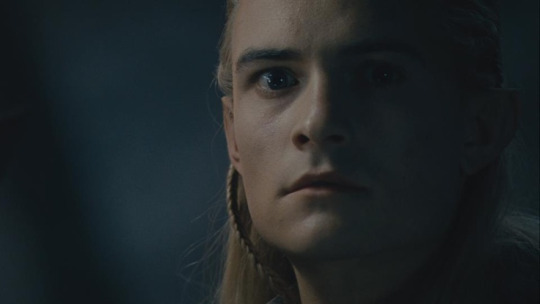
This is right after Gandalf says, “A balrog. A demon of the ancient world.”
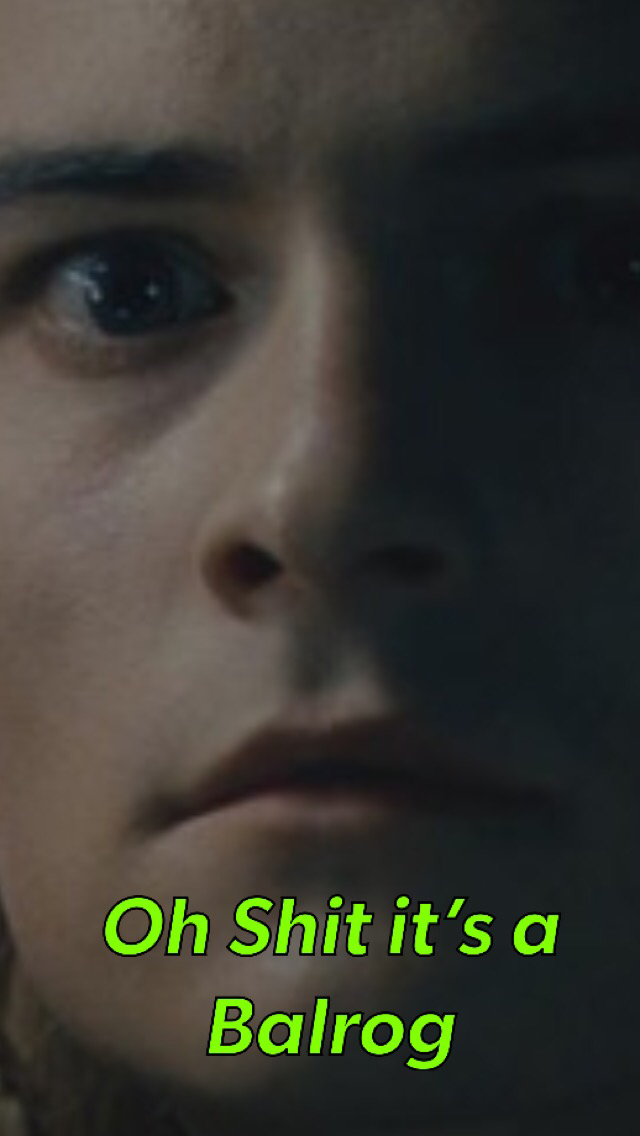
I just love how PJ chose to cut to Legolas’ face because he is exactly who you should cut to at this moment. You need an elf to show what it really means. Other than Gandalf, the rest of the Fellowship can sense something is gravely wrong, but they don’t understand just how grave. Like Gandalf, Legolas knows the terror. He understands the gravity of what lies around that corner. He’s got a piddly little bow and he is mere steps away from a demon of the ancient world. This frame shows a kid coming to the realisation that he is way out of his depth, that this mission will take him to places he only knew to exist in legends of the Elder Days, a time long gone, barely history.
He’s probably one of the youngest elves in Middle Earth at this point. He probably grew up on stories of the balrogs, slaying the ancient High Kings of the Eldar and tearing Middle Earth apart, thousands and thousands of years ago. They are legends in old crumbling books, read illicitly by a little elfling who was kept up at night by the terrible tales.They are the monsters under the bed and the shadows in the heart of the forest. They are the beasts behind the winged hordes of hell, that older elves, who’ve seen the worst that Arda has to offer, always assured him were no more than distant nightmares, stories relegated to dust and ancient memory. Except now they are real. They are here. They are coming.
The best part is that in the books he just starts screaming when he lays eyes on it
In its right hand was a blade like a stabbing tongue of fire; in its left hand it held a whip of many thongs.
‘Ai! ai! wailed Legolas. “A Balrog! A Balrog has come!’
Legolas can be relied upon to have the correct reaction to everything.
It is not necessarily normal, or socially appropriate, or sane, but it is always 100% correct.
“Many places I have been Many sorrows I have seen But I don’t regret nor will i forget All who took that road with me.” (The Last Goodbye, Billy Boyd).
“The Company of Thorin & the Fellowship od the Ring, after Rivendell”, watercolours and golden ink.
I think we really don’t give Tolkien enough credit for writing passionate male characters. And by passionate, I mean caring, kind, perhaps even emotional.
Like Finrod Felagund, who gave his own life to protect the son of the man that saved his life, and sang to the humans and loved them and wanted to teach them all he knew.
Like Elrond half-Elven, who despite having lost so much and having lived through so much bloodshed, still cares enough to read moon runes to a bunch of stubborn dwarves, and to give Bilbo a place to stay in his old age even if just for a little while.
Like Frodo Baggins and his Samwise Gamgee, who against all odds fought for a noble cause despite personal expense and who truly loved each other, because like Sam said, ‘I love him whether or no.’ And like Bilbo, who had a kind soul and wept when Thorin Oakenshield died.
Like Maedhros and Maglor, who despite their misdeeds, raised Elrond and Elros in an attempt to make up for all the harm they did, and wanted to find Elured and Elurin. And because in the end, their repentance was what decided their fate in the sea and under the earth.
Faramir’s love and mourning for Boromir, Turgon’s love for Hurin and Huor… you could even talk about Melkor’s desire to create. I could keep going on and on but I think the point is clear. Tolkien just didn’t write male characters, he wrote sensible, caring male characters.
The media often makes it so that female characters are seen as more emotional, more passionate about certain things… like Hermione Granger, who was so passionate about domestic elves, or Deanna Troi, the ship’s counselor in Star Trek TNG that tries to help everyone. But how often do we ever see male characters like the ones Tolkien gave us? Male characters that actually cry, mourn and feel openly?
I would just like to thank Professor Tolkien for actually writing real, feeling men. As a guy that feels that he has to repress his emotions to feel manly, these characters mean the world to me.
Book Frodo: linguistics nerd, hoards books, thinks he is very smart, acts chill but is actually stressed out 100% of the time, will infodump at you about elvish poetry
Film Frodo: Some kind of hipster, probably has anxiety, Elijah Wood’s Beautiful Blue Eyes, has bruises he doesn’t remember getting bcos he’s a clumsy fuck, too good for this sinful (middle) earth
Book Sam: cries when overwhelmed, writes poetry (but is too embarrassed to show it to anyone), Soft ™, drinks beer directly out of the tap, made of feelings and determination, basically a humanoid golden retriever
Film Sam: winner of world’s biggest Dad Friend award, smacks orcs w a frying pan, loves bacon, has accidentally punched self in face at least once,
(ง •̀_•́)ง
Book Merry: acts like a jaded elderly man even though he’s the hobbit equivalent of like 22, fantasises about being a Brave Knight so he can protect his friends, Brandybuck Pride!!, loves pipeweed to a near sexual degree
Film Merry: definitely a stoner, steals vegetables, says ‘fight me’ to people twice his size, Sarcasm is his primary weapon, can eat his own weight in ham
Book Pippin: baby bi, Smol, has 0 impulse control, calls everyone ‘fellow’, does not listen when people talk to him because he is thinking about sandwiches
the lord of the rings gets a lot funnier when you realise that merry and pippin were stoned out of their minds a good half of the time
imagine you and your best friend both have the munchies so you decide to
raid the local farmer’s field when you literally run into your two of
your smoking buddies from the shire and they tell you they’re hiking to
bree to meet gandalf, who you know has some top quality hash stashed on
his person at all times, so you agree to go with them and somehow end up
on a thousand-mile hike to destroy a piece of evil jewellery in a
volcano. congratulations. you’re merry and pippin now.
“Don’t go where I can’t follow” is one of the most anguish inducing and crushing otp lines out there and the fact that this line originated from Samwise Gamgee, a brave gardener with tender hands, just? Aches. There’s literally no heterosexual explanation for how Sam and Frodo treated each other






 Steel Phoenix Studios