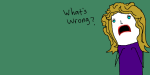
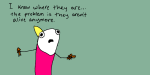
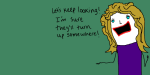
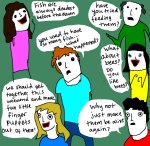
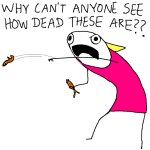
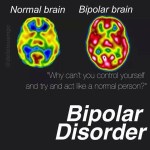
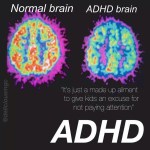
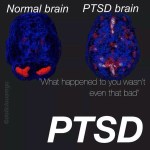
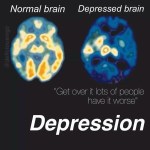
And that’s the most frustrating thing about depression. It isn’t always something you can fight back against with hope. It isn’t even something — it’s nothing. And you can’t combat nothing. You can’t fill it up. You can’t cover it. It’s just there, pulling the meaning out of everything. That being the case, all the hopeful, proactive solutions start to sound completely insane in contrast to the scope of the problem.
It would be like having a bunch of dead fish, but no one around you will acknowledge that the fish are dead. Instead, they offer to help you look for the fish or try to help you figure out why they disappeared. (x)
This is actually a really good way to explain it, I think.
I WILL NEVER NOT REBLOG THIS
I’ve seen this reblogged without the original caption before and boy was i confused
Wait, this version of the post misses out what I think is the most important bit of the paragraph
“The problem might not even have a solution. But you aren’t necessarily looking for solutions. You’re maybe just looking for someone to say “sorry about how dead your fish are” or “wow, those are super dead. I still like you, though.”“
“The phenomenon of female anger has often been turned against itself, the figure of the angry woman reframed as threat […] She conjures a lineage of threatening archetypes: the harpy and her talons, the witch and her spells, the medusa and her writhing locks. The notion that female anger is unnatural or destructive is learned young; children report perceiving displays of anger as more acceptable from boys than from girls.”
— LESLIE JAMISON, I Used to Insist I Didn’t Get Angry. Not Anymore. (via rnyfh)
some people who are ill and/or disabled CANNOT DO WHATEVER THEY SET THEIR MIND ON! some people are LIMITED by their bodies and their health and they are UNABLE to “"just choose”“ to do something! you can’t STOP being disabled by DECIDING to have a ”“good attitude”“! I am PREVENTED from doing whatever I want because I am D I S A B L E D!!
I would super appreciate it if healthy/abled people reblogged this post, because when people say these things it is so harmful to disabled, chronically ill, and mentally ill people
also! saying “I can’t do this because im disabled” is NOT “negative self-talk” or a “bad attitude”!!
In practical terms it often comes down to “if I do this then I won’t be able to do x” where x is another thing I want to do, or something I have to do, or just being able to walk tomorrow. I could do that extra series of jumps and spins in dance class, but then I’d have to sit out rehearsing our dance later. Or I could do both, and plan to spend the rest of the day in bed recovering. Or I could do everything, and risk puking myself into another ER visit. There are some things I might risk an ER visit for. But on an everyday basis? Nah. I can’t do that.
I’m my own worst critic on this topic, so this is a good reminder. Limits are real. Fuzzy limits are real, hard limits are real, invisible limits are real. Tradeoffs and decisions are very real. Hard work and determination looks like rating your activity for the best possible outcome, which looks like a whole lot of saying “I can’t.”
It is making a spreadsheet of your debt and enforcing a morning routine and cooking yourself healthy meals and no longer just running from your problems and calling the distraction a solution.
It is often doing the ugliest thing that you have to do, like sweat through another workout or tell a toxic friend you don’t want to see them anymore or get a second job so you can have a savings account or figure out a way to accept yourself so that you’re not constantly exhausted from trying to be everything, all the time and then needing to take deliberate, mandated breaks from living to do basic things like drop some oil into a bath and read Marie Claire and turn your phone off for the day.
A world in which self-care has to be such a trendy topic is a world that is sick. Self-care should not be something we resort to because we are so absolutely exhausted that we need some reprieve from our own relentless internal pressure.
True self-care is not salt baths and chocolate cake, it is making the choice to build a life you don’t need to regularly escape from.
And that often takes doing the thing you least want to do.
It often means looking your failures and disappointments square in the eye and re-strategizing. It is not satiating your immediate desires. It is letting go. It is choosing new. It is disappointing some people. It is making sacrifices for others. It is living a way that other people won’t, so maybe you can live in a way that other people can’t.
It is letting yourself be normal. Regular. Unexceptional. It is sometimes having a dirty kitchen and deciding your ultimate goal in life isn’t going to be having abs and keeping up with your fake friends. It is deciding how much of your anxiety comes from not actualizing your latent potential, and how much comes from the way you were being trained to think before you even knew what was happening.
If you find yourself having to regularly indulge in consumer self-care, it’s because you are disconnected from actual self-care, which has very little to do with “treating yourself” and a whole lot do with parenting yourself and making choices for your long-term wellness.
It is no longer using your hectic and unreasonable life as justification for self-sabotage in the form of liquor and procrastination. It is learning how to stop trying to “fix yourself” and start trying to take care of yourself… and maybe finding that taking care lovingly attends to a lot of the problems you were trying to fix in the first place.
It means being the hero of your life, not the victim. It means rewiring what you have until your everyday life isn’t something you need therapy to recover from. It is no longer choosing a life that looks good over a life that feels good. It is giving the hell up on some goals so you can care about others. It is being honest even if that means you aren’t universally liked. It is meeting your own needs so you aren’t anxious and dependent on other people.
It is becoming the person you know you want and are meant to be. Someone who knows that salt baths and chocolate cake are ways to enjoy life – not escape from it.”
The thing I hate most about depression is that it tricks you into thinking you don’t have depression. It makes you think that nothing is wrong with you, that you just feel this way because you lack value as a person. Whether that’s in your relationships, your academics, or a view of yourself, it makes you think you aren’t good enough for any of that.
“It’s not the illness,” it says, “You feel this way because it’s who you are.”
Me: I can’t get out of bed today, what is wrong with me. I’m so lazy and terrible and I am a huge flake and there has got to be something wrong with me.
Adaptable girls find socially acceptable ways to internalize or channel their discomfort and ire, sometimes at great personal cost. Passive aggressive behavior, anxiety, and depression are common effects. Sarcasm, apathy, and meanness have all been linked to suppressed rage. Troublesome behaviors, such as lying, skipping school, bullying other people, even being socially awkward are often signs that a teenager is dealing with anger that they are unable to name as anger.
Girls, taught to ignore their anger, become disassociated from themselves.
Anger is so successfully sublimated that girls lose the ability to understand what it feels and looks like. Is her heart racing? Does she feel flushed or shaky? Does she clench her jaws at night? Is she breaking out in hives? Does she cry for no reason? Laugh inappropriately during difficult conversations? Fly off the handle over something that seems inconsequential? You can see where I’m going here…those crazy girl hormones, right? Better to just think of it as a phase.
For too many women, however, the phase never ends. It’s lives spent never expressing anger at all and believing that they don’t have the right or ability to do so without great risk.
Ok this is important. I feel like this all the time.
I really feel this. A conversation I had with my psychologist last year after I described what I thought was an anxious reaction to somehow who’d hurt me calling me randomly after over a year. My heart was racing and I was shaking and felt hot all over and was on the verge of tears, and she said. “That sounds like anger. You’re allowed to be angry.” And I became very aware that I had not been able to identify my own anger and even know what it feels like up until that point.
Sometimes people hit a place in their life where things are going really well. They like their job and are able to be productive at it; they have energy after work to pursue the relationships and activities they enjoy; they’re taking good care of themselves and rarely get sick or have flareups of their chronic health problems; stuff is basically working out. Then a small thing about their routine changes and suddenly they’re barely keeping their head above water.
(This happens to me all the time; it’s approximately my dominant experience of working full-time.)
I think one thing that’s going on here is that there are a bunch of small parts of our daily routine which are doing really important work for our wellbeing. Our commute involves a ten-minute walk along the waterfront and the walking and fresh air are great for our wellbeing (or, alternately, our commute involves no walking and this makes it way more frictionless because walking sucks for us). Our water heater is really good and so we can take half-hour hot showers, which are a critical part of our decompression/recovery time. We sit with our back to the wall so we don’t have to worry about looking productive at work as long as the work all gets done. The store down the street is open really late so late runs for groceries are possible. Our roommate is a chef and so the kitchen is always clean and well-stocked.
It’s useful to think of these things as load-bearing. They’re not just nice – they’re part of your mental architecture, they’re part of what you’re using to thrive. And when they change, life can abruptly get much harder or sometimes just collapse on you entirely. And this is usually unexpected, because it’s hard to notice which parts of your environment and routine are load bearing. I often only notice in hindsight. “Oh,” I say to myself after months of fatigue, “having my own private space was load-bearing.” “Oh,” after a scary drop in weight, “being able to keep nutrition shakes next to my bed and drink them in bed was load-bearing.” “Oh,” after a sudden struggle to maintain my work productivity, “a quiet corner with my back to the wall was load-bearing.”
When you know what’s important to you, you can fight for it, or at least be equipped to notice right away if it goes and some of your ability to thrive goes with it. When you don’t, or when you’re thinking of all these things as ‘nice things about my life’ rather than ‘load-bearing bits of my flourishing as a person’, you’re not likely to notice the strain created when they vanish until you’re really, really hurting.
Almost two weeks after reading this, and I’m still kind of blown away at what a ridiculously fruitful definition this is. Like I had no idea that load bearing things were a thing that needed to have a word for them, but now I’m like holy shit I’m so glad that there’s now a word I can use to refer to this really important class of Thing.
This is astounding. Load-bearing. Forget spoons, this concept is wonderful. I’m going to update my Spear Theory with this.
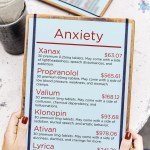
This week’s current issue in mental health: the price of medication. With numerous people sharing stories about how medication was the first step when they were getting help, we wanted to point out how the cost of these treatments is prohibitive especially for people without insurance.