this is one of the most important LGBT articles I have ever read in my life. It struck several chords with me and I recommend everyone to take some time to read it.
I was just reading this post about gendered socialization as it relates to emotional labor and I can’t find it anymore but I suspect the topic is particularly relevant to this post. Men, including gay men, never learn how to do emotional labor in their interpersonal relationships and straight men offload that labor onto their wives and girlfriends more often than not but if there’s no women around to offload the emotional labor it just … doesn’t get done. They just get increasingly mentally unwell????
So like, someone tell Michael Hobbes I have a very simple answer for his question.
Gay rights didn’t cure loneliness because toxic masculinity.
This is fascinating (in the sick to my stomach kind of way) that this is the same issues being brought up about bi, ace, and trans people: oversexualization of the community, the importance of positive representation and visibility, as well as intersectionality. It’s no wonder many minority groups don’t feel accepted into the LGBT community at large. They’re literally getting shamed out of the community by people trying to one up each other to display their masculinity to /feel loved at all/ and that’s. That’s a problem.
I also noticed this as a trans guy, but since I’ve had so much self made DBT skills on abuse and self care, especially related to my anxiety (where I got actual DBT), I’ve mostly shrugged it off and figured other guys in the community were doing that too. But thinking back on my experiences, that’s probably not actually as common as I thought.
Quote from article:
Pachankis, the stress researcher, just ran the country’s first randomized controlled trial of “gay-affirming” cognitive behavior therapy. After years of emotional avoidance, many gay men “literally don’t know what they’re feeling,” he says. Their partner says “I love you” and they reply “Well, I love pancakes.”
…Emotional detachment of this kind is pervasive, Pachankis says, and many of the men he works with go years without recognizing that the things they’re striving for—having a perfect body, doing more and better work than their colleagues, curating the ideal weeknight Grindr hookup—are reinforcing their own fear of rejection.
SERIOUSLY THOUGH SHE WAS MY FAVORITE BATMAN VILLAIN
Her physical condition didn’t allow her to age
No one took her seriously as an actress
And even when she was trying to get into a happy romantic relationship (albeit with another villain) he still couldn’t take her seriously as a consenting, sexually active and romantically interested adult
That’s a lot of blows to someone’s psyche
and Babydoll is both a sympathetic villain and a formidable one
I remember this episode fucked me up a a kid.
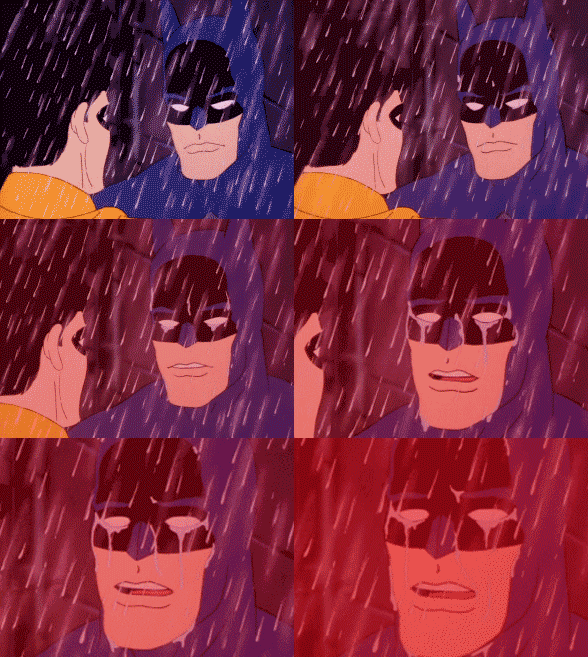
And man, do I wish we could see this Batman again: the Batman that consoles his villains, because the majority (if not all) of them are mentally ill people. And Batman knows this and wants them healthy again, not punished and GOD definitely not dead.
Baby Doll is so underrated as a Batman villain
but her episode was perfect
Batman: The Animated Series
The story of one fucked up, traumatized little boy, doing his best to help other fucked up traumatized people.
The Batman that cares about the inmates is my favorite. He doesn’t put up with their shit, but he does try to reach out here and there and he’s as human as he can be to them.
When Harley was re-institutionalized, he got her that dress she wanted.
In the comics based on B:tAS, there was a time during Christmas that there was snow and it was Mr. Freeze’s fault, and he was making it snow because Christmas was his anniversary with Nora and she LOVED it when it snowed on Christmas, so Batman let him finish mourning before calmly taking him back to Arkham.
He never, ever gives up on Harvey possibly recovering.
Sure, Batman is going to throw punches and do what it takes to take these guys down when they’re hurting or threatening people. And he’s not going be a complete bleeding heart; he has to protect the innocent. He’s going to take them down and take them back to Arkham, but it doesn’t mean he’s incapable of being a bit human to the ones who deserve it.
Batman needs become human again
Because it needs to be here:
Remember that time a young girl with near god-like psychic powers threatened to destroy reality and the only one that could stop her was Batman because he had a previous encounter with her and was tasked with killing her to restore reality.
But instead, Batman sat with her on a swing and kept her company as the girl’s psychic powers slowly killed her.
Still reading “You Mean I’m Not Lazy, Crazy or Stupid?” – a book for and about adults with add. And this is all me, especially that last bit.
rbing again to add that I want to thank op for posting this. seeing this on my dash several months ago was the very first time I ever considered I could have ADD/ADHD inattentive. I never had the slightest idea before. fast forward to now and I’ve been going to therapy and on medication and things have turned around so much for the better.
I’m so glad to hear that! That’s why I posted it, because I knew I couldn’t be the only person that this rang I giant bell with.
I WAS THAT LITTLE GIRL. THAT WAS ME.
I was AT THE SAME TIME this little girl and the “trouble with bright girls” little girl–I was told that I was smart enough to “compensate” so I didn’t need treatment/help, so anything I had difficulty with I had to avoid like the plague because even though I knew why it was hard for me because I had been told I had ADD, I also knew that my status of smartness was at risk any time I struggled with something, and had no idea how to actually consciously deal with my ADD when natural ability/terror of deadlines didn’t get me through.
thank you carrie fisher for owning your life despite mental illness and despite addiction and despite 40 years of shaming and bullshit thank you for making it okay to talk about mental illness in a way that isn’t always fun and thank you for making it okay to be mentally ill and unashamed of it thank you for owning mental illness thank you for 60 years of telling the world to go fuck themselves if they didn’t like you thank you so much thank you thank you thank you
When applied to a family, the gaslight treatment is a special form of dysfunction. It happens when you, a child, receive messages or encounter experiences within the family which are deeply contradictory. Messages which are opposing and conflicting; experiences which can’t both be true. When you can’t make sense of something, it’s natural to apply the only possible answer:
“Something is wrong with me.”
Today, scores of children are growing up under a gaslight of their own. And scores of adults are living their lives baffled by what went on in their families, having grown up thinking that they, not their families, are crazy.
I have seen gaslighting cause personality disorders, depression, anxiety, and a host of other lifelong struggles. Receiving contradictory messages that don’t make sense can shake the very ground that a child walks on.
The Four Types of Child Gaslighting:
1. The Double-Bind Parent: This type was first identified by Gregory Bateson in 1956. The double-bind mother has been linked by research to the development of schizophrenia and Borderline Personality Disorder. This type of parent goes back and forth unpredictably between enveloping (perhaps smothering) the child with love and coldly rejecting him.
The Message: You are nothing. You are everything. Nothing is real. You are not real.
The Gaslight Effect: As an adult, you don’t trust yourself, your validity as a human being, your feelings, or your perceptions. Nothing seems real. You stand on shaky ground. You have great difficulty trusting that anyone means what they say. It’s extremely hard to rely on yourself or anyone else.
2. The Unpredictable, Contradictory Parent: Here, your parent might react to the same situation drastically differently at different times or on different days, based on factors that are not visible to you. For example a parent who is under the influence of alcohol or drugs one day and not the next; a parent who is manic at times, and depressed other times, or a parent who is extremely emotionally unstable. Whatever the reason for the parent’s opposing behaviors, you, the innocent child, know only that your parent flies into a rage one moment and is calm and seems normal the next.
The Message: You are on shaky ground. Anything can happen at any time. No one makes sense.
The Gaslight Effect: You don’t trust your own ability to read or understand people; you have difficulty managing and understanding your own emotions, and those of others. You struggle to trust anyone, including yourself.
3. The Appearance-Conscious Family: In these families, style always trumps substance. All must look good, or maybe even perfect, especially when it’s not. There’s little room for the mistakes, pain, or natural human shortcomings of the family members. The emphasis is on presenting the image of the ideal family. Here, you experience a family which appears perfect from the outside, but which is quite imperfect, or even severely dysfunctional, on the inside. This can stem from Achievement / Perfection focused parents (as described in Running on Empty), or from narcissistic parents.
The Message: You must be perfect. Natural human flaws, mistakes, and weaknesses must be hidden and ignored. You are not allowed to be a regular human being.
The Gaslight Effect: You feel deeply ashamed of yourself and your basic humanness. You ignore your own feelings and your own pain because you don’t believe it’s real, or that it matters. You tend to see and focus on only the positive things in your life, which fit into a particular template. You are extremely hard on yourself for making mistakes, or you put them out of your mind and simply pretend they didn’t happen. You may be missing out on the most important parts of life which make it worthwhile: the messy, real world of intimacy, relationships and emotion.
4. The Emotionally Neglectful Family (CEN): In this family, your physical needs may be met just fine. But your emotional needs are ignored. No one notices what the children are feeling. The language of emotion is not used in the home. “Don’t cry,” “Suck it up,” “Don’t be so sensitive,” are frequently uttered by the CEN parent. The most basic, primary part of what makes you you (your emotional self) is treated as a burden or non-existent.
The Message: Your feelings and needs are bad and a burden to others. Keep them hidden. Don’t rely on others, and don’t need anything. You don’t matter.
The Gaslight Effect: You have been trained to deny the most deeply personal, biological part of who you are, your emotions, and you have dutifully pushed them out of sight and out of mind. Now, you live your life with a deeply ingrained feeling that you are missing something that other people have. You feel empty or numb at times. You don’t trust yourself or your judgments because you lack your emotions to guide you. Your connections to others are one-way or lack emotional depth. Even if you are surrounded by people, deep down you feel alone. None of it makes any sense to you.
Were you born under the gaslight? If so, you are not alone. You are not invalid or crazy or wrong. it’s vital to realize that you have been, by definition, deeply invalidated. But “invalidated” and “invalid” are not the same. “Invalidated” is an action, and “invalid” is a state of mind. You can’t change what your parents did and didn’t do, but you can change your state of mind.
Please to be remembering that today, Wednesday 25 January, is Bell Let’s Talk day
Every year, Bell raises awareness and donates money in support of mental
health initiatives like destigmatizing mental illness and improving
care and research.
You don’t have to be Canadian (or a Bell customer) to participate on
social media. They don’t track tumblr yet, but if you’ve got anything
else, tag it and they’ll contribute.
It’s the easiest good deed you can do in the middle of the week.
You still miss Carrie Fisher? Talk about her on a day dedicated to a cause she wholeheartedly believed in and tag it #BellLetsTalk.



 Steel Phoenix Studios