I don’t think Winry gets enough credit as a genius. Like, automail would need her to understand engineering, robotics, anatomy, and particularly how nervous systems work, and she’s technically a surgeon. She was already a regular helper at Pinako’s shop when she was 11. At 15, she walked into a town full of top automail experts and impressed all but one of them with a rush-order arm she’d made. Then, she took over one person’s shop so thoroughly, her customers won’t even let someone else make the outer casings. On top of that, she read medical books as a child and not only understood them, but retained enough of it to successfully deliver a baby years later even though that had nothing to do with her preferred field. And she didn’t have any help from the Truth.
Winry might not be an alchemist, but she’s a medical and engineering genius and somebody needs to tell her that right now.
I think we really don’t give Tolkien enough credit for writing passionate male characters. And by passionate, I mean caring, kind, perhaps even emotional.
Like Finrod Felagund, who gave his own life to protect the son of the man that saved his life, and sang to the humans and loved them and wanted to teach them all he knew.
Like Elrond half-Elven, who despite having lost so much and having lived through so much bloodshed, still cares enough to read moon runes to a bunch of stubborn dwarves, and to give Bilbo a place to stay in his old age even if just for a little while.
Like Frodo Baggins and his Samwise Gamgee, who against all odds fought for a noble cause despite personal expense and who truly loved each other, because like Sam said, ‘I love him whether or no.’ And like Bilbo, who had a kind soul and wept when Thorin Oakenshield died.
Like Maedhros and Maglor, who despite their misdeeds, raised Elrond and Elros in an attempt to make up for all the harm they did, and wanted to find Elured and Elurin. And because in the end, their repentance was what decided their fate in the sea and under the earth.
Faramir’s love and mourning for Boromir, Turgon’s love for Hurin and Huor… you could even talk about Melkor’s desire to create. I could keep going on and on but I think the point is clear. Tolkien just didn’t write male characters, he wrote sensible, caring male characters.
The media often makes it so that female characters are seen as more emotional, more passionate about certain things… like Hermione Granger, who was so passionate about domestic elves, or Deanna Troi, the ship’s counselor in Star Trek TNG that tries to help everyone. But how often do we ever see male characters like the ones Tolkien gave us? Male characters that actually cry, mourn and feel openly?
I would just like to thank Professor Tolkien for actually writing real, feeling men. As a guy that feels that he has to repress his emotions to feel manly, these characters mean the world to me.
This is some NEXT LEVEL nerd-ing and I nearly cried reading it.
I don’t get it
Please explain ;_;
There is a star trek TNG episode where Picard encounters a race that doesn’t speak in actual structured sentences but conveys ideas through story parralels. The ones referenced here are “Darmok and Jalad at Tanagra” – cooperation, “Shaka, when the walls fell” – failure and Temba, his arms wide/open" – signifying a gift.
OK, but here’s what’s awesome/hilarious about this.
The whole point about why communicating with the Tamarians was so frustrating was because all of their communication was contextual. The problem wasn’t that Picard couldn’t understand what words they were saying (the universal translator worked fine) the problem was that he didn’t understand what THOSE WORDS TOGETHER HAD TO DO WITH ANYTHING.
Why is this hilarious/fascinating to me? Because this is essentially what people are doing today with memes. They are posting pictures and writing sentences THAT MAKE NO SENSE WITHOUT PRIOR CONTEXT.
If Picard beamed down right now, and you told him that Data is a cinnamon roll… you are a Tamarian.
Reblogging because A) YES! and B) That commentary. It’s so true, it’s scary.
I also just want more. ^_^
Actually, this isn’t something just present in memes but it seems to be a foundation of human language and partly why a universal translator could never work (or if it somehow did, it should be programmable to handle Tamarian). It’s just that most metaphors in language are so accepted or necessary to fluency that we don’t really notice them (or they seem to be a common human perspective… which aliens don’t necessarily have to share).
It is why when speaking German I have to remember it is, “How much Clock is it?” and not “What time is it?”. The metaphor in English seems to be that moments are separate entities/temporal locations that we visit through the day so we need to determine what one we are visiting now. Whereas in German, leaving aside the fact the “clock” can clearly be a stand-in metaphor for “time” the overall metaphor there seems to be that moments in time are accumulative entities that we collect through the day and we need to determine how much we’ve collected.
And speaking of time, human languages tend towards two metaphors, either favouring one or the other or happily indulging in both… either time is a stationary path which the focus moves along (”… as we’re traveling into the month February…”) or time is a river the flows past a stationary focus (”his birthday is rapidly approaching”). Technically those are metaphors to handle an abstract concept, time could just as easily be metaphorically an object that “appears” rather than “approaches” or a location you “turn towards” instead of “move into”… and I don’t know if any human language allows you to metaphorically be a man in a boat traveling up a river (or what that would look like/imply) but it is a possibility (especially if you are considering an alien perspective on time).
Leaving behind time, some emotions are metaphorically a direction. Happy is up, sometimes way up ‘til you’re “on Cloud 9″ (and there’s no obvious reason for it to be the 9th cloud but you accept it) and on the opposite end of that spectrum sadness is down (in the dumps) when it isn’t busy being a colour (blue). And naturally you yourself are a container for your emotions, or more specifically your heart is (at least in English, in Indonesian it’s your liver) and the container can be put under pressure until it is “bursting with joy” or it “explodes in anger”.
And then there are true idioms which actually do reference historic events (which is what I assume is happening in Tamarian’s “Shaka, when the walls fell”) like “Read The Riot Act” or if you “heard it through the grapevine” your people had a mess of telegraph wires at some point and grapevines to compare them to. And “apple of one’s eye” is weird for being a double metaphor… the pupil was once believed to be a solid object metaphorically called an “apple” but then, after Shakespeare popularized the phrase in reference to a person in terms of affection, and science let us know the pupil is not apple-like at all, it came to exclusively mean “this person is very dear to me” and we all forgot why apples were involved in the first place.
Of course, I am far from a linguistic expert so you should take this all “with a grain of salt” 😉
Yes, and there’s even an Official Academic name for this: intertextuality! Aka “texts referring to other texts” – whether those texts are song lyrics, proverbs, historical references, movie quotes, clichés, memes, metaphors, in-jokes, parody, fanfic, and so on.
It doesn’t even have to be as explicit as an idiom or metaphor: even a turn of phrase will do. For example, saying something “is a truth universally acknowledged” invokes Pride and Prejudice, or “a thing of beauty and a joy forever” invokes Keats (although for me it invokes Mary Poppins, because obviously as a kid I watched that movie long before I’d ever heard of Keats), or “Strange women lying in rivers distributing words” invokes Monty Python. Intertexuality is one of the reasons people study literary works within the context of what other literary works were important at that place and time, so as to catch the intertextual references that the author may be making.
obi-wan never meaningfully cooperated with a skywalker on tatooine tho
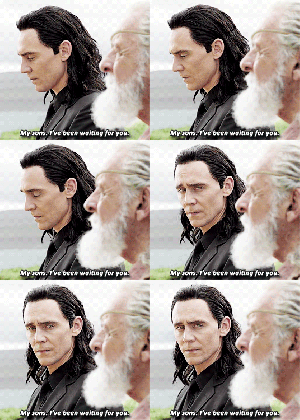
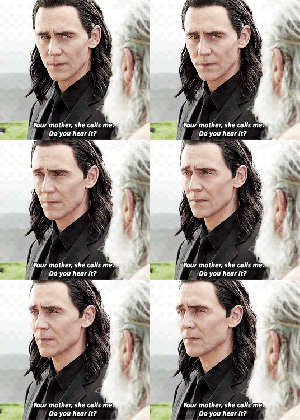
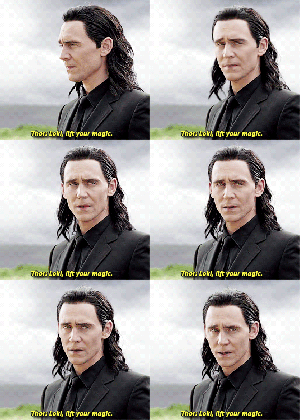
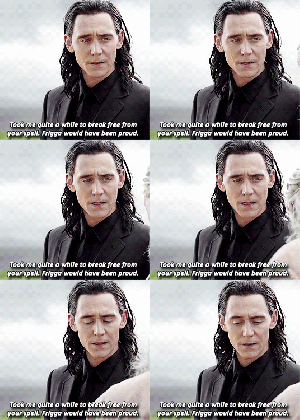
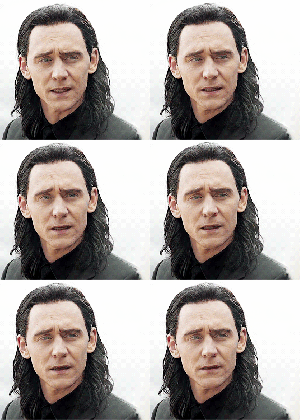
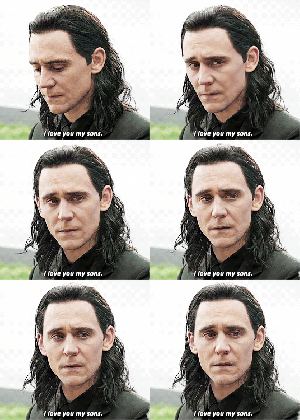
#he doesn’t speak a word of dialogue #and yet this is one of the most revealing scenes of his character that we ever get
Whatever you cannot convey through words, your eyes will.
You can literally see the emotions in his eyes, the pain, the relief, the confusion, the heartache…fuck Tom Hiddleston is such a brilliant actor and he portrayed Loki so well in this scene (every scene) it completely shatters me when I see Loki’s expression at “I love you my sons”
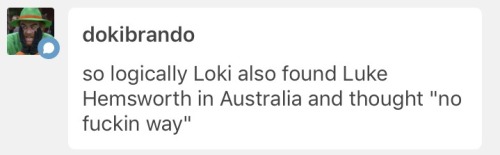
every time i watch Ragnarok I think for sure that Loki actually went to Earth and hired the real Matt Damon to play himself in a play on Asgard. It wasn’t just Matt damon playing an Asgardian in the movie I just feel it in my soul that Loki went to Earth and was like “I have a role for you”
i will never be over the fact that during first contact a human offered their hand to a vulcan and the vulcan was just like “wow humans are fucking wild” and took it
Humanity’s first contact with Vulcans was some guy going “I’m down to fuck.”
Vulcans’ first contact with Humans was an emphatic “Sure.”
“sir…these…these humans…they greet each other by…” *glances around before furtively whispering* “by clasping hands…”
*prolonged silence* “oh my…”
“sir…sir how will we make first contact with them? surely we…we cannot refuse this handclasping ritual, they will take it as an insult, but what vulcan would agree to such a distasteful and uncomfortable ritual??”
*several pensive moments later* “contact the vulcan high command and tell them to send us kuvak. i once saw that crazy son of a bitch arm wrestle a klingon, he’ll put his hands on anything”
Elsewhere, w/ kuvak: “….my day has come.”
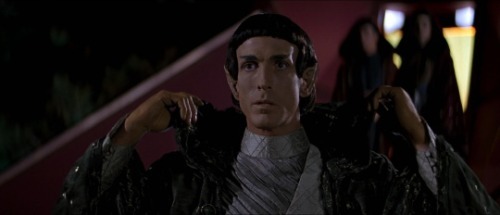
The vulcan who made first contact with humans is named Solkar guys. Y’all just be makin’ up names for characters that already have names.
Bonus: here’s a screencap of Solkar doing the “my body is ready” pose right before he shakes Zefram Cochrane’s hand:
I swear Vulcans only come in two types and they are “distant xenophobes” or “horny on main for humanity”. Also apparently this guy is Spock’s great-grandfather and frankly that explains everything.
Hey so I looked into this at one point and that handshake literally created a lifelong telepathic bond between the two of them, and basically all of Solkar’s descendants were later obsessed with humans, including freaking SPOCK, so I’m not saying that handshake was so gay and good that it created an intergenerational telepathic bond between Solkar’s descendants and humans, but I’m also not….not….saying that.
The slow deliberation with which Solkar takes Cockrane’s–I’m sorry, Cochrane’s–hand… The sheer sensuality witch which Solkar infuses an otherwise borderline impersonal social ritual… It clearly shows a very conscious knowledge, on Solkar’s part, of what the significance of the handshake is in Vulcan terms and of how affected he is by it.
That’s why he’s so slow in doing it, and so sensual. A part of Solkar can’t believe this is happening, despite it being a perfectly logical thing to expect from a human, and the rest of him can’t believe how good it is.
I bet that if the camera zoomed in any further we would see the dilation of Solkar’s pupils and a quickly-repressed shiver of delight. Cochrane’s firm, businesslike clasp is probably (in sexual terms) being perceived as a deliciously carnal display of dominance.
No wonder Solkar is all like, “TAKE ME, YOU WILD-MANNERED BARBARIAN WITH ENTICINGLY ROUGH CALLUSES.”
And so we find out that yes, there is such a thing as bottoming in Pon-farr.
Every time this post comes round my dash, it just gets better.
i just read a washington post article on romcoms aging poorly due to the pushiness (and oft-stalkery conduct) of the male characters therein, and it got me thinking about pride and prejudice, and specifically darcy saying, “one word from you will silence me on this subject forever.”
because, like, that’s the seldom-portrayed romantic dream in the patriarchal hellscape that is our world, isn’t it?
a dude being willing to say, “i understand if you don’t feel the same way about me, and i’ll leave you alone forever about this if my attention is unwanted.”
so simple, yet so wonderful in its basic human decency
and dudes to this day wonder why women still swoon over darcy
Note also: Elizabeth turns down Darcy’s first proposal, and in the process, accuses him of doing some stuff he did not do (and also some stuff he totally did).
The next day, he surprises her on her walk. He hands her a letter, asks that she read it, and then takes off.
When this happened to me after I had turned someone down IN REAL LIFE, the letter contained a passionate argument to the tune of “actually you’re wrong and you do like me and you should go out with me” and it was creepy af.
Darcy’s letter to Elizabeth starts with: “Be not alarmed, Madam, on receiving this letter, by the apprehension of its containing any repetition of those sentiments, or renewal of those offers, which were last night so disgusting to you”. He goes on to set the record straight about the stuff he didn’t do (as well as the stuff he did) which is *actually relevant* to Elizabeth. And he, as promised, doesn’t romance her further.
It’s totally bizarre that even now, this can be considered unusually great dude behaviour.
Darcy’s first proposal: “You must allow me to tell you how ardently I admire and love you.”
Darcy’s second proposal: “One word from you will silence me on this subject forever.”
His whole arc in the book is about learning to consider other people’s feelings and not just his own, but the fact that it’s expressed via who gets to talk and who is told to shut up is so, so telling. The first time around, he imposes his voice on her whether she wants it or not. The second time, he asks how she feels, and in exchange, offers her the gift of his silence.
And yeah, the fact that dudes still! have! not! learned! this! lesson! is exhausting.
I have never seen the Keira Knightley version of P&P because they cut a crucial line out of Elizabeth’s initial rejection. In the book, she smacks him down because of ‘your arrogance, your conceit, and your selfish disdain for the feelings of others’. The movie cut the selfish disdain, which is absolutely the most important part of the line. Arrogance and conceit? He already knew about those! He’d already had a conversation with her about pride, specifically his pride, and he was ready to go down with that ship.
But the selfish disdain? That was new information. That was the ‘oh shit’ moment that prompted the long letter, most of which boiled down to ‘look, I genuinely didn’t think it would hurt your sister’s feelings much and I am legit sorry about that but I love my friend and he doesn’t deserve your mother, okay, nobody deserves your mother especially not you and Jane who seem very nice and also here is the long and embarrassing story about why George Wickham’s feelings are not worth my concern or yours ever ever ever’. He may be a socially awkward idiot but he does care about people’s feelings and he wants her to know immediately that he is not the asshole she thinks he is in that regard.
And then they meet again and he practically turns himself inside out to prove that he listened and paid attention and he is being super considerate of the feelings of others at all times bc she was right and he was wrong and he is trying hard to be better about this. So he rescues Lydia not only for Elizabeth, but because he feels bad that he didn’t consider the further damage this asshole could do to other girls, he rescues Bingley and Jane’s romance because he wants to repair the hurt he caused both of them, and then he very humbly proposes again to Elizabeth, with appropriate concern about her feelings.
The entire second half of the book is ‘Darcy Is More Considerate Of Others Because He Got Called On His Behaviour And Actually Listened’ and that’s the core of his appeal. Not because he’s a jerk in part one (and I’ve seen so many guys use Darcy as an example of Women Love Jerks Not Nice Guys), but because when someone actually explains to the socially inept egg ‘you are being a jerk and hurting people’s feelings’ his response is ‘oh, shit, I didn’t mean to do that, I will work super hard at never doing that again’. And then he follows through and does work super hard at it and makes the change.
That Susan? That Susan does not embitter herself, does not brick her heart off, does not doubt like it’s a lifeline– not yet. She yanks open the wardrobe’s doors as soon as she finds her balance, shoves through the fur coats and mothballs, and slams into the solid back of it. She shuts the wardrobe and opens it; locks it and unlocks it; throws all the coats on the floor; gets wood splinters under her fingernails from trying to get through the back of it.
It is one things to lose a home, and it is another to lose a child. I don’t think she would ever stop looking.
Her little girl couldn’t have been more than four or five. Did she have Lucy’s cheeks? Edmund’s wit? Peter had been her favorite aunt or uncle, because he had been so patient with her. He had been teaching her to read.
Susan dredges up every arcane idea she’d ever heard whispered in Narnia, about its magic, about its origins, anything that might lead to a way back. She researches the wardrobe, its make, its history. She drags its purchase papers out of a sympathetic Professor Diggory, who has never had children and who does not understand, especially not with Susan’s present pubescent face glaring up at him.
When they send her back to her parents, when the war ends, she kisses her mother on the cheek and then runs away from home, to go find the wardrobe manufacturers, to find supposed occultists in cheap little flats that smell of garlic, to bury herself in library stacks.
–
And what about the child? Her mother, aunt, and uncles all gone on a single afternoon. Susan’s daughter was just learning to read, and now she is crowned princess heir. She has beaver nannies and centaur tutors, and she has stories about how beautiful her mother had been.
The last thing she had seen of her mother had been her riding away through Cair Paravel’s gate, long dark braid whipping behind her. She is afraid of horses all her life, but she rides them anyway when she is old enough. It would not do for a queen to seem frightened.
Her father is the sort of verybminor foreign royalty who had farmed his own little plot of land way out in the backcountry. They had needed to make an alliance, but for all Susan’s practicalities that was one place she remained– what was it exactly? Faithful. Childish. Stubborn. She wanted to marry for love, and she had.
But Susan disappears, the queen and king and high king with her, and her husband gets pulled out of tending his private vegetable garden to be his only daughter’s regent. He tries to keep her separate but teach her what she needs to know, all at once, so Susan’s child grows up with that weight on her shoulders early.
She does not know it, because the court artists always painted her mother smiling, but those stiff shoulders are one of the best connections she will ever have with her mother– Susan had been made the little mother too early, too, the one relied upon, who worried and herded and doubted because no one else was going to do it. Her child is a little queen, looking out and out over the acres of land and knowing what she owes this quiet piece of the world.
She rules in peace and in war, neither Gentle or Valiant but instead Wise. Her name is spoken with love and praise, and she raises her own children to be just, to be valiant, to be gentle, to be magnificent.
–
Susan has still not given up looking when her own horn calls her home to Narnia. It has been more than a year for her. It has been hundreds for her home. Cair Paravel might be overgrown, unrecognizable. It might be recently abandoned. It might still be thriving, vibrant, alive.
But this is what matters: Susan walks up to a high green hill and all the old standing stones propped up on its ridge.
She finds her husband’s name and drops wild daisies on his grave. She finds her daughter’s grave. She traces the dates of her rule, of her life, and she drops down and weeps.
They save Narnia, again, from invaders and war, and Aslan sends them back to England.
When she forgets about Narnia, seventeen and widowed, seventeen and her child grown and buried and unknown and decomposed– when Susan forgets about Narnia it will be, more than ever, an act of self defense.
–
Alternatively: Susan manages to shake news of the rings out of Professor Diggory.
She and whichever of her siblings wants to most stumble back onto Narnian soil: Peter wouldn’t leave the two younger kids alone in England; Edmund loves Narnia as much as anyone, still feels like he’s repaying it debts that it’s already forgiven him for, but Lucy has been crying since she crashed back down on her skinny knees on the upstairs bedroom floor in the Professor’s old country house. So it’s Lucy and Susan who take the rings, then. They kiss their brothers, their co-monarchs, on their cheeks and they go.
The girls hike with younger, childish muscles to Cair Paravel, their limbs growing and strengthening in the Narnian air, remembering themselves. They will not reach their exact old heights, not for years, but they are home and that is enough to send them sprinting and dancing and crying as they travel old known paths.
Susan is smaller and her child is older, closer to grown, but they slam into each other’s open arms as soon as they see each other in that royal courtyard– however close in size they get, her mother’s arms will always be the safest place she knows.
Lucy and Susan retake their crowns. Susan curls up in the warmth of her husband’s arm, buries her face in his shoulder, and tries to inhale every year she missed. He gives them to her in stories at the breakfast table for years, in ecstatic descriptions of carrot crops missed out on and fields of grain unseen. Narnian agriculture has seen a boost in the years of his regency.
There are years of Susan’s daughter’s life that she missed, and she grasps what she can of them in recollection and anecdote. She tells them about the desperation, much more amusing now, with which she searched for them. She and her daughter build something new between them, these two daughters of Eve. Lucy still gives the best piggy-back rides even when Susan’s daughter is almost of a height with her.
Lucy and Susan reign well–valiant and gentle, blinding faith and practical doubt. When Susan’s daughter is old enough, Lucy and Susan forfeit her their crowns and stay on as advisers. They never hunt stag again, but even as an eighty year old Lucy hobbles her way down to Mrs. Beaver’s daughter’s little house for tea and to hold baby beavers in her wise old lap.
–
When Peter and Edmund get yanked back into Narnia from a train stop, Susan’s old horn is not being blown by a Calormene named Caspian.
Susan is buried on a high green hill, Lucy on one side and her husband and daughter on the other. Their granddaughters and grandsons are scattered over the hill, and Peter and Ed do not even know their names.
The stones are worn by strong wind and long decades. They are overgrown with small white flowers. The boys will go up there, later, and they will cry like the earth is still dark and fresh over each of those graves. For them, it is.
But Cair Paravel is not overgrown, destroyed, or forgotten. It is centuries older and Peter and Ed do not recognize the new additions, the court fashions, or even some of the words whispered by the gathered crowd.
They do recognize the crinkled eyes on the young queen standing crowned and patient before them, a horn in her hands. She has Edmund’s best quirked grin, and they will learn she has Lucy’s talent at speech-making and Peter’s at tactics. They recognize her long dark hair.







 Steel Phoenix Studios